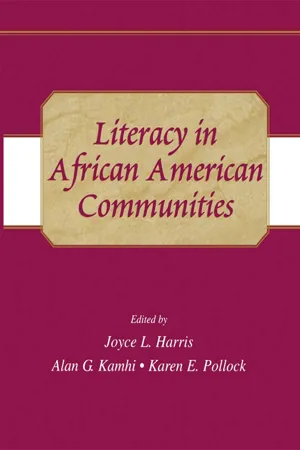
This volume explores the unique sociocultural contexts of literacy development, values, and practices in African American communities. African Americans--young and old--are frequently the focus of public discourse about literacy. In a society that values a rather sophisticated level of literacy, they are among those who are most disadvantaged by low literacy achievement. Literacy in African American Communities contributes a fresh perspective by revealing how social history and cultural values converge to influence African Americans' literacy values and practices, acknowledging that literacy issues pertaining to this group are as unique and complex as this group's collective history.
Existing literature on literacy in African American communities is typically segmented by age or academic discipline. This fragmentation obscures the cyclical, life-span effects of this population's legacy of low literacy. In contrast, this book brings together in a single-source volume personal, historical, developmental, and cross-disciplinary vantage points to look at both developmental and adult literacy from the perspectives of education, linguistics, psychology, anthropology, and communication sciences and disorders. As a whole, it provides important evidence that the negative cycle of low literacy can be broken by drawing on the literacy experiences found within African American communities.
- 344 pages
- English
- ePUB (mobile friendly)
- Available on iOS & Android
eBook - ePub
Literacy in African American Communities
About this book
Information
Chapter 1
Public and Personal Meanings of Literacy
The Pennsylvania State University
As we enter the 21st century, literacy has taken on many different meanings in this highly technological, global society. Like the concept of multiple intelligences, multiple interpretations of what it means to be literate are commonplace, creating something of a “literacy renaissance.” Diverse terms describing different literacy types support this notion. For example, functional literacy, cultural literacy, academic literacy, computer literacy, scientific literacy, and computational literacy are just some of the ways people talk about literacy. Other descriptive referents include music literacy, figurative literacy, art literacy, biblical literacy, numeric literacy, oral literacy, written literacy, family literacy, and street literacy. Considering these seemingly endless variations on the literacy theme, it is easy to conclude that the connotative meanings of literacy are many and varied. Thus, the implications of literacy are far-reaching.
To accommodate the multiple meanings of literacy, denotative meanings of literacy also have undergone change. For example, Webster’s II New College Dictionary (1995) defines literacy as “the quality or state of being literate,” where being literate means “one who can read and write; an educated person” (p. 640). The U.S. Congress, in the National Literacy Act of 1991, defined literacy as “an individual’s ability to read, write, and speak in English and compute and solve problems at levels of proficiency necessary to function on the job and in society, to achieve one’s goals, and to develop one’s knowledge and potential.” Taking the middle ground, the 1992 National Adult Literacy Survey (NAdLitS) defined literacy as “using printed and written information to function in society, to achieve one’s goals, and to develop one’s knowledge and potential.”
These characteristic references to and definitions of literacy clearly suggest that one must possess a range of skills, including the ability to speak, read, write, calculate, and solve problems, to be considered literate. In addition, one must be able to meet a certain level of proficiency in each of these areas to successfully compete in today’s technologically advanced environment. Although the personal, affective meanings of literacy are just as important as literacy proficiency, these dimensions are less frequently explored.
Thus, the primary focus of this chapter is to discuss meanings of literacy that transcend the traditional associations with “reading, writing, and ’rithmetic.” Contemporary African Americans share, in their own words, what literacy means to them. These interwoven personal accounts provide a counterpoint to historical references and existing literacy and educational statistics about African Americans. African Americans will reflect on their encounters with today’s literacy demands—which include being able to conduct print-based activities of daily living, participate in lifelong learning, engage in adequate health maintenance and management, and, importantly, to provide literacy role models for future generations. Finally, as a preliminary indication of the content and reading frequency engaged in by contemporary adult African Americans, data from the Reading History and Habits Survey (RHHS; Harris & Qualls, 1997) are provided.
WHAT DOES LITERACY MEAN?
Meanings of literacy are often qualified based on individual interpretations. Furthermore, the meaning is most likely attributed to the functions of literacy, largely derived from one’s own individual experiences and perspective as to what literacy means. For example, one individual may refer to a group of musicians playing jazz as being “musically literate,” while another individual might say that they are “jazz literate.” In both cases, the individuals provide their own interpretation of the type of literacy proficiency the jazz musicians possess. Of importance is the idea that these are subjective interpretations that may or may not be factual, especially, for example, if the musicians cannot read musical notation, or if they are unable to demonstrate the authentic jazz “feel” in their playing.
In spite of individual interpretations of what literacy means, it is generally agreed that certain common factors, such as education, socioeconomic status, and family dynamics, strongly influence beliefs about the significance and essentiality of literacy. Literacy beliefs, in turn, determine literacy practices. Moreover, these factors cross racial–ethnic and cultural boundaries. Put another way, African Americans, like other racial–ethnic–cultural groups, determine the functional significance of literacy based on their successful negotiation in educational, economic, family, and social contexts. It is not surprising, then, that although anecdotal accounts of what literacy means in African American communities yield a range of introspections, the collective tone of these accounts suggests that literacy is not only important, but is requisite for human existence and “successful” survival. Literacy is powerful—it unifies, separates, liberates.
Literacy Brings People Together …
Shortly after I started my doctoral program, I was encouraged to audition for the local symphony chorus. At the time, I wasn’t absolutely certain I wanted to make the time commitment, although I hesitantly followed up. Nevertheless, the audition time was set. When my husband and I arrived at the church where rehearsal was being held, the first thing I was told was that they did not need any more voices. Fine, I thought. Even still, after completing a form describing my musical background and experiences, I was hurriedly escorted by the choral director to a small, quiet room with a piano. I was instructed to sing a series of scales and choral melodies, and then the choral director asked me to read some scored music. Without hesitation, I sight-read the song while at the same time thinking to myself, okay, this will be over in a minute and my husband and I can go home. Well, to my surprise, the choral director jumped up and excitedly said, “You can go upstairs and get your music assignment.” I said, “Now?” He said, “Now.” Then he turned to my husband and said, “You can pick her up at 9 p.m.”
Literacy Separates …
An example of how literacy separates people can be found in Alice Walker’s (1990) The Color Purple. Celi, the main character, is separated from her sister not only by distance but also because Celi’s husband, Mista’, withheld her sister’s letters from her. Consequently, Celi assumed that her sister had completely turned away from her, and that they would never see each other again. Later, Celi, with the help of her husband’s lover, discovered Mista’s cruel deception, and Celi finds the letters from her sister.
Literacy Liberates …
Because of the Black press, many Southern Blacks became aware of economic and other opportunities of which they would not have otherwise known (Marks, 1989). By reading newspapers written by and for Blacks, many Southern Blacks became liberated—liberated from the low wages and limited employment opportunities in the South. Black-owned and-operated newspapers used various forms of print materials, including written articles, pictures, cartoons, elaborate advertisements, and written music, to lure Southern Blacks to the North to take advantage of more numerous and better economic opportunities.
LITERACY PROFILE OF AFRICAN AMERICANS: RESULTS FROM THE 1992 NALS
Adult literacy continues as a focus of national attention. Despite the fact that literacy demands continue to change, the national goal is that all adults in the United States will be literate by the year 2000. For example, although the overall level of education in the United States has increased, educational and technological advances impose ever greater literacy demands, to such an extent that more and more people are being left behind. A key issue in this regard is the cycle of low literacy, the legacy of forbidden literacy and poor educational opportunities in some groups of African Americans. Low literacy ensures restricted life chances, restricted access to information, restricted employment opportunities (Qualls & Harris, 1998), and restricted involvement in political decision making vis-à-vis voting (Kernell, 1973).
In 1992, the National Center for Educational Statistics (NCES) of the U.S. Department of Education conducted the first literacy study of its kind ever done in the United States, the NAdLitS (National Center for Educational Statistics, 1993). The literacy skills of more than 26,000 persons age 16 years and older were assessed by either written survey or interview. The population sampled included the general public, persons with disabilities, non-native English speakers, older adults, and prisoners. African Americans and Hispanic Americans were oversampled. Three types of literacy were assessed in the NAdLitS, including prose, document, and quantitative literacy, areas chosen to assess the information-processing skills and strategies used by adults to accomplish a range of literacy goals. Within each literacy type, five proficiency levels (1 = lowest, 5 = highest) were established.
Following is a partial summary of the results from the NAdLitS, with particular emphasis on the literacy status of African Americans. Readers are referred to the executive summary (National Center for Educational Statistics, 1993) for a full report of the survey results.
• Between 40 and 44 million U.S. adults demonstrated proficiencies at the lowest level (Level 1). An interpretation of these results suggests that 21% to 23% of the U.S. population is functionally illiterate.
• African American adults, along with other diverse groups (e.g., Native Americans, Hispanic Americans, etc.), were more likely than Whites to perform in the two lowest levels, a finding that was generally explained by lower levels of education in these groups compared to Whites.
• Adults with lower levels of education were more likely to perform in the lower literacy levels compared to those who had completed high school or who had some postsecondary education. The reported mean educational level for African Americans was 11.6 years.
• With the exception of African Americans, individuals born in the United States outperformed those who were not. In other words, the African Americans surveyed demonstrated proficiencies similar to non-American-born individuals (e.g., individuals born in Spanish-speaking countries).
• Adults in prison were far more likely to demonstrate lower levels of proficiency than individuals in the general population. The significance of this finding is that the incarcerated adults surveyed tended to be younger, less well educated, and from minority backgrounds (approximately 65%). When sex, race–ethnicity, age, and level of education were controlled, overall differences between the prison and household populations were attributed to demographic make-up and educational status (Haigler, Harlow, O’Connor, & Campbell, 1993).
• Adults demonstrating higher levels of literacy were more likely to be employed, worked more, and had higher wages than individuals demonstrating lower levels of proficiencies.
• Compared to middle-aged and younger adults, older adults demonstrated limited literacy proficiency, regardless of race–ethnicity, a finding partially explained by lower levels of education in adults 65 years and older.
• Nearly half (41%–44%) of the adults in the lowest proficiency level were living in poverty, compared with only 4% to 8% of those in the two highest levels. According to the National Center on Education and the Economy (1990), the poverty rate for African American families is about three times that of White families.
• Overall, adults demonstrating higher levels of proficiency were far more likely to vote than were those in the lower levels. Race–ethnicity as a factor in voting was not reported.
The results of the NAdLitS indicate relations between literacy and education level, and between literacy and socioeconomic status. Based on their literacy profiles, some African American adults experience a lower quality of life, have limited employment opportunities, and are less likely to participate in the political process. Interestingly, many of the adults who demonstrated low literacy proficiency indicated that they read and write English well (National Center for Educational Statistics, 1993). For older African Americans, in particular, a literacy disadvantage has profound implications for health care and health maintenance.
Illiteracy rates in African Americans have declined dramatically over the past 100 years. Contemporary interpretations of illiteracy are based on the concept of functional literacy—that is, the impact of educational attainment on literacy requirements dictated by society (Snyder, 1993). Functional illiteracy continues as a threat to some individuals in the African American community, particularly because literacy is measured by academic standards. Furthermore, technological advances create new forms of illiteracy that frustrate and isolate individuals and groups of individuals. Here are some comments on automatic teller machines (ATMs) and computerized digital music recording:
I can’t use those stupid bank machines [ATMs]. They talk to me and I try to understand what to do, but I just get confused. (72-year-old African American female, retired, Washington, DC)
I don’t use them [ATMs] … I let my wife fool with the damned things. I don’t know what I’ll do when she’s gone. (67-year-old African American male, retired, Tennessee)
The language of MIDI [musical instrument digital interface] sequencing and other forms of computer-generated music is a type of literacy. But, to participate successfully in the recording industry today, you must educate yourself in the language of the business, especially before spending lots of hard earned money. (54-year-old African American male, recording studio owner, Pennsylvania)
EDUCATION PROFILE OF AFRICAN AMERICANS: THEN AND NOW
Literacy is intimately linked to education, and, therefore, any discussion of literacy must take education into account. In 1993, the NCES published a document chronicling 120 years of education in America. Based on a review of historical data, this publication reports education statistics on just about every aspect of America’s educational system from 1869 to 1990. According to the NCES report, fluctuations in birth rates and shifts in the population (e.g., resulting from migratory trends) have a profound impact on society as birth cohorts move through school, workforce adulthood, and retirement. Following are only those educational statistics relevant to African Americans. Readers are referred to Snyder (1993) for a full report.
• Prior to the emancipation of Southern Blacks, school enrollment for Blacks largely was limited to only a small number of Blacks in Northern states.
• After the Civil War, enrollment rates for Blacks rose from 10% in 1870 to 34% in 1880, remaining unchanged over the next 20 years.
• The beginning of the 20th century brought sustained increases in enrollment rates for Blacks and Whites; during this period, the difference in enrollment rates between Blacks and Whites narrowed significantly.
• By the early 1970s, school enrollment rates for Blacks had risen to 90%; by 1991, 93% of 5- to 19-year-olds were enrolled in school.
• Between 1960 and 1970, the mean number of years of school completed by young Blacks rose from 10.5 to 12.2, with no change between 1970 and 1991.
• The average educational attainment for the entire population continued to rise as more highly educated younger cohorts replaced older Americans who had fewer educational opportunities. This was in sharp contrast to the 1940s, when more than half the U.S. population had completed no more than an eighth-grade education.
• In 1991, about 70% of Blacks had completed high school. A much smaller change (12% to 18%) was seen in the number of Blacks who completed 4 or more years of college during the period between 1980 and 1991.
While these data show dramatic increases in the mean educational level of African Americans over the last 100 years, educational opportunities for African Americans continue to be encumbered by issues related to access and quality, factors that directly impact on literacy. Notably, many African American children receive their education in inner-city schools. Urban school systems are often overwhelmed by a host of problems, some of which include outdated books, high student-to-teacher ratios, limited or no computers, low-quality instruction, and a less-than-adequate learning environment (e.g., no heat or air conditioning, leaky ceilings, unkempt bathrooms, discipline problems, low expectations and indifference; Kozol, 1991). As a consequence, some of these students graduate from high school lacking the basic skills necessary to gain entry into college, largely evident by low scores on college entrance exams compared to their White counterparts. Furthermore, many of these individuals who are admitted to colleges or universities require remedial work in basic reading, writing, and math and, often,...
Table of contents
- Cover
- Half Title
- Title Page
- Copyright Page
- Dedication
- Table of Contents
- About the Contributors
- Foreword
- Preface
- Acknowledgments
- Introduction
- 1 Public and Personal Meanings of Literacy
- 2 “Come Sit Down and Let Mama Read”: Book Reading Interactions Between African American Mothers and Their Infants
- 3 Spoken and Written Narrative Development: African American Preschoolers as Storytellers and Storymakers
- 4 Emergent Literacy: Home–School Connections
- 5 Literacy in the African Diaspora: Black Caribbean American Communities
- 6 Reading the Typography of Text
- 7 The Path to Reading Success or Failure: A Choice for the New Millennium
- 8 Reading Performance and Dialectal Variation
- 9 Language Variation and Literacy Acquisition in African American Students
- 10 From the Pews to the Classrooms: Influences of the African American Church on Academic Literacy
- 11 Design and Delivery Issues for Literacy Programs Serving African American Adults
- 12 Effects of Structure Strategy Instruction on Text Recall in Older African American Adults
- 13 An Age-Related View of Computer Literacy for Adult African Americans
- 14 Coming Full Circle: Some Circumstances Pertaining to Low Literacy Achievement Among African Americans John Baugh
- Author Index
- Subject Index
Trusted by 375,005 students
Access to over 1.5 million titles for a fair monthly price.
Study more efficiently using our study tools.
Frequently asked questions
Yes, you can cancel anytime from the Subscription tab in your account settings on the Perlego website. Your subscription will stay active until the end of your current billing period. Learn how to cancel your subscription
No, books cannot be downloaded as external files, such as PDFs, for use outside of Perlego. However, you can download books within the Perlego app for offline reading on mobile or tablet. Learn how to download books offline
Perlego offers two plans: Essential and Complete
- Essential is ideal for learners and professionals who enjoy exploring a wide range of subjects. Access the Essential Library with 800,000+ trusted titles and best-sellers across business, personal growth, and the humanities. Includes unlimited reading time and Standard Read Aloud voice.
- Complete: Perfect for advanced learners and researchers needing full, unrestricted access. Unlock 1.5M+ books across hundreds of subjects, including academic and specialized titles. The Complete Plan also includes advanced features like Premium Read Aloud and Research Assistant.
We are an online textbook subscription service, where you can get access to an entire online library for less than the price of a single book per month. With over 1.5 million books across 990+ topics, we’ve got you covered! Learn about our mission
Look out for the read-aloud symbol on your next book to see if you can listen to it. The read-aloud tool reads text aloud for you, highlighting the text as it is being read. You can pause it, speed it up and slow it down. Learn more about Read Aloud
Yes! You can use the Perlego app on both iOS and Android devices to read anytime, anywhere — even offline. Perfect for commutes or when you’re on the go.
Please note we cannot support devices running on iOS 13 and Android 7 or earlier. Learn more about using the app
Please note we cannot support devices running on iOS 13 and Android 7 or earlier. Learn more about using the app
Yes, you can access Literacy in African American Communities by Joyce L. Harris,Alan G. Kamhi,Karen E. Pollock in PDF and/or ePUB format, as well as other popular books in Education & Education General. We have over 1.5 million books available in our catalogue for you to explore.