- 132 pages
- English
- ePUB (mobile friendly)
- Available on iOS & Android
eBook - ePub
About this book
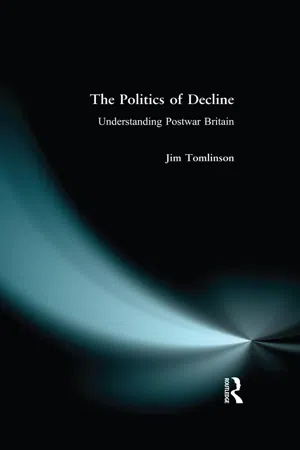
The key aim of this new book is to show how economic decline has always been a highly politicised concept, forming a central part of post-war political argument. In doing so, Tomlinson reveals how the term has been used in such ways as to advance particular political causes.
Chapter 1
The importance of decline
Decline and declinism
The ‘rise and decline’ of nations and empires has long been a seductive way to write about the past. Gibbon’s famous account of Rome in these terms has been followed by many later authors, who have applied similar terms, and often similarly moralistic arguments, to every powerful state from ancient Greece to modern America.1 In recent decades the alleged decline of the USA, particularly widely claimed in the 1980s before the demise of the Soviet Union, generated another revival of the genre, most notably in the work of those such as Paul Kennedy, for whom the fatal problem of ‘overstretch’ that undermined previous great powers provided an object lesson on the dangers facing contemporary America.2 In many of these world histories Britain plays a prominent role, with its rise to become a global power in the eighteenth and nineteenth centuries, and its decline in the twentieth; indeed, it can plausibly be argued that the model for most of these modern global histories is in effect the British case.3 Telling the story of twentieth-century Britain as one of decline has become commonplace, and only a small minority have adopted a more sceptical attitude to the usefulness and consequences of this approach.4
Central to most of this kind of ‘declinology’ is a focus on the place of individual states in the world system of power; it is global strategic and political capacity relative to others that measures rise and decline. Kennedy, like many others, sees this power status as closely linked to economic strength, but it is a country’s ability to make itself felt in world politics that is the key measure of performance. In this view, economic performance is a problem mainly if it is inadequate to support great power ambitions.
A largely separate but equally voluminous literature exists about British economic decline, which treats this perceived failure of performance as a problem in its own right, not usually attaching much importance to explaining why economic performance should be regarded as so significant. This kind of work concentrates its efforts on explaining why, on a range of measures, Britain has at various times since the late nineteenth century fallen short of the economic achievements of other nations. Usually the existence of this ‘decline’ is more or less taken for granted, with perhaps just a few figures of GDP performance used to ‘establish’ the case; the central question posed in this literature is, why has it happened?5 This book is essentially about this second notion of decline.
Whether as an account of world history over centuries or millennia, or as a local account of Britain in the twentieth century, the framework of ‘decline’ cannot be treated as an innocent description of the past. The use of the term necessarily organises our thinking into particular channels, and pushes us towards certain ways of looking at the world. So we need to step back and ask, where does the term come from, and what are the effects of using it? As Barry Supple puts it, ‘declinism is an ideology, and like all ideologies has a history’.6 The purpose of this book is to explore that history, in the belief that it has played an important part in shaping post-war British politics. As Andrew Gamble emphasises: ‘Decline is therefore politically constructed and needs to be understood through the political debates which have taken place on its dimensions, its causes and its remedies’.7 This political aspect of economic decline has been recognised in some literature on recent British politics, for example by Ian Budge, but he treats the political use of economic decline as ‘cover’ for other political projects, whereas in this book the idea of economic decline is taken seriously as an ideology that, while initially taken up for a variety of reasons, has itself fundamentally shaped political argument. Other authors have taken the formative role of economic decline in British political debate more seriously, but without offering a sustained account of either its origins or effects.8
To treat declinism as an ideology is only of use if we define that often vague term with some precision. Here it is used to denote a set of ideas, which may exist in a tightly specified group of logically connected propositions, and/or as a loosely bundled together and perhaps half-implicit set of assumptions. Whether these ideas provide in some ultimate sense a ‘true’ account of the world is not the issue; we are not defining ideology in opposition to ‘truth’. Rather we are concerned with the conditions of existence and effects of these bundles of ideas. Whatever the form of the ideology, what is crucial about it is that it motivates action. It is not just something on paper, of interest to academic scribblers, but affects the beliefs of a significant section of the population (or at least the politically active part), who deploy it to attempt to change things.
That ideology motivates action, especially political action, is one of the oldest if most contested understandings of human history. While periodically the ‘end of ideology’ is proclaimed, such assertions usually reflect either a blindness to how pervasive and multi-faced ideology is, or a desire to celebrate the death of one particular ideology the author opposes. Traditional accounts of twentieth-century Britain have often played down the importance of ideology, stressing the alleged ‘pragmatism’ or ‘consensus’ we are believed to have enjoyed. But recently historians have emphasised how misleading such a notion can be; ideology has been ‘the stranger at the feast’, whose true place needs to be reasserted if we are to better understand the British experience.9
When we talk of ideology it is common to think this term refers to the big ‘isms’ of twentieth-century life - from fascism through conservatism and liberalism to socialism and communism. Obviously these ideas have been, in varying degrees, important in twentieth-century Britain, and they and their variants can be used to say much that is interesting and important about that subject.10 But their limits are also evident; many important ideas that have had significant political impact cannot be readily categorised in this way. David Marquand, for example, has suggested the notions of ‘moralism’ and ‘hedonism’ as cross-cutting the conservatism/socialism divide in post-war Britain, and as a result providing a much finer-grained account of ideological and political developments over the last half-century.11
Declinism is an ideology that does not fit readily into the template of the great ‘isms’. It has had its impact on almost all parts of the political spectrum, from extreme Left to extreme Right, and most points in between.12 For different reasons, and with different implications, these varying political forces have found declinism a congenial way of understanding Britain. The contention of this book is that, as a result, declinism has been a major influence on post-war British politics; not only an idea widely accepted, but one that has motivated a great deal of political programme making and political action. To understand it is to understand an important part of post-war politics.
As already suggested, declinism comes in a number of forms, but the two major types that may be discerned are, on the one hand, centrally concerned with global status, and on the other with economic performance. For certain periods in recent history accounts in terms of challenges to Britain’s pretensions on the world stage accurately reflect the politics of the time with which they deal. Friedberg’s excellent account of the period before the First World War makes it clear that the overwhelming concern of ‘declinists’ at that time was strategic, with the perceived rise of challenges to British hegemony from Germany and the USA. Economic and fiscal issues figured strongly in the ensuing debates, but largely as alleged contributors to strategic weakness, not problems in their own right.13 For more recent years, a similar account might be given of the Suez affair in 1956, commonly seen as when Britain’s global hopes were finally dashed in the face of US opposition to the collusion with Israel and France in the invasion of Egypt. Undoubtedly this event gave rise to a great deal of soul-searching about Britain’s place in the world. Yet the evidence suggests that, for all the short-term excitement generated by this fiasco, its impact on British domestic politics was much less than its usually prominent place in accounts of post-war Britain would suggest.14 Throughout the post-war period prior to Suez, under both the Attlee and successor Conservative governments, the conflict between satisfying global ambition and delivering an economic performance satisfactory to the electorate was clearly recognised in ministerial and other circles. Much more than this, the priority given to domestic living standards was slowly but powerfully asserting itself Increasingly it was the need to have an economic performance adequate to meet the perceived demands of the electorate for higher consumption and better living conditions that was displacing the notion that economic performance mattered above all because of its strategic implications. This change did not happen overnight, and the old priorities continued to exist in’ some circles for a long period, but by the end of the 1950s it was the demand to satisfy the domestic voter and consumer that was clearly to the fore in political calculation by the major parties.15 This emphatically did not mean that pretensions to world power status were immediately given up - arguably they still exist in some political circles today - but that increasingly it was seen as necessary, in practical politics if not always in rhetoric, to subordinate such pretensions to domestic concerns. Thus it has been econo...
Table of contents
- Cover
- Half Title
- Title
- Copyright
- Contents
- Acknowledgements
- List of tables
- List of abbreviations
- 1 The importance of decline
- 2 Inventing decline
- 3 Decline and the Left
- 4 Decline and the Right
- 5 Decline as history, history as decline
- 6 Decline in the 1970s and 1980s
- 7 The present and future of decline
- Index
Trusted by 375,005 students
Access to over 1.5 million titles for a fair monthly price.
Study more efficiently using our study tools.
Frequently asked questions
Yes, you can cancel anytime from the Subscription tab in your account settings on the Perlego website. Your subscription will stay active until the end of your current billing period. Learn how to cancel your subscription
No, books cannot be downloaded as external files, such as PDFs, for use outside of Perlego. However, you can download books within the Perlego app for offline reading on mobile or tablet. Learn how to download books offline
Perlego offers two plans: Essential and Complete
- Essential is ideal for learners and professionals who enjoy exploring a wide range of subjects. Access the Essential Library with 800,000+ trusted titles and best-sellers across business, personal growth, and the humanities. Includes unlimited reading time and Standard Read Aloud voice.
- Complete: Perfect for advanced learners and researchers needing full, unrestricted access. Unlock 1.5M+ books across hundreds of subjects, including academic and specialized titles. The Complete Plan also includes advanced features like Premium Read Aloud and Research Assistant.
We are an online textbook subscription service, where you can get access to an entire online library for less than the price of a single book per month. With over 1.5 million books across 990+ topics, we’ve got you covered! Learn about our mission
Look out for the read-aloud symbol on your next book to see if you can listen to it. The read-aloud tool reads text aloud for you, highlighting the text as it is being read. You can pause it, speed it up and slow it down. Learn more about Read Aloud
Yes! You can use the Perlego app on both iOS and Android devices to read anytime, anywhere — even offline. Perfect for commutes or when you’re on the go.
Please note we cannot support devices running on iOS 13 and Android 7 or earlier. Learn more about using the app
Please note we cannot support devices running on iOS 13 and Android 7 or earlier. Learn more about using the app
Yes, you can access The Politics of Decline by Jim Tomlinson in PDF and/or ePUB format, as well as other popular books in Economics & British History. We have over 1.5 million books available in our catalogue for you to explore.