An area of forest the size of England is cut down in the tropics each year. Forestry is responsible for a fifth of global carbon emissions - more than the entire world transport sector. Urgent action to tackle the loss of global forests needs to be a central part of any new international agreement on climate change. Climate Change: Financing Global Forests is an independent report commissioned by the UK Prime Minister to address this vitally important issue. It assesses the impact of global forest loss on climate change and explores the future role of forests in the international climate change framework, with particular emphasis on the role of international finance. It also looks at the economic and policy drivers of deforestation and describes the incentives required to ensure more sustainable production of agriculture and timber in order to meet global demand while reducing carbon emissions. The report draws on a wide range of international expertise and will have significant national, EU and international interest and influence. It includes new modelling and analysis of the global economic impact of continued deforestation and provides a comprehensive assessment of the opportunity and capacity-building costs of addressing the problem. It shows that the benefits of halving deforestation could amount to $3.7 trillion over the long term. However, if the international community does not act, the global economic cost of climate change caused by deforestation could amount to $12 trillion. In this comprehensive and detailed report, Johan Eliasch makes a clear and forceful case for forests to be included in international carbon trading mechanisms. He calls for the international community to support forest nations to halve deforestation by 2020 and to make the global forest sector carbon neutral by 2030.
- 288 pages
- English
- ePUB (mobile friendly)
- Available on iOS & Android
eBook - ePub
About this book
Information
1. Introduction
Key Messages
Climate change is a major global threat. Over the last century, global temperatures have risen by 0.7°C. Sea levels are rising at three millimetres a year and Arctic sea ice is melting at almost three per cent a decade. Continued warming of the atmosphere at the same rate will result in substantial damage to water resources, ecosystems and coastlines, as well as having an impact on food supplies and health.
The economic costs of climate change impacts have been estimated at between 5 and 20 per cent of global GDP and could be considerably higher.
Current evidence suggests that to avoid the worst effects of climate change we should aim to stabilise levels of atmospheric CO2e at 445-490 parts per million (ppm). Achieving this global stabilisation target will require strong and urgent international action.
The forest sector plays a key role in tackling climate change. Forestry, as defined by the IPCC, accounts for around 17 per cent of global GHG emissions – the third largest source of anthropogenic GHG emissions after energy supply and industrial activity. Forest emissions are comparable to the annual CO2 emissions of the US or China.
Analysis for this Review estimates that, in the absence of any mitigation efforts, emissions from the forest sector alone will increase atmospheric carbon stock by around 30ppm by 2100. Current atmospheric CO2e levels stand at 433ppm. Consequently, in order to stabilise atmospheric CO2e levels at a 445-490ppm target, forests will need to form a central part of any global climate change deal.
In addition to their role in tackling climate change, forests provide many other services. They are home to 350 million people, and over 90 per cent of those living on less than $1 per day depend to some extent on forests for their livelihoods. They provide fuelwood, medicinal plants, forest foods, shelter and many other services for communities.
Forests also provide additional ecosystem services, such as regulating regional rainfall and flood defence and supporting high levels of biodiversity. Maintaining resilient forest ecosystems could contribute not only to reduced emissions, but also to adaptation to future climate change.
The Bali Action Plan provides a roadmap for the negotiation of a new regulatory framework for international action on climate change, following the expiry of the first commitment period of the Kyoto Protocol in 2012. The action plan sets out key areas to be negotiated with a view to reaching a new global climate change deal in Copenhagen at the end of 2009. It recognises the importance of reducing deforestation emissions and a system of international finance to meet this goal.
The aim of this Review is to examine international financing to reduce forest loss and its associated impacts on climate change. The Review focuses particularly on the scale of finance required and on the mechanisms that can, if designed well, lead to effective reductions in forest carbon emissions to help meet a global stabilisation target. It also examines how mechanisms to address forest loss can contribute to poverty reduction, as well as the importance of preserving other ecosystem services such as biodiversity and water services.
1.1 The Impacts of Climate Change
Climate change is a major global threat. Over the last century, global temperatures have risen by 0.7°C. Sea levels are rising at three millimetres a year and Arctic sea ice is melting at almost three per cent a decade. Continued warming of the atmosphere at the same rate will result in substantial damage to water resources, ecosystems and coastlines, as well as having an impact on food supplies and health.
The economic costs of climate change impacts have been estimated at between 5 and 20 per cent of global GDP, and could be considerably higher.
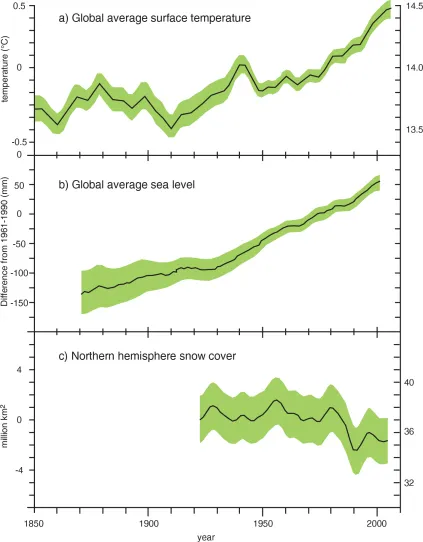
Warming of the earth’s climate system has led to increases in global average air and sea temperatures, rising global average sea levels and widespread melting of snow and ice. As Figure 1.1 illustrates, global average sea level has risen by 3.1 millimetres a year since 1993, with a total 20th century rise estimated at 0.17 metre. Satellite data since 1978 shows that the annual average arctic sea ice extent has shrunk by 2.7 per cent per decade.1
Figure 1.1: Changes in temperature, sea level and northern hemisphere snow cover
Source: IPCC (2007) AR4 Synthesis Report
A large number of other climatic changes have also been observed, including:
• an increase in the global area affected by drought;
• more frequent heat waves over most land areas;
• increased heavy precipitation events over most land areas;
• an increased incidence of extreme high sea level worldwide.
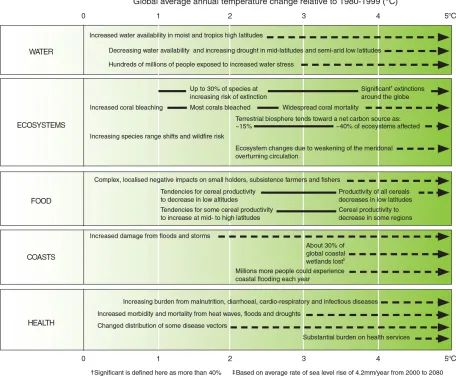
All the emissions scenarios reported by the Intergovernmental Panel on Climate Change (IPCC) project continued global warming of about 0.2°C per decade for the next two decades. These climatic changes will bring a wide range of impacts, some of which will be irreversible (Figure 1.2).
Figure 1.2: Examples of impacts associated with global average temperature change
Source: IPCC (2007) AR4 Synthesis Report
As global temperatures rise, these impacts will become more severe. Millions of people, particularly the poor, will be exposed to an increased incidence of droughts and floods, food and freshwater shortages, disease and the loss of their livelihoods and homes. Developing countries are particularly exposed to the effects of climate change because their economies are so heavily dependent on climate-vulnerable sectors such as agriculture. In addition to the direct costs to humankind, the IPCC suggests that approximately 20-30 per cent of species assessed so far are likely to be at increased risk of extinction if increases in global average temperature exceed 1.5-2.5°C.2
The Stern Review considered the physical impacts of climate change on the global economy, on human life and on the environment.3 It also estimated the damages of climate change, including integrated assessment models that estimate the economic impacts of climate change.
Stern concluded that business as usual (BAU) climate change will reduce welfare by an amount equivalent to a reduction in consumption per person of between 5 and 20 per cent now and into the future. Subsequent analysis, taking account of the increasing scientific evidence of greater risks, of aversion to the possibilities of catastrophe and of a broader approach to the consequences, suggests the appropriate estimate is likely to be in the upper part of this range.4
1.2 Climate Change Mitigation
Current evidence suggests that to avoid the worst effects of climate change we should aim to stabilise levels of atmospheric CO2e at 445-490 parts per million (ppm). Achieving this global stabilisation target will require strong and urgent international action.
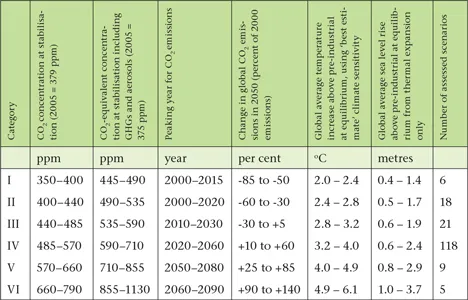
Early action could significantly reduce the risk of severe climate change impacts. In order to stabilise the concentration of greenhouse gas (GHG) emissions in the atmosphere, emissions would need to peak and then decline. The lower the stabilisation level, the sooner this peak would have to occur. Table 1.1 summarises the required emission levels and timescales for different stabilisation trajectories.
Table 1.1: Stabilisation scenario characteristics
Source: IPCC (2007) AR4 Synthesis Report
It is widely suggested that the increase in global temperature that is currently occurring should be stabilised at a maximum of 2°C over pre-industrial levels to minimise the risk of dangerous climate change.5 The IPCC has indicated in its Fourth Assessment Report that achieving a 2°C target would mean stabilising GHG concentrations in the atmosphere at around 445-490 ppm CO2 – equivalent (e)6 or lower.7 Higher levels would substantially increase the risks of harmful and irreversible climate change ...
Table of contents
- Cover
- Half Title
- Title Page
- Copyright
- Contents
- Preface
- Background papers
- Acknowledgements
- Executive summary
- 1. Introduction
- Part I: The challenge of deforestation
- Part II: Forests and the international climate change framework: the long-term goal
- Part III: The building blocks of forest financing: the medium-term approach
- Part IV: International action, capacity building and short-term funding
- Bibiliography
- Index
Trusted by 375,005 students
Access to over 1.5 million titles for a fair monthly price.
Study more efficiently using our study tools.
Frequently asked questions
Yes, you can cancel anytime from the Subscription tab in your account settings on the Perlego website. Your subscription will stay active until the end of your current billing period. Learn how to cancel your subscription
No, books cannot be downloaded as external files, such as PDFs, for use outside of Perlego. However, you can download books within the Perlego app for offline reading on mobile or tablet. Learn how to download books offline
Perlego offers two plans: Essential and Complete
- Essential is ideal for learners and professionals who enjoy exploring a wide range of subjects. Access the Essential Library with 800,000+ trusted titles and best-sellers across business, personal growth, and the humanities. Includes unlimited reading time and Standard Read Aloud voice.
- Complete: Perfect for advanced learners and researchers needing full, unrestricted access. Unlock 1.5M+ books across hundreds of subjects, including academic and specialized titles. The Complete Plan also includes advanced features like Premium Read Aloud and Research Assistant.
We are an online textbook subscription service, where you can get access to an entire online library for less than the price of a single book per month. With over 1.5 million books across 990+ topics, we’ve got you covered! Learn about our mission
Look out for the read-aloud symbol on your next book to see if you can listen to it. The read-aloud tool reads text aloud for you, highlighting the text as it is being read. You can pause it, speed it up and slow it down. Learn more about Read Aloud
Yes! You can use the Perlego app on both iOS and Android devices to read anytime, anywhere — even offline. Perfect for commutes or when you’re on the go.
Please note we cannot support devices running on iOS 13 and Android 7 or earlier. Learn more about using the app
Please note we cannot support devices running on iOS 13 and Android 7 or earlier. Learn more about using the app
Yes, you can access Climate Change: Financing Global Forests by Johan Eliasch in PDF and/or ePUB format, as well as other popular books in Politica e relazioni internazionali & Economia ambientale. We have over 1.5 million books available in our catalogue for you to explore.