![]()
Part I
Introduction
![]()
1
Introduction
Patricia Erfurt-Cooper
Introduction to Volcano and Geothermal Tourism
The Context of Volcano and Geothermal Tourism
This book presents a first collection of chapters looking more closely at a tourism sector that includes travelling to volcanic and geothermal destinations as part of the new quest for sustainable tourism. Volcano tourism is particularly popular in combination with recreational activities such as skiing, hiking, trekking, climbing and visiting hot springs, as well as many other outdoor activities (Erfurt-Cooper and Cooper, 2009), and with the need for the strengthening of attitudes and practices relating to environmentally sound tourism. Volcano and geothermal tourism as a whole are under-reported in the literature as yet, but the tourist numbers for this special interest area are rising, with study tours and field trips being offered to volcanic destinations worldwide. While in fact volcano tourism has been widespread in European countries such as Italy, Greece and Iceland for centuries, greater mobility and a personal desire for more information about these unique and active landforms are key motivations behind the growing interest of 21st century tourists in volcanic and geothermal environments.
Volcano tourism comes in many different guises – in some cases people are not even aware that they could be close to active volcanism, while for others touring active volcanic and geothermal environments is part of the trip agenda and many visitors will undertake a short side trip to volcanic landscapes to fill in a day – or sometimes less – depending on the location as part of a tour to a specific destination. For the purpose of this book we define volcano tourism as follows:
Volcano tourism involves the exploration and study of active volcanic and geothermal landforms. Volcano tourism also includes visits to dormant and extinct volcanic regions where remnants of activity attract visitors with an interest in geological heritage.
Volcanoes are described as ‘awesome and spectacular examples of natural change’ (Simkin et al, 1981, pvii) and as ‘nature’s most exciting and deadly shows’ with ‘their unpredictability and intensity matched only by their visibly stunning bursts of activity’ (Bourseillier and Durieux, 2002). Volcanic eruptions are portrayed by Sigurdsson and Lopes-Gautier (2000, p1289) as ‘one of nature’s most awesome spectacles’ with some volcanoes being exciting and dramatic symbols for a nation, for example, Vesuvius in Italy and Fuji in Japan (Fisher et al, 1997). A variety of benefits from volcanoes result in sustainable livelihoods in some locations (Kelman and Mather, 2008); these include thermal springs and geothermal energy, tourism, geothermally based agriculture and mining, whereby income can be combined with visiting hot springs or a geothermal power station (Iceland, New Zealand). Sigurdsson et al (2000) provide a summary of the literature promoting volcanic benefits like geothermal resources and tourism resulting from volcanism. Perry and Lindell (1990) suggested nearly 20 years ago that risks from volcanism are directly related to the beauty and recreational quality of an area and its power to attract visitors.
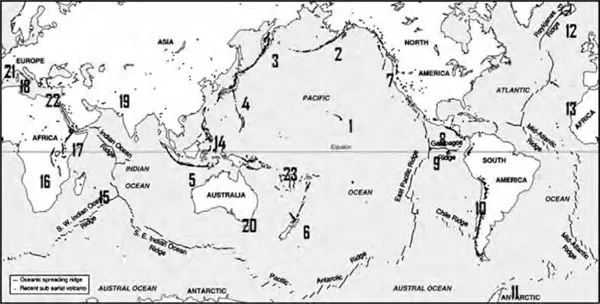
Volcano tourism is an important sector of geotourism, which includes the geodiversity and the geological heritage of unique landscape features (Dowling and Newsome, 2006), but in particular the attractions of active volcanic and geothermal environments, and it is not uncommon that some tourists, who are looking for a more adventurous getaway, are increasingly planning their travels around active volcanoes (Brace, 2000). Between 550 volcanoes with historically recorded activity (Edelmann, 2000; Schmincke, 2006) and possibly up to 1500 volcanoes in total which are believed to have erupted historically and/or during the Holocene (Smithsonian, 2009) are currently classed as active (Figure 1.1 indicates major locations); subaqueous volcanoes are not included in these figures.
Figure 1.1 The Main Volcanic Regions of the World, Generally Following the Plate Boundaries
Notes: The numbers indicate tourist destinations of significance: 1) Hawai‘i, USA; 2) Aleutians, Alaska; 3) Kamchatka, Russia; 4) Japan; 5) Indonesia; 6) New Zealand; 7) Cascades, USA; 8) Galapagos, Ecuador; 10) Andean Volcanoes, Chile, Argentina, Peru, Bolivia, Colombia; 11) Deception Island, Antarctica; 12) Iceland; 13) Cape Verde, Independent; Canary Islands, Spain; Azores and Madeira, Portugal; 14) Philippines; 15) Reunion, Africa; 16) Congo and Tanzania; 17) Ethiopia; 18) Italy; 19) Iran; 20) Australia; 21) Germany and France (dormant); 22) Greece and Turkey.
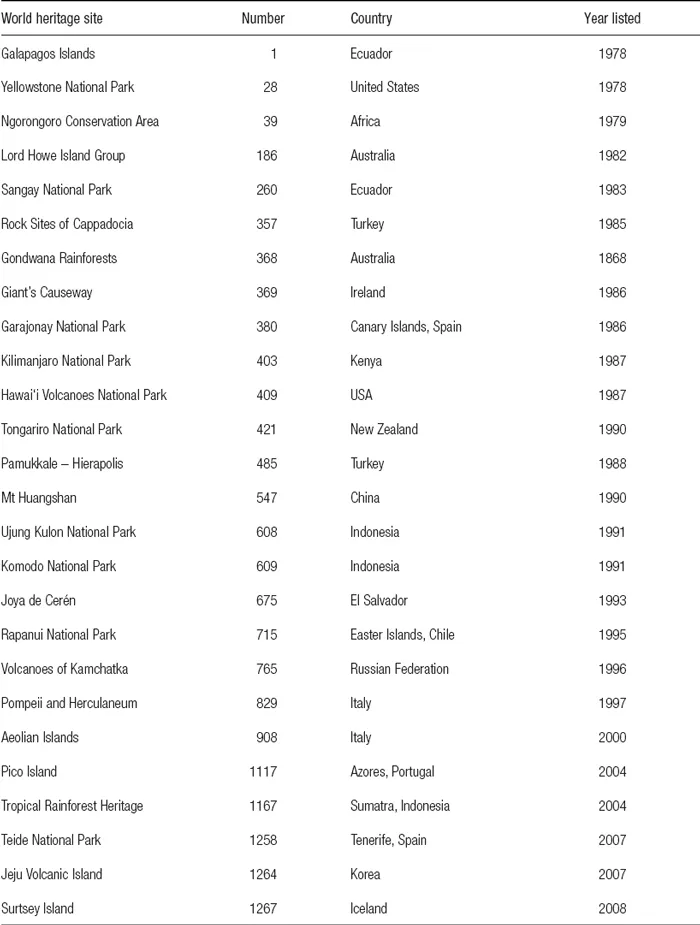
The attraction of volcanoes can be appreciated from the fact that they are included in 18 of Japan’s 28 national parks (Sakaguchi, 2005). A large number of these fascinating landforms have gained in worldwide popularity for a variety of reasons. Firstly, volcano tourism generally synergizes well with other forms of tourism such as hot spring tourism (health and wellness), ecotourism and adventure tourism (Erfurt-Cooper and Cooper, 2009). Secondly, volcano tourism includes several specific leisure and recreational activities such as skiing (e.g. Hokkaido, New Zealand), hiking and trekking, mountaineering (e.g. Cascades, Andes), and camping – all of which form a perfect combination with exploring adventurous or unique destinations. Also, natural hot springs with or without spa and resort facilities are often associated with and in close proximity to volcanic and geothermal activity, and many volcano tourists enjoy a relaxing soak in natural hot spring pools. Sampling of the local cuisine is generally one of the additional selling points. A third reason for an increase in volcano tourist numbers is the growing ease of access to remote destinations and the affordability for budget travellers (e.g. backpackers in Mesoamerica, New Zealand). A fourth reason is the growing interest in the natural environment, which includes not only the biosphere or ecosphere, but also the geosphere with an extraordinary natural heritage increasingly protected in national parks (e.g. Yellowstone, Tongariro, Mt Fuji) and world heritage sites, and as national or global geoparks (e.g. China, Europe, Australia). For a list of world heritage sites including active and dormant volcanic landforms please see Table 1.1.
Table 1.1 This table lists some examples of world heritage sites including active and dormant volcanic landforms
The Volcano Tourist
Although volcano tourism is becoming increasingly popular in many countries worldwide (Hansell and Oppenheimer, 2004), the academic and general literature covering volcanic and geothermal environments rarely mentions tourism in volcanic regions. Nevertheless, volcano viewing in active and dormant areas and the exploration of geothermal landscapes are frequently included as sightseeing activities and part of the trip agendas for many travellers every year. Quite often the visit to an active or dormant volcano or to a geothermal park is a choice made spontaneously closer to the destination and depends on various factors such as how much time is involved, the current state of volcanic or geothermal activity, the weather, ease of access, transport and distance to cover, plus possible requirements for special equipment. Level of fitness is also an important factor, as people often overestimate their personal endurance levels.
To attract visitors of different interest groups, tourism operators offer a diversity of tours with varying degrees of difficulty and risk factors. The most sought after attractions are glowing lava flows, strombolian eruptions and fissure eruptions. Night tours to popular viewing spots are organized for maximum effect. Associated activities range from trekking, hiking, climbing and skiing on or around active and dormant volcanoes, to canoeing, water skiing and fishing on crater lakes, depending on the state of environmental protection in individual areas.
Three main categories have been identified in which visits to volcanic and geothermal environments can be broadly classed with varying degrees of background information, knowledge and experience by the volcano tourist, as well as current activity levels of the destination, and any time frames involved:
1 Tours or day trips
• organized for the majority of general sightseeing tourists of all ages, interests and backgrounds;
• involve no strenuous exercise, easy to manage;
• often included in travel and sightseeing itinerary, transport by bus or cruise ship (e.g. Iceland, Japan); and
• are very casual about safety issues, but this group presents the majority of ‘volcano tourists’.
2 Excursions and field trips
• organized by or for interest groups, e.g. scientists and students, photographers;
• can be day tours, several weeks or even longer;
• involve awareness of potential risks and dangers at varying degrees; and
• are a growing market segment of geotourism with special interests in volcanic and geothermal environments.
3 Expeditions and exploration
• for experienced and fit participants able to cope with ‘unusual experiences’ along the way and prepared to go where only few or even nobody went before (e.g. Erta Ale, Nyiragongo, Kamchatka, Antarctica);
• can be ultra-extreme, partly also depending on climate and season, and need special equipment and provisions;
• involve a high awareness of potential dangers; and
• are a minority group amongst tourists.
The first group most likely represents the majority of visitors to active volcanic and geothermal environments and has the lowest level of awareness about safety and potential hazards. The second group is a fast growing market sector with a medium level of awareness and the third group, although representing currently the minority of travellers, has probably the highest level of risk awareness. The fact that specially organized volcano tours and expeditions exist reflects the sheer determination of a growing number of people to visit areas with unusual volcanic or geothermal features.
Visitor Motivations
The vast number of active volcanoes worldwide presents a huge potential for volcano tourism and is attracting many different types of visitors from all age groups and all socio-cultural and educational backgrounds. Apart from people with a general interest in nature and outdoor activities the following list gives a brief overview of tourist types generally encountered in volcanic and geothermal environments:
tour groups and individuals (domestic and international visitors)
couples, families and retirees;
adventurers and thrill seekers;
scientists and students;
hikers, trekkers, climbers, skiers;
repeat visitors (mountain collectors);
geotourists and ecotourists; and
photographers, writers.
Volcanoes are described by Lawrence (1997, p209) as having an incalculable aesthetic value with some people seeking spiritual renewal in their presence. The motives for visiting volcanic and geothermal environments are as varied as the visitor types and commonly there is a combination of more than one reason given by volcano tourists. The reasons listed below reflect some of the possible visitor motivations:
sightseeing, part of trip agenda, leisure activity;
mountain climbing, hiking, general outdoor activities;
ambition and curiosity, photography;
collecting information, field research;
scientific interest, study, education; and
collecting rock samples.
Other reasons may include the spontaneous decision to do something unusual to fill in time or the opportunity to gain a...