![]()
Chapter 1
Introduction: Challenges to Sustainable Urban Growth
Figure 1-1. Bird's-eye View of Market Square (Courtesy of City of Lake Forest.);
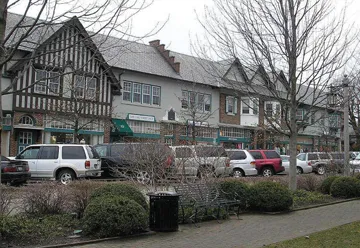
Figure 1-2. Market Square Facade (Source: Slo-mo, Wikipedia.);
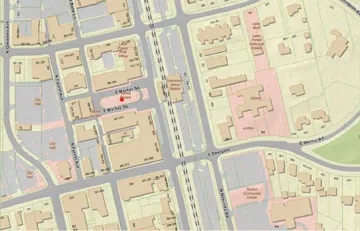
Figure 1-3. GIS Map of Market Square and Rail Line (Courtesy of City of Lake Forest.);
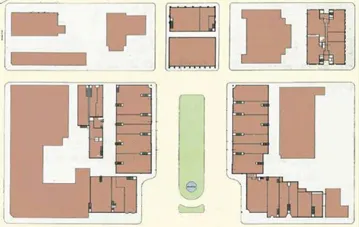
Figure 1-4. Site Plan of Market Square, Lake Forest, Illinois (Courtesy of Tom Low, Duany Plater-Zyberk& Company.)
Market Square, Lake Forest, Illinois
ARCHITECTS: Howard Van Doren Shaw, Edward H. Bennett
WEBSITE: www.historicmarketsquare.com
Market Square, designed by Chicago architect Howard Van Doren Shaw in collaboration with Edward H. Bennett, was completed in 1916 as a commercial center for Lake Forest on the north shore of Lake Michigan. A forerunner of contemporary transit-oriented development schemes, its design places a U-shaped retail mall around a landscaped commons and parking spaces across the street from a Metra commuter railroad station linking it to the metropolitan area of Chicago. Shops are on the ground floors of the buildings, with offices and apartments above. The open end of the U faces the train station, and two towers frame the sides of the square. Conceived by the city as a replacement for an unsightly commercial district, this was one of the first planned shopping centers in the United States. Market Square was listed on the National Register of Historic Places in 1979 as “America’s first planned shopping center.” It still serves as a landmark center almost 100 years after its creation. The central park space, now owned by the City of Lake Forest and a focal point for community events, was extensively renovated in 2000.
Development projects are the building blocks of urban growth. Over time, the construction of scores of individual private and public development projects determines the larger land-use and transportation patterns, neighborhood arrangements, and functioning systems of urban areas.
For cities to work well, their urban growth must be sustainable. Sustainable growth results from development that coordinates existing and future investments in civic infrastructure; accounts for the needs of current and future populations; and balances economic, environmental, and equity demands (Chakrabarti 2013). Achieving long-term sustain ability requires that urban development projects contribute to a desired sustainable future. However, the dynamism, complexity, and decentralized nature of urban development complicate the task of those trying to ensure that the continuing flow of individual projects adds up to sustainable outcomes.
Many cities in the United States will have to accommodate population and employment growth in the years ahead. Many urban-area residents have a negative view of growth. The wealthy are able to buy "safe havens" to avoid the negative impacts of growth. This tradition began with the garden suburbs of the 19th century and continues with the gated residential communities of today. But the majority of those opposed to growth try to use the public regulatory process to stop it. Certainly, neighbors opposed to adjacent proposed development have legitimate concerns. They will bear the negative impacts of growth, and these impacts should be alleviated to the extent that it is feasible. But many residents simply oppose growth itself. Their victories displace growth from p their communities to less sustainable locations, where public costs are s, higher and public benefits are lower. These victories may be substantially reduced where developers, designers, and planners work together effectively to propose more sustainable development projects.
There is wide agreement that sustainable urban development will grow in importance in the future, given the demands of increasing urban populations for new space and the impacts of climate change on energy, natural resources, and public safety. Action to achieve sustainable communities is widespread, including the use of sustainability indicators (Feiden 2011) and the inclusion of sustainability goals in comprehensive plans (Godschalk and Anderson 2012; Berke, Godschalk, and Kaiser 2006). The relevant professional organizations have issued policy statements and created programs supporting sustainable development and design: Urban Land Institute, American Planning Association, American Institute of Architects, and ICLEI—Local Governments for Sustainability.1 The present need is to build on this consensus with practical approaches aimed at seeking sustainability on the ground as new development projects are proposed and built.
Three major professional roles are involved in the creation of development projects, each with its own practice standards and techniques:
- Local government planners prepare and implement comprehensive plans that seek to guide future development toward sustain able outcomes (Godschalk and Anderson 2012; Kelly 2009; Berke, Godschalk, and Kaiser 2006; Anderson 1995). These planners, in coordination with officials and citizens, lay out desired future land-use and infrastructure patterns to be implemented through zoning; subdivision regulations; capital improvement programs; and other public sector actions, policies, and development controls. Ideally, such planning is based on an overall understanding of the economic consequences of plan adoption and implementation at both the community and neighborhood level. At the project scale, the plan is administered through zoning ordinances and other development regulations, requiring that planners become regulators in addition to fulfilling their broader roles (Talen 2012; Elliott, Goebel, and Meadows 2012).
- Real estate developers envision and propose development projects that seek to provide sustainable additions to the stock of housing and commercial property in the community (Peiser and Hamilton 2012, Peca 2009, Miles et al. 1991). These developers, in coordination with banks and equity investors, take advantage of opportunities to create urban values through investing in and developing properties. In essence, developers act as urban change agents, finding financial support and taking risks that their projects will be accepted as desirable ways to realize the urban growth contemplated in the comprehensive plan and guided by the existing development standards and regulations.
- Design and planning consultants translate development concepts into site plans, engineering schemes, and landscape and architectural visions that seek to carry out development project goals and objectives (Lu 2012, Dinep and Schwab 2010, Russ 2009, LaGro 2008, Simonds and Starke 2006, Lynch and Hack 1984). These consultants, often working in teams, do the pragmatic work necessary to fit the project onto the site, ensure that it will meet professional practice standards, consider its relationship with its context, and enable it to be permitted under the applicable development regulations. Drawing on the community's plan and vision, and the developers notion of a successful project, these consultants craft alternative proposals for the flesh-and-blood realization of this particular set of structures. They combine specialized professional knowledge with aesthetic values in order to test possible designs against local codes and sustainability standards.
Challenges of Guiding Urban Growth
At best, urban growth management is an uncertain activity. In the market economy of the United States, the engine of urban development and redevelopment is the private sector, and private real estate development is subject to dramatic boom and bust cycles that are outside the control n of local growth managers.
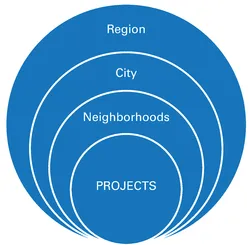
Even within local jurisdictions, property markets remain dynamic and complex, responding to unique regional economic and environ mental factors. In response to these factors, local development project g proposals are formulated and shaped by a loose community of actors, n including private real estate developers, their planning and design consultants, and local government planners and regulators. Because these projects are planned and carried out individually, it is challenging for developers, designers, and planners to ensure that they are consistent with the broader community’s sustainability visions and plans. Yet, in the aggregate, development projects have significant impacts on sustainability at the neighborhood, city, and regional scales (see figure 1-5).
Figure 1-5. Development Project Impacts
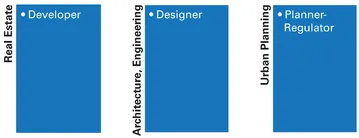
Not only is it challenging to ensure that development projects are consistent with larger visions and plans, but it is also challenging to coordinate the actions and ideas of the three major disciplines in project planning. The design, real estate development, and urban planning disciplines need to be closely linked and coordinated to create successful development outcomes. In practice, they often operate in silos with separate methodologies, terminologies, and visions of success: the developer focused on real estate practice, the design consultant focused on architectural and engineering practice, and the planner-regulator focused on urban planning practice (see figure 1-6). The purpose of this book is to connect the silos by describing and demonstrating a basic cross-disciplinary approach to creating sustainable development projects.
An Integrated and Balanced Approach
Our goal is to provide an integrated and balanced approach for creating sustainable development projects. Development projects are complex combinations of building and site design, development entrepreneurship and finance, and development regulations and policies. Projects may fail to contribute to sustainable development when the mix is flawed due to poor integration of these disciplines or domination by a single one of them. Our approach aims to facilitate more-effective integration and balance of the basic creative and analytical processes for formulating development projects.
The central theme of this book is that the sustainable development project must integrate and balance three major components:
- Design elements—the form, density, and site layouts of new residential, commercial, office, and mixed use projects, formulated by architects, landscape architects, and engineers, as expressed in architectural plans and site plan drawings.
- Development feasibility—the financial returns and construction costs analyzed by real estate developers to assess the risks of undertaking development and redevelopment projects, as expressed in financial models and pro formas comparing project revenues and expenditures.2
Figure 1-6. Professional Silos
- Regulatory standards—the land-use and public-facility requirements of local government regulations and policies written and enforced by urban planners and public officials to govern and guide the design of development projects, as expressed in development project reviews conducted in accordance with zoning and subdivision ordinances, design guidelines, and public policies.
Our approach seeks to break through the individual design, development, and regulatory silos. To do this, it is first necessary to look inside the silos and understand how they operate.
- Project design and site plan preparation is typically guided by professional best practices, design standards, legal codes, and regulations, rather than explicitly by the economic and financial dimensions of projects. The basic goal of this process is to craft designs that will be approved by clients and regulatory agencies; if designs also gain plaudits and awards from the design community, then that represents an even higher level of success.
- Development feasibility analysis is typically based on expected rates of return from standard designs rather than from design alternatives geared to unique site and environmental conditions or aimed at creating outstanding architecture. The basic goal of this process is to propose projects that will be financially successful and will be readily approved by local regulatory agencies; if the proposals also help to establish the developers' reputations and lead to further business opportunities, then that is an even higher level of success.
- Regulatory review is typically carried out to implement standards and objectives in comprehensive plans, zoning and subdivision regulations, building codes, and public facility policies rather than as a conscious attempt to use incentives and criteria to achieve design and financial objectives. The basic goal of the review process is to e...