- 450 pages
- English
- ePUB (mobile friendly)
- Available on iOS & Android
eBook - ePub
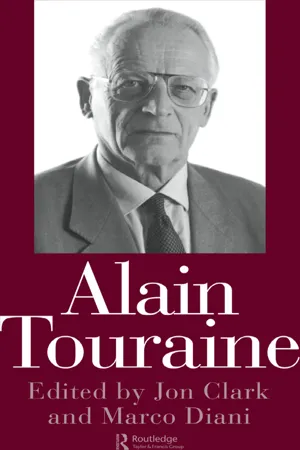
Alain Touraine
About this book
First published in 2004. The seventeen essays in this volume discuss the work of Alain Touraine and consider his contribution to the social sciences. The text includes his most recent thinkings on the market and communities.
Information
1 Introduction
The first three volumes in the Falmer Sociology series — on the work of Robert K. Merton, Anthony Giddens and John H. Goldthorpe — were edited by Jon Clark, Sohan Modgil and Celia Modgil. They were begun in 1986 and published in 1990. The fourth volume — on the work of James S. Coleman, edited by Jon Clark — was conceived in 1990, commissioned in 1992 and published in early 1996 (see Clark, 1996). This volume — on the work of the French sociologist Alain Touraine, edited by Jon Clark and Marco Diani — is the fifth in the series.
Alain Touraine is a fitting subject for the series. His work is internationally recognized in the disciplines of sociology (and politics), although until now more in continental Europe and Latin America than in the Anglo-Saxon world. His work is highly relevant to key debates in the social sciences in the 1990s, most notably his writings on social action, social movements, democracy and modernity. His major publications, and the elaboration and application of the method of sociological intervention, have also excited controversy over a period of more than forty years, starting with his empirical study of shopfloor work at Renault published in 1955, and continuing into the late 1990s with the publication and reception of his Critique of Modernity (1992, English translation 1995) and his extended essay on democracy (1994).
The volume begins with a personal, reflective essay by Michel Crozier — with Touraine, Raymond Boudon, Pierre Bourdieu and Jean-Daniel Reynaud one of the influential group of French sociologists of the immediate post-1945 generation — on Touraine’s part in creating a ‘new French sociology’ in the 1950s and 1960s. He describes how, from the beginning, Touraine was an enterprising and inspiring figure, if also a ‘maverick’, for example leaving the Ecole Normale Supérieure to work in the mines and also spending time in Hungary to experience ‘from the inside’ the transition of that country to ‘socialism’. Crozier goes on to review the role of sociological research in France in the 1950s and 1960s, identifying the contradictions and ambivalence in these ‘golden years’ of French sociology, which he sees as embodied in the person of Touraine himself: a bridge-builder between empirical work and social theory, between the revolutionary left and Gaullist technocrats, between university students and university authorities, between political commitment (to the left) and a fierce independence of mind and spirit.
Chapter 3, by Michael Rose, treats the same period and many of the same issues as Crozier, but concentrates on a closer examination of Touraine’s role in the development of sociologie du travail (a rather more all-encompassing area than the more mundane Anglo-Saxon ‘sociology of work’). He traces the common personal and intellectual debt of all French sociologists of the time to Georges Friedmann, seeing in Friedmann (and Touraine) a continuation of the Proudhonian strand in French social thought. Rose also compares the contributions of Touraine, Crozier and Reynaud to the development of French sociologie du travail in the 1960s and beyond, showing how Touraine’s output in the 1950s and 1960s underpins much of his later work on theories of post-industrialism and new social movements. The core of Rose’s chapter is an analysis of Touraine’s diverse contributions to the field: the early study of automation and mechanization at Renault’s Billancourt plant (Touraine and Verley, 1949; Touraine, 1955), which influenced the subsequent studies of Robert Blauner (1964) and Serge Mallet (1965): his theoretical book on the sociology of action (1965); its companion volume of 1966 on ‘workers’ consciousness’ drawing on over 2000 interviews with French manual workers; and numerous publications on organizational sociology and post-industrialism (Touraine, 1959, 1960, 1974). Rose concludes that the core of Touraine’s originality in the field is his insistence that ‘meaning and action are generated above all through work’ and that work transforms society by modifying our conceptions of human needs and identity. The concept of the historic subject, which lies at the heart of Touraine’s sociological project (and is examined in detail later in this volume), possesses for Rose those very moral, intellectual and historically inventive virtues attributed by Proudhonians to skilled craft workers.
In Chapter 4 Rose presents his own empirical and conceptual tribute to Touraine as a researcher in the sociology of work by discussing recent large-scale British research data on the relation between skill, flexibility and effort in a ‘post-factory world’. He reports strong statistical links between increases in skill levels at work, levels of personal responsibility, and in flexibility in the performance of work tasks and the effort required in executing them. Changes in skill and in work speed and effort were also broadly linked to class and occupational position. For example, for some, but by no means all, service class occupations, increased skill and responsibility resulted in gains in job quality through more varied work assignments. In contrast, greater flexibility in working-class occupations implied more often low or nil gains in job quality as well as work intensification in the form of faster work pace. For Rose, the retreat of the Fordist factory has eliminated many blue-collar skills, while producing a new working class which has shared very unequally in the technical change — in particular, the ‘informatization’ of work operations — that has increased the skill levels of those in intermediate class occupations. Rose concludes that the inspiration provided by Alain Touraine is enduring in an age woefully short, not only of sociological imagination, but of imagination of all kinds.
In Chapter 5 two of Touraine’s major collaborators of recent years, François Dubet and Michel Wieviorka, review his most distinctive and inventive contribution to the development of sociological method, namely the idea of sociological intervention. They identify two motivations behind this aspect of Touraine’s project: the need to develop an analytical method for the sociology of action as formalized in his book, Production de la Société (1973); and the need, more historical and concrete, to test hypotheses about the emergence of post-industrial society and the leading role of ‘new social movements’. Touraine identifies three basic levels of behaviour: historicity (collective action defined as a social movement contending for control over the cultural model underlying social action in a given type of society); competitive relations within an institutional system (normally determined by the political system); and organization (actors defined through the relative positions defended by individuals or groups). This vertical axis for interpreting social action is complemented by a horizontal axis of social change. It is the task of the method of sociological intervention to distinguish between these various logics and axes of social action. In the second main section Dubet and Wieviorka also provide a history of the method from 1977 to 1994, discussing inter alia his studies of student, anti-nuclear, working-class, ecological and women’s movements, as well as the Polish trade unions and (since 1991) a series of studies on post-communist societies. They conclude, ‘the farther we move away from the classical model of social movements grounded in the working class movement, the more the notion of social movement … shifts towards the subject, … towards the conditions for increasing the capacity of individuals for autonomous actions … sociological interventions now focus on social problems rather than organized struggles.’
In Chapter 6 Alan Scott provides a critical introduction to Touraine’s work on social movements. He distinguishes its different component elements: a theory of social action (which he compares with the work of Habermas and rational choice theory); a sociological account of the transition from industrial to post-industrial (‘programmed’) society centred on the control of knowledge and information; an exposition of the role of social movements within industrial society (the workers’/labour movement) and post-industrial society (so-called ‘new social movements’); and the research method of sociological intervention. He sees a major unresolved conflict between the first two components of the project, and argues that, while Touraine’s meta-theory liberates sociology from the formalism of much functionalist and structuralist thinking, the theory of post-industrialism drags us back to more formalistic and functionalist modes of analysis with its insistence that it is possible to identify a single social force — in the form of a social movement — suited to an oppositional role in both industrial- and post-industrial societies. While critical of much of Touraine’s interpretation of social movements, Scott argues that he has been engaged since the 1960s in an imaginative ‘deconstruction’ of the rigidity of much contemporary sociology and as such deserves greater attention from those (among whom he includes himself) trapped within Anglo-Saxon sociological discourse.
In Chapter 7 Louis Maheu argues that Touraine’s work on social movements, which he characterizes as a modernist look at post-industrial society, has not yet received the recognition it deserves in the Anglo-Saxon world of the social sciences. He identifies three basic criticisms of Touraine’s sociology of social movements, all of which are, in his view, highly problematical: that it remains a ‘pure action theory’ with little insight into the structural capacities of action; that it is overwhelmingly ‘culturalist’, tying social movements to the spontaneity of civil society; that there is an analytical and methodological rupture between Touraine’s general theory of action and his reading of post-industrial society. Maheu draws on Touraine’s classic writings on social movements, and his more recent Critique of Modernity (1992/1995), to challenge these criticisms, but also to argue for the incorporation of the idea of a social movement into a cluster-like fabric of collective actors through a revisited concept of community.
Chapter 8, by immediate past president of the International Sociological Association, T.K. Oommen, situates Alain Touraine’s work on social movements within a comparative perspective. He points out that Touraine, both independently and in collaboration with others, has analyzed social movements in three different types of society: ‘post-industrial’ democratic capitalist societies such as France; industrial communist totalitarian societies such as Poland; and industrializing non-democratic societies controlled economically by foreign multinationals such as Chile. For the purposes of comparison, however, Oommen takes as an example of the third type of society a pre-industrial, predominantly agrarian society with a colonial state, namely British India. Oommen argues that, as one follows chronologically Touraine’s analysis of different social movements from 1968 (student movement) to 1988 (Latin America), the importance of the political dimension diminishes and the cultural aspect is highlighted. For Oommen this shift in emphasis reflects a change in orientation of the movements themselves. The core of his chapter examines a range of social movements in different types of society and challenges empirically what Oommen sees as three main propositions which are central to Touraine’s theory: that social movements can emerge only in certain kinds of society, particularly industrial and ‘programmed’ societies; that they are always and necessarily class movements; and that they are not directed against the state.
In Chapter 9 sociologist Luke Martell and political scientist Neil Stammers provide a detailed critical assessment of the study of the Polish ‘social movement’, Solidarnosc, carried out by Alain Touraine and his research team in 1981 (Touraine et al., 1982). They also analyze how the study relates to concepts and categories found in Touraine’s wider social theory. They begin by locating the study and outlining its central findings, concluding that it is a comprehensive, illuminating and important piece of work. In the context of the imposition of martial law and the suppression of Solidarity by the Polish state, they find Touraine’s positive and supportive evaluation of the ‘movement’ understandable, mirroring, as it did, the wider support for opposition movements in Eastern Europe by activists and theorists in the West until the fall of one-party state regimes in 1989–90. However, they note that the rationalist and ‘optimistic’ assumptions underlying Touraine’s wider theory tended to downplay the tensions within Solidarity, in particular anti-semitism, aggressive nationalism, populism and mistrust of political action, all of which led to disintegration within the movement. They detect in Touraine’s more recent work, for example the Critique of Modernity (1992/1995), a shift in his thinking which recognizes more clearly the contradictory nature of many social movements and their ‘anti-social’ as well as ‘progressivist’ and liberating potential.
In Chapter 10 David Apter argues that Touraine’s concepts of social action and social movement were an attempt to reconstruct sociology between the structural-functionalism of Parsons and the obsolescence of the Marxian emphasis on the proletariat as the sole progressive social actors. For Touraine the new social movements constitute the moving agents of society, with conflict (confrontational action) rather than contradiction as a central feature, and historicity as the context in which such movements evolved. However, with a different emphasis but similar import to Martell and Stammers, Apter suggests that Touraine’s study of social movements neglects the phenomenon of social polarization and the multiple expressions of marginality which have led to the emergence of new and anti-social actors and violent social and political movements. For Touraine confrontational action is generally a positive notion which contributes to, rather than undermines, democracy. In contrast, for Apter the key problems for society and for social theory are to show how the conditions which lead to social marginality predispose to violence, and when and how the predisposition becomes translated into reality. One way of doing this would be to build on Touraine’s notion of social action, but to incorporate within it ‘marginal’ social actors who interpret violence as a form of morality, gaining the power of agency through such a transformational discourse. Apter concludes that whereas Marx, Parsons and Touraine aim through their analyses to provide ‘improving solutions’, today’s problems are of a kind for which resolutions are harder to come by. Indeed, where liberal democracy may not be the only form through which various groups seek to achieve their goals: ‘in short, what is needed now … are more innovative solutions and alternative forms of governing which add up to something more than default modes of liberal democracy.’
Chapter 11, by Daniel Pécaut, examines the role of politics and the political in Touraine’s theory of social movements. His basic argument is that, despite Touraine’s obvious interest in politics and political themes, essentially he asserts the primacy of social actors and systems of social action, relegating politics to a secondary and subordinate role. Pécaut begins by analyzing the importance of the ‘system of historical action’ (or ‘historicity’) for Touraine’s theory of social movements. In order of primacy, historicity precedes the social movement, which is constituted in relation to it, which, in turn, structures the space within which the political forces operate. For Touraine, therefore, it is a symptom of weakness and incipient disintegration when social movements begin to define themselves in relation to political objectives and have recourse to political action. For Pécaut, Latin America, and Chile in particular, provide the perfect terrain for Touraine’s argument. He also discusses the continuities and discontinuities in Touraine’s analysis of the political. While reaffirming the primacy of social relationships and their structuring character, Pécaut argues that the notions of ‘subject’ and ‘subjectivation’ (see in particular Touraine, 1992, 1994) give the idea of social movement a new clarity, explicitly separating it from its previous grounding in class action, emphasizing instead its cultural dimension (appeals to life, sexuality, identity, religion) and importance as a bearer of democratic aims within society. For Pécaut the relation between social movements and democratic culture implies a much more direct relationship with the political sphere, although ultimately Touraine’s analysis points beyond politics to an ‘ethical imperative’, without which democracy would be reduced to a mere technique.
Chapter 12, by political theorist Jean L. Cohen, continues the theme of the politics of social movements, placing Touraine’s work in the context of new theoretical paradigms which attempt to explain the relationship between contemporary collective action and civil society. She begins by examining in detail the ‘resource mobilization’ approach to social movements (particularly as developed by Charles Tilly) before proceeding to an extended analysis and critique of Touraine’s own theory in the context of what she calls the ‘new social movements paradigm’. She argues that, for Touraine, the contested social terrain in contemporary social systems is no longer the state or the market mechanism, but civil society. One of Touraine’s most important insights is that contemporary conflicts are not simply about the defence and autonomy of civil society against the state, but about what kind of civil society is to be defended. However, she also believes that Touraine’s model of contemporary society — which he calls post-industrial or programmed — obscures the significance of the concept of civil society while at the same time leading to a one-sided view of current social movements. Building on a critical analysis of Habermas’s recent reformulation of the theory of communicative action, Cohen underlines the dual character of contemporary social movements, arguing that civil society is both the target and the terrain of contemporary social action. She illustrates her ‘dual politics’ approach by a discussion of the trajectory of the US-American feminist movement.
Chapter 13, by Jeffrey Alexander, begins by assessing in detail t...
Table of contents
- Cover
- Half Title
- Title Page
- Copyright Page
- Table of Contents
- 1 Introduction
- 2 Alain Touraine: A Pioneer in the New French Sociology
- 3 Alain Touraine: Sociologue du Travail, Proudhonian, Pessimist
- 4 Skill, Flexibility and Effort in a Post-Factory World: Evidence from Britain
- 5 Touraine and the Method of Sociological Intervention
- 6 Movements of Modernity: Some Questions of Theory, Method and Interpretation
- 7 The Sociology of Alain Touraine: A Modernist Look at Post-Industrialization and the Ambivalence of Social Movements
- 8 Social Movements in a Comparative Perspective: Situating Alain Touraine
- 9 The Study of Solidarity and the Social Theory of Alain Touraine
- 10 Discourse as Power: A Second Look at Confrontational Adaptation
- 11 Politics, the Political and the Theory of Social Movements
- 12 Mobilization, Politics and Civil Society: Alain Touraine and Social Movements
- 13 Collective Action, Culture and Civil Society: Secularizing, Updating, Inverting, Revising and Displacing the Classical Model of Social Movements
- 14 Alain Touraine’s Conceptions of Modernity
- 15 Social Action and the Production of Society
- 16 Touraine’s Subject versus Rawls’s Homo Politicus and Habermas’s Homo Communicans
- 17 Modernity, the Subject and the Subversion of Sociology
- 18 A Sociology of the Subject
- Appendix: Curriculum Vitae and Publications of Alain Touraine
- List of Contributors
- Author Index
- Subject Index
Trusted by 375,005 students
Access to over 1.5 million titles for a fair monthly price.
Study more efficiently using our study tools.
Frequently asked questions
Yes, you can cancel anytime from the Subscription tab in your account settings on the Perlego website. Your subscription will stay active until the end of your current billing period. Learn how to cancel your subscription
No, books cannot be downloaded as external files, such as PDFs, for use outside of Perlego. However, you can download books within the Perlego app for offline reading on mobile or tablet. Learn how to download books offline
Perlego offers two plans: Essential and Complete
- Essential is ideal for learners and professionals who enjoy exploring a wide range of subjects. Access the Essential Library with 800,000+ trusted titles and best-sellers across business, personal growth, and the humanities. Includes unlimited reading time and Standard Read Aloud voice.
- Complete: Perfect for advanced learners and researchers needing full, unrestricted access. Unlock 1.5M+ books across hundreds of subjects, including academic and specialized titles. The Complete Plan also includes advanced features like Premium Read Aloud and Research Assistant.
We are an online textbook subscription service, where you can get access to an entire online library for less than the price of a single book per month. With over 1.5 million books across 990+ topics, we’ve got you covered! Learn about our mission
Look out for the read-aloud symbol on your next book to see if you can listen to it. The read-aloud tool reads text aloud for you, highlighting the text as it is being read. You can pause it, speed it up and slow it down. Learn more about Read Aloud
Yes! You can use the Perlego app on both iOS and Android devices to read anytime, anywhere — even offline. Perfect for commutes or when you’re on the go.
Please note we cannot support devices running on iOS 13 and Android 7 or earlier. Learn more about using the app
Please note we cannot support devices running on iOS 13 and Android 7 or earlier. Learn more about using the app
Yes, you can access Alain Touraine by Jon Clark,Marco Diani in PDF and/or ePUB format, as well as other popular books in Education & Education General. We have over 1.5 million books available in our catalogue for you to explore.