This glossary offers an exciting introduction to the diversity and richness of Spanish culture and society and a route-map to further study. Designed specifically with undergraduates in mind, it contains around 450 concise alphabetically arranged and accessible explanations of the key words, events, figures and concepts in Spain since 1939.
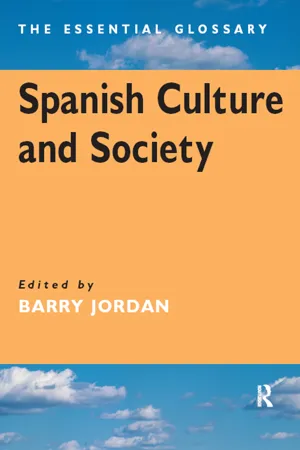
- 288 pages
- English
- ePUB (mobile friendly)
- Available on iOS & Android
eBook - ePub
About this book
Information
A
ABC Founded in 1903 by Torcuato Luca de Tena, ABC is the doyen of Spain’s national press. Currently the second most widely read general news daily, it has a circulation of around 300,000. ABC is highly traditional in both editorial line and appearance, and management control remains with the Luca de Tena family.
Originally Seville-based, ABC long continued to appear in separate Seville and Madrid versions. Editions are now printed in both cities, along with Barcelona, Vigo and Santa Cruz de Tenerife, and in Brussels and Mexico City for the international market. Madrid and Andalusia – where it is the most widely-read daily – account for around 70 per cent of its readership; otherwise it sells significantly only in Castilla-La Mancha. ABC’s early editorial line was strongly anti-Republican, and under Franco it was permitted to operate independently as a concession to his monarchist backers. After 1975, it remained unswervingly conservative, and its circulation fell sharply. However, in the 1990s, it profited from the unpopularity of the Socialist government, whose malpractices it was vociferous in denouncing. Indeed, its then editor, Luis María Ansón, subsequently revealed that ABC had been part of a coordinated anti-Socialist media campaign. Since 1996, it has been a loyal supporter of the conservative Popular Party government.
ABC’s conservatism extends to its traditional layout and magazine-style format. In some respects, however, it has undergone significant change. In 1988, the historic Blanco y Negro title was revived for its Sunday supplement. A year later, the paper moved to new headquarters on Madrid’s Avenida de América, and in 1995 an electronic edition was launched. ABC now forms part of the Prensa Española group, for which it acts as flagship. The group, whose principal owners are large banks, also includes the moderately successful business daily Gaceta de los Negocios, several local papers in Castilla-León and Castilla-La Mancha and a radio station, Punto Radio. (Christopher Ross)
abortion The first limited attempt to legalize abortion in Spain was initiated by anarchist sex reformers in Catalonia during the Second Republic. In 1941, the Franco regime banned abortion, although its practice remained widespread (Brooksbank Jones 1997). After 1975, the legalization of abortion became a central aim of the new Spanish women’s movement, while a 1977 survey indicated that 60 per cent of Spaniards opposed legalization, reflecting the continuing influence of the Catholic Church, as well as gender and generational differences (older women were the most resistant to abortion reform) (Matsell 1981). In 1976, the feminist activist Lidia Falcón estimated that abortion offences accounted for 30 per cent of women in Spanish prisons (Kaplan 1982). In the same period, well over ten thousand Spanish women travelled annually to France or London for abortions, while as many as 3000 per year died in Spain as a result of botched clandestine procedures (Matsell 1981). In 1979, nine working-class women and two doctors from Bilbao were tried (and eventually acquitted) under the 1941 law, prompting hundreds of Spanish women, including prominent politicians, union officials, lawyers and writers, to sign a document stating that they had had terminations. Not until 1985 did the PSOE government introduce an amendment to the Criminal Code, permitting abortion under three circumstances: 1) threat to the life or mental health of the mother; 2) rape; and 3) severe damage to the foetus. Subsequent attempts at legal reform have been hindered and severely delayed by the conservative stance of the now-governing Partido Popular, Spain’s bishops as well as Basque and Catalan nationalists. Spain today has one of the most restrictive abortion laws in Europe. Feminist organizations, as well as women and men in the health and legal professions, continue to campaign for open and safe access to abortion (e.g. the First Conference on Abortion in Reproductive Health, Seville, May 2000). (Carrie Hamilton)
Further reading
Brooksbank Jones (1997); Kaplan (1992); Matsell (1981).
Abril, Victoria Born 1959. Actress. For many international audiences, Victoria Abril has come to symbolize Spanish cinema. Over the past twenty-five years, she has appeared in important films by some of Spain’s top directors, most consistently Vicente Aranda, for whom she has made nine films. At seventeen, she appeared in Aranda’s Cambio de sexo (Change of Sex, 1976), in which she played a young man who undergoes a sex change operation. This controversial film brought her acclaim and offers for a series of new roles in important films of the 1980s.
Abril’s dramatic range is reflected in the array of screen characters she has portrayed, including the mother of an autistic child in Josep Antón Salgot’s Mater Amatisima (Beloved Mother, 1981), a Mexican prostitute in José Luis Borau’s Rio abajo (On the Line, 1983), and a rebellious gypsy in Aranda’s two-part film El Lute (1987–88). She is best known for her portrayal of strong-willed women, often under Aranda’s careful direction: La muchacha de las bragas de oro (Girl in the Golden Panties, 1980); Tiempo de silencio (Time of Silence, 1986); Amantes (Lovers, 1990); Intruso (Intruder, 1993).
The international success of Lovers and her appearance in two Almodóvar hits, ¡Atame! (Tie Me Up, Tie Me Down!, 1989), and Tacones lejanos (High Heels, 1992), gave Abril critical exposure in the US, and led to her Hollywood debut in Barry Levinson’s Jimmy Hollywood (1993). Despite the film’s box-office failure, Abril rebounded in Almodóvar’s Kika (1993) and Aranda’s Libertarias (1996), for which she won best actress award at the San Sebastian Film Festival. She has also appeared in numerous French films, the most popular of which was Josianne Balasko’s Gazon maudit (French Twist, 1994). (Marvin D’Lugo)
Further reading
Alvares and Frías (1991). Their essay presents an incisive biography of Abril’s career with useful discussion of films and directors.
advertising The advertising industry in Spain operates not only at regional and national levels, but is fundamentally a multinational, indeed global, phenomenon, totally integrated into the international economy. Most of Spain’s major advertising companies are foreign-owned, working through subsidiary offices, mainly in Madrid and Barcelona. The main vehicles for advertising in Spain include: television, radio, press and magazines, direct marketing, cinema, outdoor spaces (hoardings), the Internet and also point of sale publicity.
The relative strength and market position of advertising has undergone rapid change in the last two decades, with competition between the various sectors becoming extremely fierce, especially in television, the press and direct marketing. So that while, on average, the press and radio have managed to maintain their market share, television advertising has become a battleground between public and private television companies, competing for a dwindling share of business. At the other end of the spectrum, magazine advertising is doing badly and the forecasts for Internet advertising have not been met. And except for the Osborne Black Bulls, public advertising hoardings are no longer allowed on Spain’s motorways.
Capitalist modernization in Spain was uneven and almost totally dependent on imported technology. Hence, even in the 1920s, America’s ITT controlled the country’s telephone system and advertising was in the hands of J. Walter Thompson and French-owned company Havas. There were no significant Spanish advertising companies until the economic ‘lift off’ of the 1960s. Also, the advertising market was small, even in the case of TVE, the state monopoly broadcaster which, until the 1980s, offered limited opportunities for market expansion. Yet, TVE depended on advertising for over 90 per cent of its revenue in the 1970s and 1980s. With the arrival of the ‘third’ channels in the early 1980s, the market for advertising began to be squeezed, with regional channels siphoning off some revenues from the state broadcaster. Once television privatization got under way in the 1990s, state channels saw their advertising revenues fall significantly. They responded with ratings wars, which led to a lowering of programme standards and in television advertising, an increase in crude, sexist representations, especially of women. Moreover, in order to attract advertisers, spot prices have fallen and advertising breaks nowadays often last between 6 and 8 minutes, contrary to both Spanish and EU legislation. With new terrestrial, satellite and cable services, there is far too much advertising space chasing too few buyers, which will lead to severe financial pressure and a continuing decline in programming quality. (Barry Jordan)
Further reading
Maxwell (1995).
Agencia EFE Spain’s main news agency, one of the largest in the world, alongside Reuters, AP, UPI, AEP, and the largest in the Spanish-speaking world. Operating in over 100 countries and employing well over 1000 journalists, EFE provides news copy to affiliated journalists, papers and agencies across the globe through digital transmission. It also offers other information services and an annual CD-ROM.
It was established in 1938, as a means of controlling the flow of foreign news into Nationalist Spain and filtering out anything the early Francoist governments disapproved of. Unlike the prensa del Movimiento, which was gradually sold off to private interests in the late 1970s and early 1980s, EFE remained under state control. Owned by the state and with its editorial line set by the government, it remains to this day a tool of government policy, a means of media manipulation and a useful vehicle through which Spanish governments can give their side of the story. (Barry Jordan)
agriculture Formerly an intensely rural society, Spain’s agriculture now only represents 4 per cent of its GDP. In 1999, there were 1,278,000 farms covering 30 million hectares of land and employing 1,065,000 people. Until 1960, Spanish agriculture consisted mainly of low-value cereals, olive oil, fruit and vegetable production. A significant new trend in the last few decades has been the rise of intensive and profitable horticulture in Andalusia, Murcia and Valencia, stimulated both by the tourist business and by the new opportunities to export into northern Europe. By far the largest crop is winter cereals (13.1 m tonnes in 1999) followed closely by alfalfa (12.3 m), and a long way ahead of sugar beet (7.7 m), barley (7.3 m), maize (6.9 m), citrus fruits (5.4 m), wheat (5 m), grapes (4.8 m), tomatoes (3.5 m), potatoes (3.3 m), and olives (2.9 m). The national cattle herd totalled 6 m, with 23.7 m sheep and goats, 21.7 m pigs and 37 m poultry. It is a very varied sector, with highly efficient production in some areas like fruit and vegetables, but less so in cereals and dairy farming.
Spanish agriculture was seriously affected by entry into the EEC. While some sectors such as horticulture benefited from the new markets, others such as dairy farming were badly hit by new competition: the number of milk producers fell from 240,000 to 70,000 in the 1990s as it no longer remained viable to rear tiny herds for milk. EU quotas on traditional products such as olive oil have also been very contentious. EU subsidies amount to about 25 per cent of farming income – some 1 per cent of GDP. They averaged an apparently modest £2,363 per farm in 2000 (tenth place in the EU league table). But these subsidies are very unevenly distributed, and small producers repeatedly complain that they get little help from them, with 80 per cent of subsidies going to 20 per cent of farmers. (Tony Morgan)
AIDS AIDS has infected over 36 million people worldwide, causing 11 million deaths so far. The first case of AIDS appeared in Spain in 1981 in a homosexual male; the following year, the first known case of a female victim emerged, infected through intravenous use of drugs with a shared needle. Twenty years on, according to the National AIDS register for the year 2000, AIDS in Spain remains alarmingly prevalent, at 62,000 cases overall, more than 50 per cent of which have already died. The areas most affected are Madrid, Catalonia and Andalusia. Yet, in the same year of 2000, 2745 new cases were diagnosed, representing a 7 per cent fall compared to the previous year. Up to June 2001, there were 1002 new cases. Thus the trend over the last five years appears to be one of a general, overall decline in new cases. This is mildly encouraging and arguably a function of new treatments and medicines available, new awareness campaigns and a greater degree of coordination between the Ministry of Health and Consumption and the regional health services, according to the national AIDS plan (Plan Nacional del Sida).
The groups most at risk continue to be those engaged in drug use (with some 75,000 cases in Spain being prescribed methodone); however relative incidence appears to be falling slightly among drug users while it is rising a little in homosexual and in heterosexual relations. Ministry of Health figures suggest that the highest levels of transmission occurred during the period 1985–88; by the mid-1990s, the annual totals were beginning to fall (from 7359 cases in 1994 to 6538 cases in 1996). Spain remains the European country with the highest incidence of AIDS cases, though thanks to new treatments, therapies and greater awareness of risk, AIDS sufferers are no longer contemplating certain death. The condition, though still incurable, has been stabilized to some extent, though official organizations emphasize the need never to be complacent. The annual cost of treatments born by the Spanish health service is around €270.45 m. This is ‘money well spent’, according to Fase, Spain’s Anti-Aids Foundation. (Barry Jordan)
Alaska (real name Olvido Gara) Born 1963, Mexico. Singer and songwriter. Olvido Gara’s Cuban mother and Spanish father were both political exiles in Mexico where Olvido was raised until she was ten. Arriving in Madrid in 1973, her late adolescence coincided with Madrid’s movida giving her the opportunity, as Alaska, to become one of its greatest protagonists. At 15, Alaska not only stood out by wearing punk safety pins, but she was given the co-lead role as lesbian sadist Bom in Almodóvar’s 1980 feature debut, Pepi, Luci, Bom y otras chicas del montón, not by virtue of her acting abilities (which were nil), but by her iconic status as a movida figure. Alaska has formed the centre of some of the most significant Spanish bands. Guitarist in Spain’s first punk group Kaka de Luxe (Crap De Luxe), Alaska only began singing with her second group Alaska y los Pegamoides. It was this band, and her third, Alaska y Dinarama, that produced many of her most famous hits with titles such as ‘Horror en el hipermercado’ (‘Horror in the Hypermarket’), ‘Quiero ser santa’ (‘I want to be a Saint’) and the movida (and now also gay) anthem ‘¿A quién le importa?’ (Who Cares?). Alaska, alongside Nacho Canut, the only original member of Kaka de Luxe still working with her, now performs in Fangoria. While its output is arguably musically the best in her career, Fangoria has a lower profile than her earlier bands and Alaska is now equally famous as a media personality, icon of both youth culture and gay culture, and occasional actress. Studying for a degree in history and anthropology while she tours the country, Alaska is accepted by many as bridging the divide between intellectual and popular culture. She is one of very few of the pr...
Table of contents
- Cover
- Half Title
- Title Page
- Copyright Page
- Table of Contents
- Preface
- Thematic categories and entry lists
- Notes on contributors
- Acknowledgements
- Glossary
- Bibliography
Trusted by 375,005 students
Access to over 1.5 million titles for a fair monthly price.
Study more efficiently using our study tools.
Frequently asked questions
Yes, you can cancel anytime from the Subscription tab in your account settings on the Perlego website. Your subscription will stay active until the end of your current billing period. Learn how to cancel your subscription
No, books cannot be downloaded as external files, such as PDFs, for use outside of Perlego. However, you can download books within the Perlego app for offline reading on mobile or tablet. Learn how to download books offline
Perlego offers two plans: Essential and Complete
- Essential is ideal for learners and professionals who enjoy exploring a wide range of subjects. Access the Essential Library with 800,000+ trusted titles and best-sellers across business, personal growth, and the humanities. Includes unlimited reading time and Standard Read Aloud voice.
- Complete: Perfect for advanced learners and researchers needing full, unrestricted access. Unlock 1.5M+ books across hundreds of subjects, including academic and specialized titles. The Complete Plan also includes advanced features like Premium Read Aloud and Research Assistant.
We are an online textbook subscription service, where you can get access to an entire online library for less than the price of a single book per month. With over 1.5 million books across 990+ topics, we’ve got you covered! Learn about our mission
Look out for the read-aloud symbol on your next book to see if you can listen to it. The read-aloud tool reads text aloud for you, highlighting the text as it is being read. You can pause it, speed it up and slow it down. Learn more about Read Aloud
Yes! You can use the Perlego app on both iOS and Android devices to read anytime, anywhere — even offline. Perfect for commutes or when you’re on the go.
Please note we cannot support devices running on iOS 13 and Android 7 or earlier. Learn more about using the app
Please note we cannot support devices running on iOS 13 and Android 7 or earlier. Learn more about using the app
Yes, you can access Spanish Culture and Society by Barry Jordan in PDF and/or ePUB format, as well as other popular books in Social Sciences & Journalism. We have over 1.5 million books available in our catalogue for you to explore.