What is parental control? Is it positive or negative for children? What makes parents controlling with their children, even when they value supporting children's autonomy? Are there alternatives to control and how might we apply them in important domains of children's lives, such as school and sports? This book addresses these and other questions about the meaning and predictors of parental control, as well as its consequences for children's adjustment and well-being. While the topic of parental control is not new, there has been controversy about the concept, with some researchers and clinicians weighing in on the side of control and others against it. This book argues that part of the controversy stems from different uses of the term, with some investigators focusing more on parents being in control and others on controlling children. Using a definition of control as "pressure for children to think, feel, or behave in specific ways," the author explores research on parental control, arguing that there is more consensus than previously thought. Using this research base, the author provides evidence that parental control can be subtle and can lurk within many "positive" parenting approaches; parental control undermines the very behaviors we wish to inculcate in our children; providing autonomy support--the opposite of control--is a challenge, even when parents are committed to doing so.
With controversy in the literature about parental control and attention in the media on the ways in which parents step over the control line (e.g., screaming on the soccer sidelines, pressuring children in academics), this book is especially timely. It provides an empathic view of how easily parents can become trapped in controlling styles by emphasizing performance and hooking their own self-esteem on children's performance. Examples of how this can happen in academic, sporting, and peer situations with their emphasis on competition and hierarchy are provided, as well as strategies for parenting in highly involved but autonomy supportive ways.
A highly readable yet research-based treatment of the topic of parental control, this book:
*explores the controversial topic of parental control; addresses controversy about the positive and negative effects of parental control; and disentangles various parenting concepts, such as involvement, structure, and control;
*illustrates how control can be overt, such as in the use of corporal punishment or covert, as in the use of controlling praise;
*provides evidence that control may produce compliance in children preventing them from initiating and taking responsibility for their own behavior;
*explores why parents are controlling with their children, including environmental and economic stresses and strains, characteristics of children that "pull" for control, and factors in parents' own psychologies that lead them to be "hooked" on children's performance; and
*provides examples of control in the areas of academics and sports--the hierarchical and competitive nature of these domains is seen as contributing to parents' tendencies to become controlling in these areas.
- 200 pages
- English
- ePUB (mobile friendly)
- Available on iOS & Android
eBook - ePub
About this book
Information
Publisher
Psychology PressYear
2002Print ISBN
9780805835410
9780805835403
Edition
1eBook ISBN
9781135659837


The Concept of Control
Not so very long ago, Ellen Perkins took her 7-year-old daughter, Hannah, dress shopping for a special occasion. They started out at a store near their house. Hannah looked adorable in the pink chiffon she tried on, but Hannah hated pink. Her mother was exasperated but agreed to go to the mall to look some more. The problem was that Mrs. Perkins was already strapped for time. The mall was 30 minutes away. When they arrived at the mall, Mrs. Perkins decided to try to check one more thing off her list. Hannah’s bangs were in her eyes. “Let’s get those bangs trimmed right here,” Mrs. Perkins said.
Hannah refused. “No! I don’t trust those haircutters!”
Mrs. Perkins, already stressed, reacted: “If you don’t get your hair cut, then we’ll go home right now. You won’t get a dress.”
“Fine,” Hannah said.
Not getting what she wanted, Mrs. Perkins decided to up the ante of control. “If you don’t get your bangs cut, then I’m not going to get the present you want to get for your friend, and no one else will buy it either.”
Hannah started to cry.
In this case, the increasing pressure and force applied by Mrs. Perkins signals control, but just what does it mean to be controlling? In this chapter I explore the concept of control. I discuss terms such as psychological control, autocratic parenting, and the authoritarian style, and I contrast those styles with psychological autonomy, democratic parenting, and the authoritative style. On the basis of this work, I differentiate the concept of being “in control” from that of being “controlling.” I will also contrast the ideas of involvement and control. One question I explore later is: When does involvement become controlling?
PARENTING DIMENSIONS
The literature on parenting is replete with a sometimes-confusing array of terms to describe parenting types and dimensions. Researchers have used terms such as responsive parenting, sensitive parenting, democratic versus autocratic, and restrictive versus nonrestrictive. Trying to determine what makes for “good” parenting means wading through these terms—and more. Often the meaning is unclear from the label and readers have to judge a particular researcher’s usage and intent and evaluate the way in which parenting dimensions are measured. The task is complicated even more by the fact that the same term can have different meanings to different researchers.
The terminology mire can be daunting. It can appear that no two researchers are studying the same concepts, much less yielding consistent findings. However, when parenting questionnaires, made up of multiple self-report parenting items, or ratings of parents drawn from observations, have been factor analyzed during the last 35 years, two dimensions consistently emerge. Regardless of what they are called, they appear to be reliably tapping two key parenting dimensions.
The first dimension has been variously called parental warmth, acceptance, responsivity, and child-centeredness. Figure 1.1 presents a list of some of these terms. In general the dimension refers to parents providing emotional and material resources to their children. In my own work I have referred to this dimension as involvement.
Earl Schaefer (1959) suggested that parents could be placed along a warmth–hostility dimension, with ratings of high affection, positive reinforcement, and sensitivity to the child’s needs and desires at one end and rejection and hostility at the other. Alfred Baldwin (1955) and Wesley Becker (1964) found evidence of a dimension that ranged from warmth to coolness. Lea Pulkkinen (1982) distinguished parent-centered versus child-centered parenting, and G. Parker, Tupling, and Brown (1979), using the Parent Bonding Instrument, identified caring and empathic parenting versus rejecting or indifferent parenting. Diana Baumrind’s (1967) typological scheme identifies authoritative parents as warm and accepting and authoritarian parents as cool and aloof. Researchers who hold an attachment perspective posit that children develop secure attachments to their caregivers through available, responsive parenting (Sroufe & Waters, 1977).
Evidence for the underlying correspondence of these differently named constructs comes from the fact that each construct predicts similar qualities in children. Warmth was found to be associated with children’s higher self-esteem in classic studies by Coopersmith (1967). Parental involvement has been linked to children’s self-esteem (Loeb, Horst, & Horton, 1980) as well as to higher levels of achievement and motivation and lower levels of delinquency and aggression (Hatfield, Ferguson, & Alpert, 1967). I present these facts without elaboration for now, but later I argue that the effects of warmth and involvement depend on other dimensions. Nonetheless, at this point we can conclude that warm, responsive, and involved caretaking yields positive effects.
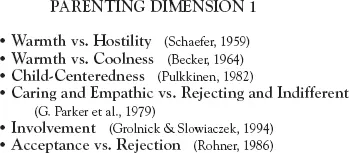
FIG. 1.1. Parenting Dimension 1.
The second dimension that emerges in the majority of parenting studies is far more perplexing than involvement. What unites this second dimension as it emerges across various studies is its relation to control. Descriptions of this dimension include controlling versus permissive, firm control versus lax control, psychological control versus psychological autonomy, restrictive versus permissive, and controlling versus autonomy supportive (see Fig. 1.2 for a list of some of these terms). How have different researchers understood this dimension?
EARLY CONCEPTS OF CONTROL
Baldwin’s (1948) groundbreaking investigation of child rearing conducted at the Fels Research Institute in the 1940s was one of the first to examine systematically the idea of parental control. Baldwin interviewed the parents of 67 children, beginning when the children were 4 years old then observing the parents and children every 6 months afterward. On the basis of the interviews and observations he rated children and parents on a number of dimensions, including sensitivity, impatience, and affectionateness. Factor analysis of the ratings of parents yielded two general factors: Control and Democracy. Control, as defined by Baldwin, “emphasizes the existence of restrictions upon behavior which are clearly conveyed to the child” (p. 130). Democracy involved high levels of verbal contact between parent and child and openness of communication. In democratic parenting, polices are arrived at by mutual agreement, reasons are given for disciplinary actions, and the child’s input in parenting decisions is sought when possible. Control and Democracy were positively correlated.
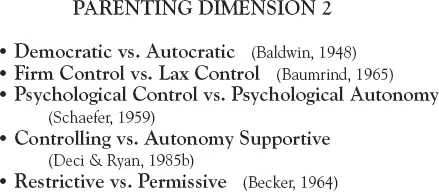
FIG. 1.2. Parenting Dimension 2.
Thus in Baldwin’s (1948) study, control refers to the limits, rules, and restrictions placed on children’s behavior. For Baldwin, control was positive. However, although control and democracy tended to be correlated, it was possible to have control within the context of democratic or more autocratic parenting.
What effects do these parenting characteristics have on children? Keeping control constant, Baldwin (1948) found that democracy produces an aggressive, fearless, and playful child who tends to be a leader but also who is cruel to his or her peers. With democracy held constant, control decreases quarrelsomeness, negativism, and disobedience. Occurring together, control and lack of democracy create a quiet, well-behaved child who is low in creativity. The best outcomes were observed in homes in which there was a great deal of interaction between parents and children, along with democracy.
Becker (1964) proposed two factors of parenting: restrictiveness versus permissiveness and warmth versus hostility. He characterized the restrictive end as having “restrictions and strict enforcement of demands in the areas of sex play, modesty behavior, table manners, toilet training, neatness, orderliness, care of household furniture, noise, obedience, aggression to siblings, aggression to peers, and aggression to parents” (p. 174). The permissive end included fewer restrictions, and the enforcement was less firm. Becker crossed the two dimensions to yield four types of parents: warm–restrictive, warm–permissive, hostile–restrictive, and hostile–permissive. He determined that the warm–permissive quadrant contained the most positive characteristics.
How can one reconcile the fact that in Baldwin’s (1948) work control was positive, whereas in Becker’s (1964) work permissiveness was more desirable? One way is to note that in Becker’s work restrictiveness included two issues: the degree to which rules and regulations existed and the degree to which these were “strictly reinforced.” It is likely that Becker’s negative findings reflect the fact that he was conflating two dimensions, one related to having rules, and the other to administering those rules in a controlling (or undemocratic) manner. The fact that the dimension picked up rules conveyed in a controlling manner was likely responsible for the negative findings. By contrast, Baldwin separated out having rules and limits from parents’ general styles of democratic or undemocratic parenting.
BAUMRIND’S TYPOLOGICAL CONCEPTUALIZATION
In her highly influential early work on parental authority with children Diana Baumrind (Baumrind, 1967, 1977) took a typological approach, dividing parents into different categories. She initially described three patterns of parental authority based on a cluster analysis of 50 behavior ratings of parent interviews and home observations: permissive, authoritarian, and authoritative (see Table 1.1). The authoritarian parent attempts to shape, control, and evaluate the child using set standards. He or she values obedience first and foremost and uses forceful measures to inculcate desired behavior. This parent does not encourage verbal give and take but prefers that the child accept his or her word for what is right. This type of parent tends to enforce rules firmly, confronts and sanctions negative behavior on the part of the child, and discourages independence and individuality. He or she also tends to be rejecting, although Baumrind did identify some authoritarian parents who were less so.
The authoritative parent, on the other hand, attempts to direct the child in a rational, issue-oriented manner. He or she encourages verbal give and take, provides reasons for her decisions, and solicits the child’s opinions. This parent, like the authoritarian parent, firmly enforces rules and is willing to confront misbehavior, yet, in contrast, he or she encourages independence and individuality.
TABLE 1.1
Baumrind’s Patterns of Child Rearing
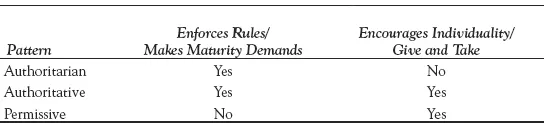
The permissive parent is nonpunitive, accepts the child’s impulses, and is unlikely to intervene by curbing them. He or she also responds to the child in an affirmative way. This parent imposes few demands, and thus the child has few household responsibilities. The permissive parent does not enforce rules firmly and tends to ignore or excuse misbehavior but, like the authoritative parent, encourages independence and individuality.
Baumrind and Black (1967) examined the consequences of these parenting patterns for children in preschool. In a follow-up study, Baumrind (1977) evaluated the children when they were 8 and 9 years old. She found that the preschool children of authoritarian parents were moody and unhappy, relatively aimless, and did not get along well with other children. By ages 8 and 9, these same children, particularly the boys, were low in achievement motivation and social assertion.
In contrast, the preschool children of authoritative parents were energetic, socially outgoing, and independent. The 8- and 9-year-olds were highly achievement oriented, friendly, and socially responsive.
Finally, the preschool children of permissive parents lacked impulse control and were self-centered and low in achievement motivation. By ages 8 and 9 they were described as low in both social and cognitive competence.
Using this same sample of parents and children, Baumrind (1996) later reframed her views of parenting. She used a two-dimensional conceptualization, that included demandingness and responsiveness. She defined demandingness as the “claims parents make on the child to become integrated into the family whole by making maturity demands, supervision, disciplinary efforts and willingness to confront the child who disobeys” (p. 411). Thus, demanding parents supervise and monitor their children and are willing to openly confront them when there is a disagreement or wrongdoing. They expect children to perform up to their abilities and to contribute to the family. She defined responsiveness as the extent to which parents “intentionally foster individuality, self-regulation, and self-assertion by being attuned, supportive and acquiescent to the children’s special needs and desires” (p. 410). The responsivity dimension thus combined warm supportiveness with valuing and promoting individuality through open give and take.
In Baumrind’s (1991a) scheme, parents can be divided into four types: authoritative (demanding and responsive), authoritarian (demanding but not responsive), permissive (more responsive than demanding), and rejecting/neglecting (neither responsive nor demanding). When Baumrind examined how children of parents placed into these categories fared, she found the best outcomes for children of authoritative parents and the worst for the rejecting/neglecting parents.
When the children were approximately 15 years old, Baumrind (1991b) conducted another follow-up, this time dividing the parents into six types. She further differentiated the demanding–responsive parents in a way that was particularly relevant to parenting in adolescence. First, she distinguished parents who were authoritative (demanding and responsive) from those who were directive (valuing conformity above individuality and high in demandingness). The directive parents were further divided into intrusive and nonintrusive types (authoritarian–directive and nonauthoritarian directive, respectively). There were two types of permissive parents: Those who were highly committed to their children were labeled democratic, and those who were not as committed were labeled nondirective. A good enough group was characterized by medium low to medium high demandingness but only moderate supportiveness. Finally, an unengaged group did not structure or monitor their children and was highly disorganized.
Comparing the children of these different groups, Baumrind (1991b) found that adolescents of authoritative and democratic parents were high in competence, individuation, maturity, achievement motivation, and self-regulation. Children of directive parents lacked individuation and autonomy and were rated high in seeking adult a...
Table of contents
- Cover
- Halftitle
- Title
- Copyright
- Contents
- Acknowledgments
- Introduction
- 1 The Concept of Control
- 2 Fulfilling Children’s Needs: The Self-Determination View
- 3 The Complexity of Control: Disentangling Parenting Dimensions
- 4 Overt and Covert Control
- 5 Differentiating the Effects of Control: Compliance Versus Internalization
- 6 Control in Context
- 7 What Makes Parents Controlling: Pressure From Above and Below
- 8 What Makes Parents Controlling: Pressure From Within
- 9 Control and Academics
- 10 Control and Sports
- 11 Conclusions
- References
- Author Index
- Subject Index
Trusted by 375,005 students
Access to over 1.5 million titles for a fair monthly price.
Study more efficiently using our study tools.
Frequently asked questions
Yes, you can cancel anytime from the Subscription tab in your account settings on the Perlego website. Your subscription will stay active until the end of your current billing period. Learn how to cancel your subscription
No, books cannot be downloaded as external files, such as PDFs, for use outside of Perlego. However, you can download books within the Perlego app for offline reading on mobile or tablet. Learn how to download books offline
Perlego offers two plans: Essential and Complete
- Essential is ideal for learners and professionals who enjoy exploring a wide range of subjects. Access the Essential Library with 800,000+ trusted titles and best-sellers across business, personal growth, and the humanities. Includes unlimited reading time and Standard Read Aloud voice.
- Complete: Perfect for advanced learners and researchers needing full, unrestricted access. Unlock 1.5M+ books across hundreds of subjects, including academic and specialized titles. The Complete Plan also includes advanced features like Premium Read Aloud and Research Assistant.
We are an online textbook subscription service, where you can get access to an entire online library for less than the price of a single book per month. With over 1.5 million books across 990+ topics, we’ve got you covered! Learn about our mission
Look out for the read-aloud symbol on your next book to see if you can listen to it. The read-aloud tool reads text aloud for you, highlighting the text as it is being read. You can pause it, speed it up and slow it down. Learn more about Read Aloud
Yes! You can use the Perlego app on both iOS and Android devices to read anytime, anywhere — even offline. Perfect for commutes or when you’re on the go.
Please note we cannot support devices running on iOS 13 and Android 7 or earlier. Learn more about using the app
Please note we cannot support devices running on iOS 13 and Android 7 or earlier. Learn more about using the app
Yes, you can access The Psychology of Parental Control by Wendy S. Grolnick in PDF and/or ePUB format, as well as other popular books in Psychology & Developmental Psychology. We have over 1.5 million books available in our catalogue for you to explore.