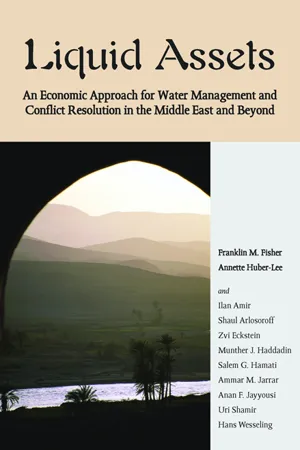
Liquid Assets shows that the common view of water as an inevitable cause of future wars is neither rational nor necessary. Typically, two or more parties with claim to the same water sources are thought to play a zero-sum game with each side placing a high emotional and political value over the ownership of the water. However, Franklin Fisher and his coauthors demonstrate that when disputes in ownership are expressed as disputes about money values, in most cases, the benefits of ownership will be surprisingly small. By assigning an economic value to water and treating water as a tradable resource, parties see that the gains from cooperation exceed the costs resulting from the change in ownership. A zero-sum game becomes a win-win situation. To support this new approach, Liquid Assets presents an innovative water allocation model that can be used to assist water management, the cost-benefit analysis of water infrastructure, and the resolution of disputes. The model takes system-wide effects into account and is the first to overcome the failure of actual water markets to cope with the divergence between social and private benefits (as implied by agricultural subsidies), permitting the model-user to impose his or her own values or policies. Liquid Assets applies its methodology to Israel, Jordan, and Palestine, a region where water is scarce and water conflicts are often thought to be explosive. Indeed, this book is the result of a joint effort of Israeli, Jordanian, Palestinian, American, and Dutch experts. But the book's message and methods are not restricted to the Middle East. They are applicable to water management and water disputes around the globe.
eBook - ePub
Liquid Assets
An Economic Approach for Water Management and Conflict Resolution in the Middle East and Beyond
- 272 pages
- English
- ePUB (mobile friendly)
- Available on iOS & Android
eBook - ePub
Liquid Assets
An Economic Approach for Water Management and Conflict Resolution in the Middle East and Beyond
About this book
Information
Part I
General Methodology
CHAPTER
1
Water and Economics
Water is essential for human existence, and in many regions of the world, water is scarce. As a result, conflicting claims on existing water resources are often put forward. These are sometimes conflicting claims by different political entities—countries, states, or provinces—and sometimes conflicting claims by different types of water users—farmers, households, industry, environmental groups. The first type of conflict is often predicted to be a likely cause of future wars, but even the second is a very serious matter.
Claims to water are almost invariably stated in terms of water quantities. The contending parties put forward conflicting arguments as to their rights to certain water sources or certain amounts of water. Those arguments are based on various principles; the principles often conflict; and each party bases its claim on the principle that results in an outcome it considers favorable. Often there is much to be said for each side, and the resolution of the claims is not an easy matter even when the parties are otherwise friendly.
This book sets forth a wholly different way of looking at water disputes, water allocation, and water management. That way is based on economic principles, although it is by no means restricted to economics narrowly construed. To see why such an approach may be useful, consider the following.
Water is not generally scarce in terms of quantity. If for no other reason, the availability of seawater desalination means that there is abundant water for the world as a whole and for any country that has a seacoast. But of course, seawater desalination is expensive (current estimates run roughly 50 to 60 cents per cubic meter on the Mediterranean coast of Israel and Gaza), and conveyance facilities to locations far from the sea may themselves be expensive or even nonexistent. There are two lessons to be learned here. First, water scarcity is a matter of cost and value, not merely of quantity. Second, the value of water and also its scarcity will be different in different locations. These are two of the principal themes of this book.
Microeconomics1 is basically about the allocation of scarce resources and about the relation of the value of those resources to their scarcity and their allocation. The fact that water is essential for human life makes water and its allocation very important, but it does not exempt it from the principles of microeconomics.
For many people, of course, this seems unnatural. If water is essential for human life, why isn't it beyond price? How can one put a value on something so important? Sometimes, indeed, one encounters the opposite view (occasionally from the same people): Water is a natural right. It should be charged for at the direct cost (extraction, treatment, conveyance, etc.) of providing it.
Both those views are wrong, and it is instructive to see why that is so. An important (but not basic) reason that water is not somehow “beyond price” has already been given. No matter how important water is and no matter what special values are believed to attach to water in certain uses, it is irrational to value water at more than the cost of replacing it.2 Hence the possibility of seawater desalination places an upper bound on the value of water.
More than replacement costs are at issue here, however; demand factors also play a role. To see this, observe that if water were truly beyond price, then it would pay any country with a seacoast to desalinate seawater and convey the resulting sweet water to any location no matter how far. Landlocked countries would make any offer, no matter how large, to have desalinated water delivered to them. Obviously, this does not happen because the costs involved are too high. But then the value of water at particular locations cannot exceed those costs.
On the other hand, the value of water does not merely consist of direct costs, such as extraction, treatment, and conveyance. Consider a lake and suppose, for simplicity, that it costs nothing to take water from the lake in terms of direct costs. Suppose, however, that there are sufficient people living near the lake that, at zero cost, their total annual demand for water is greater than the available supply (say, the annual renewable amount in the lake). Then the value of the water in the lake is not zero; if there were additional water, there would be positive benefits to the people living on the lakeshore and they would be willing to pay for those benefits.
This example is important, and we shall return to it. For the present, observe the following:
- The fact that the value of the water in the lake is greater than the direct costs of supply means that the lake water has a positive scarcity rent (a concept that will be rigorously defined later).
- The scarcity rent is a measure of scarcity. Indeed, with only a few people living near the lake, the same water, equally essential for human life, might not be scarce at all. In that case, its scarcity rent would be zero.
- It is the scarcity of water and not directly its importance for human life that makes water valuable. Water is valuable only where it is scarce.
As the above discussion suggests, our analysis will run in terms of values rather than quantities. To do this, however, we must first dispose of another common misconception.
The person, group, or political entity that owns a particular amount of water and uses the water does not generally obtain it for nothing. If someone else values the same water and would pay for it, then the using owner is giving up the value for which it could sell it. In this case, the owner is said to incur an opportunity cost.
Now, the behavior of the owner in such circumstances is worth analyzing. Consider the owner's decision about whether to consume the last cubic meter of water owned. If the value of that cubic meter of water to the owner is greater than the opportunity cost (the price at which it could be sold to another), then the owner will consume the water itself. On the other hand, if the opportunity cost of the last cubic meter is greater than its value to the owner, then the owner will gain more by not consuming it. But these considerations are the same as those in the mind of any buyer: If the water to be purchased is worth more than its price, then it is worth purchasing; if the water to be purchased is worth less than its price, then it will not be purchased. In effect, a water owner that uses the water itself is purchasing the water; it is purchasing the water from itself. The difference between owning the water and not owning it is only a matter of where the money goes.
This, in turn, reveals an important set of propositions:
- The ownership of water is the ownership of the money value that the water represents.
- Who owns water and who uses water are not the same question. Although they are both important questions, they are analytically independent.3
It is important to understand that the methods put forth in this book do not deal directly with the question of water ownership. Rather they deal with the question of optimal water usage—of providing tools for the efficient management of water systems for the public good, taking into account the values of the tool user. On the other hand, by focusing on the costs, values, and scarcity rents of water, our methods do provide an estimate of what water ownership is worth and of the benefits to be had from cooperation rather than conflict in water. In that sense, our analysis may make conflict resolution easier by providing a new mode for thinking about water.
We shall have more to say about such wider issues later on, but our main focus for the present is on optimal water management for a particular political entity, say, a country. Of course, even that discussion involves conflict resolution, since it implicitly or explicitly involves the resolution of conflicting claims to water by various user groups.
1. Markets and the Management of Natural Resources
If economists had only one thing to say to the rest of the world, it would concern the way in which private, competitive markets lead to an efficient and indeed, in some sense, optimal allocation of resources. The theorems that describe this—the First and Second Welfare Theorems—are doubtless the most important results of microeconomic analysis. But if economists had a second thing to say, it probably would (or at least should) concern the circumstances under which the two welfare theorems do not apply and markets do not lead to an optimal result. It is important to understand that such is the case for water (for reasons given below) and that we are definitely not recommending a system of private water markets. Nevertheless, the role of markets and the reasons for their failure are central in our analysis. Hence we begin with a brief discussion of the issues involved in the management of natural resources through markets.
Consider a fictitious mineral, Ozite, which is nonrenewable. Society wishes to have Ozite extracted optimally. Since extracting more Ozite now means that there will be less to be extracted later, society's interest includes consideration of the rate of extraction.4 Further, Ozite, when used, will bring benefits, and the extraction of Ozite will involve costs. As a general matter, both benefits and costs in a given year will depend on the amount extracted in that year—costs because extracting more Ozite in a given period will typically cost more, and benefits because additional Ozite will presumably be useful. Note, however, that it is quite possible, even likely, that marginal benefits (the benefits from an additional unit of Ozite) will fall with the amount extracted as Ozite is used first for high-priority uses and then for lower priority ones. We assume that both benefits and costs can be measured in monetary units.
If Ozite were to be extracted for only one year, then society's interests could be expressed by saying that extraction should be such as to maximize the difference between benefits and costs. But the fact that there are multiple years involved makes matters more complicated. In this case, society's interest can be represented by maximizing the present value of the stream of net benefits from Ozite, where net benefits are defined as benefits minus costs and the interest rate used to discount the future represents society's trade-off between years.
This can all be described in symbols. Let
| t | = the year, with the present denoted by t = 0; |
| x(t) | = the amount of Ozite to be extracted in year t; |
| B(x(t)) | = the gross benefits from Ozite extracted in year t; |
| C(x(t)) | = the total cost of Ozite extracted in year t; |
| r | = society's discount rate; and |
| V | = the present value of the Ozite resource. |
(Fo...
Table of contents
- Front Cover
- Half Title
- Title Page
- Copyright
- About Resources for the Future and RFF Press
- Contents
- About the Authors
- Preface
- PART I General Methodology
- PART II Results for Israel, Palestine, and Jordan
- Notes
- References
- Index
Trusted by 375,005 students
Access to over 1.5 million titles for a fair monthly price.
Study more efficiently using our study tools.
Frequently asked questions
Yes, you can cancel anytime from the Subscription tab in your account settings on the Perlego website. Your subscription will stay active until the end of your current billing period. Learn how to cancel your subscription
No, books cannot be downloaded as external files, such as PDFs, for use outside of Perlego. However, you can download books within the Perlego app for offline reading on mobile or tablet. Learn how to download books offline
Perlego offers two plans: Essential and Complete
- Essential is ideal for learners and professionals who enjoy exploring a wide range of subjects. Access the Essential Library with 800,000+ trusted titles and best-sellers across business, personal growth, and the humanities. Includes unlimited reading time and Standard Read Aloud voice.
- Complete: Perfect for advanced learners and researchers needing full, unrestricted access. Unlock 1.5M+ books across hundreds of subjects, including academic and specialized titles. The Complete Plan also includes advanced features like Premium Read Aloud and Research Assistant.
We are an online textbook subscription service, where you can get access to an entire online library for less than the price of a single book per month. With over 1.5 million books across 990+ topics, we’ve got you covered! Learn about our mission
Look out for the read-aloud symbol on your next book to see if you can listen to it. The read-aloud tool reads text aloud for you, highlighting the text as it is being read. You can pause it, speed it up and slow it down. Learn more about Read Aloud
Yes! You can use the Perlego app on both iOS and Android devices to read anytime, anywhere — even offline. Perfect for commutes or when you’re on the go.
Please note we cannot support devices running on iOS 13 and Android 7 or earlier. Learn more about using the app
Please note we cannot support devices running on iOS 13 and Android 7 or earlier. Learn more about using the app
Yes, you can access Liquid Assets by Franklin Fisher,Annette Huber-Lee in PDF and/or ePUB format, as well as other popular books in Biological Sciences & Ecology. We have over 1.5 million books available in our catalogue for you to explore.