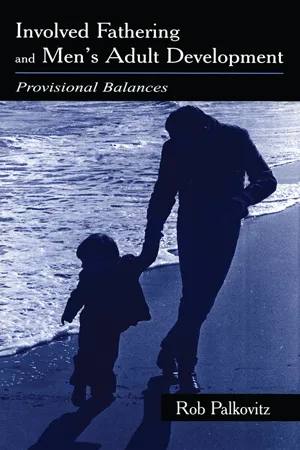
Involved Fathering and Men's Adult Development is an interdisciplinary book that synthesizes theoretical, empirical, and anecdotal writings from different fields and provides an analysis of extensive interviews with 40 fathers. Along with the exploration of the distinct contribution that fathers make to their children's development, the author pursues the parallel theme of the effect this involvement has on the fathers' own development in adulthood.
This book will provide its readers with a realistic and useful beginning point to bring a synthesis of developmental theories, family studies perspectives, and men's insights about fathering that will enhance our academic understanding of fathering and adult development. This book can also spark reflective and practical application for fathers and families, whether readers are academicians, practitioners, policymakers, or fathers in the trenches.
- 326 pages
- English
- ePUB (mobile friendly)
- Available on iOS & Android
eBook - ePub
About this book
Information
Publisher
Psychology PressYear
2014Print ISBN
9780805835656
9780805835649
Edition
1eBook ISBN
9781135658922
Appendix 1
Interview Schedule
Following is the “normal” sequence of questions and their forms for interviews conducted with each of the 40 study participants. In each interview, this schedule was used as a flexible guide for talking with study participants about the central issues of the research project. If men spontaneously began to discuss an area that was scheduled for later exploration, the “natural” flow of the conversation was allowed to progress, and the interviewer brought the participant back toward the planned sequence of questions as appropriate. Levels of language were adjusted to individual father’s educational or communication style. Because demographic questionnaires were filled out by participants prior to the interview, and because the interviewer reviewed those questionnaires with each father to clarify the information and establish rapport (a process requiring approximately 20 minutes of interaction), the interviewer had a basis for understanding communication styles and language levels prior to beginning the interview.
Interview Guide: The Effects of Parenting On Men’S Development
How old were you when you had your first child?
Please describe and extenuating or qualifying circumstances concerning your children: planning, timing, illnesses, developmental disabilities, etc.
Sometimes you hear men make statements like “I am really a different person than I would otherwise be because I have children.” Other men may feel that fatherhood has had little or no impact on who they are as people. Do you feel that fatherhood has played a major or minor role in shaping who you are? Please elaborate …
If you feel that your life is significantly different than it would be if you didn’t have children, please be specific in describing how you think it is different.
Aside from how you spend time and money (quantitative differences), do you feel that fatherhood has made you a qualitatively different person? That is, has it caused you to develop differently than you would have developed had you never been a father? Has it significantly affected who you are, your skills, your personality, or the quality of your life course? If so how? If not, why not?
Do you feel that fatherhood has in any way affected your maturity? Please explain.
How has fatherhood changed you in regards to the way you approach and view responsibility, if at all?
What are the primary feelings/emotions, both positive and negative, that you associate with fatherhood?
Do you believe that these feelings/emotions can be experienced in the same way in another context, like work or another relationship? Why or why not?
Do you believe that fatherhood has influenced the way you experience, control, and express emotions? If so, how? Are you an emotionally different person?
In terms of your career or work history, what impact, if any, has fatherhood had on your work?
Are there any specific ways that fatherhood has influenced your work history?
Do you feel that you would be further along, just about where you are now, or less far advanced in your work situation if you had never had children?
Any further comments about fathering and work?
How does/has parenthood impacted your relationship with your spouse/partner?
What impact has fatherhood had on your sexuality?
—frequency?
—quality?
—other aspects?
How has parenthood affected your relationship to other relatives?
—your view of your own parents?
Have you become more or less understanding or critical?
How has fatherhood effected your feelings about your own childhood?
Have you thought over how your parents brought you up?
—positive or negative events you experienced?
—reflected on your interests or viewpoints?
How has fatherhood affected your social life or friendships?
—the number of people you interact with?
—network size?
—the types of people you spend time with?
—composition? How often you get together?
—frequency of contact?
Please describe any effect fatherhood has had on your involvement in your community/or in organizations:
Has fatherhood had any significant effect on your ability or desire to take the perspective of others?
Has fatherhood influenced your perceptions of individual differences or diversity in other people?
How, if at all, has fatherhood changed the way you think about and plan for the future?
Has fatherhood influenced what you view to be the main priorities, or what is important in life?
Has fatherhood influenced your views of moral issues?
Has fatherhood influenced your commitment to religion?
—in terms of religious faith?
—in terms of religious behavior/expression?
Has fathering resulted in any shifts in your values?
If so what may those shifts be?
How did fathering interact with these shifts?
What impact, if any, has fathering had on your health habits?
—diet?
—exercise?
—smoking/drinking/drug usage?
—access to medical care (the way you view benefits packages)?
—other?
What impact has fathering had on where you live?
The way your living space is organized, divided, maintained?
Do you feel that fatherhood causes one to experience more conflicting demands than would be the case if you did not have children? Please elaborate …
Has fatherhood brought about any changes in your own competence/self-esteem?
Are there specific areas of competence or ability that you would not have developed had you not been a father?
Are there other areas you would have developed or pursued had you not been a father? Are there different choices you would have made or different interests you would have developed?
Overall, would you say that fatherhood has made you more or less flexible? How so?
How has fatherhood changed you in regards to the way you approach and view problem solving?
What do you view to be the primary benefits of fatherhood?
—the primary costs?
Overall, do you view fatherhood to be a positive or negative shaper of your life and why?
If you had a “magic wand” and could change the number, spacing, timing of children, etc., what would you change and why?
Please describe how you view the father’s role.
In everyday terms, what makes a good father?
What do you see as a father’s main responsibilities/jobs:
—with regard to his children?
—with regard to his wife?
Are there some things only a dad can do?
Are there some things only a mom can do?
What’s the toughest part of being a dad?
Some men are primarily involved as fathers by being a provider. Others may take more active roles in direct involvement with the daily activities of their children. Some men are the primary caregivers for their children. Please describe your pattern of involvement with your children.
In terms of rough percentages, how do you split the following things with your spouse/partner?
—time spent in parenting (overall time doing things with or for the kids)?
—number of parenting tasks?
—responsibility of parenthood (making appointments/arrangements for children … making sure they have what they need … clothing, food, supervision, education)?
Has it always been this way, or has your involvement changed over time? If so, how?
Is there anything I should know about your background to help me understand who you are as a dad?
How did you learn to be a father?
Do you have any closing thoughts on fatherhood? Any areas that we haven’t discussed that you feel are important to consider?
We have now explored a lot of areas o...
Table of contents
- Cover
- Half Title
- Title Page
- Copyright Page
- Dedication
- Table of Contents
- Acknowledgments
- Preface
- I: Foundations for Understanding Fathering and Development
- II: The Self Domain
- III: The Social Domain
- IV: The Work Domain
- V: Summary, Evaluations, and Applications
- Appendix 1: Interview Schedule
- Appendix 2: Biographical Sketches of Study Participants
- References
- Author Index
- Subject Index
- Participant Quote Index
Trusted by 375,005 students
Access to over 1.5 million titles for a fair monthly price.
Study more efficiently using our study tools.
Frequently asked questions
Yes, you can cancel anytime from the Subscription tab in your account settings on the Perlego website. Your subscription will stay active until the end of your current billing period. Learn how to cancel your subscription
No, books cannot be downloaded as external files, such as PDFs, for use outside of Perlego. However, you can download books within the Perlego app for offline reading on mobile or tablet. Learn how to download books offline
Perlego offers two plans: Essential and Complete
- Essential is ideal for learners and professionals who enjoy exploring a wide range of subjects. Access the Essential Library with 800,000+ trusted titles and best-sellers across business, personal growth, and the humanities. Includes unlimited reading time and Standard Read Aloud voice.
- Complete: Perfect for advanced learners and researchers needing full, unrestricted access. Unlock 1.5M+ books across hundreds of subjects, including academic and specialized titles. The Complete Plan also includes advanced features like Premium Read Aloud and Research Assistant.
We are an online textbook subscription service, where you can get access to an entire online library for less than the price of a single book per month. With over 1.5 million books across 990+ topics, we’ve got you covered! Learn about our mission
Look out for the read-aloud symbol on your next book to see if you can listen to it. The read-aloud tool reads text aloud for you, highlighting the text as it is being read. You can pause it, speed it up and slow it down. Learn more about Read Aloud
Yes! You can use the Perlego app on both iOS and Android devices to read anytime, anywhere — even offline. Perfect for commutes or when you’re on the go.
Please note we cannot support devices running on iOS 13 and Android 7 or earlier. Learn more about using the app
Please note we cannot support devices running on iOS 13 and Android 7 or earlier. Learn more about using the app
Yes, you can access Involved Fathering and Men's Adult Development by Rob Palkovitz in PDF and/or ePUB format, as well as other popular books in Psychology & Developmental Psychology. We have over 1.5 million books available in our catalogue for you to explore.