In this volume, Berkowitz develops the argument that experiential and behavioral components of an emotional state are affected by many processes: some are highly cognitive in nature; others are automatic and involuntary. Cognitive and associative mechanisms theoretically come into play at different times in the emotion-cognition sequence. The model he proposes, therefore, integrates theoretical positions that previously have been artificially segregated in much of the emotion-cognition literature.
The breadth of the implications of Berkowitz's theory is also reflected in the diversity of this book's companion chapters. Written by researchers whose work focuses on both social cognition and emotion, these articles provide important insights and possible extensions of the "cognitive-neoassociationistic" conceptualization developed in the target article. Although each chapter is a valuable contribution in its own right, this volume, taken as a whole, is a timely and important contribution both to social cognition and to research and theory on emotion per se.
eBook - ePub
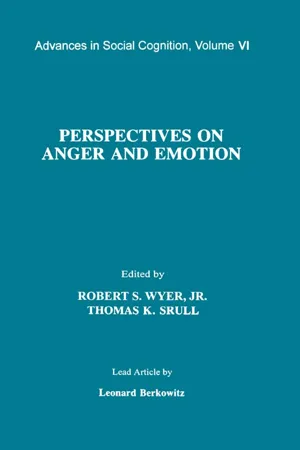
Perspectives on Anger and Emotion
Advances in Social Cognition, Volume Vi
- 216 pages
- English
- ePUB (mobile friendly)
- Available on iOS & Android
eBook - ePub
Perspectives on Anger and Emotion
Advances in Social Cognition, Volume Vi
About this book
Information
Publisher
Psychology PressYear
2014Print ISBN
9780805813272
9780805813265
Edition
1eBook ISBN
9781317781486
1 | Towards a General Theory of Anger and Emotional Aggression: Implications of the Cognitive-Neoassociationistic Perspective for the Analysis of Anger and Other Emotions |
The remarkable spurt of interest in the psychology of emotion over the past few decades has inevitably generated considerable controversy and theoretical ferment. The mounting research has brought not only new findings but ever more challenges to old ideas. It is now clearer than ever before that the most popular psychological analyses of emotion can readily account for some phenomena but have difficulty explaining other research results. Some examples come quickly to mind: The so-called “peripheral theories” cannot satisfactorily deal with the influence of attributions using only their own terms, whereas the cognitive formulations have problems with the facial feedback effects, and none of the leading analyses can say why the experimental establishment of such negative emotional states as sadness often produces anger as well (Moore & Isen, 1990).
Theorists seeking to resolve these problems might be well advised to broaden their perspective and bring together ideas from widely different research traditions. This chapter suggests one way in which such an integration could be accomplished. Although it appears to be narrow in scope, in that it focuses largely on the anger experience and emotional aggression, its basic formulation, combining both cognitive and associationistic concepts, has significant implications for the analysis of emotions more generally. Thus, although the chapter devotes considerable attention to research on aggression, partly because it is important to understand the origins of this fundamentally antisocial behavior, it also highlights some matters that should be confronted by a truly comprehensive general theory of emotion.
I start by contrasting two different approaches to the study of anger and emotional aggression in order to identify some of the shortcomings in the conventional cognitive formulations of anger. However, it should be clear, this critique is not intended to be a dismissal of the cognitive perspective. Instead, I hope it contributes to the development of a more sophisticated and broader ranging theory of emotion, one that will have major cognitive components, by first, identifying phenomena that have been neglected unduly by most present-day cognitive models, and second, suggesting how these phenomena might be incorporated into such a general theory.
SOME SHORTCOMINGS IN THE RESEARCH ON AGGRESSION
There is a curious division in the psychological research on anger and aggression. Because of differences in interest, theoretical orientation, and methodology, studies of this emotion seem to be proceeding along two independent tracks, with remarkably, and unfortunately, little connection between them. One path is followed by a group of experimental social and personality psychologists who study aggression as a class of behaviors essentially similar to most other antisocial actions. These researchers say little about emotion, and typically are interested in the aggressors’ feelings only to validate an experimental manipulation—that is, to determine if an experimentally established provocation was successful. Psychologists concerned with emotions in general seem to be working along very different lines. With the exception of those dealing mainly with the biological aspects of emotional states, their attention is focused largely on people’s reports of how their emotional feelings and/or actions came about. Unfortunately for both groups, there isn’t very much communication between them, and they do not read and consider as much of each other’s research literature as they should.
In my view, most experimental social-personality psychologists, and indeed most social scientists, do not adequately recognize how much of aggression is emotional in nature. With some exceptions (e.g., Berkowitz, 1993; Rule & Nesdale, 1976), their theoretical analyses usually assume violence is just as purposeful and thought out as most other forms of human conduct, and that there are basically few major differences between aggression and other socially disapproved modes of behavior.
This is not to say that social-personality psychologists think all aggression is alike. Although virtually all of them define aggression as the intentional injury of some target, they typically share Feshbach’s (1964) distinction between hostile and instrumental aggression, and say it is only in the case of hostile aggression that the victim’s injury is the primary aim. Instrumental aggression, on the other hand, attempts to hurt the target but does so largely in pursuit of some other goal such as money or social status. We are here concerned solely with hostile aggression, and more specifically, with those aggressive acts that are part of a strong emotional state. As I indicated before, with some notable exceptions (Rule & Nesdale, 1974), few experimental social psychologists have tried to spell out in any detail the possible relationship between aggression and the fairly specific emotional state commonly termed anger.1 This chapter attempts to do just this.
For their part, emotion theorists have also suffered from their one-sided neglect of the research in the other camp. In particular, I believe their theoretical analyses have been based too exclusively on subjective reports so that they have disregarded pertinent findings obtained from laboratory experiments. People’s accounts of why and how they act as they do obviously are susceptible to all too many distortions, some produced by their desire to present themselves in a favorable light and some arising from the intrusion of their theories as to why the given event had occurred (cf. Nisbett & Wilson, 1977). Relatively few emotion researchers have acknowledged these problems or taken steps to deal with them.
Perhaps because of this excessive reliance on self-reports, many of the current analyses of emotional experiences have been, in my estimation, much too cognitive and rationalistic. This is clearly apparent in the typical emotion theorists’ discussion of how anger arises. Basing their formulations on what the majority of ordinary persons say about themselves, these investigators usually focus on anger as a reaction to the perception of having been deliberately and improperly mistreated (e.g., Averill, 1982; Frijda, 1986; Smith & Ellsworth, 1985; Weiner, 1982), and disregard the other possible sources of anger mentioned by a minority of the respondents.
There is no doubt that intentional misdeeds can provoke anger, and indeed, a very great proportion of the anger-arousing incidents “in nature” may actually involve the perception of having been deliberately wronged by someone. The question is, however, whether this perception is as necessary as these emotion theorists seem to suggest. A growing body of laboratory experiments and field studies have now demonstrated that unpleasant occurrences can evoke aggressive reactions along with feelings of anger, irritation, and annoyance even though the events are not socially illegitimate and are unintended (Anderson, 1989; Berkowitz, 1982, 1989, 1993). Many persons may not recognize, or care to admit, that they occasionally become angry and aggressive when something bad happens to them even when this event is not controllable, is not aimed at them specifically, and is not even socially improper. But the fact that relatively few people report feeling angry at these times does not mean these anger reactions do not occur at all. And if they do arise, moreover, any truly comprehensive account of anger and emotional aggression must deal with these less common reactions as well as with the more frequent sources of anger and aggression.
This chapter basically assumes the same underlying psychological processes are involved in all of these instances of anger and emotional aggression, whether the precipitating event is a deliberate personal attack or an uncontrollable and not-improper happening, and proposes what some of these processes might be. More than this, however, as I said earlier, the formulation spelled out here is directly relevant to theories of emotion, and thus might also contribute to our understanding of the psychological processes involved in the formation and expression of other emotions as well, especially the negative ones.
The stance taken here is relatively eclectic. I certainly am not arguing that the cognitive theorists are entirely wrong and that cognitive processes have little role in emotional experience and behavior. Rather, my position is that the experiential (such as anger) and behavioral (such as aggression) components of the emotional state are affected by a broad variety of psychological processes, some of which are highly cognitive in nature, but others are governed by more automatic and involuntary systems throughout the body. Associative mechanisms are especially important in this second category. My basic contention is that both the cognitive and associationistic approaches to emotion are right—but at different times in the emotion-generation sequence2—and I thus believe it is entirely appropriate to say this formulation adopts a cognitive-neoassociationistic perspective.
In order to introduce this attempted integration and emphasize some of the broader issues the present model raises, I return to anger and emotional aggression, concentrating mostly on the effects of situational frustrations. I describe how some of the best known cognitive theories of emotion account for anger and frustration reactions and then try to rebut several of their arguments as a way of identifying problems these conventional formulations leave unresolved. After this, I sketch out briefly my own interpretation of emotional aggression, one that incorporates both associative and cognitive concepts. The remainder of the chapter provides additional evidence consistent with this cognitive–neoassociationistic model and also spells out some of its implications for emotion theorizing generally.
THEORIES OF ANGER/AGGRESSION GENERATION
Cognitions as All-Important
The Conventional Cognitive Analysis
Drawing their ideas largely from everyday beliefs as to how anger arises, psychologists taking a strong cognitive stance generally insist that only arbitrary and unjustified thwartings generate aggressive inclinations. Averill’s (1982) statement along these lines is typical:
Anger ensues primarily when the frustration is occasioned by the actions of another person, actions which are appraised by the angry individual as unjustified or at least avoidable. Experimental research has also demonstrated that it is primarily arbitrary (unwarranted) frustrations that arouse subjects to anger and/or aggression. (p. 128)
This contention is, of course, entirely consistent with the underlying assumptions of conventional cognitive social psychology. With Ross and Nisbett (1991), we can say the dominant theoretical perspective in our field supposes that virtually everything people do and feel in a given situation is determined by their construal of what is happening. More particularly, however, the statement is also in accord with the prevailing social psychological understanding of emotion based on a combination of the Schachter-Singer (1962) two-factor theory of emotion with later attributional formulations.
Schachter’s analysis had maintained that the bodily and neural responses to an emotion-precipitating occurrence do not in themselves provide specific stimulation to a given form of behavior or even to the qualitative feelings that are experienced. In the case of a frustration, for example, the failure to reach a desired goal presumably creates only a diffuse and undifferentiated arousal state. What specific feelings are experienced and what actions are undertaken supposedly depend entirely on the afflicted persons’ interpretation of their internal sensations. And so, the thwarted people theoretically will not strike out at the perceived obstacle to their goal attainment unless they think of themselves as angry.
Attribution theorizing added to Schachter’s argument by proposing that the label the aroused individuals give to their sensations is greatly influenced by their beliefs as to what caused their feelings. They presumably will regard themselves as angry and then attack their frustrater only if they think this person had deliberately and wrongly prevented them from getting what they wanted.
Several aspects of this line of thought are especially important for our present purposes. One, the Schachter-Singer analysis (but not Weiner’s, 1982, attributional theory) holds that events are not intrinsically pleasant or unpleasant in themselves; these happenings presumably become positive or negative only as a result of how they are construed by the individual. Second, this conventional formulation suggests that the unhappy occurrence, however it arises, does not in itself produce motor reactions having particular aims. The afflicted individual supposedly behaves in a certain way because of a decision, reached consciously or unconsciously, as to how to act.
Although much of the empirical support for this reasoning rests on people’s descriptions of their everyday experiences (e.g., Smith & Ellsworth, 1985; Weiner, 1982), as I mentioned earlier, adherents to this conventional cognitive perspective sometimes also cite a number of laboratory experiments. Zillmann’s excitation transfer is especially well-known. In one of his experiments (Zillmann, Katcher, & Milavsky, 1972), as a notable example, the male subjects were first either provoked or not provoked by their partners and then were required to work on either strenuous or easy physical tasks. Shortly afterward, when the men had an opportunity to punish their partners, the men gave these targets the most intense shocks if they had been previously mistreated by them and had then engaged in the effortful activity. According to Zillmann, these subjects (a) had not realized their exercize-induced excitation was produced by the strenuous activity; (b) mistakenly attributed this excitation to the most salient feature of their environment, their partners’ earlier provocation; and (c) concluded they were very angry with their partners, and then acted accordingly.
Questions Can Be Raised
I certainly do not intend to dismiss attribution theorizing out of hand. Cognitions about the cause of the emotion arousal can indeed determine what happens next; attributions can influence what is felt and done (cf. Reisenzein, 1983; Rule & Nesdale, 1976). Nevertheless, it should also be recognized, the evidence supporting this view is not as clear and unequivocal as one would like (Maslach, 1979; Reisenzein, 1983). Thus, to mention only one ambiguity, neither the Zillmann, Katcher, and Milavsky (1972) experiment just cited or the conceptually similar one by Konecni (1975) provide any direct evidence that the provoked and then physiologically aroused subjects had actually misattributed their strong arousal to the provocation and therefore felt very angry. And then too, a modified version of Hullian behavior theory gives us a simpler and relatively parsimonious alternative to the attribution explanation of the Zillmann findings. Without going into the details here, this alternative would say that, in the absence of cognitively activated restraints, the arousal produced by the exercize had energized whatever aggressive action tendencies had been generated by the partners’ earlier insult.3
Frustration-Generated Anger and Aggression
To repeat myself, my point here is not that cognitions and attributions do not contribute to emotional aggression but that they are not all-important. As a matter of fact, a considerable body of experimental research shows that even nonarbitrary frustrations can incite subjects to anger and/or aggression (Berkowitz, 1989). There is no need to review the relevant studies here, but one experiment not mentioned in my survey o...
Table of contents
- Cover
- Half Title
- Title Page
- Copyright Page
- Table of Contents
- Preface
- 1. Towards a General Theory of Anger and Emotional Aggression: Implications of the Cognitive-Neoassociationistic Perspective for the Analysis of Anger and Other Emotions
- 2. Putting the Social in Social Cognition, With Special Reference to Emotion
- 3. Where Does Anger Dwell?
- 4. Affect, Appraisal, and Action: Towards a Multiprocess Framework
- 5. The Network Model of Emotion: Motivational Connections
- 6. A Componential, Self-Regulative Systems View of Berkowitz’s Cognitive Neoassociationistic Model of Anger
- 7. The Role of Cognition and Effort in the Use of Emotions to Guide Behavior
- 8. Those to Whom Evil Is Done
- 9. On the Scientific Study of Angry Organisms
- 10. More Thoughts About the Social Cognitive and Neoassociationistic Approaches: Similarities and Differences
- Author Index
- Subject Index
Trusted by 375,005 students
Access to over 1.5 million titles for a fair monthly price.
Study more efficiently using our study tools.
Frequently asked questions
Yes, you can cancel anytime from the Subscription tab in your account settings on the Perlego website. Your subscription will stay active until the end of your current billing period. Learn how to cancel your subscription
No, books cannot be downloaded as external files, such as PDFs, for use outside of Perlego. However, you can download books within the Perlego app for offline reading on mobile or tablet. Learn how to download books offline
Perlego offers two plans: Essential and Complete
- Essential is ideal for learners and professionals who enjoy exploring a wide range of subjects. Access the Essential Library with 800,000+ trusted titles and best-sellers across business, personal growth, and the humanities. Includes unlimited reading time and Standard Read Aloud voice.
- Complete: Perfect for advanced learners and researchers needing full, unrestricted access. Unlock 1.5M+ books across hundreds of subjects, including academic and specialized titles. The Complete Plan also includes advanced features like Premium Read Aloud and Research Assistant.
We are an online textbook subscription service, where you can get access to an entire online library for less than the price of a single book per month. With over 1.5 million books across 990+ topics, we’ve got you covered! Learn about our mission
Look out for the read-aloud symbol on your next book to see if you can listen to it. The read-aloud tool reads text aloud for you, highlighting the text as it is being read. You can pause it, speed it up and slow it down. Learn more about Read Aloud
Yes! You can use the Perlego app on both iOS and Android devices to read anytime, anywhere — even offline. Perfect for commutes or when you’re on the go.
Please note we cannot support devices running on iOS 13 and Android 7 or earlier. Learn more about using the app
Please note we cannot support devices running on iOS 13 and Android 7 or earlier. Learn more about using the app
Yes, you can access Perspectives on Anger and Emotion by Robert S. Wyer, Jr.,Thomas K. Srull in PDF and/or ePUB format, as well as other popular books in Psychology & History & Theory in Psychology. We have over 1.5 million books available in our catalogue for you to explore.