The theory of information integration provides a unified, general approach to the three disciplines of cognitive, social, and developmental psychology. Each of these volumes illustrates how the concepts and methods of this experimentally-grounded theory may be productively applied to core problems in one of these three disciplines.
- 424 pages
- English
- ePUB (mobile friendly)
- Available on iOS & Android
eBook - ePub
About this book
Information
Chapter 1
Functional Memory in Person Cognition
Preface
Functional memory—memory as it functions in goals and actions of everyday life—departs from the dominating tradition of reproductive memory in two major respects. First, what is stored goes beyond the original stimulus materials to include inferences from those materials relevant to operative goals. Second, this memory store is conceptualized as a knowledge system—which functions in construction of values relative to present and subsequent goal-directed action. In both respects, reproductive memory has secondary significance.
A concrete illustration of this functional-reproductive contrast comes from a serial list of adjectives that describe a person. Attitude about the person is developed through serial valuation and integration of implications of the given adjectives—relative to the operative goal. A cornerstone of the functional approach is that this attitude memory is distinct from the verbal recall.
Accuracy—the standard tool of reproductive memory—is not too useful for studying functional memory. The serial curve of attitude memory cannot be derived from the serial curve of recall. A new kind of measurement is needed, one that can handle the two basic problems of valuation (allowing personal, individual values for each stimulus item) and of integration (allowing each response to depend on multiple determinants).
Both problems, valuation and integration, can be resolved under certain conditions using the methodology of functional measurement. It is thus possible, in particular, to measure the serial curve of attitude memory, that is, the effect of each item in the list on the final attitude, given only the final attitude itself. This represents a beachhead on measurement of memory as it functions in construction of judgment and action.
Person cognition is an attractive domain in which to study functional memory. A set of words, or other, nonverbal stimuli that describe a person exhibits a functional organization. Processing these stimuli, moreover, typically exhibits purposiveness. Purposiveness and organization are both fundamental in psychology, but they have resisted theoretical analysis. A new perspective on both issues emerges from the study of memory function in everyday judgment and action.
This functional perspective obtains an effective grip on purposiveness through functional measurement of values, in which purposiveness is immanent. The functional perspective treats organization in terms of knowledge systems, which involve goal-directed operators as well as declarative-type knowledge. On these two difficult problems, the theory of information integration has made modest but real progress.
Person cognition offers a rich domain for cognitive theory. Two main characteristics are purposiveness and organization, both extensively developed in everyday life. Purposiveness appears in our many goal-directed activities, especially those that require allowance for reactions of others. Organization appears in many forms: in our conceptions of family members and friends; in social roles and stereotypes; in attitudes, motivations, and long-term goals; in diverse social-personal affects; and in self concepts. All these are extensively developed through a lifetime of daily experience. Person cognition thus provides unparalleled opportunities for cognitive analysis.
Cognitive theory should, in principle, include person cognition with other forms of cognition in a unified framework. Despite clear differences in certain phenomena, general principles should be found common to all domains. Not everyone would agree with this view, but it has been adopted by many, and it is adopted here.
Mainstream cognitive theory, however, has not been too useful in person cognition. This mismatch may be illustrated with two issues: affect and memory. Affect is central to person cognition, as it is to purposiveness, yet cognitive theories have generally segregated affect from cognition and largely ignored it. Memory theory, on the other hand, might be expected to be directly useful because it has been so extensively and intensively investigated. But memory theory has been wholly dominated by the conception of reproductive memory. Person cognition requires a different conception of functional memory, that is, memory as it functions in setting and seeking goals.
This chapter applies the theory of information integration to person cognition and person memory. Basic to this development is functional measurement. Functional measurement is useful for analysis of functional memory, and allows modest but real progress on certain problems of cognitive organization.
Overview of Information Integration Theory
Basic concepts of the theory of information integration are summarized in the following overview, in relation to the integration diagram of Figure 1 and the general functional perspective. A typical experimental task of person cognition is used to make concrete the distinction between functional memory and reproductive memory. This distinction is related to the key problem of measuring the serial curve of functional memory, discussed later with Figure 2.
Integration Diagram
Three operators are shown in the integration diagram of Figure 1, each concerned with some form of cognitive organization. The diagram itself shows a field of stimuli, (S1, S2, …), that undergo three successive operations: valuation, which transforms the given stimuli, Si, into their psychological representations, Si integration, which combines these psychological stimuli into an implicit response, r; and action, which transforms the implicit response into the observable response, R.
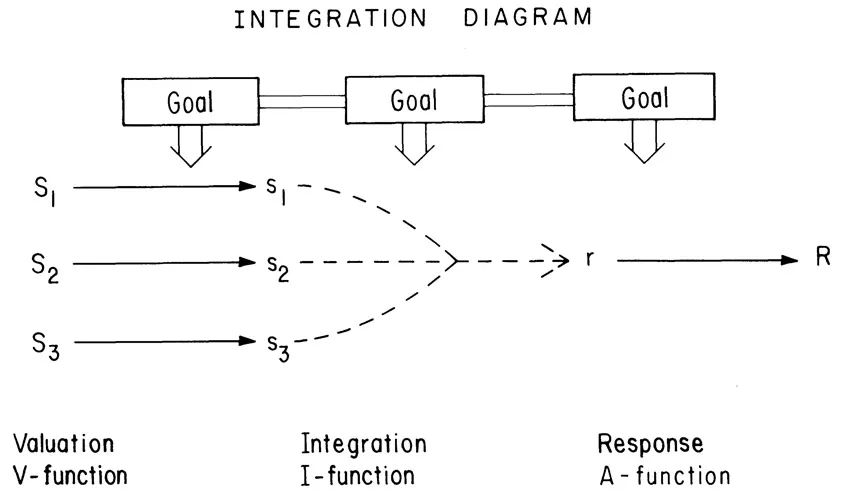
Figure 1. Information integration diagram. Chain of three linked operators, V - I - A, leads from observable stimulus field, {Si}, to observable response, R. Valuation operator, V, transforms observable stimuli, Si, into subjective representations, si. Integration operator, I, transforms subjective stimulus field, {si}, into implicit response, r. Action operator, A, transforms implicit response, r, into observable response, R. (After N. H. Anderson, Foundations of Information Integration Theory, 1981.)
Integration. Integration is an organizing process, almost by definition, for it involves combining parts into wholes. The integration operator, I, is thus a schema, and the study of its structure is at once the central concern and the foundation issue of information integration theory.
The importance of integration mirrors the importance of multiple determination. Judgment and action depend on multiple determinants, arising from present motivations and goals, from constraints of the present situation, and from past experience, all of which condition present judgment and action. The problems of integration lie at the heart of general cognitive theory.
Among integration schemas, the algebraic operators have special interest and value. They have been established empirically in many domains, and they have many uses in cognitive analysis. These algebraic schemas, collectively called cognitive algebra, are a singular exception to the vagueness of most schema formulations.
Valuation. The valuation operator, V, leads from the operative stimuli, si, to their psychological counterparts, s,. Because values depend on the operative goal, the same objective stimulus will have different values in different contexts. These values are not properties of the stimulus per se, but depend on stimulus-organism interaction, being generally constructed for the task and goal at hand. Valuation thus involves organized utilization of memory knowledge, together with external stimulus information, under guidance of the goal.
Cognitive analysis faces a difficult problem in valuation, for it can be indefinitely complicated. Interpretation of even a single trait adjective in a person description, for example, involves a chain of processes that begin at the sense receptors and involve a complex of linguistic knowledge, general background knowledge, and task-specific knowledge. Since much of this knowledge complex is practically unknowable, exact theory at the level of judgment and action might seem unattainable.
But exact theory is possible, by virtue of cognitive algebra. The psychological s-value of the integration diagram is an exact summary of all the valuation processing. No matter how complex, interactive, or unknowable this processing may be, it is completely and exactly summarized in the s-value. These functional values can, under certain conditions, be determined with the functional measurement methodology. These functional values also provide a unique tool for deeper analysis of valuation processing.
Action. The action operator, A, maps the internal response onto its overt manifestation. Previous work has relied heavily on the rating response, owing to the need for linear (equal interval) response scales in cognitive algebra. The action of rating involves an organized response system, for any one rating must be relative to the others, to the range of stimuli, and to the more or less arbitrary rating scale itself (Anderson, 1982, Sections 1.1 and 3.11). Only through the theoretical and empirical development of the rating schema was cognitive algebra put on a firm base.
More complex action schemas appear when the goal path requires multiple steps. Construction tasks (this volume, Chapter 2) provide one approach to the study of organization in action schemas. Also relevant is the concept of assemblage discussed later. On these problems, however, little is yet known.
The Three Unobservables. The integration diagram embodies the following symbolic integration equation:

where lowercase s and r refer to the internal, psychological values of stimuli and response. Since r, si, and I are all unobservable, this equation may be called the problem of the three unobservables.
A solution for the three unobservables must rest on observable information, namely, the dependence of the observable R on the observable si. This may seem difficult, even impossible, because three unknowns intervene. In an important class of tasks, fortunately, a solution can be obtained very simply with functional measurement theory. Functional measurement has been empirically productive and has revealed the existence of a general cognitive algebra of integration operators. Aside from their cognitive interest as modes of organization, these algebraic operators also solve the longstanding problem of psychological measurement.
Psychological Measurement. Two measurement problems, of response and of stimulus, are included in the problem of the three unobservables. Both problems appear in the simple addition rule:

This equation could be tested by measuring the three terms and checking whether they add up. But this requires proper linear (equal interval) scales for each term, a requirement long-known from psychophysics to be controversial. Furthermore, the three scales must have a common unit and known zeros, which may seem hardly possible when the three terms correspond to different concepts, as in the basic blame schema,

But these measurement problems can be solved, often in a simple way. Functional measurement methodology can transform the cited blame schema into a true cognitive equation. The feeling of blame becomes quantifiable; psychological scales of the two stimulus concepts, motive and harm, can also be derived, and their relative importance can be assessed. Other algebraic schemas may be utilized in similar manner.
Response measurement is primary. A key problem was the development of procedures that could ensure a valid linear response scale. These procedures, once developed, could be used in tasks that did not exhibit any simple algebraic structure. This is essential for progress on many problems of interaction and configural integration.
Stimulus measurement needs to be personal and functional. Different persons have different values; the child’s form of the blame schema cannot be determined using the mother’s values; the wife’s feelings of fairness cannot be studied using the husband’s values. Functional measurement measures the stimulus values that were functional in the given situation. Stimulus values depend on the goal; the same stimulus will in general have different values relative to different goals. Capability for goal-dependent measurement is a useful, if not necessary tool for cognitive analysis.
Cognitive Algebra. Writers as far back as Aristotle have conjectured that human judgment obeys algebraic rules in various situations. But these conjectures remained conjectures; they could not be tested without psychological measurement. This measurement problem was solved with the methodology of functional measurement.
The essential idea of functional measurement is to make the integration rule the base and frame for measurement. The foregoing addition rule, r = s1 + s2, implicitly quantifies the response variable and the two stimulus variables. This algebraic structure alone is sufficient to solve the measurement problem. Establishing the algebraic rule thus constitutes a simultaneous solution for all three unobservables.
Two basic tools are the parallelism theorem, which says that an addition rule will produce a pattern of parallelism in the factorial plot, and the linear fan theorem, which says that a multiplication rule will produce a linear fan pattern. The observed pattern in the factorial plot thus allows diagnosis of which, if either, of these two basic algebraic operators is at work. Other response patterns point to ratio rules and to averaging rules.
As an historical note, cognitive algebra looks much clearer in hindsight because much of the uncertainty caused by nonparallelism has been cleared up. Parallelism has a natural interpretation as joint support for an additive integration and a linear response. But nonparallelism is ambiguous, for it could result from nonlinearity in the response or from nonadditivity in the integration—or from some uncertain combination of both together. And in fact, nonparallelism was frequently observed. Many tasks that were hypothesized to follow an adding rule t...
Table of contents
- Cover
- Title
- Copyright
- CHAPTER CONTENTS
- Dedication
- PREFACE
- Chapter 1. FUNCTIONAL MEMORY IN PERSON COGNITION
- Chapter 2. SCHEMAS IN PERSON COGNITION
- Chapter 3. A COGNITIVE THEORY OF JUDGMENT AND DECISION
- Chapter 4. FUNCTIONAL MEASUREMENT APPROACH TO SELF-ESTIMATION IN MULTIATTRIBUTE EVALUATION
- Chapter 5. INTUITIVE STATISTICAL ESTIMATION
- Chapter 6. STUDIES OF A TWO PROCESS THEORY FOR GEOMETRIC ILLUSIONS
- Chapter 7. LANGUAGE PROCESSING AND INFORMATION INTEGRATION
- Chapter 8. INTEGRATION PSYCHOPHYSICS IN THE CHEMICAL SENSES
- Chapter 9. FUNCTIONAL MEASUREMENT ANALYSIS OF RESPONSE TIMES IN PROBLEM SOLVING
- Chapter 10. PARAMETER ESTIMATION FOR AVERAGING THEORY
- INDEX TO VOLUME I
Trusted by 375,005 students
Access to over 1.5 million titles for a fair monthly price.
Study more efficiently using our study tools.
Frequently asked questions
Yes, you can cancel anytime from the Subscription tab in your account settings on the Perlego website. Your subscription will stay active until the end of your current billing period. Learn how to cancel your subscription
No, books cannot be downloaded as external files, such as PDFs, for use outside of Perlego. However, you can download books within the Perlego app for offline reading on mobile or tablet. Learn how to download books offline
We are an online textbook subscription service, where you can get access to an entire online library for less than the price of a single book per month. With over 1.5 million books across 990+ topics, we’ve got you covered! Learn about our mission
Look out for the read-aloud symbol on your next book to see if you can listen to it. The read-aloud tool reads text aloud for you, highlighting the text as it is being read. You can pause it, speed it up and slow it down. Learn more about Read Aloud
Yes! You can use the Perlego app on both iOS and Android devices to read anytime, anywhere — even offline. Perfect for commutes or when you’re on the go.
Please note we cannot support devices running on iOS 13 and Android 7 or earlier. Learn more about using the app
Please note we cannot support devices running on iOS 13 and Android 7 or earlier. Learn more about using the app
Yes, you can access Contributions To Information Integration Theory by Norman H. Anderson in PDF and/or ePUB format, as well as other popular books in Psychology & Developmental Psychology. We have over 1.5 million books available in our catalogue for you to explore.