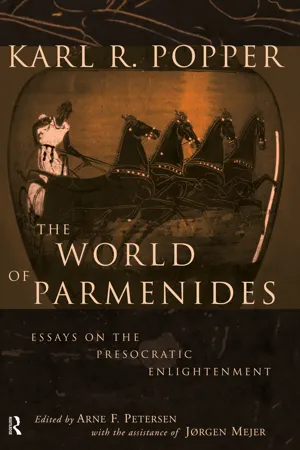
This unique collection of essays, published together for the first time, not only elucidates the complexity of ancient Greek thought, but also reveals Karl Popper's engagement with Presocratic philosophy and the enlightenment he experienced in his reading of Parmenides. As Karl Popper himself states himself in his introduction, he was inspired to write about Presocratic philosophy for two reasons - firstly to illustrate the thesis that all history is the history of problem situations and secondly, to show the greatness of the early Greek philosophers, who gave Europe its philosophy, its science and its humanism.
eBook - ePub
The World of Parmenides
Essays on the Presocratic Enlightenment
- 352 pages
- English
- ePUB (mobile friendly)
- Available on iOS & Android
eBook - ePub
The World of Parmenides
Essays on the Presocratic Enlightenment
About this book
Information
Essay 1
Back to the Presocratics
I
'Back to Methuselah' was a progressive programme, compared with 'Back to Thales' or 'Back to Anaximander': what Shaw offered us was an improved expectation of life - something that was in the air, at any rate when he wrote it, I have nothing to offer you, I am afraid, that is in the air today; for what I want to return to is the simple straightforward rationality of the Presocratics. Wherein does this much-discussed 'rationality' of the Presocratics lie? The simplicity and boldness of their questions is part of it, but my thesis is that the decisive point is the critical attitude which, as I shall try to show, was first developed in the Ionian School.
The questions which the Presocratics tried to answer were primarily cosmological questions, but there were also questions of the theory of knowledge. It is my belief that philosophy must return to cosmology and to a simple theory of knowledge. There is at least one philosophical problem in which all thinking men are interested: the problem of understanding the world in which we live; and thus ourselves (who are part of that world) and our knowledge of it. All science is cosmology, I believe, and for me the interest of philosophy, no less than of science, lies solely in its bold attempt to add to our knowledge of the world, and to the theory of our knowledge of the world. I am interested in Wittgenstein, for example, not because of his linguistic philosophy, but because his Tractatus was a cosmological treatise (although a crude one), and because his theory of knowledge was closely linked with his cosmology.
For me, both philosophy and science lose all their attraction when they give up that pursuit - when they become specialisms and cease to see, and to wonder at, the riddles of our world. Specialization may be a great temptation for the scientist. For the philosopher it is the mortal sin.
II
In this paper I speak as an amateur, as a lover of the beautiful story of the Presocratics. I am not a specialist or an expert: I am completely out of my depth when an expert begins to argue which words or phrases Heraclitus might, and which he could not possibly, have used. Yet when some expert replaces a beautiful story, based on the oldest texts we possess, by one which — to me at any rate — no longer makes any sense, then I feel that even an amateur may stand up and defend an old tradition. Thus I will at least look into the expert's arguments, and examine their consistency. This seems a harmless occupation to indulge in; and if an expert or anybody else should take the trouble to refute my criticism I shall be pleased and honoured.1
I shall be concerned with the cosmological theories of the Presocratics, but only to the extent to which they bear upon the development of the problem of change, as I call it, and only to the extent to which they are needed for understanding the approach of the Presocratic philosophers to the problem of knowledge — their practical as well as their theoretical approach. For it is of considerable interest to see how their practice as well as their theory of knowledge is connected with the cosmological and theological questions which they posed to themselves. Theirs was not a theory of knowledge that began with the question, 'How do I know that this is an orange?' or, 'How do I know that the object I am now perceiving is an orange?' Their theory of knowledge started from problems such as, 'How do we know that the world is made of water?' or, 'How do we know that the world is full of gods?' or, 'How can we know anything about the gods?'
There is a widespread belief, somewhat remotely due, I think, to the influence of Francis Bacon, that one should study the problems of the theory of knowledge in connection with our knowledge of an orange rather than our knowledge of the cosmos. I dissent from this belief, and it is one of the main purposes of my paper to convey to you some of my reasons for dissenting. At any rate it is good to remember from time to time that our Western science — and there seems to be no other — did not start with collecting observations of oranges, but with bold theories about the world.
III
Traditional empiricist epistemology and the traditional historiography of science are both deeply influenced by the Baconian myth that all science starts from observation and then slowly and cautiously proceeds to theories. That the facts are very different can be learnt from studying the early Presocratics. Here we find bold and fascinating ideas, some of which are strange and even staggering anticipations of modern results, while many others are wide of the mark, from our modern point of view; but most of them, and the best of them, have nothing to do with observation. Take, for example, some of the theories about the shape and position of the Earth. Thales said, we are told [A 15], 'that the Earth is supported by water on which it rides like a ship, and when we say that there is an earthquake, then the Earth is being shaken by the movement of the water'. No doubt Thales had observed earthquakes as well as the rolling of a ship before he arrived at his theory. But the point of his theory was to explain the support or suspension of the Earth, and also earthquakes, by the conjecture that the Earth floats on water; and for this conjecture (which so strangely anticipates the modem theory of continental drift) he could have no basis in his observations.
We must not forget that the function of the Baconian myth is to explain why scientific statements are true, by pointing out that observation is the 'true source of our scientific knowledge. Once we realize that all scientific statements are hypotheses, or guesses, or conjectures, and that the vast majority of these conjectures (including Bacon's own) have turned out to be false, the Baconian myth becomes irrelevant. For it is pointless to argue that the conjectures of science — those which have proved to be false as well as those which are still accepted — all start from observation.
However this may be, Thales' beautiful theory of the support or suspension of the Earth and of earthquakes, though in no sense based upon observation, is at least inspired by an empirical or observational analogy. But even this is no longer true of the theory proposed by Thales' great pupil, Anaximander. Anaximander's theory of the suspension of the Earth is still highly intuitive, but it no longer uses observational analogies. In fact it may be described as counter-observational. According to Anaximander's theory [A 11],
The Earth . . . is held up by nothing, but remains stationary owing to the fact that it is equally distant from all other things. Its shape is . . . like that of a drum. . . . We walk on one of its flat surfaces, while the other is on the opposite side.
The drum, of course, is an observational analogy. But the idea of the Earth's free suspension in space, and the explanation of its stability, have no analogy whatever in the whole field of observable facts.
In my opinion this idea of Anaximander's is one of the boldest, most revolutionary, and most portentous ideas in the whole history of human thought. It made possible the theories of Aristarchus and Copernicus. But the step taken by Anaximander was even more difficult and audacious than the one taken by Aristarchus and Copernicus. To envisage the Earth as freely poised in mid-space, and to say 'that it remains motionless because of its equidistance or equilibrium' (as Aristotle paraphrases Anaximander), is to anticipate to some extent even Newton's idea of immaterial and invisible gravitational forces.2
IV
How did Anaximander arrive at this remarkable theory? Certainly not by observation but by reasoning. His theory is an attempt to solve one of the problems to which his teacher and kinsman Thales, the founder of the Milesian or Ionian School, had offered a solution before him. I therefore conjecture that Anaximander arrived at his theory by criticizing Thales' theory. This conjecture can be supported, I believe, by a consideration of the structure of Anaximander's theory.
Anaximander is likely to have argued against Thales' theory (according to which the Earth was floating on water) on the following lines. Thales' theory is a specimen of a type of theory which if consistently developed would lead to an infinite regress. If we explain the stable position of the Earth by the assumption that it is supported by water - that it is floating on the ocean (Okeanos) - should we not have to explain the stable position of the ocean by an analogous hypothesis? But this would mean looking for a support for the ocean, and then for a support for this support. This method of explanation is unsatisfactory: first, because we solve our problem by creating an exactly analogous one; and also for the less formal and more intuitive reason that in any such system of supports or props, failure to secure any one of the lower props must lead to the collapse of the whole edifice.
From this we see intuitively that the stability of the world cannot be secured by a system of supports or props. Instead Anaximander appeals to the internal or structural symmetry of the world, which ensures that there is no preferred direction in which a collapse can take place. He applies the principle that where there are no differences there can be no change. In this way he explains the stability of the Earth by the equality of its distances from all other things.
This, it seems, was Anaximander's argument. It is important to realize that it abolishes, even though not quite consciously, perhaps, and not quite consistently, the idea of an absolute direction — the absolute sense of 'upwards' and 'downwards'. This is not only contrary to all experience but notoriously difficult to grasp. Anaximenes ignored it, it seems, and even Anaximander himself did not grasp it completely. For the idea of an equal distance from all other things should have led him to the theory that the Earth has the shape of a globe. Instead he believed that it had the shape of a drum, with an upper and a lower flat surface. Yet it looks as if the remark, 'We walk on one of its flat surfaces, while the other is on the opposite side' [A 11], contained a hint that there was no absolute upper surface, but that on the contrary the surface on which we happened to walk was the one we might call the upper.
What prevented Anaxirnander from arriving at the theory that the Earth was a globe rather than a drum? There can be little doubt: it was observational experience which taught him that the surface of the Earth was, by and large, flat. Thus it was a speculative and critical argument, the abstract critical discussion of Thales' theory, which almost led him to the true theory of the shape of the Earth; and it was observational experience which led him astray.
V
There is an obvious objection to Anaximander's theory of symmetry, according to which the Earth is equally distant from all other things. The asymmetry of the universe can be easily seen from the existence of Sun and Moon, and especially from the fact that Sun and Moon are sometimes not far distant from each other, so that they are on the same side of the Earth, while there is nothing on the other side to balance them. It appears that Anaximander met this objection by another bold theory - his theory of the hidden nature of the Sun, the Moon, and the other heavenly bodies.
He envisages the rims of two huge chariot wheels rotating round the Earth, one 27 times the size of the Earth, the other 18 times its size. Each of these rims or circular pipes is filled with fire, and each has a breathing-hole through which the fire is visible. These holes we call the Sun and the Moon respectively. The rest of the wheel is invisible, presumably because it is dark (or misty) and far away. The fixed stars (and presumably the planets) are also holes on wheels which are nearer to the Earth than the wheels of the Sun and the Moon. The wheels of the fixed stars rotate on a common axis (which we now call the axis of the Earth) and together they form a sphere round the Earth, so the postulate of equal distance from the Earth is (roughly) satisfied. This makes Anaximander also a founder of the theory of the spheres. (For its relation to the wheels or circles see Aristotle De Caelo 289b10-290b10.)
VI
There can be no doubt whatever that Anaximander's theories are critical and speculative rather than empirical: and considered as approaches to truth, his critical and abstract speculations served him better than observational experience or analogy.
But, a follower of Bacon may reply, this is precisely why Anaximander was not a scientist. This is precisely why we speak of early Greek philosophy rather than of early Greek science. Philosophy is speculative: everybody knows this. And as everybody knows, science begins only when the speculative method is replaced by the observational method, and when deduction is replaced by induction.
This reply, of course, amounts to the thesis that, by definition, theories are (or are not) scientific according to their origin in observations, or in so-called inductive procedures'. Yet I believe that few, if any, physical theories would fall under this definition. And I do not see why the question of origin should be important in this connection. What is important about a theory is its explanatory power, and whether it stands up to criticism and to tests. The question of its origin, of how it is arrived at — whether by an 'inductive procedure', as some say, or by an act of intuition — may be extremely interesting, especially for the biographer of the man who invented the theory, but it has little to do with its scientific status or character.
VII
As to the Presocratics, I assert that there is the most perfect possible continuity of thought between their theories and the later developments in physics. Whether they are called philosophers, or pre-scientists, or scientists matters very little, I think. But I do assert that Anaximander's theory cleared the way for the theories of Aristarchus, Copernicus, Kepler, and Galileo. It is not that he merely 'influenced' these later thinkers; 'influence' is a very superficial category. I would rather put it like this: Anaximander's achievement is valuable in itself, like a work of art. Besides, his achievement made other achievements possible, among them those of the great scientists mentioned.
But are not Anaximander's theories false, and therefore non-scientific? They are false, I admit; but so are many theories, based upon countless experiments, which modern science accepted until recently, and whose scientific character nobody would dream of denying, even though they are now believed to be false. (An example is the theory that the typical chemical properties of hydrogen belong only to one kind of atom - the lightest of all atoms.) There were historians of science who tended to regard as unscientific (or even as superstitious) any view no longer accepted at the time they were writing; but this is an untenable attitude. A false theory may be as great an achievement as a true one. And many false theories have been more helpful in our search for truth than some less interesting theories which are still accepted. For false theories can be helpful in many ways; they may, for example, suggest so...
Table of contents
- Cover
- Title
- Copyright
- Contents
- Preface
- List of abbreviations
- Introduction: Aristotle's invention of induction and the eclipse of Presocratic cosmology
- Essay 1 Back to the Presocratics
- Essay 2 The unknown Xenophanes: an attempt to establish his greatness
- Essay 3 How the Moon might shed some of her light upon the Two Ways of Parmenides (I)
- Essay 4 How the Moon might throw some of her light upon the Two Ways of Parmenides (1989)
- Essay 5 Can the Moon throw light on Parmenides' Ways? (1988)
- Essay 6 The world of Parmenides: notes on Parmenides' poem and its origin in early Greek cosmology
- Essay 7 Beyond the search for invariants
- Essay 8 Comments on the prehistoric discovery of the self and on the mind-body problem in ancient Greek philosophy
- Essay 9 Plato and geometry
- Essay 10 Concluding remarks on support and countersupport: how induction becomes counterinduction, and the epagōgē returns to the elenchus
- Appendix Popper's late fragments on Greek philosophy
- Index
Trusted by 375,005 students
Access to over 1.5 million titles for a fair monthly price.
Study more efficiently using our study tools.
Frequently asked questions
Yes, you can cancel anytime from the Subscription tab in your account settings on the Perlego website. Your subscription will stay active until the end of your current billing period. Learn how to cancel your subscription
No, books cannot be downloaded as external files, such as PDFs, for use outside of Perlego. However, you can download books within the Perlego app for offline reading on mobile or tablet. Learn how to download books offline
Perlego offers two plans: Essential and Complete
- Essential is ideal for learners and professionals who enjoy exploring a wide range of subjects. Access the Essential Library with 800,000+ trusted titles and best-sellers across business, personal growth, and the humanities. Includes unlimited reading time and Standard Read Aloud voice.
- Complete: Perfect for advanced learners and researchers needing full, unrestricted access. Unlock 1.5M+ books across hundreds of subjects, including academic and specialized titles. The Complete Plan also includes advanced features like Premium Read Aloud and Research Assistant.
We are an online textbook subscription service, where you can get access to an entire online library for less than the price of a single book per month. With over 1.5 million books across 990+ topics, we’ve got you covered! Learn about our mission
Look out for the read-aloud symbol on your next book to see if you can listen to it. The read-aloud tool reads text aloud for you, highlighting the text as it is being read. You can pause it, speed it up and slow it down. Learn more about Read Aloud
Yes! You can use the Perlego app on both iOS and Android devices to read anytime, anywhere — even offline. Perfect for commutes or when you’re on the go.
Please note we cannot support devices running on iOS 13 and Android 7 or earlier. Learn more about using the app
Please note we cannot support devices running on iOS 13 and Android 7 or earlier. Learn more about using the app
Yes, you can access The World of Parmenides by Karl Popper, Jørgen Mejer,Arne Petersen, Jørgen Mejer, Arne Petersen in PDF and/or ePUB format, as well as other popular books in Philosophy & Philosophy History & Theory. We have over 1.5 million books available in our catalogue for you to explore.