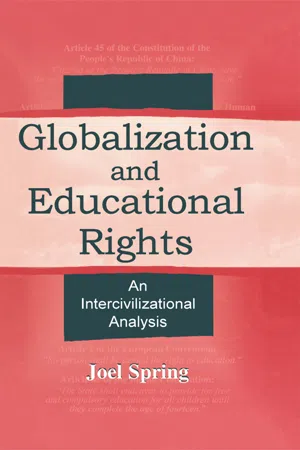
This is the first book to explore the meaning of equality and freedom of education in a global context and their relationship to the universal right to education. It also proposes evaluating school systems according to their achievement of equality and freedom.
Education in the 21st century is widely viewed as a necessary condition for the promotion of human welfare, and thus identified as a basic human right. Educational rights are included in many national constitutions written since the global spread of human rights ideas after World War II. But as a global idea, the meaning of educational rights varies between civilizations. In this book, which builds on the concept of the universal right to education set forth in Spring's The Universal Right to Education: Justification, Definition, and Guidelines, his intercivilizational analysis of educational rights focuses on four of the world's major civilizations: Confucian, Islamic, Western, and Hindu.
Spring begins by considering educational rights as part of the global flow of ideas and the global culture of schooling. He also considers the tension this generates within different civilizational traditions. Next, he proceeds to:
*examine the meaning of educational rights in the Confucian tradition, in the recent history of China, and in the Chinese Constitution;
*look at educational rights in the context of Islamic civilization and as presented in the constitutions of Islamic countries, including an analysis of the sharp contrast between the religious orientation of Islamic educational rights and those of China and the West;
*explore the problems created by the Western natural rights tradition and the eventual acceptance of educational rights as represented in European constitutions, with a focus on the development and prominence given in the West to the relationship between schooling and equality of opportunity; and,
*investigate the effect of global culture on India and the blend of Western and Hindu ideas in the Indian constitution, highlighting the obstacles to fulfillment of educational rights created by centuries of discrimination against women and lower castes.
In his conclusion, Spring presents an educational rights statement based on his intercivilizational analysis and his examination of national constitutions. This statement is intended to serve as a model for the inclusion of educational rights in national constitutions.
- 200 pages
- English
- ePUB (mobile friendly)
- Available on iOS & Android
eBook - ePub
About this book
Information
1 Global Education and an Intercivilizational Analysis
DOI: 10.4324/9781410606020-1
What is the goal of the 1948 Universal Declaration of Human Rights declaration that “Everyone has a right to education”? What is the meaning of equality and freedom as related to this goal? Do human rights, equality, and freedom have the same meaning in all civilizations? Is there an evolving global purpose for education?
In answering these questions, I examine differing civilizational concepts of education, equality, and freedom. Also, I study the educational rights provisions in a representative sampling of national constitutions. Based on these analyses, I propose constitutional amendments to ensure the implementation of a right to education that affirms equality and freedom of education.
My analysis includes Confucian, Islamic, Western, and Hindu civilizations. These represent the majority of the world’s people; I did not include, for reasons of time and space, the world’s indigenous civilizations. For my purposes, civilization refers to “religions, languages, ethics, and customs that influence thoughts and behavior of people transcending national boundaries.”1 Within this meaning, Confucian civilization refers to those Asian people who are influenced in their thinking by centuries of Confucian teachings. Islamic civilization is held together by the teachings of the Qur’an and the use of Qur’anic Arabic. Western civilization is a product of Judaic-Christian ideas, and the legacy of the Greek and Roman cultures. I selected Hindu civilization, which rests on ancient Hindu laws, because the current constitution of India is a product of the clash between Western and Hindu civilizations. Besides being a product of intercivilizational exchanges, the Indian constitution provides important insights into the problems of establishing standards for the implementation of the universal right to education.
Illustrating the Growing Uniformity of Global Education: “Not One Less”
Amidst these civilizational differences, there is a growing uniformity of global education. This uniformity is a reflection of global economics. Throughout this book, I discuss the interaction between the uniformity of global education and differing civilizational concerns about education. Also, I want to consider my opening questions on equality and freedom of education in the context of global educational trends. This discussion will sharpen the differences between civilizational concepts of education and global trends.
The Chinese movie “Not One Less” provides a good illustration of the use of equality and freedom in global patterns of education. In the movie a 13-year-old substitute teacher in a poor and desolate village in rural China excites her charges with the arithmetic problem of determining how many bricks must be moved in a nearby factory to earn enough money for the teacher to travel to the city in search of a missing student. After moving 1,000 bricks, the pupils and teacher stop at a store to buy something to drink. Being poor and growing up in rural isolation, the teacher and students don’t know what can be bought to quench their thirsts. The shopkeeper acts as an instructor in modern consumption. She points to a shelf of Coca-Cola®. The teacher and students then engage in another arithmetic exercise and determine that they can afford two cans of the liquid refreshment. The teacher and students experience their first taste of Coca-Cola®. Later in the film, after the teacher has slept on city streets and on a train station floor in search of her missing student, a local television studio decides to use her to highlight problems facing rural education in China. Appearing on the program “China Today,” the frightened girl stares speechless into a video camera marked with the Sony Corporation logo. A Sony brand television conveys her image to the lost student who is in a street restaurant having been helped by its compassionate owner.
The film’s concluding credits thank the financial support received from the Coca-Cola Corporation, the Ford Motor Company, and the Sony Corporation followed by a general request for donations to help support education in rural China. Obviously, these three multinational corporations would love to change the lives of rural peasants so that they could earn enough money to buy their products. In the film’s final scenes, “China Today’s” film crew arrives in the village with the teacher and lost student accompanied by a truck full of educational materials. The students use colored chalk from the new supplies to write messages of appreciation on the classroom chalkboard.
“Not One Less” suggests that the universal right to education means learning to be modern workers who are able to purchase products of multinational corporations. Of course, at one level, there is nothing wrong with this goal. The movie’s impoverished villagers do seem to lack adequate nutrition and health care. Certainly, education and economic development could help solve these problems. On the other hand, will the villagers be happier if they are educated so that they can work to purchase canned soda drinks, televisions, and cars? Furthermore, it is through education that the teacher and students acquire a taste for these products. They learn to want and need these commodities!
The film’s overall message is that educational and economic development will provide equality of opportunity in the labor and consumer markets. Rather than being lost and begging in the city’s work and consumer world, educated students will have an equal chance to compete for jobs and money, and the freedom to buy. Education will save the rural peasantry!
As reflected in “Not One Less,” equality and freedom in education are frequently thought of as preparing students for equality of opportunity in the competition for jobs and income and the freedom to consume. However, I do not feel that these definitions should represent all the goals implied in Article 26 of the 1948 Universal Declaration of Human Rights. Equality of opportunity and freedom of consumption, I believe, fail to adequately express the full range of meaning of equality and freedom existing within the world’s civilizations.
An Intercivilizational Approach to Defining Equality and Freedom of Education: Confucian, Islamic, Western, and Hindu
Do all civilizations share a common meaning regarding “human rights,” “education,” “equality,” and “freedom?” To answer this question, I will apply an intercivilizational method suggested by Onuma Yasuaki, a Professor of International Law at the University of Tokyo. He argues for an intercivilizational approach because the people of Western countries assume that they are the reason for the global presence of human rights doctrines. Onuma Yasuaki argues that Asian countries that are denounced for violation of human rights “were once under colonial rule and the victims of military intervention and economic exploitation by developed countries.”2 Onuma charges Western nations with hypocrisy when charging nations such as China with human rights violations. He stresses that, “For those who have experienced colonial rule and interventions under such beautiful slogans as ‘humanity’ and ‘civilization’, the term ‘human rights’ looks like nothing more than another beautiful slogan by which great powers rationalize their interventionist policies.”3 Onuma contends that finding a human rights tradition in Western societies is very difficult because of the West’s long history of feudalism, colonialism, enslavement of other populations, genocide of indigenous peoples, and discrimination against women. Certainly, the very existence of Hitler and the Jewish Holocaust raises doubts about the superiority of Western societies over others in the arena of human rights. Human rights, meaning rights provided to all human beings including women and children, is not part of the natural rights movements in Western societies as they originated in the 18th and 19th centuries.
Westerners, Onuma contends, assume only non-Western religions and cultures have to be examined to discover human rights traditions. For instance, Westerners do not attempt to “find” human rights in Christianity or Western cultures because they assume that they are a distinct part of those traditions. Westerners write books and articles that attempt to identify human rights traditions in such religious and cultural traditions as Buddhism, Confucianism, Muslimism, and Hinduism.4
Representing what he feels are the doubts held by many East Asians about the West’s claim to superiority in human rights, Onuma writes, “Prior to the twentieth century, the history of human rights is the history of qualifications. The male-dominated French National Assembly of 1792 denied the Declaration of the Rights of Women, and the West-centric Versailles Conference of 1919 rejected the Japanese proposal for including a racial equality clause in the Covenant of the League of Nations. The century and a half following the American Declaration of Independence and the French Declaration of the Rights of Man and Citizens … witnessed the peak of colonization by Western powers.”5
For instance, when it was proclaimed in the 1776 American Declaration of Independence that “All men are created equal” the White citizens of these sparsely populated and relatively unknown group of British colonies owned slaves, and they were engaged in wars of genocide against a local native population.6 The previous year, colonist Patrick Henry, ignoring the plight of slaves and Native Americans, declared, “I know not what course others may take, but as for me, give me liberty or give me death!”7 The words were intended for the ears of fellow slave-holding Virginians who were debating resistance to the British crown and not those of enslaved Africans and Native Americans.
In reality, the human rights movement of the 20th century resulted from interaction between civilizations. In fact, the 1948 Declaration of Human Rights was a product of a dialogue between members of the United Nations. Of course, Western nations participated in the dialogue and exerted influence. But, given the painful history of Western violations of human rights, it would be difficult to maintain the argument that the West is the sole source of ideas about human rights and of concern about protecting the welfare of all human beings.
Consequently, I take an intercivilizational approach to defining equality and freedom in education. As I will demonstrate, every civilization has given different meanings to these concepts. From this intercivilizational approach I extract universal concepts of equality and freedom in education and I demonstrate the problems and prospects for their applicability in differing civilizations.
The Universal Declaration of Human Rights as an Intercivilizational Document
The intercivilizational nature of equality, freedom, and human rights was exemplified by a symposium hosted by the United Nations Educational, Scientific and Cultural Organization (UNESCO) just prior to the issuance of the 1948 Declaration.8 The purpose of the symposium was to find a common ground among various intellectual traditions for the support of human rights. China was represented by Chung-Shu Lo, who in his symposium essay demonstrated the difference between Chinese and Western concepts of rights. He observed that “the problem of human rights [as conceived by Westerners] were seldom discussed by Chinese thinkers … There was no open declaration of human rights in China … until this conception was introduced from the West.”9 In fact, according to Chung-Shu, there was no Chinese equivalent for the word rights. The Chinese translation of rights includes two words Chuan Li, meaning “power and interest.” Lo claimed this translation was done by an unnamed Japanese writer on Western public law in 1868 because Japan also lacked any equivalent words for the Western idea of rights.
However, despite the lack of any clearly identifiable human rights tradition, Chung-Shu suggested that some traditional Chinese ideas could be considered close to Western ideas. For instance, he quoted the Chinese classic, Book of History: “Heaven sees as our people see; Heaven hears as our people hear. Heaven is compassionate towards the people … Heaven loves the people; and the Sovereign must obey Heaven.”10 Based on this quote, Chung-Shu argued that the Chinese people believed in the right to revolt against rulers who did not serve the welfare of the people. Chung-Shu stated that the Chinese relationship of the ruler to the ruled paralleled some European traditions. He claimed that “human” rights doctrines could be supported by Chinese traditions. Chung-Shu observed, “The sovereign as well as the officials were taught to regard themselves as the parents or guardians of the people, and to protect their people as they would their own children.”11
Other essayists to the UNESCO volume objected to the Western natural rights traditions. S.V. Puntambekar presented a Hindu concept of human rights that emphasizes the spiritual nature of humans. He criticized the Western stress on reason and science that marked the emergence European rights doctrines. In criticizing the Western tradition for suppressing the spiritual nature of life, Puntambekar wrote, “We shall have to give up some of the superstitions of material science and limited reason, which make man too much this-worldly, and introduce higher spiritual aims and values for [human]kind.”12
Puntambekar derived a set of human rights from Hindu traditions. He identified five social freedoms and five individual possessions or virtues necessary for achieving the good spiritual life. Each social freedom was linked to an individual possession or virtue. Puntambekar provided a list of social freedoms and individual virtues; this is presented in Table 1.1.
| Social Freedoms | Individual Possessions or Virtues |
|---|---|
|
|
Also concerned about Western claims to originating human rights ideals, Islamic leaders are divided between those who worry that the human rights movement is an attempt to impose Western values on them and those advocating an Islamic basis for universal human rights. International legal scholar Ann Mayer writes, “One finds Muslims who disparage human rights as reflecting alien, Western values. In their view, international human rights are incompatible with Islam, Muslims must reject them.”14
However, Islamic scholars do identify traditional ideas that are designed to protect the rights and welfare of Muslim people. For instance, a number of Muslim countries participated in the writing of the 1981 Universal Islamic Declaration of Human Rights. This declaration recognizes the benevolent and protective aspects of Moslem traditions.15 The 1990 Cairo Declaration on Human Rights in Islam declares, “Fundamental rights and Universal freedoms in Islam are an integral part of the Islamic religion and that no one as a matter of principle has the right to suspend them in whole or in part or violate or ignore them …”16
Some Weste...
Table of contents
- Cover
- Halftitle Page
- Sociocultual, Political, and Historical Studies in Education
- Title Page
- Copyright Page
- Contents
- Preface
- 1 Global Education and an Intercivilizational Analysis
- 2 China: Confucius, Mao Zedong, and Socialist Modernization
- 3 Equality and Freedom in Islamic Education
- 4 Natural Rights and Education in the West
- 5 India: Education, Human Rights, and the Global Flow
- 6 A Constitutional Provision for Educational Rights
- Notes
- Index
Trusted by 375,005 students
Access to over 1.5 million titles for a fair monthly price.
Study more efficiently using our study tools.
Frequently asked questions
Yes, you can cancel anytime from the Subscription tab in your account settings on the Perlego website. Your subscription will stay active until the end of your current billing period. Learn how to cancel your subscription
No, books cannot be downloaded as external files, such as PDFs, for use outside of Perlego. However, you can download books within the Perlego app for offline reading on mobile or tablet. Learn how to download books offline
Perlego offers two plans: Essential and Complete
- Essential is ideal for learners and professionals who enjoy exploring a wide range of subjects. Access the Essential Library with 800,000+ trusted titles and best-sellers across business, personal growth, and the humanities. Includes unlimited reading time and Standard Read Aloud voice.
- Complete: Perfect for advanced learners and researchers needing full, unrestricted access. Unlock 1.5M+ books across hundreds of subjects, including academic and specialized titles. The Complete Plan also includes advanced features like Premium Read Aloud and Research Assistant.
We are an online textbook subscription service, where you can get access to an entire online library for less than the price of a single book per month. With over 1.5 million books across 990+ topics, we’ve got you covered! Learn about our mission
Look out for the read-aloud symbol on your next book to see if you can listen to it. The read-aloud tool reads text aloud for you, highlighting the text as it is being read. You can pause it, speed it up and slow it down. Learn more about Read Aloud
Yes! You can use the Perlego app on both iOS and Android devices to read anytime, anywhere — even offline. Perfect for commutes or when you’re on the go.
Please note we cannot support devices running on iOS 13 and Android 7 or earlier. Learn more about using the app
Please note we cannot support devices running on iOS 13 and Android 7 or earlier. Learn more about using the app
Yes, you can access Globalization and Educational Rights by Joel Spring in PDF and/or ePUB format, as well as other popular books in Education & Education General. We have over 1.5 million books available in our catalogue for you to explore.