Rethinking Northern Ireland provides a coherent and critical account of the Northern Ireland conflict. Most writing on Northern Ireland is informed by British propaganda, unionist ideology or currently popular 'ethnic conflict' paradigm which allows analysts to wallow in a fascination with tribal loyalty. Rethinking Northern Ireland sets the record straight by reembedding the conflict in Ireland in the history of an literature on imperialism and colonialism.
Written by Irish, Scottish and English women and men it includes material on neglected topics such as the role of Britain, gender, culture and sectarianism. It presents a formidable challenge to the shibboleths of contemporary debate on Northern Ireland. A just and lasting peace necessitates thorough re-evaluation and Rethinking Northern Ireland provides a stimulus to that urgent task.
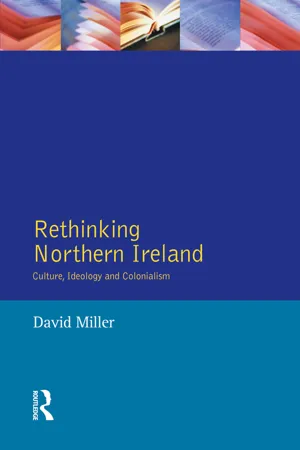
- 342 pages
- English
- ePUB (mobile friendly)
- Available on iOS & Android
eBook - ePub
About this book
Information
Part One
Explanations, Ideologies and Strategies
CHAPTER 1
Colonialism and academic representations of the troubles
David Miller
According to the vast bulk of literature on the topic Northern Ireland is not a colony of Britain and the conflict there is not colonial in nature. Many analysts are willing to admit that there used to be a colonial relationship between Britain and Ireland (although a substantial portion see this as of little significance and some even appear to deny that Ireland was a colony). When we come to the present, hardly a whisper is heard about the colonial relationship between Britain and Northern Ireland. Most historians do refer to relations between Britain and Ireland as colonial for the years between the late medieval period and the eighteenth century (see Ruane 1992). But after that colonialism as an explanation seems to vanish’reference to it by historians becomes ‘unusual’ (Ruane 1992: 296). Economists, sociologists and anthropologists have tended not to analyse the political, economic or cultural development of Ireland in colonial terms. Political scientists – especially in Ireland’and geographers have analysed the relationship between Britain and Ireland in terms of colonialism at least at some stage in history. But as we move nearer to the present references to colonialism become rarer. According to Ruane no anthropological study has referred to Northern Ireland as a colonial situation (1992:303). This is at best curious.
Amongst those who acknowledge a colonial relationship or dimension in the past, there is little which identifies the precise date or historical period when Northern Ireland ceased to be a colony. If all Ireland was a colony of Britain, did it stop being so with the Act of Union in 1801? Did the North stop being a colony in 1920 with the Government of Ireland Act? Or perhaps in 1921 with the ending of the war of independence and the withdrawal of British forces from the 26 counties of the Free State? Was it before that with the alleged emergence of a separate ‘nation’ in the North in the nineteenth century? Was it when the British state ceased to have economic interests in Ireland which some argue was after 1945? Or was it when unionist one-party rule was ended in 1972 and Westminster imposed direct rule? Or when British strategic interests became less important in the 1970s and 1980s and decisively so after 1989? The date is not specified and the discussion on this matter severely underdeveloped. As one leading analyst (who himself does not describe the North of Ireland as a colony) has observed, those authors who do not use a colonial model ‘simply remain silent on the subject, and do not actually argue the case against employing it’ (Whyte 1990: 178). Similarly, Ruane states ‘the language of colonialism simply stopped with the advent of the nineteenth century, without explicit discussion or justification’ (1992: 318).
The argument here is that none of the above dates is of any significance for describing the colonial relations between Britain and Ireland and later between Britain and Northern Ireland, since they refer to arguments about changes in British (or Irish) interests or to arguments about settler identity which do not relate to the structural and historical realities of the contemporary situation. Nor would such arguments be accepted in analyses of other settler colonial societies. No one now suggests that Northern Ireland is really part of ‘Great Britain’ and the mouthful which is the name of the state reflects this’the ‘United Kingdom of Great Britain and Northern Ireland’. When people in Northern Ireland claim to be British they justify this in imperial and ideological terms since they don’t actually live in Britain. Ulster is British in the sense that it is a colonial possession which the British state has tried to present as an integral part of the state. Not even Margaret Thatcher really believed that Northern Ireland was, in her own phrase, ‘as British as Finchley’, as her memoirs show (Thatcher 1995:385).
This chapter will examine how academics in Britain, Ireland and beyond have responded to the conflict in Northern Ireland. First it will examine the inadequacies of a wide variety of academic work which has dealt with Northern Ireland, ranging across both the social and human sciences, from history, political science, sociology, international relations, economics, economic history, psychology and geography to philosophy, literary criticism, art history and media and cultural studies. This section will highlight how such studies deal with the question of colonialism, and with their characterisations especially of unionism.
Academic explanations of the conflict
If Northern Ireland is a colony the question arises, how could so many academic ‘experts’ get their analyses so comprehensively wrong? Whyte seems somewhat perplexed by the failure to argue about colonial explanations in the literature, tending to treat academic explanations of the conflict at face value rather than as emanating from and contributing to the ideological contest over definition of the conflict.1 This chapter sets contemporary Northern Ireland in its colonial context and argues that colonialism and its associated propaganda, information and cultural enterprises are part of the reason for the systematic inadequacy of much writing on Northern Ireland. In other words it directs attention to the class, national and ethnic backgrounds of intellectuals and academics, their sectional interests, and their role in hegemonic contest (see O’Dowd 1996b). But before we go on to assess some of the reasons for this, let us turn to some of the arguments for and against colonialism as an explanation.
Northern Ireland as a colony
Northern Ireland is a colony of ‘Great Britain’. But this does not necessarily mean that the conflict is ‘colonial’in exactly the same way as all other colonial conflicts. For a start, as Pamela Clayton argues (this volume, 1996; see also Lustick 1993; MacDonald 1986; Weitzer 1990) Northern Ireland exhibits many of the characteristics associated with settler colonialism. Apposite parallels include Rhodesia, Palestine and especially French Algeria. South Africa also exhibits some of the same features, though matters are made more complex by two competing groups of settlers. Northern Ireland, by contrast, shows less parallel with colonial situations such as India under the Raj, any of the other British non-settler colonies, or with the resistance against repressive third world regimes such as those in Nicaragua under Somoza or Chile under Pinochet. The colonial relationship between Britain and Ireland also makes the conflict different from other armed struggles in Western Europe, such as those waged by the Rote Armee Fraktion in West Germany, by the Combatant Communist Cells in Belgium or by Action Directe in France. The situation in Euskadi (the Basque country) does bear more comparison (in the strategies of the state and the insurgents and arguably in the facets of relations between the Spanish state and the Basque country which have colonial parallels), but the specifically settler dimension of the conflict in Northern Ireland does mark it out as different.
However, the designation settler colonialism cannot by itself explain everything. We must also take into account how settler colonies differ and the specific historical circumstances and contests which shape every conflict. Not all settler societies resolve the tensions which tend to arise between settlers and natives in the same way and consequently the process of decolonisation (where it occurs) varies.2 The declaration of UDI by the white settlers in Rhodesia is one variation (Weitzer 1990). Although there have been some stirrings amongst Ulster unionists on this matter, it is not more than a minority demand. More fundamentally, one key way to avoid conflicts between settlers and natives over territory and resources’by exterminating them’did not happen in Ireland as it did in, for example, North America. Today, few unionists publicly advance the extermination of natives as a policy goal’although in 1984 DUP Belfast city councillor, George Seawright, did propose that the council purchase an incinerator to burn Catholics and their priests (Johnson 1984). Loyalist paramilitaries also seem to have this as part of their military strategy, expressed in slogans in wall murals such as ‘Kill All Irish’ and ‘Any Catholic Will Do’.
Ireland is also different in that it was ruled by ‘Britain’ for a long time prior to the processes generally identified as colonialism and imperialism and some writers have referred to Ireland as a whole as an integral part of British attempts at nation-building. This is one key way in which Northern Ireland is different from some other colonies. Ireland was Britain’s first colony, but there was also an attempt to integrate it into the national territory. This strategy failed with the creation of the Irish Free State. Today Northern Ireland is officially a part of the ‘UK’ state. It is not, however, part of ‘Great Britain’. In a sense then, Northern Ireland is a less integral part of Britain than Algeria was as a departèment of France. But Northern Ireland is to some extent integrated into the UK state and political system, albeit not to the extent that Scotland and Wales are.
To be fair, settler colonialism does seem to be a fairly widespread characterisation of the origins of the conflict in Northern Ireland. It has recently been partially endorsed by the leading political science commentators (O’Leary and McGarry 1993; McGarry and O’Leary 1995). However, many such commentators are reluctant to follow the point through and describe the current conflict as colonial in the same terms. Reading McGarry and O’Leary (1995) one is left feeling’contrary to evidence they quote elsewhere’that the conflict is simply about the playing out of historical wrongs as if it had been frozen in political stasis since the plantation. They argue that settler colonialism fits the experience of ‘historic Ulster’ (1995: 334) and that dispossession of the natives left a ‘legacy of bitterness’ (1995: 334). This is quite true, but it is surely not meant to suggest that this is the key motivator of the current conflict, nor could such a factor account for the significant periods of peace in Northern Ireland between the 1920s and 1960s. Although McGarry and O’Leary also note that the role of Britain is important they say only that it showed ‘a lack of will’ to solve the conflict. Britain is henceforth referred to as the ‘sovereign power’ with the colonial dimension mysteriously slipping out of view.
Imperialism
Nor does maintaining a settler-colonial position require one to subscribe to the crude parodies of vulgar Marxism available in the literature or to the crude analyses of vulgar Marxism itself. Much of the debate on the left in social science seems to have been over the question of imperialism. Left writers are criticised by non-Marxists for a crude and conspiratorial conception of the interests of British imperialism (Whyte 1990; McGarry and O’Leary 1995) and by revisionist Marxists for overestimating the homogeneity of the Protestant community and underestimating the progressive potential of the Protestant working class (Morgan 1980; Bew et al 1980; Patterson 1980b). We will return to the substantive issue of Protestantism, unionism and loyalism below. For present purposes we can note that the interests of the British state do not affect the characterisation of the problem as colonial, since whether the colonial power wants to retain a territory or not, the important point for analysis is whether it does or not. To be fair, to designate the Northern Ireland problem as one of imperialism can tend to imply the pursuit of interests. In general Marxist writers from the varying revisionist camps (in common with non-Marxists) tend not to say explicitly why they do not describe the conflict in colonial terms. Some stress internal factors in producing conflict, and others the role of the state in mediating ruling class interests
The most well known example of the latter, and the most widely cited, is that of Paul Bew and his colleagues (Bew et al. 1979,1980; Bew and Patterson 1985). They attack approaches which emphasise the material interests of the participants in the conflict as economistic and reductionist. Their approach’drawing partly on Althusserian Marxism (and on Poulantzas)’emphasises the relative autonomy of the state from the ruling class since it must be able to broker contradictions in ruling class interest. The chief problems with this type of work at a theoretical level are its functionalism and lack of agency. In the end it is as reductionist as its opponents in seeing state actions as a necessary function of bourgeois (and therefore capitalist) interests (Althusser 1970, 1971). The ‘glacial grip’ (Eagleton 1996b:3 ) of Louis Althusser on their theoretical conception of the state is related to their inability fully to comprehend the sectarian nature of class relations in Northern Ireland. For them sectarianism is a superstructural phenomena, relatively autonomous of economic determination. Pre-1972 Northern Ireland was, they say, in many ways an ‘ordinary bourgeois’ state (1980:155). This is a rather breathtaking misdescription of the actual situation, which sees the colonial marker of difference and domination as somehow an epiphenomenon of deeper structural processes. As Paul Stewart has put it
Unless one recognises that the process of class rule depended upon … Catholic subordination, the notions of ‘ordinariness’ and ‘normality’ merely serve to reinforce the ‘Alice in Wonderland’ optic which was the prevailing way of viewing Northern Ireland from Westminster between 1920 and 1968.(Stewart 1991:199)
The advantage of a conceptualisation involving settler colonialism, is that it requires that we analyse colonial/sectarian relations as well as class relations in explaining the conflict.
One of the few academics to address the colonial argument explicitly argues that his own ‘preference, when it comes to contextualising the Irish experience, is for a European comparative perspective’ (Kennedy 1996: xv). This can certainly be illuminating as can comparison with non-European countries, but Kennedy adopts a severely empiricist argument which fails to capture structural relationships in its haste to castigate Irish nationalism (and to a lesser extent Ulster unionism). He advances the rather patronising thesis that Irish nationalists claim to be ‘Most Oppressed People Ever (MOPE)’. This framework, Kennedy argues, ‘speaks as much to emotion as to reason’ and results in ‘a flourishing of the wilder forms of fanaticism, feeding off their mutual atavisms’ (1996:222). He proceeds to demolish the arguments of Irish exceptionalists by reference to slaughter and genocide elsewhere; since proportionately more Algerians died in their struggle for independence than died in Ireland, the colonial comparison breaks down. But the argument that the pools of blood in Ireland were historically not so deep as those in Germany, Russia, North America or Algeria seems rather incidental to both normative and conceptual questions.
Kennedy also attacks those who bewail British colonialism in Ireland by noting that Ireland ‘was relatively advantaged by its mild climactic conditions’ having more rain and fewer ‘hot, dry summers’ (p. 188) than even some other European countries. It is as if the relationship of conquest and domination between Britain and Ireland are all a fiction of the fevered imagination of the ‘atavistic’ Irish brought on by insufficiently rigorous application of British torture and killing and by a lack of sunny weather
Ironically much of Kennedy’s energy is devoted to attacking that brand of cultural analysis known as postcolonial studies, which, he reasons, must’when it refers to Ireland’see colonialism as at least a historical experience. Sadly, he is mistaken. Postcolonial studies originate with the study of literature in societies emerging from colonial domination. As with much contemporary cultural theory in its obsession with ‘discourse’ (see Philo and Miller 1998), a fair proportion of such work has very little grasp of empirical, economic or political realities in postcolonial societies and has very little account of postcolonial misery (Eagleton 1996c). Furthermore, some exponents find it difficult to avoid the temptations of colonial ideology when discussing Ireland. In one study, which includes even the USA, Canada and Australia in the postcolonial, Ireland (together with Scotland and Wales) is excluded, because:
while it is possible to argue that these societies were the first victims of English expansion, their subsequent complicity in the British imperial enterprise makes it difficult for colonised peoples outside Britain .to accept their identity as postcolonial.(Ashcroft et al 1989: 33)3
As Luke Gibbons notes:
this extraordinary statement (which does not appear to include Ireland as one of those countries ‘outside Britain’) only makes sense if one identifies the Irish historically with the settler colony in Ireland … thus erasing in the process the entire indigenous population.(Gibbons 1996: 174)
Furthermore as one observer has pointed out:
The term ‘post-colonialism’ is, in many cases, prematurely celebratory: Ireland may, at a pinch, be ‘post-colonial’, but for the inhabitants of British occupied Northern Ireland, … there may be nothing ‘post’ about colonialism at all.(McClintock 1994: 294)
We should have to say no more than Liam O’Dowd’s neat summary that ‘attempts to cont...
Table of contents
- Cover Page
- Half Title page
- Title Page
- Copyright Page
- Dedication
- Contents
- Notes on Contributors
- Preface
- Acknowledgements
- Part One Explanations, Ideologies and Strategies
- Part Two Spaces, Structures and Struggles
- Part Three Culture, Conflict and Representation
- Bibliography
- Index
Trusted by 375,005 students
Access to over 1.5 million titles for a fair monthly price.
Study more efficiently using our study tools.
Frequently asked questions
Yes, you can cancel anytime from the Subscription tab in your account settings on the Perlego website. Your subscription will stay active until the end of your current billing period. Learn how to cancel your subscription
No, books cannot be downloaded as external files, such as PDFs, for use outside of Perlego. However, you can download books within the Perlego app for offline reading on mobile or tablet. Learn how to download books offline
Perlego offers two plans: Essential and Complete
- Essential is ideal for learners and professionals who enjoy exploring a wide range of subjects. Access the Essential Library with 800,000+ trusted titles and best-sellers across business, personal growth, and the humanities. Includes unlimited reading time and Standard Read Aloud voice.
- Complete: Perfect for advanced learners and researchers needing full, unrestricted access. Unlock 1.5M+ books across hundreds of subjects, including academic and specialized titles. The Complete Plan also includes advanced features like Premium Read Aloud and Research Assistant.
We are an online textbook subscription service, where you can get access to an entire online library for less than the price of a single book per month. With over 1.5 million books across 990+ topics, we’ve got you covered! Learn about our mission
Look out for the read-aloud symbol on your next book to see if you can listen to it. The read-aloud tool reads text aloud for you, highlighting the text as it is being read. You can pause it, speed it up and slow it down. Learn more about Read Aloud
Yes! You can use the Perlego app on both iOS and Android devices to read anytime, anywhere — even offline. Perfect for commutes or when you’re on the go.
Please note we cannot support devices running on iOS 13 and Android 7 or earlier. Learn more about using the app
Please note we cannot support devices running on iOS 13 and Android 7 or earlier. Learn more about using the app
Yes, you can access Rethinking Northern Ireland by David Miller in PDF and/or ePUB format, as well as other popular books in Politics & International Relations & British History. We have over 1.5 million books available in our catalogue for you to explore.