Nonfiction Strategies That Work
eBook - ePub

Nonfiction Strategies That Work

Do This--Not That!

  1. 146 pages
  2. English
  3. ePUB (mobile friendly)
  4. Available on iOS & Android
eBook - ePub

Nonfiction Strategies That Work

Do This--Not That!

About this book

Teachers are being bombarded with ideas for teaching nonfiction, but what really works? In this essential book, dynamic author Lori G. Wilfong describes ten best practices for teaching nonfiction and how to implement them in the classroom. She also points out practices that should be avoided, helping you figure out which strategies to ditch and which to embrace.

Topics covered include…

  • Finding quality, differentiated texts to teach content
  • Selecting support strategies with purpose
  • Providing students with a range of scaffolds for effective summary writing
  • Purposely selecting vocabulary words to support content learning
  • Working with students to develop strategies to cite textual evidence
  • Using text structure as both a reading and writing tool for analyzing nonfiction
  • And much more!

Every chapter begins with an engaging scenario and ends with action steps to help you get started. The book also contains tons of handy templates that you can reproduce and use in your own classroom.

Frequently asked questions

Yes, you can cancel anytime from the Subscription tab in your account settings on the Perlego website. Your subscription will stay active until the end of your current billing period. Learn how to cancel your subscription.
No, books cannot be downloaded as external files, such as PDFs, for use outside of Perlego. However, you can download books within the Perlego app for offline reading on mobile or tablet. Learn more here.
Perlego offers two plans: Essential and Complete
  • Essential is ideal for learners and professionals who enjoy exploring a wide range of subjects. Access the Essential Library with 800,000+ trusted titles and best-sellers across business, personal growth, and the humanities. Includes unlimited reading time and Standard Read Aloud voice.
  • Complete: Perfect for advanced learners and researchers needing full, unrestricted access. Unlock 1.4M+ books across hundreds of subjects, including academic and specialized titles. The Complete Plan also includes advanced features like Premium Read Aloud and Research Assistant.
Both plans are available with monthly, semester, or annual billing cycles.
We are an online textbook subscription service, where you can get access to an entire online library for less than the price of a single book per month. With over 1 million books across 1000+ topics, we’ve got you covered! Learn more here.
Look out for the read-aloud symbol on your next book to see if you can listen to it. The read-aloud tool reads text aloud for you, highlighting the text as it is being read. You can pause it, speed it up and slow it down. Learn more here.
Yes! You can use the Perlego app on both iOS or Android devices to read anytime, anywhere — even offline. Perfect for commutes or when you’re on the go.
Please note we cannot support devices running on iOS 13 and Android 7 or earlier. Learn more about using the app.
Yes, you can access Nonfiction Strategies That Work by Lori G. Wilfong in PDF and/or ePUB format, as well as other popular books in Education & Education General. We have over one million books available in our catalogue for you to explore.

Information

Publisher
Routledge
Year
2014
Print ISBN
9780415735285
eBook ISBN
9781317936886
Edition
1

Chapter 1
Select and Instruct Nonfiction Support Strategies with Purpose

“How does your teaching of nonfiction differ from your instruction of fiction texts?” I asked the group of fifth grade teachers sitting in front of me. A look of guilt crossed their faces. One teacher raised a timid hand in the back. “To be honest,” she said, “we usually just skip those stories in the textbook. The kids find them boring.” The other teachers around her nodded their heads in agreement. Another teacher raised her hand, more boldly this time. “I think you can’t go wrong with a good ol’ KWL chart.” A few more heads bobbed to bless this strategy. I wrote KWL on the dry erase board behind me. “Anything else?” I asked, hoping that the KWL strategy might open a flood of other nonfiction strategies. Judging from the lack of eye contact from the group, I knew we were done.

Why Is This Item on the List So Important?

It is no secret that the Common Core State Standards have brought to light an interesting paradox in the teaching of language arts: we teach reading, but the majority of the reading we teach is fiction. When the revised standards were released, an equal amount of attention was finally given to the teaching of nonfiction texts; 10 standards devoted to the comprehension, vocabulary, author’s craft, and analysis of informational pieces. And the language arts world was thrown into a bit of a tizzy. Appendix A of the Common Core Standards (CCSS, 2011) clearly states that the type of reading students do should change—50% nonfiction texts in grades three through five, 70% nonfiction texts in grades six through eight, and 80% nonfiction texts in grades nine through twelve. It is easy to brush this recommendation off, thinking that our content area colleagues will come to bail us out. And it is true: our content area colleagues are now charged with their own literacy standards for use in their classrooms. But as the primary teacher of reading and writing, our responsibility to prepare students to effectively comprehend and respond to all texts, especially nonfiction, is greater than ever.
A portion of this responsibility lies in the strategies we use in our classroom to ease our students into reading nonfiction. These strategies can be twists on traditional fiction reading strategies but they also can be tailored to suit the unique characteristics of nonfiction text—examination of headings and captions, for example. In any case, we need a specific set of strategies that will scaffold independent reading of these texts so that students can end the year feeling ready to tackle any text with confidence:
Do this—not that principle #1: DO select and instruct support strategies with purpose; DON’T simply assign readings without scaffolding or modeling effective reading strategies.

Instructional Practices to Update

Updated Strategy #1: Read Nonfiction like Fiction

Thomas Newkirk (2012) states, “We crave narrative.” It is simply in our human nature to look for problem and solutions, storylines, plot, in all reading, not just what we think of as typical fiction. So it makes sense to help students see the narrative in all texts—what problem does the text present? Who are the characters (and these are not always people in nonfiction text!)? How is the problem solved? By helping students see that a nonfiction text does not mean abandoning everything they already know about reading (mostly from fiction texts), we are alleviating some of the anxiety that nonfiction texts produce.
To use this strategy, you will want to begin with a nonfiction text that has all the elements of narrative. Newspaper or gossip magazine articles are a great place to start. Here is an article excerpted from www.timeforkids.com (a favorite source for kid-aimed news articles—more about that in Chapter 3):
Twins For the Record
Eleven-year-old twins Luke and Ryan Novosel of Wilmette, Illinois, had a goal. The fifth-graders wanted to set a Guinness world record. Some of their friends had already tried to jump on a pogo stick longer than anyone else. One even attempted to produce the loudest burp. But none of them came close.
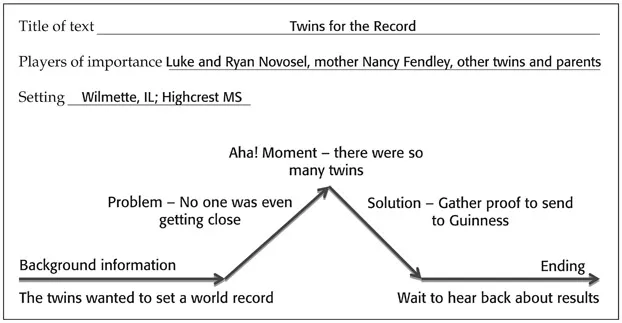
This article has all the elements of a great narrative—characters, a problem, and the beginning of a plot. It can be broken down into the elements on the Nonfiction to Narrative template (Figure 1.1):
Figure 1.1 Nonfiction to Narrative Template
If we keep reading, we are able to identify more elements of the narrative unfolding:
Then Luke and Ryan realized that there were lots of other twins in their grade at Highcrest Middle School. They did a full count, and were amazed to discover 24 sets of twins in all. Most of them are fraternal, or non-identical. Of those 24 sets, three are boy-boy, 11 are girl-girl, and 10 are boy-girl. There are only two pairs of identical twins—all girls.
“We were absolutely shocked,” Luke and Ryan’s mother, Nancy Fend-ley, told the Associated Press. The boys figured they now had their Guinness record: most pairs of twins in one grade. The current record is 16 pairs, and is shared by Valley Southwoods Freshman High School in Iowa, Staples High School in Connecticut, and Maine South High School in Illinois.

Proving the Point

Earlier this year, Luke and Ryan—with help from their parents—sent an application to Guinness. They added birth certificates, photos, and proof that all of the sets of twins attend Highcrest Middle School. They expect to hear back in several weeks on whether they actually set a new world record.
“The whole school thinks it’s the greatest thing,” Fendley said. “It’s been such a fun, creative experience.”
Figure 1.2 Completed Nonfiction to Narrative Template
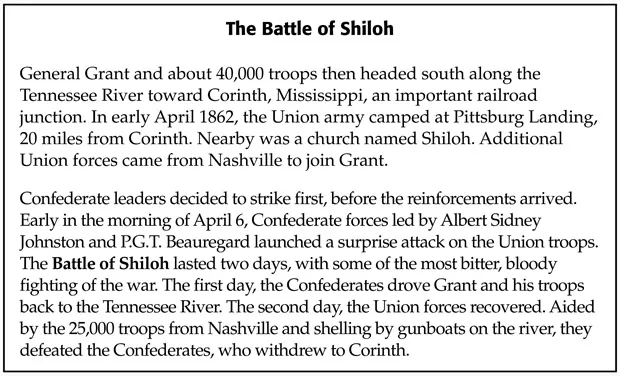
As long as the article is not to purely inform (many encyclopedia entries fit this category), most nonfiction text fits this template—even textbooks! Figure 1.3 is an excerpt of an eighth grade history textbook, which perfectly fits the Nonfiction to Narrative template.
Figure 1.3 Nonfiction to Narrative—Eighth Grade Social Studies Example
(American Journey, 2012)
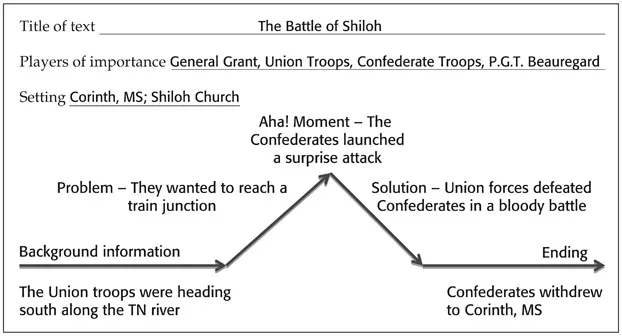
It is easy to pick out the narrative elements, as seen in Figure 1.4 (a blank template is included at the end of the chapter).
Figure 1.4 Nonfiction to Narrative Template—The Battle of Shiloh

Updated Strategy #2: Selecting Appropriate Pre-During-Post Supports for Nonfiction Texts

The KWL mentioned in the anecdote in the beginning of the chapter is there for a reason: KWLs work. The simple organization of helping students figure out what they already know about a topic before they begin reading, what they want to learn from the reading, and the place to record what they did learn is a structural tool that will never go out of fashion (Ogle, 1986).
The structure of the KWL lends itself nicely to a variety of strategies that support students before, during, and after they read. There are many great texts out there written solely about these strategies including, 50 Instructional Routines to Develop Content Literacy (Fisher, Brozo, Frey, & Ivey, 2010) and Classroom Strategies for Interactive Reading (Buehl, 2008). The strategies presented here fall into my “greatest hits” collection—they are engaging and meaningful and provide direct connections to Common Core Informational Text Standards.
I am a big believer of using routines to support learning for all students, and comprehension strategies, like the ones described below, fall neatly into a reading routine across content areas. If a grade level team can agree on a set number of strategies to use for a quarter, semester, or even a year—say three pre, three during, and three post strategies—then they will have 27 different ways they can teach any text! Each teacher can select one pre, one during, and one post strategy to use with the text and mix it up depending on the text being taught. And once the strategies are initially taught (usually by the language arts teacher), the teacher can focus on making the meaning of the text come alive. Table 1.1 lists the pre, during, and postreading strategies described in this section; more of these strategies are described throughout the book (Chapters 2, 4, 5, 8, and 10 have strategies that can be added to Table 1.1).
Table 1.1 Pre, During, and Postreading Strategies
PRE DURING POST
Tea Party Sketch to Stretch I Am Poems
Book Box Text Annotations License Plates
Prereading strategies. Prereading strategies have come under fire under the Common Core. David Coleman, an architect of the Common Core State Standards for English Language Arts, has very clearly stated that prereading activities can...
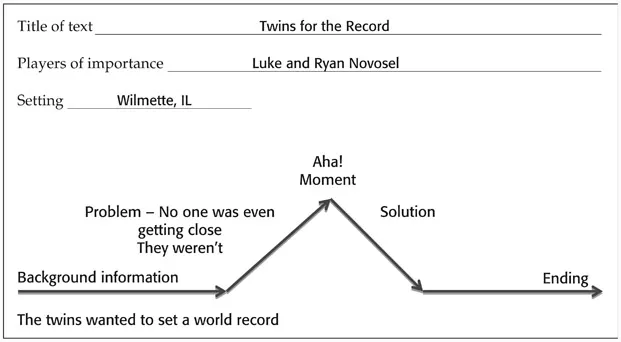
Table of contents

  1. Cover
  2. Title
  3. Copyright
  4. Dedication
  5. Contents
  6. Supplemental Downloads
  7. Meet the Author
  8. Introduction
  9. 1 Select and Instruct Nonfiction Support Strategies with Purpose
  10. 2 Provide Students with a Range of Scaffolds for Effective Summary Writing
  11. 3 Implement Quality, Differentiated Nonfiction Texts to Teach Language Arts Standards
  12. 4 Purposefully Select and Study Vocabulary Words to Support Nonfiction Reading
  13. 5 Work with Content Area Colleagues to Select Nonfiction Topics that Cross the Curriculum
  14. 6 Work with Students to Develop Strategies to Cite Evidence When Working with All Texts
  15. 7 Create and Scaffold Varied and Interesting Nonfiction Writing Assignments that Range from Informal to Formal, Depending on Purpose
  16. 8 Use Text Structure as Both a Reading and Writing Tool to Assist Students in Analyzing Any Nonfiction Text
  17. 9 Encourage Independent Reading of Nonfiction Texts as Part of a Balanced Self-Selected Reading Diet
  18. 10 Use Nonfiction for Active Comprehension Strategies Like Readers’ Theatre, Tableaux, and Character Walks