eBook - ePub
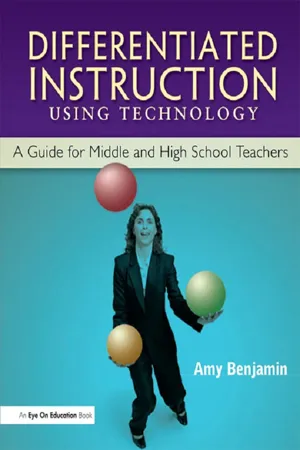
Differentiated Instruction Using Technology
A Guide for Middle & HS Teachers
- 176 pages
- English
- ePUB (mobile friendly)
- Available on iOS & Android
eBook - ePub
About this book
Like Amy Benjamin's other books, this one is easy to read and simple to implement. It demonstrates that you can manage the complexities of differentiated instruction – and save time -- by using technology as you teach. It showcases classroom-tested activities and strategies which are easy to apply in your own classroom.
Information
1
Foundations
An Overview of Differentiated Instruction
Differentiated instruction (DI) is a broad term. It refers to a variety of classroom practices that allow for differences in students’ learning styles, interests, prior knowledge, socialization needs, and comfort zones. The standards tell us what students need to know and be able to do. Differentiated instruction practices help to get students there, while at the same time teaching them how to learn in a meaningful way.
In its modern application, a differentiated classroom is widely heterogeneous, dynamic, purposeful, and intense. On the secondary level, few classes are differentiated all of the time. Whole-class instruction prevails much of the time, as new information is introduced. Differentiation can come in at any point in the learning cycle.
The pedagogical theory that guides differentiation is constructivism: the belief that learning happens when the learner makes meaning out of information. That may sound too self-evident to deserve mention. Of course, learning involves making meaning out of information. What else would learning involve? Well, if you’ve ever seen a kid memorize definitions for a list of vocabulary words without having the slightest idea of how to use, or any intention of using, those words in context, then you know what learning is not: We do not know the meaning of a word, the significance of a historical event, or the applications of a formula just because we have memorized a set of words. That is why the first step toward DI is knowing what understanding means.
Differentiated instruction, when done well, has a side benefit: Because students may have learned about different exemplars of a concept, they learn from each other when the class comes together for presentation. The concept may be something like this: “Geographical features determine economy and lifestyle.” A middle school American studies class is divided into five groups, each group applying the concept to a region of the United States. After their projects are completed, each group will present to the class; thus, time is used efficiently for durable learning of an essential concept.
The mainstays of DI are flexible grouping, unit menus, and tiered tasks. Flexible grouping distinguishes true DI classes from those that are de facto “in-class tracking.” The latter results in a rigidly stratified class in which some students feel like second-class citizens. Flexible grouping allows for a healthy socialization among members of the class. Groups can form in various configurations. Sometimes it’s appropriate to group students by ability, as demonstrated through some sort of assessment. Ability groups can be homogeneous or heterogeneous. Other times, groups can form on the basis of interest, with students choosing particular topics. Students can form their own groups, or groups can be assigned randomly. What’s important is that a differentiated classroom is a dynamic place, in which students often work collaboratively and have some choice and control of their own learning, if not the content itself, then certainly the process. Although all students need to show competency on the standards, they can sometimes find different ways to show what they know. I believe strongly, and the learning experiences in this book will show, that reading and writing needs to be emphasized in all subject areas. Differentiation absolutely does not mean that we teach around literacy skills, especially for special education students.
Unit menus are lists of choices. Some teachers set these up as choice boards or task cards. A well-designed unit menu presents an array of processes and assessments, all of which would take comparable amounts of time and effort to complete, while satisfying the same essential questions and meeting the same learning goals. This book presents numerous examples of unit menus that employ technology in the mix. You may be used to using unit menus as assessment choices. Unit menus can also be offered prior to whole-class instruction to establish a knowledge base on which students can build the details that you will be teaching. If you do this, you will have built-in experts as you teach the unit. You can also offer unit menus as the process for learning. After you’ve instructed the whole class, you can offer a menu of choices in ways to gather and synthesize information. Then, you could give a traditional test to the whole class. Unit menus capitalize on learning style. They say to the student: “Here are some ways that you can make this information yours in the way that you learn best. We are all learning the same information, but we can learn it, or show that we know it, in different ways.” Again, the language and literacy skills of the subject should be there, and all items on the unit menu should reach toward the standards.
Tiered tasks are leveled according to sophistication. Usually, there are three tiers. Students choose, or are assigned to, a particular tier. As you will see in the examples, the three tiers are not just increasingly complex versions of the same task; that would be demeaning to the students with the least demanding task. Rather, they are different kinds of tasks, but each should involve the same amount of time and effort, while satisfying the same essential questions and learning goals. Designing tiered tasks requires imagination, a variety of resources, and a thorough knowledge of the standards. The key to successful tiering is to balance fairness (of grading) with appropriateness (of task). You may have read of differentiating being “invisible” to the students. This means that students don’t feel that they or others are “getting off easy” or made to do “harder work” for the same grade. In elementary grades, this invisibility may be easier to achieve than it would be at the secondary level. For that reason, I always recommend that students have a choice in the tiered tasks, and that the grade is adjusted, reflecting the complexity of the task.
Technology in Education
The thought of bringing more technology into our classrooms, especially in terms of differentiation—an already mind-boggling thought—is overwhelming. No one could have prepared me for the tidal wave of information on the Internet available for teachers. As you learn about what’s out there, you will surely feel amazed and invigorated. But you can also expect to feel intimidated and maybe a little lost. It’s like trying to take a drink of water from a fire hydrant.
What are teachers around the country actually doing with technology? It may seem that more is happening than actually is. I run workshops in very resource-rich districts in major cities and affluent suburbs around the country. I learn a lot about what’s available and how state-of-the-art educators are using it. But I also notice many teachers’ and district Web sites that are just announcement boards or on-screen workbook pages. This book is about bringing technology to your classroom in a way that truly enriches communication and broadens a student’s world.
You may be quite sophisticated in your use of technology, but you haven’t really thought about it in terms of differentiation. You won’t need the glossaries and introductory explanations in this book that give the basics of applications and the Internet. You may want to see how you can use your Web site to provide prescriptive lessons based on work that your students e-mail you. You may be interested in setting up tiered WebQuests, or tailoring your favorite WebQuests for different levels. You may not have thought about using blogging as an assessment, or having your students use their e-speak to transition into academic language.
You may have practiced differentiation with some tiered tasks or unit menus, but have stayed away from technology except for some basic applications that you learned a few years ago. I suggest that you start to include some technology-assisted presentations on PowerPoint in your unit menus, think about how you can make instructive use of word processing, try a WebQuest or two, start taking student work through e-mail and dabble in on-screen feedback, maybe advance from paper portfolios to Webfolios.
If you are a novice at both differentiation and technology, you are in a good position to put both to use at the same time. I’ve included some vignettes showing how teachers like you put their feet in the water, implementing some simple but very effective differentiated structures that use easy applications of technology. You will be surprised, when you look at some Internet sites, such as MarcoPolo.com, EdHelper.com, MoneyInstructor.com, Myschoolonline.com, or Thirteen.org, at how much has already been done for you! If nothing else, you’ll find more lesson plans, teaching tips, professional workshops, and accessible resources for educators than you ever dreamed possible.
Technology, whether that means a sharp pencil or the most sophisticated computer, should fulfill a need that a nontech or low-tech tool will not fill. Computers are not a fad in education, but we can make the mistake of under using them by treating them as fancy workbooks.We may be used to thinking of computers as tools, but they are more than that: Computers are environments for communication and learning, for work and play.
When it comes to DI, we don’t want to put kids on computers just to keep them occupied while we work with other groups. We want computers to enhance instruction, not just parallel it. That is why, though there are countless programs and Web sites out there that offer workbook on-screen experiences, I will not be directing you to them. Even when it comes to graphic organizers, which you can download in profusion, it is my opinion that we can draw our own Venn diagrams and T charts. The same is true with educational games: Although they are useful in providing reinforcement and review of concepts taught in class, I would like to direct you to uses of technology that are truly constructivist, where students engage in higher level thinking, meaningful communication, creation of original work, and problem solving in nonlinear ways. Think of technology as a means of providing support, opportunity, and clarity.
Working Collegially
Recently, I was in my school’s computer lab with a ninth-grade class. I wanted to set up an intraclass chat room for them, and my plan wasn’t working because some unnamed force had disabled the e-mail function (so that students wouldn’t waste computer lab time with frivolous e-mail). Frustrated, I do what I always do in school whenever technology doesn’t yield to my command: I asked the kids for help. Stephen, one of my ninth-grade students, showed me how to set up a group in Yahoo, and away we went on our e-chat.
A rookie teacher using the computer behind me looked a little baffled at my surprise at being able to set up this Yahoo group. “I didn’t know to do this. Isn’t this great?” I remarked. This young teacher may have been trying to disguise his surprise at my incompetence, but he was looking at me as if I’d told him that I didn’t know how to make a peanut butter and jelly sandwich. This got me to thinking: Our young colleagues, like our students, are as used to e-communications and e-learning as we veteran teachers are to keeping a grade book by hand. We, however, have much to offer them in terms of managing multileveled, heterogeneous classes. What we know about classroom management, they know about technology. This is where we need to collaborate. As never before, novices and veteran teachers have much to offer each other.
Differentiated instruction is a lot of work, as is finding resources on the Internet and setting up a classroom Web site with prescriptive lessons. You don’t have to go it alone in either endeavor. Ideally, departments and clusters of like-minded teachers can put together all kinds of concept-based learning experiences and even keep track of what students have already done from one class and year to the next. Naturally, building a collaborative faculty is the job of leaders. Curriculum coordinators and department heads need to match teachers to one another to create in-house libraries. If teachers work collaboratively, schools can establish coherent structures for using technology to differentiate instruction.
Features of Technology that Support Differentiated Instruction
The purpose of this book is not just to encourage the use of computers, telecommunications, and multimedia; my purpose, more specifically, is to show how DI can be accomplished through technology. Once we understand what DI is all about, why shouldn’t we use technology to get us there?
♦Privacy. A thorny problem in DI is how to protect the self esteem of the student who is working on the least sophisticated task. Not only does computer work afford privacy, but it is possible to give the least sophisticated group the most sophisticated technology with which to accomplish their task. Technology is always to be thought of as just one of many options for learning.
♦Collaboration and communication skills. Although some people are concerned that computers are isolating, computers can help us bond as a class, forming a learning community. When students work in clusters, when they e-conference and e-mail, when they strategize a complex problem and share their findings, the best kinds of educational communication take place. As teachers, we need to design learning experiences that foster communication to strengthen learning.
♦Organization. If you are going to differentiate instruction, you are going to have to count on your students to do a lot of the organizational work that you might do yourself (for them) in whole-class instruction. Programs such as Inspiration Software produce outlines and graphic organizers that help students be independent. Tables, databases, and spreadsheets help them document their observations. And, of course, e-files and folders are easier to keep track of than papers (assuming proper backup procedures have been followed!).
♦Learning styles and sensory learning. Computers allow for visual, auditory, and social learning. The interplay and possibilities of learning through words, images, and sounds, as well as the availability of review, make computers extremely effective as learning tools.
♦Choices. The sheer extravagance of information available on the Internet and in software at all different levels of depth and complexity makes us understand the usefulness of computers in DI.
♦Authentic learning. Differentiated instruction tends to be projects-based, favoring authentic, constructivist activities over traditional testing (although traditional testing is still, more than ever, an important component).
In addition to the above, we acknowledge the motivational value of computers for most students. Computers are how they hear and find their music, talk with their friends, get information, shop, and entertain themselves. Many, if not most, teenagers do the majority of their reading on computers. They participate in an informal language community called e-speak. This language is not, as some people think, a degeneration of English language conventions: Rather, e-speak is one evolution of language, a cross between writing and speech. It is writing because, obviously, it uses symbols rather than voice. But, unlike writing, e-speak is quick and evanescent. The receiver is not expecting the same deliberation and adherence to rules that is normally expected in written communication. In that sense, e-speak is more like spontaneous speech. Actually, it’s a transcribed telephone call, a new form of the English language. Don’t expect it to go away.
No Teacher Left Behind
Technology has always revolutionized societies. Revolutions always have unexpected consequences. When revolutions happen, the younger generation always outpaces the older generation. As teachers, we can’t be the last to catch on; we have to be willing to learn from our students, to accept their world. If we don’t, if we teachers leave ourselves behind, then what we have to offer studentswill be irrelevant to the world that they are to inherit. They will know that this gap exists well before we do.
We have as much as educators ever have had to offer our students in terms critical thinking, love of the beautiful and the complex, unlocking meaning, perceiving subtlety, communicating clearly, transcending the obvious. But if we teach in the 21st century with the equipment of the 20th century, then we will mismatch ourselves to our students. Teaching with technology is transformative. It is we who must transform. Society already has.
As for differentiation, we need to understand how constructivist pedagogy undergirds teaching that results in durable, meaningful learning. Constructivists follow these practices:
♦Teaching subject area content and simultaneously teaching students how to learn. The content and the metacognition form parallel teaching: Students learn what they are learning, as well as how they are learning it. The former is likely to be forgotten as way leads on to way in life; the latter endures as a life skill.
♦Encouraging students to be autonomous learners, bringing new information into their experience so that it makes sense.
♦Using a variety of media, but not losing sight of reading, writing, and communicating in the language of the subject area.
♦Respecting and using the students’ home language to help them integrate academic language.
♦Teaching organically, allowing for teachable moments and inquiry that comes out of authentic student interest and open-ended questions.
♦Teaching cumulatively, thinkin...
Table of contents
- Cover
- Title Page
- Copyright Page
- Table of Contents
- Acknowledgments
- Meet the Author
- User’s Guide
- 1 Foundations
- 2 The Language of Differentiated Instruction
- 3 Tiered Tasks
- 4 Unit Menus
- 5 Using Technology to Construct Learning Centers and Stations
- 6 Differentiated Instruction in Whole-Class Instruction
- 7 Differentiating Traditional Tests
- 8 E-Communications
- 9 Prescriptives
- 10 Assistives & Tutorials
- 11 Using Databases to Make Instructional Decisions
- 12 Models
- References
- Appendix
Trusted by 375,005 students
Access to over 1.5 million titles for a fair monthly price.
Study more efficiently using our study tools.
Frequently asked questions
Yes, you can cancel anytime from the Subscription tab in your account settings on the Perlego website. Your subscription will stay active until the end of your current billing period. Learn how to cancel your subscription
No, books cannot be downloaded as external files, such as PDFs, for use outside of Perlego. However, you can download books within the Perlego app for offline reading on mobile or tablet. Learn how to download books offline
Perlego offers two plans: Essential and Complete
- Essential is ideal for learners and professionals who enjoy exploring a wide range of subjects. Access the Essential Library with 800,000+ trusted titles and best-sellers across business, personal growth, and the humanities. Includes unlimited reading time and Standard Read Aloud voice.
- Complete: Perfect for advanced learners and researchers needing full, unrestricted access. Unlock 1.5M+ books across hundreds of subjects, including academic and specialized titles. The Complete Plan also includes advanced features like Premium Read Aloud and Research Assistant.
We are an online textbook subscription service, where you can get access to an entire online library for less than the price of a single book per month. With over 1.5 million books across 990+ topics, we’ve got you covered! Learn about our mission
Look out for the read-aloud symbol on your next book to see if you can listen to it. The read-aloud tool reads text aloud for you, highlighting the text as it is being read. You can pause it, speed it up and slow it down. Learn more about Read Aloud
Yes! You can use the Perlego app on both iOS and Android devices to read anytime, anywhere — even offline. Perfect for commutes or when you’re on the go.
Please note we cannot support devices running on iOS 13 and Android 7 or earlier. Learn more about using the app
Please note we cannot support devices running on iOS 13 and Android 7 or earlier. Learn more about using the app
Yes, you can access Differentiated Instruction Using Technology by Amy Benjamin in PDF and/or ePUB format, as well as other popular books in Education & Education General. We have over 1.5 million books available in our catalogue for you to explore.