- 296 pages
- English
- ePUB (mobile friendly)
- Available on iOS & Android
eBook - ePub
About this book
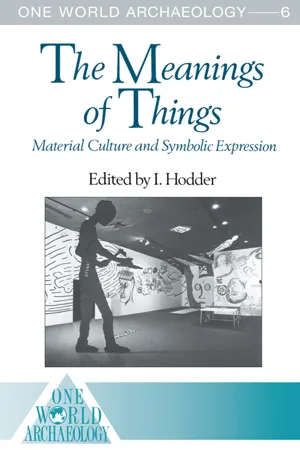
This unique and fascinating book concentrates on the varying roles and functions that material culture may play in almost all aspects of the social fabric of a given culture. The contributors, from Africa, Australia and Papua New Guinea, India, South America, the USA, and both Eastern and Western Europe, provide a rich variety of views and experience in a worldwide perspective. Several of the authors focus on essential points of principle and methodology that must be carefully considered before any particular approach to material culture is adopted. One of the many fundamental questions posed in the book is whether or not all material culture is equivalent to documents which can be 'read' and interpreted by the outside observer. If it is, what is the nature of the 'messages' or meanings conveyed in this way? The book also questions the extent to which acceptance, and subsequent diffusion, of a religious belief or symbol may be qualified by the status of the individuals concerned in transmitting the innovation, as well as by the stratification of the society involved. Several authors deal with 'works of art' and the most effective means of reaching an understanding of their past significance. In some chapters semiotics is seen as the most appropriate technique to apply to the decoding of the assumed rules and grammars of material culture expression.
Information
1 Post-modernism, post-structuralism and post-processual archaeology
Post-modernism
We are already post-modern … when we finally become free of the frame of the modern movement, when the morphology does not have to follow the function … An architecture which … has created a new reality as if we would do the shopping for the week in the ‘hypermarket’ of the memory – pieces of classic architecture, comics, and sets … mixed.
Manuel Blanco 1985. La Luna de Madrid. Madrid.
It was only in the 1970s that the historical limits of modernism, modernity and modernisation came into sharp focus. The growing sense that we are not bound to complete the project of modernity … and still do not necessarily have to lapse into irrationality or into apocalyptic frenzy.
Andreas Huyssen 1986. After the great divide: modernism, mass culture, post-modernism.
Indiana University Press.
The freedom to consume a plurality of images and goods is equated with freedom itself … As we make images and consume them, we need still more images; and still more.
Susan Sontag 1978. On photography. Allen Lane.
There is a new depthlessness, appearance is everything … All culture becomes a parody of past forms.
Sandy Nairne 1987. State of the Art. Chatto & Windus.
There’s a superabundance of explanations and purposes to suit any inquisition, any situation. That isn’t the problem. The problem is to select from an almost infinite spectrum of reasons why … The answers are all around you. The head is drenched with thoughts and images that supersede one another with such rapidity that writing and even speaking become intolerable … You don’t what any image, you want to be transparent, a projection almost seen on a cloud of cigarette smoke. And you know as you say it that all you’re doing is to make another kind of image …
Mark Boyle 1986. Beyond image: Boyle family. Arts Council of Great Britain. The false search for the ‘real’ her is exactly what the work is about … The attempt to find the ‘real’ Cindy Sherman is so unfulfillable, just as it is for anyone, but what is so interesting is the obsessive drive to find that identity.
Judith Williamson 1983. Screen. London.
Women are never acceptable as they are … at a deeper level, they (we) are somehow inherently disgusting, and have to be deodorised, depilated, polished and painted into the delicacy appropriate to our sex.
Lisa Tickner 1978. Art History 1.2.
Society is a battlefield of representations, on which the limits and coherence of any set are constantly being fought for and regularly spoilt.
T. J. Clark 1985. The painting of modern life. Thames & Hudson.
A society without power relations can only be an abstraction. Which … makes all the more politically necessary the analysis of power relations in a given society, their historical formation, the source of their strength or fragility, the conditions which are necessary to transform some and abolish others.
Michel Foucault 1982. In Art after modernism: rethinking representation, B. Wallis (ed.) New York: New Museum of Contemporary Art.
It is thoroughly engrossing for an archaeologist, a student of cultural change, to be living through the apparent ‘birth’ of a new cultural style. Yet it is surprising how difficult it is to define and understand what is happening. The more I try to tie down post-modernism, the less coherent it seems. I see ‘it’ happening all around me – in architecture, art, literature, philosophy, fashion and music. However, I feel uncomfortable with many of the analyses of it that I read. There is, of course, a growing literature by cultural analysts seeking to capture the new essence and create a theory out of the disparate events (for example, Nairne 1987, Jameson 1984, Lyotard 1984, Appignanesi 1986). Yet somehow the growth of the style seems bigger than any individual analyst’s attempts to characterize it. Ultimately it engulfs any attempt to fix it. It runs on freely, following laws that we all know but that none of us can understand. However, still I try to grasp it, understand it and control it within my structured text.
The various strands of post-modernism are alluded to in the above quotes. First, there is a sense of disillusion with the projects of science and progress. Since at least the Enlightenment, but also to some degree since the classical Greek world, there has been a notion of progress towards some better state, latterly through scientific and technological as well as through social advance. However, modernism – the high point of this development – did not deliver any eradication of inequality, poverty, inhumanity and exploitation.
Secondly, modernism is seen as having produced alienation, cynicism and detachment. Particularly in modern architecture, the individual became lost in an identical, sterile and dehumanizing world. The search for symbols of the past within post-modern architecture has, among other things, the aim of reintroducing ‘meaning’, including irony and parody, into everyday life.
Thirdly, a number of changes in society since World War II can be seen to have produced a new relation between people, meanings and images. The terms abound: post-industrialism, world capitalism, consumerism, media society and planned obsolescence. The rate of fashion and style change has increased massively. Advertising and the media penetrate ever further into our lives. People become separated from their images of themselves. The images proliferate, and anyone can be a ‘star for a day’. The images seem to be divorced from any meaning. Signifier is separated, floating free from signified. There is little remaining difference between ‘high’ and ‘low’ culture, or between fine art and kitsch. In contrast with modernism in which the meaning was in the functional form, now the facade is everything.
Fourthly, there is an awareness of the ways in which interest groups, whether these be multinationals or individuals, manipulate images in order to gain and maintain political, economic or social advantage. There is an increasing understanding that the creation of any discourse, whether in speech, clothing or fine art, is involved in power relations.
Yet when looked at in detail, these four points break down into a conflicting set of problems and questions rather than into a coherent set of answers. This new style concerns what we worry about in contemporary society. No overall solution is offered. For example, on the one hand there is an attempt in postmodern architecture to find an older ‘meaning’ for cultural products by plundering the past for classical columns and Egyptian motifs. At the same time the proliferation of de-contextualized images, the free play of signifiers, appears to constitute a radical critique of any attempt to find meaning – since everything is superficial image. Equally, some artists are convinced that the only truth left is to reach beyond image to find reality, while at the same time accepting that reality is itself only an image. Power, too, presents a contradictory situation. On the one hand power is present in all imaging and in all discourse, but to create a critique of power in a new discourse is itself to create a new power. Should we play the game of power, or somehow seek to step outside it altogether? Can we fight for a cause, while at the same time seeing that cause as no more than another image?
A brief account of one particular group of artists – the Boyle family – will accentuate these ambiguities and contradictions in a context which is of particular interest to archaeologists, and of particular relevance to this book. In an introduction to a recent exhibit of the Boyle family’s work at the Hayward Gallery in London, Mark Boyle (1987) begins with an expression of radical doubt, part of which is quoted above, concerning the relationship between art and interpretation. The polysemy of the art object, and the way explanations of the artist’s work seem to ‘take off’ into a multiplicity of debates has clearly led to a revulsion towards the creation of meaning and a cynicism towards interpretations, images and signs. Interpretations are seen as related to prejudices and preferences, manipulating the image. One reaction taken by many post-modern artists is to become overly critical, and to politicize the image. However, the reaction of the Boyle family is to go ‘beyond image’ to some ‘reality’. They want only to say of their art ‘there is this, there is this, there is this’. ‘As far as I can be sure there is nothing of me in there. [The paintings] present as accurately and objectively as I can manage certain sites randomly selected, isolated at one moment’ (Boyle 1987, p. 8).
The Boyle family thus worked under the name ‘The Institute of Contemporary Archaeology’. In the late 1960s they blindfolded friends and members of the public and invited them to fire darts at a map of the world. Each randomly selected site was then visited, and so as further to remove subjectivity of choice, a metal right angle was thrown in the air, and where it landed became the corner of their square ‘canvas’. An exact copy was made of the Earth’s surface – the sand, mud or concrete painstakingly transformed into paint and resin, strengthened with a fibreglass backing. These little random pieces of reality, frozen in time, were then displayed in galleries as art.
In this almost scientific concern with making an accurate replica of the Earth’s surface, the Boyle family talk of ‘digging’ our environment, just as an archaeologist does. It is of course one of the central paradoxes of archaeology that the objects dug up are concrete and real things, yet it is so difficult to ascribe any meaning to them. The Boyle family exploit this distance between an event and our interpretations of it. Their pieces of the Earth’s surface that are hung in an art gallery seem a mockery of traditional art and its interpretation. Their ‘archaeological’ approach ‘problematizes’ the whole process of representation. Even the ‘reality’ in their fibreglass canvases is ultimately only an image of something beyond itself, charged with meaning.
The work of the Boyle family is particularly relevant to this book and to the event from which it derives – a 1½ day session at the World Archaeological Congress in Southampton 1986. It was as if darts had been thrown at a map of the world, identifying a random set of archaeologists from more than 70 countries. Of course human action is never random, and in many ways my analogy with the Boyle family event is false. The World Archaeological Congress had been carefully planned, and many people were involved in making choices about who could attend, including governments, national archaeological services, visa departments, the organizers of the Congress and myself. Nevertheless, I did not hand-pick all of the participants in my session according to theme or approach. I solicited few of the papers, and I knew the work of very few of the participants. Even though, in rejecting some of the contributions to the Congress to produce this book (see Preface), I placed some coherence on the chapters, the end-result reflects much of the variability of the original Congress session itself. I had made limited attempts to define subthemes and to control what perspectives would dominate the discussion at the Congress. The participants arrived, more than 50 of them, as if at random, with different backgrounds, aims and expectations, to participate in a session on ‘Material Culture and Symbolic Expression’. The event was quite unpredictable, and indeed there were a number of unexpected and difficult moments during the course of the 1½ days. Certainly there was much misunderstanding, and little overall coherence. The end-result was a pastiche of contributions, interjections and movements – rather like the random pieces of the Earth shown in the Boyle family exhibition.
The event, then, was as ‘open’ and as ‘real’ as it could possibly be. The attempts made by the chairpeople of the discussions to keep the participants to any one theme were often frustrated. Because of the large size of the session and the multiplicity of special interests present, there was no time for the discourse to be set, defined and dominated. Each participant experienced the event in different ways and went away with different experiences. The overall result was decidedly ‘post-modern’ in its mixing of decontextualized, almost meaningless statements, and in the plurality of images which the participant was free to consume. The session was also self-reflexive. Anyone who attended the Congress had been forced to think hard about political issues concerning South Africa and academic freedom. The meeting was clearly political. The mix in each session of Western and Third World, West and East, and male and female was a directed attempt to erode established power relations.
Post-structuralism
Many of the corners of post-structuralism are reminiscent of the tensions at the centre of post-modernism. However, post-structuralism brings us closer both to the study of material culture and to the critical analysis of archaeological events such as conferences and books.
Post-structuralism is again an uncertain term. As used here, the term is mainly associated with a group of French writers including Foucault, Barthes, Derrida and Ricoeur. Of the many and complex strands of argument followed by these authors, I wish to emphasize only certain themes. In particular I want to characterize a central concern within post-structuralism as a movement from language to text. As Tilley (Ch. 14, p. 185) demonstrates, post-structuralism developed out of a critique of structuralism, which was itself based on Saussure’s analysis of language. Many of the aspects of this critique concern the distance between an abstract language and a particular concrete text written in that language.
There are two aspects of texts that will be discussed here. The first is that a text has to be written, and the second is that it has to be read.
(a) Within structuralism a sign has meaning by being placed in an abstract and internally structured code of presences and absences, similarities and differences. Thus ‘white’ is the opposite of ‘black’ and different from ‘while’. The structured sets of differences in the language are separated from the activity of speech – parole. It is this separation of langue and parole which makes the analysis of symbolic structures so difficult, and which accounts for the inability of structuralism to deal with social and structural change and with human activity as a creative process.
In writing a text one does, of course, use rules, structures and grammars. The text may be an article or a book, but we can also talk of spatial texts or material culture texts. Here again, rules and structuring principles (up–down, left–right, inside–outside) are employed in the organization of...
Table of contents
- Cover
- Half Title
- Title Page
- Copyright Page
- Table of Contents
- List of contributors
- Foreword P. J. Ucko
- Preface Ian Hodder
- 18 The political use of Australian Aboriginal body painting and its archaeological implications Robert Layton
- 25 Terracotta worship in fringe Bengal D. K. Bhattacharya
- 13 Iron and beads: male and female symbols of creation. A study of ornament among Booran Oromo (East Africa) Aneesa Kassam and Gemetchu Megersa
- 6 The messages of material behaviour: a preliminary discussion of non-verbal meaning Roland Fletcher
- 24 Religious cults and ritual practice among the Mendi people of the Southern Highlands Province of Papua New Guinea Theodore Mawe
- 9 Sites as texts: an exploration of Mousterian traces Lucy Jayne Botscharow
- 2 Style and changing relations between the individual and society Polly Wiessner
- 1 Post-modernism, post-structuralism and post-processual archaeology Ian Hodder
- 22 ‘We, the post-megalithic people …’ Felipe Criado
- 3 The diffusion of religious symbols within complex societies L. Carless Hulin
- 5 Social evidence from the interpretation of Middle Minoan figurines Angeliki Pilali-Papasteriou
- 11 The Priestess Figure of Malta Cristina Biaggi
- 8 Ethno-archaeological cognition and cognitive ethno-archaeology Zbigniew Kobyliński
- 21 Heresy and its traces: the material results of culture K. Teague
- 17 Etics, emics and empathy in archaeological theory E. M. Melas
- 7 Bark capes, arrowheads and Concorde: on social representations of technology Pierre Lemonnier
- 15 The artefact as abbreviated act: a social interpretation of material culture Miles Richardson
- 12 The material symbols of the Winnebago sky and Earth moieties Robert L. Hall
- 14 Interpreting material culture Christopher Tilley
- 4 Divine kingdoms in northern Africa: material manifestations of social institutions Else Johansen Kleppe
- 16 Towards an archaeology of thought Whitney Davis
- 23 Tusona ideographs – a lesson in interpretive objectivity Gerhard Kubik
- 19 Organizational constraints on tattoo images: a sociological analysis of artistic style Clinton R. Sanders
- 10 A semiotic approach in rock-art analysis Ana Maria Llamazares
- 20 Habitus and social space: some suggestions about meaning in the Saami (Lapp) tent ca. 1700–1900 Timothy Yates
- Index
Trusted by 375,005 students
Access to over 1.5 million titles for a fair monthly price.
Study more efficiently using our study tools.
Frequently asked questions
Yes, you can cancel anytime from the Subscription tab in your account settings on the Perlego website. Your subscription will stay active until the end of your current billing period. Learn how to cancel your subscription
No, books cannot be downloaded as external files, such as PDFs, for use outside of Perlego. However, you can download books within the Perlego app for offline reading on mobile or tablet. Learn how to download books offline
Perlego offers two plans: Essential and Complete
- Essential is ideal for learners and professionals who enjoy exploring a wide range of subjects. Access the Essential Library with 800,000+ trusted titles and best-sellers across business, personal growth, and the humanities. Includes unlimited reading time and Standard Read Aloud voice.
- Complete: Perfect for advanced learners and researchers needing full, unrestricted access. Unlock 1.5M+ books across hundreds of subjects, including academic and specialized titles. The Complete Plan also includes advanced features like Premium Read Aloud and Research Assistant.
We are an online textbook subscription service, where you can get access to an entire online library for less than the price of a single book per month. With over 1.5 million books across 990+ topics, we’ve got you covered! Learn about our mission
Look out for the read-aloud symbol on your next book to see if you can listen to it. The read-aloud tool reads text aloud for you, highlighting the text as it is being read. You can pause it, speed it up and slow it down. Learn more about Read Aloud
Yes! You can use the Perlego app on both iOS and Android devices to read anytime, anywhere — even offline. Perfect for commutes or when you’re on the go.
Please note we cannot support devices running on iOS 13 and Android 7 or earlier. Learn more about using the app
Please note we cannot support devices running on iOS 13 and Android 7 or earlier. Learn more about using the app
Yes, you can access The Meanings of Things by I. Hodder in PDF and/or ePUB format, as well as other popular books in Social Sciences & Archaeology. We have over 1.5 million books available in our catalogue for you to explore.