- 204 pages
- English
- ePUB (mobile friendly)
- Available on iOS & Android
eBook - ePub
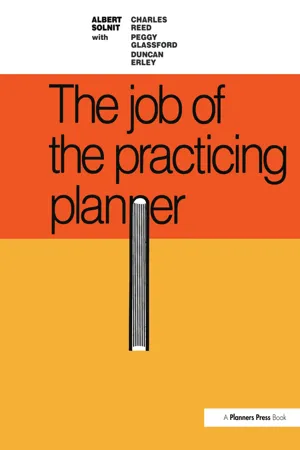
Job of the Practicing Planner
About this book
This practical handbook demystifies development review. It explains the tools of local regulation and the technical, bureaucratic, and organizational skills planners need to be effective. Solnit shows how to work with developers, evaluate projects, and use fiscal impact analysis. Includes a section on planning ethics, checklists, and tips on negotiating. Chapters by contributing authors cover subdivision plats, site plans, appearance codes, and writing zoning reports. The Job of the Practicing Planner is a perfect introductory textbook in classes for planners and a practical handbook for people already on the job.
Information
CHAPTER 1
The Tools of Local Regulation of Private Development
Albert Solnit
Pogo explains how the country ticks: "There's the public, business, and the ever-luvin' gummint. The public elects the gummint and works in business. The gummint controls business, so that business won't control the public and the public controls the gummint so that it can't control business too much or the public wouldn't elect the gummint which would hurt the controls to save the public."
Tad: "What's all these enemies of each other got to do with the country?"
Pogo: "They's not enemies, they's all the same thing. They's the country."
WALT KELLEY
Many learned discussions and scholarly articles written by academics and lawyers advance the impression that land use regulation is really a diabolical scheme to extend the powers of a faceless bureaucracy whose basic motivation is to strip away the rights of property owners, forever shackle the initiative of free enterprise, and curtail the rightful returns of business initiative. In point of fact, the United States has a vast history of disasters caused by unfettered business initiative ranging from the sweatshops and the slums of the East to the more recent land frauds in the West perpetrated by a lack of subdivision controls. Many of the regulations that are on the books today were not the initiatives of bureaucrats seeking to extend their powers over the private sector, but rather were the result of a public outcry that government should do something to protect people from further calamities. Despite all the rhetoric about overregulation, there still are new disasters, such as Times Beach, Missouri, or the Love Canal District in New York, where lack of regulation allowed the endangerment of the public health, welfare, and safety.
Traditional Purposes of Land Use Regulation
Traditionally, the purposes of land use regulation have been fairly simple. They include the following.
1. To maintain property values. This purpose is based on the theory that building and land values are preserved and enhanced by orderly as opposed to haphazard, development. An emerging concern in this area has been the enhancement and preservation of the tax base.
2. To stabilize neighborhoods and preserve their quality. The quality of neighborhoods is not determined only by the standard at which one person maintains a house, but by the desirability of all the homes surrounding a home. Traditionally, the leading indicator of neighborhood quality has been density. The folklore of real estate has it that neighborhoods with low density are generally of higher quality. This produces one of the most common battles in zoning and planning. Developers have a great incentive to locate higher density development in high-quality, low-density neighborhoods because of the obviously greater return to the same building in the more desirable location. On the other hand, the owners of the low-density housing fight vigorously to prevent the entry of such developments, contending that there is a strong tendency for high-quality, low-density neighborhoods to decline once the homogeneity of such neighborhoods is breached.
Another consideration that enters into this conflict is that economies of scale in public services and in capital improvements are present in the higher density areas, while many low-density neighborhoods really do not pay their way. In strictly fiscal terms, mixed densities are often more economically attractive to the municipal treasury. In addition, the argument is often advanced that housing mixtures are more socially desirable because they provide a wider range of affordable housing for all the residents of a community. However, one of the unspoken understandings between city officials and the owners of high-quality housing is that the city officials are expected to act as stewards of the collective investment the owners have in good neighborhoods, and woe to any public official who seems to betray that responsibility.
3. To provide uniform regulations throughout each district. For many years, the idea was that similar properties similarly situated should be treated similarly, and one of the worst deeds in the world of zoning was discriminating against or allowing a special advantage to one piece of land. This was called spot zoning—the blackest of planning sins — and is something the courts have struck down again and again.
But with the trend toward negotiable controls in the 1960s, rigid zoning controls began to give way to more flexible controls that allowed the exercise of the widest administrative discretion. In other words, a zone change under common special permit procedures or planned unit development requirements does not have to rely on the standards, lists of permissible uses, and other matters of right in a zoning ordinance. The local government's approval is very often based on the best deal it can get.
These changes meant that the practicing planner had to evolve from a plan checker to a skilled negotiator. The skill of negotiating for better development in the public interest is something that is critical to the planning agency that wants to do an effective job. This matter is so important that it will be treated later in a separate section.
4. To move traffic rapidly in safety. Probably no other purpose of land use regulations is used more frequently to argue against nonresidential development in residential areas than traffic safety. Complaints most commonly used are dangers to children and increased noise. In these types of regulations, street widths are often keyed to the intensity of activity allowed in each district. Off-street parking requirements also are justified on the basis of maintaining street capacity and public safety. As cities become more congested and parking from high-traffic generators spills into other areas, the American "right" to park anywhere on the street increasingly is being challenged by such things as residents-only permit systems (e.g., San Francisco). Reduction of traffic often is used to justify density controls and it is common for street dedications and large projects' off-site dedications to be made a condition of variances or zone changes related to lessening congestion in the streets.
5. To control aesthetics and architectural harmony. In architectural control, the courts have upheld the denial of permits for structures that are so at odds with existing structures or the nature of the district that they cause a depreciation of property values. Nevertheless, this is usually a very hazy area, and unless every structure in a district has to go through design review it is virtually impossible to regulate against bad taste in design. Many home owners to not understand that bad architecture cannot be prohibited everywhere. The city really needs to set its priorities in the general planning process and then subject to design review those new structures that might block views or desecrate historic areas or simply ruin the unity of Main Street.
Many cities arid counties have enacted such architectural controls in an effort to assure that development will be compatible and harmonious with the use and enjoyment of nearby properties. The controls deal with such things as the harmony of external design, colors, materials, and architectural features that must relate to other structures and the natural environment.
There seems to be little doubt that these regulations are legally permissible. As far back as 1960, a test case involved the city of Laguna Beach, California, which had adopted an ordinance requiring all future buildings to conform to a particular type of architecture. The California Court of Appeals upheld the validity of this action, and said that it would help to assure orderly development in the vicinity.
But the movement almost from the outset was in the direction of eventually recognizing aesthetics alone as being a sufficient reason for an ordinance. With a relatively minimal shift in emphasis, the California Court of Appeals in Van Silkin v. Brown in 1971 was able to use the word "aesthetics" broadly enough to include maintaining property values, protecting tax revenues, providing neighborhood social and economic stability, attracting business and industry, and encouraging conditions that make a pleasant community for living and working. With a definition as broad as that, there can be little question but that "aesthetics" is regarded by the courts as a proper subject of regulation.
New Vistas for Land Use Regulation
Many land use controls, either indirectly or in effect, regulate competition. Attorneys continue to debate the business of compensation and unfair takings as a result of the regulation of competition, but generally it is held that preserving the stability and profitability of existing business districts is as valid a use of the police power as stabilizing the property values (read: resale prices) of high-quality neighborhoods. There has been some talk in the legal fraternity about challenging under anti-trust statutes the prohibition of the entry of ruinous competition to existing businesses. What will come of this remains to be seen.
In recent years, any act of government that the law interprets as protection of "public health, safety, morals, and welfare" can be applied to private property. Thus, some of the newer concerns, such as the protection against negative impacts on environmental resources and the control of pollution, have become part of land use regulation. Even more recently, the enhancement of the future economy of an area and the protection of the economic stability of the governmental entity are concerns that are b...
Table of contents
- Cover
- Half Title
- Title
- Copyright
- Contents
- Foreword
- Introduction
- 1. The Tools of Local Regulation of Private Development Albert Solnit
- 2. Understanding the U.S. System of Land Use Controls Albert Solnit
- 3. Skills Needed to be an Effective Practicing Planner Albert Solnit
- 4. Working with the Developer and the Project Albert Solnit
- 5. How to Red-Pencil Preliminary Subdivision Plats Charles Reed
- 6. How to Red-Pencil Site Plans Charles Reed
- 7. Regulating Appearance Peggy Glassford
- 8. Writing Better Zoning Reports Duncan Erley
- 9. The Public Economics of Development Impacts Albert Solnit
- 10. Ethics and the Planner Albert Solnit
- Glossary
- Bibliography
- Index
Trusted by 375,005 students
Access to over 1.5 million titles for a fair monthly price.
Study more efficiently using our study tools.
Frequently asked questions
Yes, you can cancel anytime from the Subscription tab in your account settings on the Perlego website. Your subscription will stay active until the end of your current billing period. Learn how to cancel your subscription
No, books cannot be downloaded as external files, such as PDFs, for use outside of Perlego. However, you can download books within the Perlego app for offline reading on mobile or tablet. Learn how to download books offline
Perlego offers two plans: Essential and Complete
- Essential is ideal for learners and professionals who enjoy exploring a wide range of subjects. Access the Essential Library with 800,000+ trusted titles and best-sellers across business, personal growth, and the humanities. Includes unlimited reading time and Standard Read Aloud voice.
- Complete: Perfect for advanced learners and researchers needing full, unrestricted access. Unlock 1.5M+ books across hundreds of subjects, including academic and specialized titles. The Complete Plan also includes advanced features like Premium Read Aloud and Research Assistant.
We are an online textbook subscription service, where you can get access to an entire online library for less than the price of a single book per month. With over 1.5 million books across 990+ topics, we’ve got you covered! Learn about our mission
Look out for the read-aloud symbol on your next book to see if you can listen to it. The read-aloud tool reads text aloud for you, highlighting the text as it is being read. You can pause it, speed it up and slow it down. Learn more about Read Aloud
Yes! You can use the Perlego app on both iOS and Android devices to read anytime, anywhere — even offline. Perfect for commutes or when you’re on the go.
Please note we cannot support devices running on iOS 13 and Android 7 or earlier. Learn more about using the app
Please note we cannot support devices running on iOS 13 and Android 7 or earlier. Learn more about using the app
Yes, you can access Job of the Practicing Planner by Albert Solnit in PDF and/or ePUB format, as well as other popular books in Architecture & Urban Planning & Landscaping. We have over 1.5 million books available in our catalogue for you to explore.