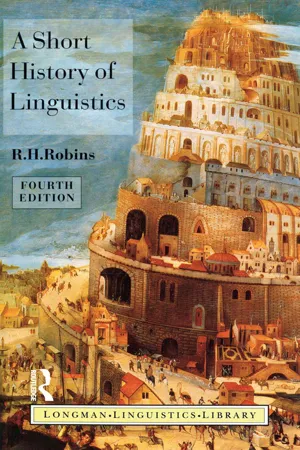
This complete revision and updating of Professor Robins' classic text offers a comprehensive account of the history of linguistic thought from its European origins some 2500 years ago to the present day. It examines the independent development of linguistic science in China and Medieval Islam, and especially in India, which was to have a profound effect on European and American linguistics from the end of the eighteenth century.
The fourth edition of A Short History of Linguistics gives a greater prominence to the work of Wilhelm von Humboldt, because of the lasting importance of his work on language in relation to general eighteenth century thinking and of its perceived relevance in the latter half of the twentieth century to several aspects of generative grammatical theory. The final section, covering the twentieth century, has been rewritten and divided into two new chapters, so as to deal effectively with the increasingly divergent development of descriptive and theoretical linguistics that took place in the latter half of this century.
Readable and authoritative, Professor Robins' introduction provides a clear and up-to-date overview of all the major issues in the light of contemporary scholarly debate, and will be essential reading for undergraduate and graduate students of linguistics alike.
- 296 pages
- English
- ePUB (mobile friendly)
- Available on iOS & Android
eBook - ePub
A Short History of Linguistics
About this book
Information
Chapter 1
Introduction
During the greater part of our lives, we accept our use and understanding of our native language without awareness, comment, or questioning. Memories of early childhood and experience in bringing up young children may cause us temporarily to ponder the complexity of every normal person's linguistic ability, and the learning of one or more foreign languages after mastering one's first or native tongue reveals just how much is involved in mankind's faculty of communication through language.
However, despite this general acceptance of the gift of articulate speech, most cultures in the world have engendered among certain of their members some realization of the scope and power of language. This linguistic self-consciousness may be first stimulated by contacts with foreign speakers, by the existence and recognition of dialect cleavage within a speech community, or by a particular orientation of man's inherent and disinterested curiosity about himself and the world around him. From this source springs 'folk linguistics', speculation or dogmatic pronouncement about the origin of language, or of one's own language, and its place in the life of the community. It may take the form of pejorative comments on other dialects and other languages; but many cultures contain aetiological myths purporting to describe the origin of language as a whole or, at least, of the favoured language of the people. The conception of language as a special gift of a god has been found in several diverse and unrelated cultures, and is itself significant of the reverence rightly accorded by reflective persons to this priceless human capability.1
In certain cultures, namely those that are for this and for other reasons credited with the title of civilizations, curiosity and awareness of one's environment have been able to grow into a science, the systematic study of a given subject or range of phenomena, deliberately fostered and transmitted from one generation to another by persons recognized for their skill and knowledge in a particular activity of this sort; and all mankind owes a great debt to those cultures that have in one way or another fostered the growth of the sciences.
Among the sciences that arise in this fashion, folk linguistics has developed in different parts of the civilized world into linguistic science. The term science in the collocation linguistic science is used here deliberately, but not restrictively. Science in this context is not to be distinguished from the humanities, and the virtues of exactness and of intellectual self-discipline on the one hand, and of sensitivity and imagination on the other, are all called into operation in any satisfactory study of language.
The sciences of man, which include linguistics, arise from the development of human self-awareness. But equally these sciences, or more strictly their practitioners, may become aware of themselves for what they are doing and for what they have done. When this scientific self-awareness includes an interest in the origin and past development of a science, we may recognize the birth of that specific discipline known as the history of science. In recent years the rapid and at times bewildering growth in linguistics as an academic subject, both in the numbers of scholars involved and in the range of their activities, has led to a corresponding growth in the interest of linguists in the past history of the subject. In part this may be due to the feeling that some understanding and appreciation of the problems and achievements of earlier generations may be a source of stability during a period of unprecedentedly swift changes in theory, procedures, and applications.
During the past thirty years the history of linguistics has established for itself a recognized and distinctive place in the teaching and research comprised by general linguistics. It has been allocated positions in the degree structures of linguistics in European, American and other universities. It appears among the courses offered in linguistics institutes, and it has its own section in the CIPL Bibliographie linguistique.
Since 1978 an International Conference on the history of the Language Sciences has met every three years, with its Proceedings published under various titles. The following societies are among those specifically devoted to the history of linguistics: La Société d'Histoire et d'Epistémologie des Sciences du langage (1978- ); The Henry Sweet Society for the History of Linguistic Ideas (1984- ); The North American Association for the History of the Language Sciences (1987- ); and the Studienkreis: Geschichte der Sprachwissenschaft (1990- ). A considerable number of books have been published on the subject over this period, some of which are listed in the booklists of the chapters in the book. Articles and reviews on the history of linguistics appear in most linguistics periodicals, but the following may be regarded as the specialist serials in the field and they should be consulted by those with particular interest in this aspect of linguistics:
Studies in the history of linguistics (volumes 1-15), thereafter generally.
Studies in the history of the language sciences (Amsterdam studies in the theory and history of linguistic science) III (1973- ).
Historiographia linguistica (1974- ).
Histoire épistémologie langage (1979- ).
Beiträge zur Geschichte der Sprachwissenschaft (1991- ).
Linguistic science today, like other parts of human knowledge and learning, and like all aspects of human cultures, is the product of its past and the matrix of its future. Individuals are born, grow up, and live in an environment physically and culturally determined by its past; they participate in that environment, and some are instrumental in effecting changes in it. This is the basis of human history. Like a people and like an intellectual or a moral conception, a science (in the widest sense) has its history. Scientists do not start from scratch in each generation, but work within and on the basis of the situation which their science, and science in general, has inherited in their culture and in their age. Historical thinking about science or about anything else in human affairs consists in the study of the temporal sequences of persons and events, and the causal connections, influences, and trends that may be discovered in them and may throw light on them.
It is tempting, and flattering to one's contemporaries, to see the history of a science as the progressive discovery of the truth and the attainment of the right methods, something of a counterpart to what has been called 'Whig history' in political historiography.2 But this is a fallacy. The aims of a science vary in the course of its history, and the search for objective standards by which to judge the purposes of different periods is apt to be an elusive one. 'The facts' and 'the truth' are not laid down in advance, like the solution to a crossword puzzle, awaiting the completion of discovery. Scientists themselves do much to determine the range of facts, phenomena, and operations that fall within their purview, and they themselves set up and modify the conceptual framework within which they make what they regard as significant statements about them.
Brief historical sketches of a subject, such as are often included in introductory textbooks, inevitably look at the past through the eyes of the present, concentrating on those aspects of earlier work that seem either peculiarly relevant or, on the other side, shockingly irrelevant, to present-day approaches. This is quite proper, indeed it is almost inevitable, in such limitations; but it carries with it the danger of evaluating all past work in a subject from the point of view in favour at the present, and of envisaging the history of a science as an advance, now steady, now temporarily interrupted or diverted, towards the predetermined goal of the present state of the science.
This does not mean that one should exclude the evaluation of past work against later achievements and against the present position in the same field, where there is reason to see therein a definite advance. Indeed, such comparisons may be rewarding, in that they show which aspects of a science were most favoured by particular circumstances and in particular periods and areas of civilization. What is needed is an attempt to discern the evolution of the past into the present and the changing states of the science in its changing cultural environments. One should strive to avoid the deliberate selection of only those parts of earlier work that can be brought into a special relationship with present-day interests.
If history is to be more than just an annalistic record of the past, some subjective judgement is inevitable in the ordering and in the interpretation of events; hence the classic statement that there can be no unbiased history. In the history of a science, and in the present case in the history of linguistics, there is the additional subjective element involved in determining what activities and aims on the part of earlier workers shall be deemed to fall within its sphere and so to belong to its history. In order not to impose the standards of linguistics today on the decision about what to admit as linguistic work from the past, we may agree to understand as part of the history of linguistics any systematic study directed towards some aspect or aspects of language envisaged as an interesting and worthy object of such study in its own right.
Changes and developments in a science are determined by a number of causes. Every science grows from its past, and the state reached in a previous generation provides the starting point for the next. But no science is carried on in a vacuum, without reference to or contact with other sciences and the general atmosphere in which learning of any sort is encouraged or tolerated in a culture. Scientists and persons of learning are also people of their age and country, and they are participants in the culture within which they live and work. Besides its own past, the course of a science is also affected by the social context of its contemporary world and the intellectual premises dominant in it. Applications of the science, its uses for practical purposes and the expectations that others have of it, may be a very important determinant of the directions of its growth and changes. In linguistics, as elsewhere, attempted and projected applications, practical ends to be achieved, have often preceded the statement of the theoretical positions on which they implicitly depend.
Scientists are not all alike in ability, motivation, and inspiration. All practitioners must learn their craft and master the state of their science as it is presented to them when they enter upon it; and if it is to continue, some must teach it in turn to others. Probably most scientists must be content to do no more than that, but every lively branch of knowledge attracts a few persons of outstanding enterprise who are able to take some control of its direction and to respond positively to the challenges that the present inherits from the past. Such persons think more deeply and question accepted theory and practice more searchingly. If a culture is not to be entirely static they are a necessity, and in our own European history it is fortunate that ancient Greece of the classical age produced people of this character in hitherto unprecedented numbers and of unprecedented qualities, in so many spheres of human thought and activity.
When some lead, others follow; and leaders and innovators in a science, given favourable circumstances or making for themselves favourable circumstances, become the founders of schools, with disciples and followers continuing the exploitation of the lines of thought or practice developed by the founder or leader. Changes in scientific thinking and in scientific attitudes may arise from outside or from inside the science whose history is being traced. The existing state of a science, the starting point for any change, is the product both of external and internal factors. The general contemporary intellectual and social context, whether favouring stability or encouraging change, is largely external to the particular science itself, although each science and branch of learning is a part of the whole context along with all the others and with the general cultural attitude towards learning.
Following these considerations one may look further and perhaps more deeply into the history of a science, in our own case linguistics, by seeking to identify and set forth, not just the beginnings and the development of the publications, the conceptual categories and systems, and the finished products of successive practitioners, but also the ways and the contexts in which their thoughts were fashioned and directed. As linguists are members of a society and a part of its cultural tradition and milieu, their thinking will have ranged further than thinking specifically about language. We may find ourselves asking not so much what they wrote and taught, but more fundamentally why and how they came to engage in such thinking and teaching. In this way the history of linguistics may be envisaged both within the history of the sciences and within the general history of ideas among mankind.
When the dominant innovators in a science respond to the challenge of a situation that demands some change in its practice, this may take a number of forms, and...
Table of contents
- Cover
- Title
- Copyright
- Contents
- From the preface to the first edition
- Preface to the second edition
- Preface to the third edition
- Preface to the fourth edition
- Dedication
- 1 Introduction
- 2 Greece
- 3 Rome
- 4 The Middle Ages
- 5 The Renaissance and after
- 6 The eve of modern times
- 7 Comparative and historical linguistics in the nineteenth century
- 8 Linguistics in the twentieth century: first period
- 9 Linguistics in the twentieth century: second period
- Index
Trusted by 375,005 students
Access to over 1.5 million titles for a fair monthly price.
Study more efficiently using our study tools.
Frequently asked questions
Yes, you can cancel anytime from the Subscription tab in your account settings on the Perlego website. Your subscription will stay active until the end of your current billing period. Learn how to cancel your subscription
No, books cannot be downloaded as external files, such as PDFs, for use outside of Perlego. However, you can download books within the Perlego app for offline reading on mobile or tablet. Learn how to download books offline
Perlego offers two plans: Essential and Complete
- Essential is ideal for learners and professionals who enjoy exploring a wide range of subjects. Access the Essential Library with 800,000+ trusted titles and best-sellers across business, personal growth, and the humanities. Includes unlimited reading time and Standard Read Aloud voice.
- Complete: Perfect for advanced learners and researchers needing full, unrestricted access. Unlock 1.5M+ books across hundreds of subjects, including academic and specialized titles. The Complete Plan also includes advanced features like Premium Read Aloud and Research Assistant.
We are an online textbook subscription service, where you can get access to an entire online library for less than the price of a single book per month. With over 1.5 million books across 990+ topics, we’ve got you covered! Learn about our mission
Look out for the read-aloud symbol on your next book to see if you can listen to it. The read-aloud tool reads text aloud for you, highlighting the text as it is being read. You can pause it, speed it up and slow it down. Learn more about Read Aloud
Yes! You can use the Perlego app on both iOS and Android devices to read anytime, anywhere — even offline. Perfect for commutes or when you’re on the go.
Please note we cannot support devices running on iOS 13 and Android 7 or earlier. Learn more about using the app
Please note we cannot support devices running on iOS 13 and Android 7 or earlier. Learn more about using the app
Yes, you can access A Short History of Linguistics by R.H. Robins in PDF and/or ePUB format, as well as other popular books in Languages & Linguistics & Historical & Comparative Linguistics. We have over 1.5 million books available in our catalogue for you to explore.