The concept of intelligence, and its measurement, present us with a curious paradox. On the one hand, we have hardboiled scientists devoting their lives to the exploration of cognitive abilities, and expert in the complex statistics that are involved in testing theories about intelligence, regarding this body of work as an outstanding success of experimental psychology, marking the first triumph in actually measuring, with considerable accuracy, a mental quality. On the other hand, we have journalists, media people, and even the occasional scientist drifting in from other disciplines, not expert, or even knowledgeable in the field, decrying the whole effort as a waste of time, futile busywork, socially divisive, and useless in practice. This surely is an odd situation, particularly when we find that intelligence testing has attracted much political hostility—Hitler banned it because it was Jewish, Stalin because it was bourgeois. (They banned Einstein’s relativity theory for the same reasons!)
What are the main criticisms and questions you can hear over and over again in the media? One frequent assertion is that psychologists can’t agree on the nature of intelligence, and thus obviously have no idea what it actually is. Another assertion maintains that IQ tests have no practical importance, and measure nothing but the ability to do IQ tests. A third assertion is that the notion that IQ differences are largely due to genetic causes has been conclusively disproved since certain results reported by Sir Cyril Burt have been suggested to have been fraudulent. A fourth assertion states that IQ testing was invented to maintain the “status quo,” favouring the ruling class, and helping to suppress the working class. And as a fifth and final assertion we have the notion that IQ testing is a tool of racists to demonstrate the superiority of the white race. These five assertions have achieved great popularity among the uninformed; they share one characteristic in common—they are all completely false. I shall discuss them all in detail in due course, but will begin by briefly discussing each in turn.
1. Psychologists disagree about the nature and definition of intelligence
In 1988, Mark Snyderman and Stanley Rothman published a book, The IQ Controversy, which contained the answers of over 600 experts in the fields of intelligence testing, educational psychology, developmental psychology, behavioural genetics, sociology and education, cognitive science, counselling psychology, and occupational psychology to questions about intelligence, 99.3 percent agreed on the importance of abstract thinking and reasoning; 97.7 percent on problem-solving ability, and 96.0 percent on the capacity to acquire knowledge. This does not suggest a lack of agreement, and indeed these definitions agree well with common sense—we tend to call somebody intelligent who can reason clearly, think well in abstract terms, solve mental problems, and learn rapidly. Why then the notion that psychologists disagree?
Psychologists often describe the many things a high IQ enables us to do. These are indeed manifold, but to concentrate on one or the other does not imply disagreement on the nature of intelligence itself. Physicists may study many different consequences of gravitation—the apple falling on Newton’s head, the globular shape of the planets, the creation of the galaxies, the movements of the planets, the occurrence of tides, the existence of black holes, the laws of gunnery. This does not mean that physicians are in disagreement on the fundamental law of gravitation. Similarly, many different consequences can be deduced from the postulation of a factor of general intelligence, but that does not imply disagreement on its nature. There are of course debates about important aspects of intelligence, but then so are there debates about the nature of gravitation—is it a distortion of Einstein’s space-time continuum, is it a question of particle interaction, “gravitons” as quantum mechanics would have it, or what? Complete agreement on everything is not necessary to make a concept meaningful.
5. IQ testing was introduced to bolster the claims of the white race to superiority
Tests are essentially colour-blind, and give an objective estimate of intellectual ability. If anyone fancied, or hoped, that they would prove the superiority of the white (Caucasian) race he would have been bitterly disappointed. The races showing the highest IQ are the mongoloid races—Japanese, Chinese, Korean; whites are certainly not at the top. The highest scores go to the Jews who probably should not be counted as a race but as a religious sect; nevertheless, it will hardly gratify racist groups to find Jews at the very pinnacle of intellectual achievement!
All these criticisms tend to have a political context, as one might have anticipated from the dislike expressed towards IQ testing by Hitler and Stalin, brothers-in-arms to ban any signs of objectivity from the political landscape. Modern writers who seek to castigate IQ testing often sail under the flag of Marxism; this would include people like Steven Rose, Leon Kamin, and R.L. Lewontin, whose book, Not in Our Genes, received much favourable attention from journalistic reviewers in the media, and severe criticism from experts writing in scientific journals. The same was true of Stephen Jay Gould, whose book, The Mismeasure of Man, has more factual errors per page than any book I have ever read. Actually these writers, and many others who had added their voices to the Marxist choir, have not even been able to quote Marx and Lenin accurately. Here is a definitive statement from Lenin that should clear the air: “When one says that experience and reason testify that men are not equal, then one understands under equality the equality of abilities or the equivalence of bodily strength and mental capacities of men. It is quite obvious that in this sense men are not equal. No single reasonable man and no single socialist ever forgets this.”
Lenin goes on to characterize as an “absurdity” the idea of extending equality into these spheres and concludes by saying, “When socialists speak of equality, they understand thereby social equality, the equality of social position, but not at all the equality of physical and mental abilities of individual persons.” Even the Communist Manifesto asks “from each according to his abilities,” postulating differential abilities even after the communist heaven has been achieved!
I will not deal with political arguments any further. I am a scientist, not a politician, and while it is obvious that scientific findings may have social and political implications, these are never apparent, and the uses made of scientific findings depend more on one’s value system than on the facts discovered. When you find that a given person, or group of persons, has a low IQ, you may say, “Let them sink to the bottom where they belong,” or you may say, “Let us do whatever we can to allow them to develop whatever gifts they have to the utmost of their ability.” Facts are objective, decisions subjective. We may not like the facts, but they are stubborn; facts are the products of nature, and scientists are merely the messengers who seek and pass on the messages nature has for us. Don’t shoot the messenger, he is doing his best!
The notion is quite popular that the concept of “intelligence” is very modern and was invented by psychologists less than 100 years ago. It is also often said to be purely Western, and geared to capitalist economics. But of course intellegentia was used by the ancient Romans in much the same way we use the term “intelligence,” and even earlier the Chinese elaborated ideas about intelligence that are very similar to our own most modern views. Thus almost 2,500 years ago this concept was clearly defined by Confucius. He and his followers regarded it as being related to having a “top brain” and a quick mind, a reference to speed of mental functioning that we shall find amply supported by the most recent experimental studies. He also emphasized sensory discrimination, that is, the quality of eyes and ears to take in information, and use it to discriminate between different precepts. Again, the idea was used by Charles Spearman in 1904 to construct tests of intelligence which later work showed to correlate quite well with IQ tests. Confucius categorized people into three types: superior, medium, or inferior—“as stupid as two spring worms,” as the Chinese put it. This classification, of course, reminds us of Plato’s men of gold, of silver, and of brass, again referring to differences in mental ability.
Confucius laid it down that all people should be taught regardless of their ability, but type of education should be according to their ability. This again agrees well with modern achievement doctrines, as does his distinction between general ability and specific abilities, which we shall come across later on in its modern form. Finally, Confucius made the distinction between tian zi, the mental ability given by heaven, and shuan chang, the result of learning through training and education, an adumbration of theories of nature and nurture. The Chinese had no doubt about the importance of heredity in this context. They phrased this notion in terms of intelligence being a “gift from heaven”; thus an intelligent person is described as being de thian du hou, meaning “getting a uniquely big share from heaven.”
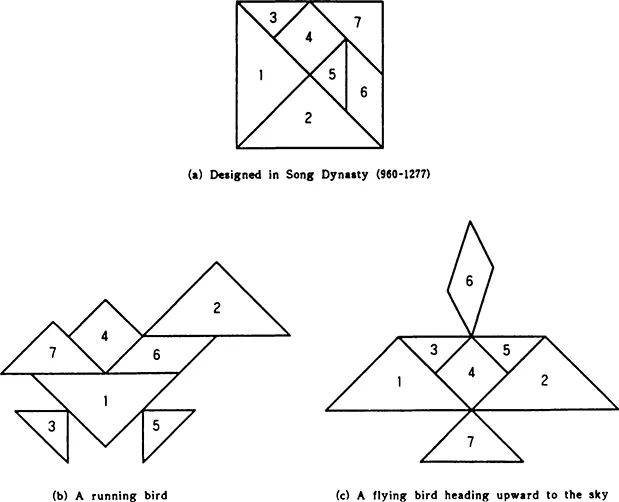
It would be equally wrong to imagine that intelligence tests are of modern vintage. Over one thousand years ago, the Chinese elaborated a test called the “Seven Coincidence Boards,” or wisdom boards; these closely resemble the Form Boards used in modern nonverbal intelligence tests. The wisdom boards can be manipulated to form a variety of figures, as shown in figure 1.1, thus testing visuo-spatial perception, divergent thinking, and creativity, although of course they did not form part of a psychometrically tested, explicit theory of mental ability. But implicitly China relied for 2,000 years on a civil service selected objectively by means of examinations open to all, and almost certainly correlating quite highly with IQ, this produced the longest period of existence for any civilized society the world has ever known, and also led to the discovery of many scientific and technical facts and inventions thousands of years before Europe was able to emulate the Chinese sages. As these few lines show, this tendency to outpace Europeans in scientific discovery extends even to the field of intelligence; here too the Chinese have anticipated most of our theories and practices, but as in physics, chemistry, medicine and astronomy, without putting their findings into an explicit theoretical context, or elaborating them into a properly organized practice.
Before going into detail about IQ measurement, it may be useful to say a few words about the concept of intelligence, if only because it is often used in different ways by different people, or even by the same person in different contexts, and this often causes confusion. One might even say that most of the confusion that is often apparent in public debates is due to simple misunderstandings that could easily be avoided with a little care. Let us start with a historical note. Our term “intelligence” comes from two Latin words: intellegentia and ingenium. The former, when you consider the ways Cicero used the term, means something like “understanding” and “knowledge”; the latter “natural disposition” or “ability.” These are two meanings of our term, intelligence, that have always adhered to it. Fundamental to intelligent behaviour is an underlying disposition that enables us to reason, to think abstractly, to learn. The greater this ability, the more we are likely to learn, and to know. This knowledge is thus itself a sign of high intelligence, although in a sense derivative. Raymond Cattell, one of the famous names in intelligence research, labelled these two aspects of intelligence “fluid” and “crystallized ability.” “Fluid ability” refers to the dispositional concept, the ability to acquire many kinds of knowledge. “Crystallized ability” refers to the knowledge already gained. Scientists will recognize the same sort of difference as that between potential and kinetic energy. Fluid ability is often written gf, crystallized ability gc, where g refers to general intelligence.
Figure 1.1 Chinese Seven Coincidence Board (wisdom board)
Nine-hundred-year-old intelligence test used in China. The task is to use the seven pieces in (a) to construct meaningful figures, as in (b) and (c).
These two aspects of intelligence are of course closely related. A vocabulary test is one of the best measures of intelligence because it is obviously a test of gc, the number of words acquired by listening and reading is a function of gf provided the environment contains a sufficient supply of spoken and written words. Tests of gf contain no material that would not be familiar to everyone of a given age; the problem in each case cannot be solved by acquired knowledge. For example, the sequence of numbers:
2 4 7 11 16 ?
obviously requires for an answer the number 22, but this has to be worked out. The elements, simple numbers, are known to everyone. Of course this is a very simple test of gp but it will illustrate the point. Even tests like this demand some small amount of knowledge, and if that is not forthcoming the test will be me...