This volume represents an advance in our understanding of how to represent and reason about organizational phenomena. Although organizational theorists have long grappled with the complexities of adaptive agents, ecological systems, and non-linear relations among the basic elements of organizational design, they have not, until recently, had the tools to grapple with these complex relationships. Recent advances in logic, symbolic programming, network analysis, and computer technology have made possible a series of tools that can be used to understand the complexities of organizational behavior. New computational techniques make it possible to develop and test more realistic models of organizational behavior. This volume offers examples of this new breed of models, and provides insight into how these advances and techniques can be used to extend our theoretical understanding of organizations.
Authored by leading researchers in the area of computational organization theory, the various chapters demonstrate the value of computational analysis for organizational theory and advance our understanding of the relationship between organizational design and performance. This book contains both theoretical and methodological contributions that enable organizational theorists to use computational and mathematical techniques to systematically address the complex relationships that underlie organizational life. It also presents new -- or sometimes, renewed -- approaches on how to conduct organizational research from multiple formal perspectives including: simulation, numerical analysis, symbolic logic, mathematical modeling, and graph theory.

eBook - ePub
Computational Organization Theory
- 336 pages
- English
- ePUB (mobile friendly)
- Available on iOS & Android
eBook - ePub
Computational Organization Theory
About this book
Information
Publisher
Psychology PressYear
2014Print ISBN
9781138971400
9780805814064
Edition
1eBook ISBN
9781317781158
1
The “Virtual Design Team”: Simulating How Organization Structure and Information Processing Tools Affect Team Performance
This chapter reports the initial results of research to build and test a computer simulation model of information processing and communication in a multidisciplinary engineering design organization. The Virtual Design Team (VDT) is a computational discrete event simulation model incorporating qualitative reasoning concepts derived from artificial intelligence research. VDT explicitly incorporates information-processing and communication models from organization theory that allow qualitative predictions of organizational performance. The inputs to VDT are a description of the design task and the subtasks that comprise it, including sequential dependencies between subtasks; a description of the actors in the design team and of their organizational structure; and a listing of the communication tools (e.g., facsimile, voice mail, electronic mail, meetings) available to each actor. The output of VDT is a prediction of the total processing time required to complete all subtasks (a surrogate for total labor cost of design), and of the duration to complete the entire design project along the longest or critical path through subtasks. VDT's behavior has been validated extensively for internal consistency. Its behavior also compares well with theoretical predictions about, and the observed behavior of, a 120-person team engaged in the design of a large petrochemical refinery. The simulation model can serve as a facility to formulate and test specific conjectures regarding the qualitative effect on project cost and duration of changes in the organization structure of the team, or in the communications tools available to participants. Engineering disciplines have long had mathematical models and, more recently, numerical computational models, tosupport analysis and optimization of physical systems. This work provides initial evidence that symbolic computer modeling can be used to express and test social science theories applied to real world organizations and the communication tools that they employ.
The goal of the Virtual Design Team research project is to develop computerized analysis tools to support the systematic design of organization structures —including the communication tools that permit data, decisions, and knowledge to be shared within and between organizations — for complex, project-oriented tasks. We begin by sketching out the nature of a systematic design process to show the crucial role of analysis tools in design.
Design of artifacts to meet human needs—whether they be physical artifacts such as buildings, or social artifacts such as business organizations—is a ubiquitous human activity and can be broken down into the following generic steps:
1. Requirements definition—A set of functional, esthetic, and other objectives for the artifact is specified, along with cost, time, regulatory, and other constraints; the required behavior of key subsystems and components can be derived from this set of objectives and constraints for the artifact.
2. Synthesis—A candidate design solution is synthesized, typically by selecting elements from sets of more or less standard primitive components or features, connecting them (to provide load paths, fluid flow channels, information communication channels, etc.), and locating the elements in space.
3. Analysis —The behavior of each candidate solution is predicted by simulating the behavior of the system of connected primitive elements, using cognitive, physical, mathematical, or computational models.
4. Evaluation—The behavior of each candidate solution's subsystems (at whatever level of detail is deemed necessary) is compared against the derived requirements for subsystem behaviors.
5. Acceptance or recycling —Based on the evaluation of performance, a candidate solution is accepted or cycles back to synthesis, with changes guided by the latest evaluation results (Levitt, Jin, & Dym, 1991).
If analysis capabilities are lacking in a given domain, then the relative performance of alternative syntheses cannot be predicted and compared a priori. In this case, evaluation must be based on experience with a given synthesis, so that the design process reverts to adaptation of past experience.
For physical systems such as chemical plants or complex building structures, the behaviors of interest (e.g., reaction products or deflections) can often be predicted by solving sets of equations involving continuous numerical variables. Since the 1960s, the analysis phase of design for many kinds of physical artifacts has been revolutionized by the use of computational analysis tools that have greatly speeded up analysis and have extended its range to situations where closed-form mathematical analysis was previously impossible. Because of this, design has become highly formalized in these engineering domains, and tremendous progress has been made both in understanding the behaviors of interest in each domain and in generating interesting new syntheses, greatly extending the range of artifacts that can be designed and manufactured safely and economically.
In contrast, the use of computers to support analysis in the design of social systems has been very limited. Most organizational behaviors of interest to scientists or managers can only be represented as discrete, nominal, or ordinal variables, leading to a mismatch between these theories and the continuous, quantitative models suited to traditional simulation techniques. Consequently, as Tatum (1984) found, managers of large design and construction projects—like most managers designing large-scale organizations to carry out complex tasks —still rely on adaptation of past organization structures, rather than on systematic generation and evaluation of alternatives, in designing their organization structures.
During the 1980s, artificial intelligence (AI) researchers developed techniques for representing discrete, nonnumerical variables, and for reasoning rigorously about relationships between them (Kunz, Stelzner, & Williams, 1989). These qualitative reasoning techniques provide researchers with a powerful new set of tools to begin developing computational models of problem domains that require qualitative reasoning with discrete, nonnumerical variables (Clancey, 1989). A number of engineering researchers have embraced AI techniques to begin formalizing other phases of design, in particular synthesis of physical artifacts and assembly sequences to manufacture them (Coyne, Rosenman, Radford, Balachandran, & Gero, 1990; Levitt, 1990).
Although others have proposed the use of artificial intelligence modeling ideas to simulate micro-organizational behavior (e.g., Bushnell, Serf arty, & Kleinman, 1988; Carley, Kjaer-Hansen, Newell, & Prietula, 1992; Cohen, 1986; Masuch & LaPotin, 1989), the Virtual Design Team is a pioneering effort to employ ideas from artificial intelligence for modeling the behavior of full-scale organizations (Cohen, 1992; Cohen & Levitt, 1991). Our long-range goal is to develop robust computer simulation models of large-scale, concurrent engineering organizations in order to predict the impact of alternative task definitions, organization structures, and communication tools on the quality, cost, and production time of their products. The VDT model described here is a first step toward that goal: Given detailed descriptions of tasks, actors (individuals and groups), communication tools available to actors, team organizational structure, and a definition of the tasks involved in design of the product, VDT predicts the duration of the design project. The current version of VDT treats the tasks, actors, and product as fixed, and examines the impact of alternative communication tools and organizational structures on the productivity of the design team.
To verify our representation and reasoning framework, we chose to test VDT by observing and modeling a large petrochemical design project. This project was selected as a test case because the engineering design issues were well understood, without significant or novel technical problems.
ORGANIZATION CONCEPTS REPRESENTED IN VDT
The basic premise of the VDT model is that organizations are fundamentally information-processing structures —a view of organizations that dates back to Max Weber's work in the early 1900s, and that is elaborated in the work of March and Simon (1958), Simon (1976), and Galbraith (1977). In this view, an organization is an information-processing and communication system, structured to achieve a specific set of tasks, and comprised of limited information processors (individuals or subteams). These information processors send and receive messages along specific lines of communication (e.g., formal lines of authority) via communication tools with limited capacity (e.g., memos, voice mail, meetings). To capture these characteristics and constraints, VDT employs explicit descriptions of tasks, communications, actors, tools, and structures. Thus, for example, each modeled manager has specific and limited (boundedly rational) information-processing abilities, and managers send and receive messages to and from other actors along prespecified communication channels, choosing from a limited set of communication tools. The view of organizations that we have implemented is presented in Fig 1.1.
Task
Our goal is to analyze engineering design teams carrying out routine designs. We therefore view the task of the design team as the completion of a set of predetermined activities. These activities consist of the design, review, and approval of a series of components or subsystems of the artifact to be designed. For instance, in the case of a refinery, the activities include chemical process design, piping design, and structural design. Each activity involves processing of an amount of information defined as the magnitude of the activity, and communication of information between and among design team participants. These activities are modeled as being sequentially interdependent (Thompson, 1967)—that is, the output of a given task is the input for a succeeding task. Thus, the subtasks can be represented in a precedence network.
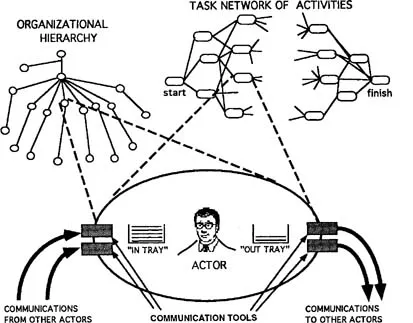
FIG. 1.1. Overview of the virtual design team. VDT models the design task, actors, organization structure, and communication tools. The design task is broken down into a series of activities with precedence relationships and responsible actors. Actors are modeled as information processors with rules for attending to communications waiting for the actor's attention in an “in tray,” and rules for deciding which communication tool to employ for sending communications to other actors via an “out tray.” The organization structure is defined in terms of communication paths between actors, and the level of the hierarchy at which reviews and approvals can be made. Communication tools, such as meetings, telephones, voice mail, electronic mail, file sharing, and so forth, are modeled in terms of attributes such as synchronicity and bandwidth for communications involving different natural idioms (e.g., text, schematics, three-dimensional geometry). Activities are processed as multiple chunks of information termed communications in a stochastic, discrete event simulation.
Because the purpose of VDT is to predict task duration rather than to automate design, we can use an abstracted description of design tasks and the activities that comprise them. Each activity description includes the magnitude of the activity, expressed in terms of the expected number of “communications” needed to satisfy its objectives; precedence constraints with related activities; complexity (high, medium, or low); variability (high, medium, or low); percentage completed; and budgeted duration. In addition, we introduce the notion that both communication and information processing for a given activity will be most effectively performed if the information is represented in an appropriate natural idiom (e.g., text, schematics, three-dimensional geometry). For instance, dimen...
Table of contents
- Cover
- Half Title
- Title Page
- Copyright Page
- Table of Contents
- Foreword
- Introduction: Computational Organization Theory
- 1 The “Virtual Design Team”: Simulating How Organization Structure and Information Processing Tools Affect Team Performance
- 2 Evolving Novel Organizational Forms
- 3 TASCCS: A Synthesis of Double-AISS and Plural-Soar
- 4 ACTS Theory: Extending the Model of Bounded Rationality
- 5 Graph Theoretical Dimensions of Informal Organizations
- 6 A Theoretical Evaluation of Measures of Organizational Design: Interrelationship and Performance Predictability
- 7 Modeling and Computational Analysis of Reactive Behavior in Organizations
- 8 Validating an Expert System That Designs Organizations
- 9 Computer Simulations of Organizations as Experiential Learning Systems: Implications for Organization Theory
- 10 Social Dilemmas and Fluid Organizations
- 11 Human and Artificially Intelligent Traders in Computer Double Auctions
- 12 Team Coordination Under Individual and Team Goals
- 13 A Decision Logic for Operational Risk Management
- Author Index
- Subject Index
Trusted by 375,005 students
Access to over 1.5 million titles for a fair monthly price.
Study more efficiently using our study tools.
Frequently asked questions
Yes, you can cancel anytime from the Subscription tab in your account settings on the Perlego website. Your subscription will stay active until the end of your current billing period. Learn how to cancel your subscription
No, books cannot be downloaded as external files, such as PDFs, for use outside of Perlego. However, you can download books within the Perlego app for offline reading on mobile or tablet. Learn how to download books offline
Perlego offers two plans: Essential and Complete
- Essential is ideal for learners and professionals who enjoy exploring a wide range of subjects. Access the Essential Library with 800,000+ trusted titles and best-sellers across business, personal growth, and the humanities. Includes unlimited reading time and Standard Read Aloud voice.
- Complete: Perfect for advanced learners and researchers needing full, unrestricted access. Unlock 1.5M+ books across hundreds of subjects, including academic and specialized titles. The Complete Plan also includes advanced features like Premium Read Aloud and Research Assistant.
We are an online textbook subscription service, where you can get access to an entire online library for less than the price of a single book per month. With over 1.5 million books across 990+ topics, we’ve got you covered! Learn about our mission
Look out for the read-aloud symbol on your next book to see if you can listen to it. The read-aloud tool reads text aloud for you, highlighting the text as it is being read. You can pause it, speed it up and slow it down. Learn more about Read Aloud
Yes! You can use the Perlego app on both iOS and Android devices to read anytime, anywhere — even offline. Perfect for commutes or when you’re on the go.
Please note we cannot support devices running on iOS 13 and Android 7 or earlier. Learn more about using the app
Please note we cannot support devices running on iOS 13 and Android 7 or earlier. Learn more about using the app
Yes, you can access Computational Organization Theory by Kathleen M. Carley, Michael J. Prietula, Kathleen M. Carley,Michael J. Prietula in PDF and/or ePUB format, as well as other popular books in Psychology & History & Theory in Psychology. We have over 1.5 million books available in our catalogue for you to explore.