eBook - ePub
Creating Social Value
A Guide for Leaders and Change Makers
- 179 pages
- English
- ePUB (mobile friendly)
- Available on iOS & Android
eBook - ePub
Creating Social Value
A Guide for Leaders and Change Makers
About this book
There is a new business landscape, where companies are increasingly being judged on their ability to generate _social value_. But there is no off-the-shelf solution for the leaders and change makers in this new domain. Creating social value is a journey, and each company must chart its own path through uncertain and complex terrain. We invite you to discover how the entrepreneurial leaders profiled in this book have become trailblazers, using strategy and innovation to generate profits and social value simultaneously.Creating Social Value provides insights into the motivations and preoccupations of groundbreaking entrepreneurial leaders as they look to activate change not just within their companies, but also in their sectors, value chains and even through co-creating partnerships with their competitors. Such change requires fundamentally new styles of leadership and business design where companies seek to be generative rather than extractive.This book also bears witness to the emergence of new language to describe these innovative concepts. Working with and sharing ideas with social entrepreneurs and entrepreneurs inside, the authors became aware of the building blocks of a new lexicon with the power to inspire and positively influence the culture of an organization. Many of the leaders included in this book have driven change by harnessing the power of language to reroute their company's direction.For example, The Campbell Soup Company has created _destination goals_ to describe the long-term vision of the company to nourish its customers, employees and neighbours. Roshan has worked on _nation building_, creating physical infrastructure in Afghanistan, a country decimated by war. UPS has worked to understand its impact on the planet, building a _materiality matrix_ of the issues that matter to its stakeholders, while working to create a culture that fosters social innovation and seeks to understand _constructive dissatisfaction_. Ford is redefining its mission, imagining a different future in which it provides _mobility solutions_, rather than only manufacturing cars. Ford is working with Toyota to co-create technologies to combat climate change.This book sets out a manifesto for Social Value Creation, which is defined as a strategy that combines a unique set of corporate assets (including innovation capacities, marketing skills, managerial acumen, employee engagement, scale) in collaboration with the assets of other sectors and firms to co-create breakthrough solutions to complex economic, social and environmental issues that impact the sustainability of both business and society. Social innovation differs from corporate responsibility in two significant ways: it is strategic and it leverages a wide range of corporate assets and core competencies.Creating Social Value has been designed as a manual for change. It will be essential reading for business students, entrepreneurs and all of those wishing to effect positive, generative change in larger organizations.
1
Strategy and innovation
How does one of the best-known food companies work to promote a healthier range of products? How can a company known for its iconic brand work within the urban community in which it is headquartered to reduce hunger and obesity? Campbell Soup Company shows how a company can articulate destination goals to create social value for its consumers, its employees, communities, and the natural environment through innovation.
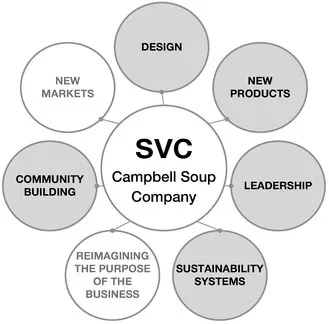
This chapter is based on classroom discussions and interviews from 2011 and 2012, and does not represent a totality of the activities in which the company is engaged. The diagram at the beginning of the chapter is meant to orient the reader as to the contents of the chapter rather than the breadth of issues covered by the company.
Campbell Soup Company
“There is an enormous space here for innovation to generate a competitive advantage to industries that are able to get ahead of the game in developing foods and beverages that taste good and are healthful.”
Dr. Julio Frenk, Dean of Harvard School of Public Health1
Background
Campbell Soup Company is a 140-year-old company which manufactures and markets convenience food products under its own brand. The company features a diversified product line across five divisions: U.S. Simple Meals, North American Food Service, International Simple Meals & Beverages, U.S. Beverages, and Global Baking & Snacking. The product line is sold worldwide and includes the iconic soups, as well as canned pasta, beans, gravy, juices, beverages, and baked goods and snacks. Popular products like Goldfish Crackers, Pepperidge Farm Bread, Pace Salsa, Prego pasta sauce, Spaghetti-Os, and Swanson Stock are all Campbell’s products.
In the United States, Canada, and Latin America, the company’s products are resold to consumers in retail food chains and other retail, commercial, and non-commercial establishments. Over the fiscal year ending July 2012, Campbell’s had $7.7 billion in net sales, $1.3 billion in earnings before interest and taxes (EBIT), and $846 million in net earnings. Campbell’s currently employs over 19,000 people across 20 countries and 31 plant sites.
Corporate social responsibility (CSR) and sustainability at Campbell's
CSR at Campbell Soup Company is aligned with the company’s strategic growth initiatives. The company’s growth strategy can be summarized as the pursuit of three strategic objectives:
- To become a more innovative company, by being “critically focused on consumer-driven innovation in products and packaging as the primary driver of organic growth”
- To become a more balanced company, in an effort to “drive our company’s growth by providing a wide array of delicious, nutritious, and convenient products across a growing global consumer base”
- To become a more responsive company, in order to “be far better positioned for engagement with new and growing consumer groups”2
Setting destination goals
Dave Stangis, Campbell Soup Company’s Vice President of CSR and Sustainability, was instrumental in helping Campbell’s to set destination goals. These ten-year goals are ambitious and set the company on a journey to create social value. Many companies set annual targets for CSR. According to Dave, “When you set annual targets, you think small: this is what we did this year; we think we can do that next year, let’s make that our goal, and then if we’re good we’ll exceed it.”3 To Dave, short-term goals are more likely to be a description or a prediction.
Campbell’s has established the following destination goals for 2020:
- Nourishing Our Planet by cutting the company’s environmental footprint in half
- Nourishing Our Consumers by continually advancing the nutrition and wellness profile of the product portfolio
- Nourishing Our Neighbors by measurably improving the health of young people in our hometown community
- Nourishing Our Employees by promoting 100% employee engagement in CSR and sustainability4
Destination goals help to drive systems change, not just incremental change. By setting a destination, leaders within the company can then chart a course. Destination goals create a kind of creative tension; they inspire people to think in new ways and give employees permission to develop new types of design, whether it is packaging, manufacturing, or new sources of energy.
Dave is very candid about his view of what the destination goals should include:
I had advocated that one of our destination goals should be to feature the healthiest product portfolio on the planet. And I actually got buy-in from a number of our business leaders. But I didn’t win over a couple businesses—and in the end, they were right. It was hard for these businesses to conceive of a strategy where the product portfolio can be the healthiest in the marketplace. We have created a strategy and direction around “choice.” Making sure consumers can choose their version of what’s best for them and their families across the portfolio.
My goal is to put dedicated resources in each of the major business groups. These are resources I know the company needs, and I have worked and argued for this. We have made progress by placing a sustainability leader in procurement. The goal is the same in R&D and marketing.5
Defining CSR and sustainability strategies at Campbell's
Campbell Soup Company has adopted a regimented approach toward including corporate social responsibility and sustainability in the core strategic planning for company growth and evolution. The company conducts an annual strategic planning session for all company strategies, which includes corporate plans for CSR and sustainability programs. Campbell’s considers CSR strategies as “core platforms that are incorporated into key business and functional-unit strategic plans with three-year time horizons and annual performance goals that then lead to executive and personal performance objectives.”6
The strategic planning process for CSR at Campbell’s includes a comprehensive assessment of the needs and desires of key internal and external stakeholders, as well as consideration for key trends in corporate social responsibility and sustainability within and between industries like their own. In short, Campbell’s attempts to recognize and deliver upon as many areas of corporate focus as is economically and logistically possible to support the corporate mission statement of “Nourishing People’s Lives Everywhere, Every Day.” Their internal stakeholders range from C-suite executives down to functional-unit managers and contributors. The external stakeholders are too diverse to catalog, but they directly contribute to Campbell’s CSR strategy via a range of engagements and an annual consumer survey.
In fact, the most recent Campbell’s CSR consumer survey provided compelling input which helped to establish the need for Campbell’s to provide special focus in the following four areas:
- Strategic community initiatives: Giving back to the community is something that is expected. Food companies should also help minimize hunger in the community.
- Commitment to food safety: A commitment to food safety should be listed as a priority for Campbell’s in its CSR reporting to the public.
- Prioritizing affordability: Manufacturing and marketing products in a way to keep food affordable, while maintaining shareowner value, should be included as a priority for the company.
- Championing nutrition: Improving the nutritional content of food should also be a focus area, including a focus on using all-natural ingredients.7
Addressing hunger and obesity
Campbell Soup Company is headquartered in Camden, New Jersey, where hunger and obesity pose major challenges. Approximately 40% of Camden children aged 3–19 are obese.8 Camden is also a food desert, with only one full-service grocery store.9 Given the dire situation, the company is working to combat hunger and obesity in several innovative ways. Campbell’s is the first food company to develop a metric to address obesity and hunger.
In order to meet its goal of “Nourishing our Neighbors,” the company is working to turn its employees into social entrepreneurs. An example of how effectively the company has worked to catalyze its employees is the initiative “Just Peachy.” One of Campbell’s key partners in the community, the Food Bank of South Jersey, spoke to farmers to hear their concerns. One of the problems faced by peach farmers was the disposal of 800,000 pounds of peaches which were either too small or too blemished to sell. These peaches were delicious, but they just could not be sold in traditional venues. The peach farmers would spend $80,000–100,000 to dispose of the peaches, which was a waste of resources. The Food Bank of South Jersey had an idea: why not turn the blemished peaches into peach salsa? They didn’t know if it was possible, or how to make it happen—but they knew a company that would know. Campbell’s chefs developed the recipe and its employees canned 54,000 jars of peach salsa in hand-labeled jars in Campbell’s facilities, using donated jars and cilantro. The initiative generated $100,000 for the Food Bank of South New Jersey which serves over 175,000 clients.
Campbell’s is also addressing nutrition by creating healthier products. As part of Campbell’s commitment to healthier foods that support healthier lifestyles, the company has achieved the following milestones in the U.S.:
- More than 300 products that are low in fat, saturated fat, and cholesterol
- More than 200 products with reduced levels of sodium (products launched at Food and Drug Administration (FDA) level of 480 mgs or reduced from original product by 10–50%)
- More than 200 products that have 100 calories or fewer per serving
- More than 75 products that are certified by the American Heart Association10
Long-term environmental goals
In addition to the remarkable progress and achievements of Campbell’s CSR team since inception, the following long-term destination goals have been set, with a target to achieve them by 2020:11
- Reduce energy use by 35% and source 40% of energy from renewable or alternative energy sources
- Recycle 95% of waste generated globally
- Eliminate 100 million pounds of packaging from Campbell’s products
- Make a positive impact on the lives of 100 million youth through volunteer, community, and signature programs
Since January 1, 2009, Campbell’s:
- Now uses 1 billion fewer gallons of water each year (a cumulative saving of more than 4.4 billion gallons)
- Now uses 450,000 fewer mmbtus of energy each year (a cumulative saving of more than 280,000 metric tons of CO2)
- Has initiated projects to extend its installed solar panels from a few kW to more than 12MW (8% of total energy)
- Has invested in projects that deliver cumulative savings of more than $42.9 million
In the 2012 fiscal year alone, Campbell’s:
- Saved more than 11 million gallons of water and reduced greenhouse gas emissions by more than 83,000 metric tons of CO2
- Saved more than 2.4 million pounds of packaging through package redesign and lightweighting
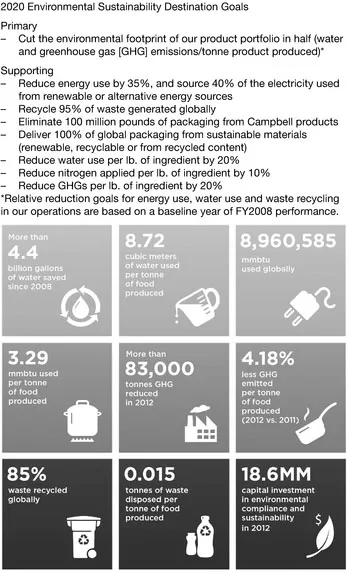
Figure 1.1 Campbell's environmental and sustainability goals and dashboard Source: Campbell's 2013 performance update of the corporate social responsibility report12
Dave Stangis, Vice President, Public Affairs and Corporate Responsibility for Campbell Soup Company and President of the Campbell Soup Foundation
Dave Stangis joined the Campbell Soup Company team in September 2008 with responsibility for both designing and managing Campbell’s CSR strategy and programs. He also oversees the Community Affairs strategy, including Campbell’s signature Healthy Communities Initiative, as well as the activities of the Campbell Soup Foundation, the primary philanthropic arm of Campbell Soup Company.
Dave and his team work in collaboration with internal business units to deliver long-term business value across broad CSR platforms including the Marketplace, Community, Environmental Sustainability, and the Workplace. Since his arrival at Campbell’s, the company has been named to the Dow Jones Sustainability Indices, Corporate Responsibility Magazine’s 100 Best Corporate Citizens List, and as one of the World’s Most Ethical Companies by Ethisphere Magazine. He has made significant strides towards Campbell’s CSR initiatives, with a focus on environmental sustainability.
Dave has over 20 years of experience in corporate social responsibility and the environment, health, and safety fields. He previously held the position of Global Director of Corporate Responsibility at Intel Corporation, where he developed and implemented Intel’s CSR policies. His efforts helped Intel to achieve the top spot on the Dow Jones Sustainability Index for seven consecutive years. Dave is on the advisory boards of the Graham Sustainability Institute at the University of Michigan, Net Impact, University of Detroit College of Business, and Ethical Corporation magazine. In 2008, he was named o...
Table of contents
- Cover
- Half Title
- Title
- Copyright
- Dedication
- Contents
- Foreword
- Acknowledgments
- Introduction: An introduction to creating social value
- 1 Strategy and innovation
- 2 Nation-building
- 3 Addressing environmental and social needs
- 4 Creating social value through social entrepreneurship
- 5 Social innovation in hiring and PathMaking
- 6 Co-creating new sources of recycled materials
- 7 Sustainability by design
- 8 Creating Shared Success
- 9 Combining social value with business opportunity
- 10 Serving new markets
- 11 Leadership and social value creation
- Concluding thoughts
- Index
Trusted by 375,005 students
Access to over 1.5 million titles for a fair monthly price.
Study more efficiently using our study tools.
Frequently asked questions
Yes, you can cancel anytime from the Subscription tab in your account settings on the Perlego website. Your subscription will stay active until the end of your current billing period. Learn how to cancel your subscription
No, books cannot be downloaded as external files, such as PDFs, for use outside of Perlego. However, you can download books within the Perlego app for offline reading on mobile or tablet. Learn how to download books offline
We are an online textbook subscription service, where you can get access to an entire online library for less than the price of a single book per month. With over 1.5 million books across 990+ topics, we’ve got you covered! Learn about our mission
Look out for the read-aloud symbol on your next book to see if you can listen to it. The read-aloud tool reads text aloud for you, highlighting the text as it is being read. You can pause it, speed it up and slow it down. Learn more about Read Aloud
Yes! You can use the Perlego app on both iOS and Android devices to read anytime, anywhere — even offline. Perfect for commutes or when you’re on the go.
Please note we cannot support devices running on iOS 13 and Android 7 or earlier. Learn more about using the app
Please note we cannot support devices running on iOS 13 and Android 7 or earlier. Learn more about using the app
Yes, you can access Creating Social Value by Cheryl Kiser,Deborah Leipziger,J. Janelle Shubert in PDF and/or ePUB format, as well as other popular books in Business & Business General. We have over 1.5 million books available in our catalogue for you to explore.