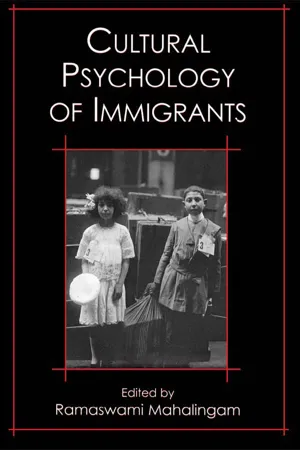
This new volume provides an interdisciplinary perspective on how intersections of race, class, gender, sexuality, and culture shape the cultural psychology of immigrants. It demonstrates the influence transnational ties and cultural practices and beliefs play on creating the immigrant self. Distinguished scholars from a variety of fields examine the cultural psychological consequences of displacement among different immigrant communities. Cultural Psychology of Immigrants opens with a variety of theoretical perspectives on immigration and a historical overview of sociological research on immigrants. It then examines the racial discrimination of immigrants and the multifaceted influences on the creation of immigrant identities. The final section documents the pivotal role of family contexts in shaping identity. Each chapter illustrates the commonalities and differences among immigrants in the ways in which they make sense of their newfound selves in a displaced context.
Intended for advanced students and researchers in the fields of psychology, social work, marriage and family therapy, public health, anthropology, sociology, education, and ethnic studies, the book also serves as a resource in courses on cultural psychology, immigrant studies, minority groups, race and ethnic relations, self and identity, culture and human development, and immigrants and mental health.
- 400 pages
- English
- ePUB (mobile friendly)
- Available on iOS & Android
eBook - ePub
Cultural Psychology of Immigrants
About this book
Information
1
Cultural Psychology of Immigrants: An Introduction
University of Michigan
Cultural psychological research has demonstrated the constituent role of culture in how we think, how we feel, and how we perceive our social experience (Cole, 1996; Markus & Kitayama, 1991; Nisbett, 2003; Rogoff, 2003; Shweder & Sullivan, 1990; Sperber, 1996). The major strands of research in cultural psychology have generally ignored immigrants, with a few exceptions, such as research on psychological acculturation (Berry, 1995), biculturalism (Hong, Morris, Chiu, & Benet-Martinez, 2000), and identity negotiation (Suarez-Orozco & Suarez-Orozco, 2001). Interestingly, cultural psychology, as a discipline, does not generally treat immigrants as an intrinsically interesting or worthy object of study. In fact, most research on cultural psychology treats immigrants as a control group (e.g., Nisbett, 2003). This research places them on a continuum between participants in their “home” culture and their “host” culture. Although this approach has some merit, cultural psychology needs to take into account the distinct aspects of immigrants’ social location and its impact on their psychological well-being.
Bhatia and Ram (2001), highlight some major gaps in how cultural context is conceptualized in cultural psychological studies on immigrants. In particular issues of power, transnational ties, and social marginality have not been adequately addressed in cultural psychological research on immigrants. In summary, there are at least two major shortcomings in cultural psychological approaches to the study of immigrants. The first is related to insufficient theorization of how immigrants “represent their culture.” The second is inadequate exploration of how power and social marginality shape immigrants’ representations of culture. To address these lacune in research on immigrants, this chapter provides a cultural psychology framework to study cultural psychology of immigrants. Integrating current research on social marginality and idealized cultural narratives, I identify the following three interrelated aspects of an immigrant’s social experience as the core of the proposed cultural psychology framework: (a) representations of culture, (b) social location and marginality, and (c) idealized cultural identities. In the following sections, I discuss the importance of each of these features in detail before proposing a cultural identities model to study immigrants.
IMMIGRANTS AND REPRESENTATIONS OF CULTURE
Immigrants are exposed to dual worldviews, cultural practices, and beliefs. Immigrants’ “home culture” alone may not be sufficient to help us understand the cultural psychology of immigrants. Unlike people in their “home culture,” the comparative sociocultural context of immigrants influences how they “represent” their “home culture” while trying to make sense of their “host culture.” Immigrants are both folk anthropologists and informants at the same time. The relational context of their displacement makes them aware of the comparative nature of their cultural identity, and they are challenged to develop a deeper understanding of their own culture. They develop a newer appreciation of culture not merely as a set of practices and shared values, but as something that needs to be reflected on and explained. A new immigrant, like an anthropologist in an “exotic culture,” tries to make sense of the host culture—its mores and practices and the meaning and grammar of various social cartographies.
As “aliens,” immigrants are constantly asked to explain various aspects of their “culture” to the “natives”—ranging from food customs to foreign policy issues to tips on the best ethnic restaurant in town. In the process, they try to decipher various meanings associated with the new identities that are forced on them. While making sense of the racial and social arrangements of the host society, they also embody the newer forms of racial and ethnic identities that codify their social and historical experiences (Kim, 1999). The dual role of informing and absorbing the new culture uniquely positions an immigrant to be aware of social hierarchies and power among various social groups.
Although there are similarities between immigrants and anthropologists, there are some interesting differences. Immigrants’ attitudes toward the dominant culture often remind me of Annam, a kind of swan that is believed to have a mythical ability to separate the good from the bad. For instance, if you give Annam a mixture of water and milk, it will drink the milk and leave the water in the bowl. Immigrants often view American cultural experience is a mixture of milk and water, and like Annams, they believe they can take the “milk” (good American values such as independence, hard work) and leave the “water” (the undesirable aspects of the culture, such as dating, violence, and drugs). They also expect their children to imbibe the qualities of Annams. Immigrants often make “value judgments” about their “home” and “host” cultures. As Daniel (this volume) points out, although immigrants share the same predicament as anthropologists in the ways they experience the disruption of their “culture,” immigrants do not have the same cultural privileges associated with a Western anthropologist who studies a non-Western culture. Thus, their marginalized social location colors immigrants’ representations of “host” as well as “home” culture.
SOCIAL LOCATION AND MARGINALITY
According to Mahalingam (in press), social location refers to intersecting identities such as race, caste, class, gender, and sexuality embedded in a social context, where the power differential among these axes of identities locates an immigrant in a complex field of racial positioning (Kim, 1999). Dominant group members essentialize social categories in order to legitimize existing social hierarchies. In contrast, a marginalized social location heightens one’s awareness of social power and of contextual influences on identity (Fiske, 1993; Mahalingam, 2003). Marginalized groups have to contest such essentialist representations, because they become tropes for discriminatory ideologies that justify the marginalized status of immigrants. To negate such hegemonic social representations, people at marginalized locations feel a stronger need to create a positive identity than do members of a dominant group.
Because many immigrants lack the social and cultural capital necessary to successfully negotiate their social status, they are often marginalized (Portes & Rumbaut, 1996). Like other marginalized groups, immigrants seek a positive cultural identity by locating their roots in a mythical past and claiming a legacy as inheritors of a “richer” civilization. As folk anthropologists, immigrants construct a narrative of their cultural heritage in order to develop a reflective understanding, making sense of their cultural practices. Such selective invocation of cultural heritage provides an interesting counterpoint to the denigrating dominant cultural accounts of representations of immigrants—also known as ethnophaulisms (see Mullen, 2001, for a review).
Such idealized identities play a significant role in creating and sustaining an essentialized sense of “community,” devoid of internal contradictions (Anderson, 1991). Although much scholarly attention has focused on the historical and social contingencies of such “imagined communities,” the discipline of psychology has rarely examined the role of marginalized social location in accentuating our general psychological need to create an “idealized” positive identity (Tajfel, 1981) and the psychological consequences of such idealizations.
CULTURAL NARRATIVES AND IDEALIZED CULTURAL IDENTITIES
Cultural narratives of those on the social margins often are the communal memory of resilience and resolve under oppressive and marginal locales (Mahalingam, in press). They valorize the triumph of individuals who succeed against all odds and in the face of social discrimination. Three cultural narratives exemplify the valorization of self among marginalized groups. An example from India is the story of Ekalaivya, a Dalit (formerly treated as “Untouchable”). He was a great archer who is valorized for being an ideal student. At the request of his teacher (who was a Brahmin), Ekalaivya gave up his right-hand thumb as Gurudakshina (gift to a guru), knowing very well that he could never practice archery again. Ekalaivya is still viewed as the embodiment of an ideal student for giving up all his learning for his teacher (see Mahalingam, in press).
In a study of slave narratives, Sanger (1995) found that slave folk songs revealed that slaves believed that they had a more privileged relationship with God than did Whites.
Spirituals contained descriptions of the rewards the slaves envisioned as a result of their status as God’s chosen … For instance, in the song, “Hold the wind”, the slaves sang ‘when I get to heaven, gonna be ease,’ ‘Me and my God gonna do as we please’ and ‘gonna chatter with the Father, and argue with the Son Tell them about the world I just come from …’ Slaves implicitly claimed for themselves a relationship with God more personal and more privileged than that experienced by Whites. (Sanger, 1995, pp. 188–189)
Another example is the story of John Henry, an African American sharecropper who worked himself to death while competing with a power drill. His narrative presents an idealized prototype symbolizing strength and persistence of African Americans.
These examples suggest the power of idealized narratives and the acute need for marginalized communities to create such idealized narratives to foster a positive self identity. However, they are also stark and ominous reminders of the heavy cost of asserting agency from an unprivileged location. These costs are both physical and psychological. In studying the health disparities of African Americans, James (1994) found that African Americans who internalize the values signified by the John Henry myth (hard work, excellence), but nevertheless are not economically successful, are more likely to suffer from hypertension, even after controlling for the effects of income and education.
CULTURAL PSYCHOLOGY OF IMMIGRANTS: AN IDEALIZED CULTURAL IDENTITIES MODEL
These three examples of narratives of idealized selves of marginalized groups such as Dalits and African Americans suggest the acute need to create and believe in such idealizations because these idealizations help them to negate dominant groups’ view that they lack “culture” (e.g., “deficit cultural” models; for a review, see Ogbu, 1981). As empirical research on John Henryism suggests, there are costs and benefits associated with such idealized views of self. Such ideals could help individuals to cope, to assert and to feel proud of their identity. Their salience in defining self-worth also becomes especially significant as these cultural narratives play a vital role in the construction of idealized group identities.
Extending the research on social marginality and idealized cultural identities to the study of immigrants and refugees, I argue that immigrants may feel the need to idealize their identities. The dual role of immigrants in a new cultural milieu—as folk anthropologists and as informants—also forces them to rethink their assumptions about their culture and identity. Such rethinking profoundly influences their need to “imagine” or “project” an idealized cultural identity in order to assert, negotiate and make sense of their social positioning.
In summary, marginalized status contributes to the idealization of one’s identity. Internalization of such idealizations has positive and negative consequences. Intersections of race, class, gender, and sexuality (Stewart & McDermott, 2004) and transnational ties (Foner, 2002; Murphy & Mahalingam, 2004) also play a critical role in the appropriation of these ideals.
Intersections of Race, Class, Gender, and Idealized Cultural Identities
Intersections of ethnicity, class, gender, and sexuality play a critical role in the production and appropriation of these ideals. Idealized cultural identities serve multiple functions. Because gender is a major site for inscribing idealized cultural identities, engendered idealized cultural identities affect ethnic women’s lives in complex ways. Several cultural theorists have pointed that in many cultures women are believed to embody the essence of their culture and group identity and are thought to be repositories of family honor (Dube, 2001: Ortner, 1974). Research on gender socialization among immigrants indicates that immigrants view women as the purveyors of “culture” (Dasgupta & Dasgupta, 2000; Dion, this volume; Espiritu, 2001; Gill & Vasquez, 1996). There is more pressure on first-and second-generation women than there is on men to uphold idealized cultural identities. Gender-specific cultural ideals valorize ethnic women as more “chaste” and “family-oriented” than “White” women (Espiritu, 2001; Mahalingam & Haritatos, this volume). Several variants of female ideals are culture specific. For instance, the notion of Pativirda (the devoted wife) has a strong influence in how first- and second-generation immigrants view how an Indian American woman “ought” to behave, and their everyday lives are influenced by such ideals (Abraham, this volume). Similarly Gil and Vasquez (1996) argued that the notion of Marianismo has a major impact on Latina women’s mental health. Based on their clinical work, they describe some specific Marianista beliefs:
(a) a good wife must always provide her husband and children with a good meal which she prepares herself (b) a good mother should not argue with her husband before her children (c) a good wife must put up with her husband’s relatives, no matter how offensive or inconsiderate they are (d) a good wife must have an impeccable home and preferably must keep it that way herself (e) a good Latina must obey traditions al pie de la letra, to the letter of the law (f) a good mother should take care of her children herself or with the help of very trustworthy relatives. (Gil & Vasquez, 1996, p. 184)
Thus, engendered cultural ideals not only constrict ethnic women’s lives but also imply that they should strive to achieve these ideals in order to be different and superior to “White women” (Mahalingam & Leu, 2005). In addition, the first- and second-generation immigrant women are expected to be morally, academically, and professionally better than White women (Mahalingam & Leu, in press).
Internalization of idealized cultural identities has several consequences. An idealized cultural identity may positively contribute to a positive sense of self, but it may also become a source of stress (Mahalingam & Haritatos, 2005). In a study conducted in India, Mahalingam and Jackson (2005) found that Indian women from caste groups that commit female infanticide (where the sex ratios can be as dramatic as 614 girls for every 1000 boys) tend to valorize their gender identity and strongly believe in the power of chaste women and macho men (Mahalingam & Jackson, 2005). Such essentialist beliefs about gender ideals, although contributing to strong self-esteem, also contribute increased feelings of shame and depression. Mahalingam and Haritatos (2005) examined the relationship between internalization of a model minority myth and psychological well-being among Asian Americans. They found that internalization of Asian American women ideals contributed both to pride in being a model minority and to pressure to be a model minority. Individual...
Table of contents
- Cover Page
- Half Title page
- Title Page
- Copyright Page
- Dedication
- Contents
- Preface
- Contributors
- 1 Cultural Psychology of Immigrants: an Introduction
- Part I: Immigration, Globalization, and Transnationalism: Theoretical Perspectives
- Part II: Immigration and Race
- Part III: Immigration, Self, Gender, and Narratives
- Part IV: Immigration and Family
- Author Index
- Subject Index
Trusted by 375,005 students
Access to over 1.5 million titles for a fair monthly price.
Study more efficiently using our study tools.
Frequently asked questions
Yes, you can cancel anytime from the Subscription tab in your account settings on the Perlego website. Your subscription will stay active until the end of your current billing period. Learn how to cancel your subscription
No, books cannot be downloaded as external files, such as PDFs, for use outside of Perlego. However, you can download books within the Perlego app for offline reading on mobile or tablet. Learn how to download books offline
Perlego offers two plans: Essential and Complete
- Essential is ideal for learners and professionals who enjoy exploring a wide range of subjects. Access the Essential Library with 800,000+ trusted titles and best-sellers across business, personal growth, and the humanities. Includes unlimited reading time and Standard Read Aloud voice.
- Complete: Perfect for advanced learners and researchers needing full, unrestricted access. Unlock 1.5M+ books across hundreds of subjects, including academic and specialized titles. The Complete Plan also includes advanced features like Premium Read Aloud and Research Assistant.
We are an online textbook subscription service, where you can get access to an entire online library for less than the price of a single book per month. With over 1.5 million books across 990+ topics, we’ve got you covered! Learn about our mission
Look out for the read-aloud symbol on your next book to see if you can listen to it. The read-aloud tool reads text aloud for you, highlighting the text as it is being read. You can pause it, speed it up and slow it down. Learn more about Read Aloud
Yes! You can use the Perlego app on both iOS and Android devices to read anytime, anywhere — even offline. Perfect for commutes or when you’re on the go.
Please note we cannot support devices running on iOS 13 and Android 7 or earlier. Learn more about using the app
Please note we cannot support devices running on iOS 13 and Android 7 or earlier. Learn more about using the app
Yes, you can access Cultural Psychology of Immigrants by Ramaswami Mahalingam in PDF and/or ePUB format, as well as other popular books in Psychology & Social Psychology. We have over 1.5 million books available in our catalogue for you to explore.