Construction for Interior Designers is a highly readable, comprehensive and informative text proving all the technical information required. The second edition has been fully updated to reflect the 1991 amendments if the 1985 Building Regulations and includes a new chapter on environmental issues affecting construction. Important concepts are explained from first principles with three-dimensional diagrams and informative tables. No previous knowledge of the subject is assumed.

- 464 pages
- English
- ePUB (mobile friendly)
- Available on iOS & Android
eBook - ePub
Construction for Interior Designers
About this book
Information
Chapter 1
Structural principles
Introduction
A structure might be described as a series of components or ‘structural elements’ which, when fitted together, are capable of withstanding the loads and forces to which they are subjected.
A building is such a structure, being composed of a wide variety of components of different sizes and materials which, when fitted together, are capable of withstanding such loads and forces as:
- wind;
- the furnishings, people and machinery in the building (referred to as ‘superimposed’ loads);
- the considerable loads imposed by the weight of the building components themselves (referred to as ‘dead’ loads).
Clearly then, in the designing of a building and its interior, it is necessary to understand the way in which structures behave in relation to the materials and the construction techniques used.
Much of building design utilises the knowledge of established materials and components (such as bricks, timber joists, doors, etc.), which are fitted together by established techniques (for example the typical techniques used for forming a window opening, or for installing a staircase). Designers need to be sufficiently versatile to adapt and elaborate on these established principles, in order to fulfil the design requirements peculiar to a particular building/interior scheme. Sometimes, however, the designer will use less familiar techniques and materials in the design of a building/interior structure. In such circumstances, the designer might use the services of a structural engineer, who is trained to:
- calculate the loads and forces to which the structure will be subjected;
- calculate and design structural components of suitable size and of suitable material to withstand these loads and forces.
This chapter explains some of the terminology used in the study of the behaviour of structures, and considers some of the structural behaviour that might be expected in the components of a building/interior.
Definitions of basic terms
For a building structure to function properly, it should be capable of remaining stable when it is subjected to the various forces imposed on it. This does not mean that the building structure should be totally rigid, but that the degree of movement should be kept within tolerable limits. In fact, the material of any structure will move or deflect to some extent when subjected to a force.
Force
A ‘force’ acting on a structure, is the effect of weight on the structure, For example, a person weighing 70 kilograms (70 kg) standing on a floor, will push down on the floor with a force of 70 kilograms force (kgf). A strong wind blowing against the side of a wall will also exert a force of so many kilograms.
Forces due to the ‘mass’ (or weight) of objects are different from forces due to factors such as the wind, since they are subject to the effect of gravity. Gravity has the effect of pulling objects downwards at a rate of acceleration of 9.81 metres per second, per second (m/s2). Forces are measured in units of ‘newtons’ (N) or:
One newton is the force required to accelerate a weight of 1 kg by 1 m/s2.
Consequently, an object of 1 kg weight which is subjected to gravitational force will exert a force of 9.81 N (or 1 kg ×9.81 m/s2 = 9.81 N), In the case of the person standing on a floor, the force exerted will be 70 kg × 9.81 m/s2 = 686.7 N
Structural stability relies on a structure, or part of a structure, resisting ‘active forces’ (imposed forces) by ‘passive forces’ (a balancing force produced within the structure).
For example, when a chair is placed on a floor, the chair kgs exert a downwards active force on the floor. In order to resist the active force, the floor produces an upwards passive force of similar magnitude. If a person sits on the chair, the active force is increased, and consequently the floor will provide an increased, upwards passive force, Passive force is produced in a structure by the material of the structure actually changing shape due to the exertion of an active force.
Figure 1.1(a) illustrates:
(i) | a block of material which is securely suspended from a structure; |
(ii) | a similar block, which is placed on a secure floor structure. In both cases, the blocks are free from applied active forces, and the material of the blocks is relatively ‘at rest’. |
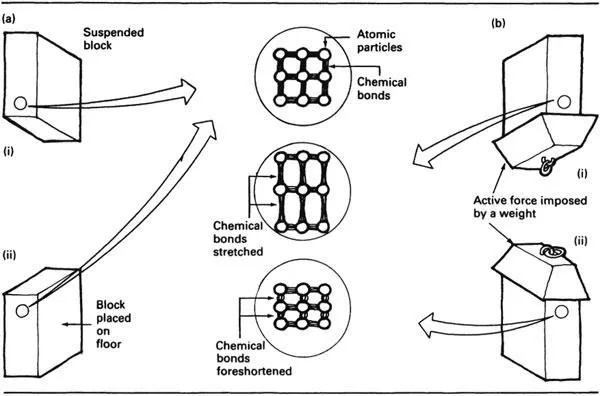
Fig. 1.1(a)
(i) | Suspended block at rest |
(ii) | Block at rest on floor |
Fig. 1.1(b)
(i) | Active force applied to suspended block |
(ii) | Active force applied to block on floor |
The inset diagram of Fig. 1.1(a) illustrates diagrammatically a typical material at rest, where the atomic particles are held together by chemical bonds. In Fig. 1.1(b), an active force is applied to each of the blocks. In the case of (i) above, the active force pulls the material of the block, and a passive force is produced by the chemical bonds between the atomic particles being stretched. In the case of (ii) above, the active force pushes down on the block, and a passive force is produced by the chemical bonds between the atomic particles being foreshortened. The degree of elongation or foreshortening which occurs in the block will depend not only on the magnitude of the applied force, but also on the nature of th...
Table of contents
- Cover
- Half Title
- Title Page
- Copyright Page
- Table of Contents
- Preface to Second Edition
- Preface to First Edition
- Acknowledgements
- Chapter 1: Structural Principles
- Chapter 2: External Structure: Foundations and Walls
- Chapter 3: Roofs and Floors
- Chapter 4: Work to Existing Buildings
- Chapter 5: Internal Structure
- Chapter 6: Internal Furnishings and Fittings
- Chapter 7: Structural Materials: Timber, Metals, Concrete and Plastics
- Chapter 8: Internal Finishes and Materials
- Chapter 9: Environmental Issues
- Bibliography
- Index
Trusted by 375,005 students
Access to over 1.5 million titles for a fair monthly price.
Study more efficiently using our study tools.
Frequently asked questions
Yes, you can cancel anytime from the Subscription tab in your account settings on the Perlego website. Your subscription will stay active until the end of your current billing period. Learn how to cancel your subscription
No, books cannot be downloaded as external files, such as PDFs, for use outside of Perlego. However, you can download books within the Perlego app for offline reading on mobile or tablet. Learn how to download books offline
Perlego offers two plans: Essential and Complete
- Essential is ideal for learners and professionals who enjoy exploring a wide range of subjects. Access the Essential Library with 800,000+ trusted titles and best-sellers across business, personal growth, and the humanities. Includes unlimited reading time and Standard Read Aloud voice.
- Complete: Perfect for advanced learners and researchers needing full, unrestricted access. Unlock 1.5M+ books across hundreds of subjects, including academic and specialized titles. The Complete Plan also includes advanced features like Premium Read Aloud and Research Assistant.
We are an online textbook subscription service, where you can get access to an entire online library for less than the price of a single book per month. With over 1.5 million books across 990+ topics, we’ve got you covered! Learn about our mission
Look out for the read-aloud symbol on your next book to see if you can listen to it. The read-aloud tool reads text aloud for you, highlighting the text as it is being read. You can pause it, speed it up and slow it down. Learn more about Read Aloud
Yes! You can use the Perlego app on both iOS and Android devices to read anytime, anywhere — even offline. Perfect for commutes or when you’re on the go.
Please note we cannot support devices running on iOS 13 and Android 7 or earlier. Learn more about using the app
Please note we cannot support devices running on iOS 13 and Android 7 or earlier. Learn more about using the app
Yes, you can access Construction for Interior Designers by Roland Ashcroft in PDF and/or ePUB format, as well as other popular books in Architecture & Architecture Methods & Materials. We have over 1.5 million books available in our catalogue for you to explore.