- 338 pages
- English
- ePUB (mobile friendly)
- Available on iOS & Android
eBook - ePub
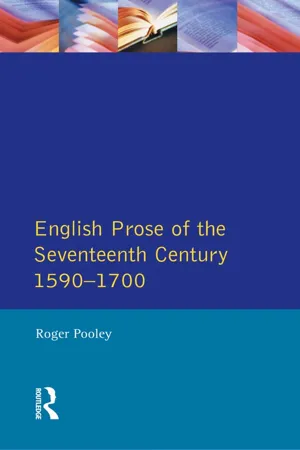
English Prose of the Seventeenth Century 1590-1700
About this book
This is the first book-length history of the range of seventeenth-century English prose writing. Roger Pooley's study begins with narrative, ranging from the fiction of Bunyan and Aphra Behn to the biographical and autobiographical work of Aubrey and Pepys. Further sections consider religious prose from the hugely influential Authorised Version to Donne's sermons, the political writing of figures as diverse as Milton, Hobbes, Locke and Marvell, cornucopian texts and the writings of the new scientists from Bacon to Newton. At a time when the boundaries of the `canon' are being increasingly revised, this is not only a major survey of a series of great works of literature, but also a fascinating social history and a guide to understanding the literature of the period as a whole.
Information
Part One
Narrative
Narrative
Chapter 1
Elizabethan Fiction
Elizabethan Fiction
Sidney, Lyly, Greene, Nashe and Deloney
Many of the changes in recent fiction, even those associated with the postmodern, such as pastiche, the preoccupation with stylishness, and discontinuity, find a curious, partial echo in this earlier fiction. Elizabethan fiction seems principally designed for stylistic display — true of at least some of Sidney, Lodge, Nashe and Greene. Increasingly common as we move into seventeenth-century fiction is an avowal of plainness, in a product designed for a newly literate middle-class audience, or for women, or for a moment's leisure. Occasionally, as in the religious fiction of Bunyan, we get the sense of fiction as the individual's search through a landscape which is as much of ideas as of other people.
‘Novel’ as a critical term is seductive but elusive. Michael McKeon has signalled a return to the study of seventeenth-century fiction as the ‘origins’ of the novel.1 However, as he demonstrates, there is no one clear line of filiation between seventeenth- and eighteenth-century fiction. The term existed in the period, but as a translation of the French nouvelle or Italian novella, a short form of maybe a hundred pages distinguished from romance by its commitment to (relatively) realistic story-telling and psychological analysis.2 But modern, or nineteenth-century, expectations of realism and character will be disappointed; better to think about the fluidity of generic boundaries with Bakhtin:
In its earliest stages, the novel and its preparatory genres had relied upon various extra-literary forms of personal and social reality, and especially those of rhetoric … And in later stages of its development the novel makes wide and substantial use of letters, diaries, confessions, the forms and methods of rhetoric associated with recently established courts and so forth. Since it is constructed in a zone of contact with the incomplete events of a particular present, the novel often crosses the boundary of what we strictly call fictional literature — making use first of a moral confession, then of a philosophical tract, then of manifestoes that are openly political, then degenerating into the raw spirituality of a confession, a ‘cry from the soul’ that has not yet found its formal contours.3
The inclusiveness, the multi-voiced nature of the genre is a good way of looking at developments in prose fiction. In this period we might draw up a different list of forms within the form — rhetoric, certainly, and letters, poems, trial narratives and gallows confessions, sermons, political speeches, travellers' tales, allegory — additions which define the form, rather than additions to some generically secure core. Least of all can we be confident about the relation between realism, history and truth: many of these texts can bear a variation on the old disclaimer, ‘Any resemblance to any living person is entirely intentional.’ One of many reasons is that journalism and contemporary history are similarly embryonic; only in the 1690s can we trace a significant parallel between novel, news and novelty, and even then it is confusing.4
A more obvious generic place to start might be Romance, though, like the novel, it is easier to define by its inclusiveness than its boundaries. The eighteenth-century apologists for the novel defined the ‘new’ novel form by its anti-romance truthfulness, and, as late as Henry James's seminal preface to The American, romance and realism are presented as polar opposites within fiction. Anti-romance as a truth-telling topos is common in our period, too. Nashe attacks those who attempt ‘to repair the ruinous walls of Venus's court, to restore to the world that forgotten legendary licence of lying, to imitate afresh the fantastical dreams of those exiled abbey-lubbers, from whose idle pens proceeded those worn-out impressions of the feigned nowhere acts, of Arthur of the Round Table … with infinite others’.5 Don Quixote, the greatest European prose fiction of the period, translated into English as early as 1612, is posited on the contrast between book-learnt romance chivalry and real life. The joke in Don Quixote is that the modern world is just as full of illusion and enchantment (at least, in the hero's mind) as that of the romance.
Romance is both inclusive and formulaic. On the one hand, almost any incident, however strange, can find its way into the romance narrative; on the other hand, its characteristic topoi, such as wandering in an alien land, disguise, the quartet of lovers, or the last-minute reprieve, can seem like a fiction construction kit. The incredible coincidence is so much a part of the mode that it can be expected, as it were cheered on, by the experienced reader rather than dismissed as a fault. We might even say, with A.C. Hamilton, that the resulting amazement and wonder is actually what the romance writer wants, drawing readers into the text ‘in order totally to absorb and possess them’.6 Such ‘possession’ could be seen as dangerous. So we find the repertoire of romance usefully but tartly listed in an attack by the Quaker William Penn in 1669:
Some strange adventures, some passionate amours, unkind refusals, grand impediments, tedious addresses, miserable disappointments, wonderful surprises, unexpected rencounters, and meeting of supposed dead lovers, bloody duels, languishing voices, echoing from solitary groves, air-heard mournful complaints, deep-fetched sighs sent from wild deserts, intrigues managed with unheard-of subtlety; and whilst all things seem at the greatest distance, then are dead people alive, enemies friends, despair turned to enjoyment, and all their impossibilities reconciled; things that never were, are not, nor shall, or can be come to pass.7
The almost biblical tone of Penn's conclusion indicates that he sees the threat of romance as an alternative mystery — perhaps that the resurrections and reconciliations of romance detracted from, rather than pointed to, the real thing.
Marvels and marriages may be the heart of Elizabethan romance, but, like Cheryl Summerbee in David Lodge's novel, Small World, we need to distinguish between the ‘debased versions of the sentimental novel of courtship and marriage’ which constitute present-day mass-market romances, and books which an Elizabethan might recognise as romance: ‘Real romance is a pre-novelistic kind of narrative. It's full of adventure and coincidence and surprises and marvels, and has lots of characters who are lost or enchanted or wandering about looking for each other, or for the Grail, or something like that. Of course, they're often in love too …’.8 The hero has already, and condescendingly, found it odd that she should be reading The Faerie Queene rather than ‘Bills and Moon’ romance, but that also reflects a feature of prose romance from the earlier period — romance is a genre written for women. As Caroline Lucas has argued, many Elizabethan romances show the traces of a male author addressing women readers. More speculatively, she suggests women readers of the romance ‘might … have found a refuge from a reality of female powerlessness’ in it.9 Fictions of female power in this period are not confined to the romance genre, as every student of Jacobean tragedy knows; and with a queen on the throne, heroic romance writers such as Spenser and Sidney make much of Amazons. To adapt Spenser's phrase, fierce wars as well as faithful loves moralise the position of women in Elizabethan romance. But romance can still be put down, as only fit for women. If Arcadia was read by chambermaids, should anyone else take it seriously?10
Romance is also subject to humanist attack, as an inferior, less serious mode to classical epic. In practice, the Renaissance epic, notably The Faerie Queene, is very hospitable to the inclusive, interwoven style of romance. The influence of the Italian romantic epics of Ariosto and Tasso is considerable here. Puttenham defends less ambitious romances as ‘sundry forms of poems’, not subject to the constrictions of unity or high decorum like epic or tragedy.11 The same might be said of the prose romance.
The compositional history of Sidney's prose romance, the Arcadia, demonstrates how close romance and epic became during the period, although its original shape was that of a five-act pastoral tragicomedy with poetic interludes. There are in effect three Arcadias. The first, generally known as The Old Arcadia, written about 1577–81, circulated in manuscript, but was not printed in full until 1926. The New Arcadia, containing Sidney's elaborate revision of the first two and a half books, was published posthumously in 1590 as The Countess of Pembroke's Arcadia, dedicated to Sidney's sister who had become Countess of Pembroke. It breaks off in mid-sentence. In 1593 a folio version supervised by the Countess of Pembroke amalgamated the revised fragment with the rest of the book in its first version, with some further revision; this composite, often reprinted, is what people regarded as Sidney's Arcadia until Bertram Dobell came across manuscripts of the earlier version at the beginning of this century.
Both Old and New/composite versions have their fans. The main factors in defence of the Old Arcadia is that it is complete, composed and circulated as a whole (not a draft), and that it is less verbose — a relative rather than an absolute virtue, as we shall see. The New Arcadia is, however, a record of Sidney's second thoughts on the text, even if he seems to have abandoned the revision some time before his early death. It emphasises and amplifies the heroic aspects of the text. It has epic ambitions.
In a notable essay on Arcadia, Virginia Woolf suggests that ‘all the seeds of English fiction lie latent’ in it, ‘romance and realism, poetry and psychology’.12 Despite this variety in the text, its startling turns of plot and its emotional range, what might strike another modern reader coming to it with experience only of later fiction is the prominence of rhetoric. The characters are forever making speeches to each other. Their emotion is eloquent. The command of rhetoric can be an index to a character's self-control, as when Philanax's rage undermines ‘his precise method of oratory’ when prosecuting the heroes Pyrocles and Musidorus.13 Or it can disclose a character's true class, as when Pamela sees through Musidorus' disguise as ‘Dorus’ by ‘the matter Dorus spake and the manner he used in uttering it’.14 As with Hamlet's soliloquies, the skill of arguing is as revealing as the content. At every turn of the plot, the ability to persuade others is as important as swordsmanship. Lions and bears are no match for Pyrocles and Musidorus in their physical valour, but when they are threatened by men well-framed words work best.
Twe...
Table of contents
- Cover
- Half Title
- Title Page
- Copyright Page
- Table of Contents
- Longman Literature in English Series
- Editors' Preface
- Author's Preface
- Introduction: Reading Seventeenth-Century Prose
- Part One: Narrative
- Part Two: Religious Prose
- Part Three: Essays and Cornucopian Texts
- Part Four: The Discourse of Modernity: New Idioms in Science and Politics
- Chronology
- General Bibliographies
- Individual Authors
- Index
Trusted by 375,005 students
Access to over 1.5 million titles for a fair monthly price.
Study more efficiently using our study tools.
Frequently asked questions
Yes, you can cancel anytime from the Subscription tab in your account settings on the Perlego website. Your subscription will stay active until the end of your current billing period. Learn how to cancel your subscription
No, books cannot be downloaded as external files, such as PDFs, for use outside of Perlego. However, you can download books within the Perlego app for offline reading on mobile or tablet. Learn how to download books offline
Perlego offers two plans: Essential and Complete
- Essential is ideal for learners and professionals who enjoy exploring a wide range of subjects. Access the Essential Library with 800,000+ trusted titles and best-sellers across business, personal growth, and the humanities. Includes unlimited reading time and Standard Read Aloud voice.
- Complete: Perfect for advanced learners and researchers needing full, unrestricted access. Unlock 1.5M+ books across hundreds of subjects, including academic and specialized titles. The Complete Plan also includes advanced features like Premium Read Aloud and Research Assistant.
We are an online textbook subscription service, where you can get access to an entire online library for less than the price of a single book per month. With over 1.5 million books across 990+ topics, we’ve got you covered! Learn about our mission
Look out for the read-aloud symbol on your next book to see if you can listen to it. The read-aloud tool reads text aloud for you, highlighting the text as it is being read. You can pause it, speed it up and slow it down. Learn more about Read Aloud
Yes! You can use the Perlego app on both iOS and Android devices to read anytime, anywhere — even offline. Perfect for commutes or when you’re on the go.
Please note we cannot support devices running on iOS 13 and Android 7 or earlier. Learn more about using the app
Please note we cannot support devices running on iOS 13 and Android 7 or earlier. Learn more about using the app
Yes, you can access English Prose of the Seventeenth Century 1590-1700 by Roger Pooley in PDF and/or ePUB format, as well as other popular books in Literatura & Crítica literaria inglesa. We have over 1.5 million books available in our catalogue for you to explore.