- 264 pages
- English
- ePUB (mobile friendly)
- Available on iOS & Android
eBook - ePub
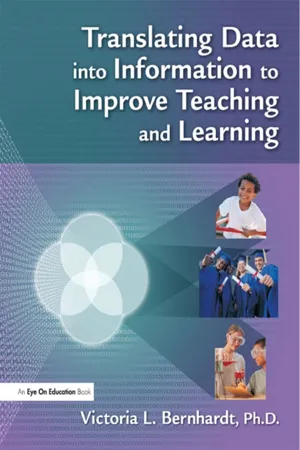
Translating Data into Information to Improve Teaching and Learning
About this book
Here it is ... the latest from best-selling author Victoria Bernhardt. This book helps educators think through the selection of the data elements and data tools needed to support quality decisions for improving teaching and learning. It shows you how to use data to help make decisions about strategies to improve student achievement.
Information
CHAPTER 1
INTRODUCTION:
A VISION FOR USING DATA TO
IMPROVE TEACHING AND LEARNING
A VISION FOR USING DATA TO
IMPROVE TEACHING AND LEARNING
A superintendent I know spoke for 99 percent of the
school districts in America today when he told me
that his district had systems to manage money down to the dime,
but no systems to manage the learning mission. This is
the most critical challenge for school districts to meet.
school districts in America today when he told me
that his district had systems to manage money down to the dime,
but no systems to manage the learning mission. This is
the most critical challenge for school districts to meet.
Larry Lezotte, Learning for All
A Vision for Data Tools
In every classroom, imagine starting the school year with historical data about every student—even a student just enrolled in school that morning. The data would include student achievement test results since the student’s initial enrollment in school and would track information about what standards she or he has mastered, the names of the student’s teachers in previous grades, the absences, discipline referrals, and more—all easily accessible electronically.
Imagine teachers setting end-of-year goals, assessing students at the beginning of the year to understand what the students know and don’t know, and measuring their students’ progress toward these goals several times during the year using assessment tools that school and district personnel have selected. By revisiting and measuring their goals throughout the year, teachers are better able to decide whether they need to alter what they are doing to ensure that each student reaches those year-end goals. In addition, teachers can print report cards to send home at the same time the class grades are sent electronically to the district office. Imagine a teacher’s computer dashboard alerting her/him immediately after an electronically scored assessment is given that a student is at risk of failing a standard if certain skills are not mastered.
At the school level, imagine students accessing a special password-driven section of the classroom database to add self-assessment data, their goals for improvement, and completed projects, and to view assessments and grades with their parents. Imagine students receiving suggestions on electronic lessons to help them learn the concepts they missed on the last assessment. Just imagine parents’ delight with their ability to view or receive, on demand, progress reports about their daughter or son!
At the district level, imagine administrators knowing exactly which data reports are crucial for helping schools understand the impact of their processes on student learning. These enlightened districts “batch” (i.e., predefine, automatically assemble, and produce) standard reports to all schools to give them powerful information about their systems. These districts also use these data to show administrators where and when the district needs to provide new programs, professional development, technical assistance, leadership, and other resources to achieve the purpose and mission of the district. The data could ensure that a continuum of learning is maintained within and across schools.
Imagine school and district administrators being alerted by their computer dashboards when students are absent. Phone calls can be made to determine the reason for a student’s absence and to get truant students back to school. Ongoing evaluations can be made to ensure instructional offerings are compelling enough to keep the students interested in school. Alerts can also be triggered when student information has been “misentered” into the district’s comprehensive integrated information system. This system would allow administrators to check and recode records such as free/reduced lunch status. For example, if younger siblings of a high school student have been identified as qualifying for free or reduced lunch status and the high schooler has not, the alert system would identify the high school student as someone whose records do not accurately reflect her/his status. These alerts could be set to keep the district from losing dollars and to ensure the accuracy of data, the safety of children, and the effectiveness of instructional offerings.
Now imagine that all of this information, which helps teachers, schools, and districts perform most effectively for all students, also satisfies all the state and federal departments of education data requirements. Imagine the ability to send reports electronically to state and federal agencies with the touch of a key.
Imagine having the data tools that would do all these things and more....
Data and Data Tools are Important for Improving Teaching and Learning
Data can help teachers, principals, and school district administrators ensure a continuum of learning from preschool to elementary to middle to high school, and even to college. Data can also provide valuable information with respect to the effectiveness of instruction, professional development, financial expenditures, and specific programs and processes, districtwide and at each school.
With data, schools can monitor a continuum of learning across grade levels, in alignment with the school and district visions, and identify specific school needs. Data can give school personnel the ability to predict potential successes, as well as to intercede to prevent failure from occurring and to ensure success.
Data can give school
personnel the ability to
predict potential successes as
well as to intercede to prevent
failure from occurring and
to ensure success.
personnel the ability to
predict potential successes as
well as to intercede to prevent
failure from occurring and
to ensure success.
In classrooms, teachers can know exactly how a student has performed on different student achievement measures and standards when the student first arrives in class. Teachers can monitor each student’s progress on an on-going basis and know exactly the knowledge and skills attained by each student as she or he moves on to the next grade. Based on data, instructional strategies can be adjusted at any time to ensure attainment of the standards by all students.
Without the use of data at each grade level and across grade levels, instructional decisions, which ultimately impact students, are based on best guesses, hunches, gut feelings, and experiences; what some refer to as gut-based decision making. Without the use of data that reflect actual learning measures and not just test scores, personnel at each grade level are probably doing the same things over and over and experiencing disappointment because they are expecting different results.
If personnel in districts, schools, and classrooms want to improve student learning and teaching effectiveness, as well as spend money more efficiently, they have to use data. If these personnel had access to quality data when they needed them and knew how to use them, the world of education would look very different from the way it looks today. If dollars could be spent only on effective programs, perhaps students would not fall through the cracks. Programs that are not working could be identified, and the resources used for these programs could be redirected to better address student learning. Lost dollars due to miscoding, missing forms, or absent students could be regained and reinvested into instructional programming.
If personnel in districts,
schools, and classrooms want
to improve student learning
and teaching effectiveness,
as well as spend money
more efficiently,
they have to use data.
schools, and classrooms want
to improve student learning
and teaching effectiveness,
as well as spend money
more efficiently,
they have to use data.
Teachers, school administrators, and regulatory office and school district personnel need data to understand the impact of their work with schools and students. With comprehensive data analysis, educational personnel are able to understand the results of their efforts, pinpoint what is working and what is not, and tailor better learning experiences for individual students. In order to use data effectively to improve teaching and learning, educators need to acquire and use data tools.
Purpose and Contents of this Book
The purposes of this book are threefold: 1) to describe what data can improve teaching and learning, 2) to assist educators in thinking through the issues surrounding the selection of data tools that will help them get the data they need to improve teaching and learning, and 3) to facilitate educators’ understandings of quality data and reports at each educational level to improve teaching and learning. To these ends:
Chapter 1 provides a vision for using data to improve teaching and learning and establishes the need for data tools to use data effectively.
Chapter 2 describes the functions of today’s most used data tools— student information systems, curriculum/instruction/assessment management software, and analytical data tools such as data warehouses—and how they must integrate with each other.
Chapter 3 discusses what data will provide the information needed to improve teaching and learning.
Chapter 4 delves into the issue of cleaning data and how to improve data quality.
Chapter 5 explains analytical data tools such as data warehouses and highlights issues learning organizations must think through as they plan to transform data into information to improve teaching and learning.
Chapter 6 covers the topics of data discovery and data mapping; both of which are necessary to prepare data to connect into a warehouse or any other analytical data tool.
Chapter 7 provides tips on selecting analytical data tools.
Chapter 8 looks at whether you should create your own inhouse analytical data tools or go with an outside vendor; it also provides an example of a district that created tools itself.
Chapter 9 offers advice on how to create a culture that values the use of data and data tools.
Chapter 10 addresses reporting and using data results to improve teaching and learning.
Chapter 11 gives an account of who must get trained on the data tools and who should have access.
Chapter 12 answers questions about managing the data tools or warehouse—how much time it will take, how many people it takes, and what is included.
Chapter 13 reports on school districts using data warehouses to improve teaching and learning.
Chapter 14 offers recommendations on how to get started with a data warehouse to improve teaching ...
Table of contents
- Cover
- Title Page
- Copyright Page
- Acknowledgements
- About the Author
- Table of Contents
- Foreword
- Preface
- 1 Introduction: A Vision for Using Data to Improve Teaching and Learning
- 2 Data Tools for Improving Teaching and Learning
- 3 Data That Will Improve Teaching and Learning
- 4 Improving the Quality of Data
- 5 Planning for a Data Warehouse to Translate Data Into Information to Improve Teaching and Learning
- 6 Data Discovery and Data Mapping
- 7 Selecting Analytical Data Tools to Improve Teaching and Learning
- 8 Build It Yourself or buy from a Vendor
- 9 Creating the Culture to Use Data and Data Tools
- 10 Reporting and Using Data Results
- 11 Who Gets Trained on the Tools: Who Gets Access?
- 12 Managing the Data Warehouse
- 13 Stories of School Districts Building Data Warehouses
- 14 Issues and Recommendations Regarding Successful use of a Data Warehouse
- Appendix: Continuous Improvement Continuums for Districts and Schools
- Glossary of Terms
- References and Resources
- Index
Trusted by 375,005 students
Access to over 1.5 million titles for a fair monthly price.
Study more efficiently using our study tools.
Frequently asked questions
Yes, you can cancel anytime from the Subscription tab in your account settings on the Perlego website. Your subscription will stay active until the end of your current billing period. Learn how to cancel your subscription
No, books cannot be downloaded as external files, such as PDFs, for use outside of Perlego. However, you can download books within the Perlego app for offline reading on mobile or tablet. Learn how to download books offline
Perlego offers two plans: Essential and Complete
- Essential is ideal for learners and professionals who enjoy exploring a wide range of subjects. Access the Essential Library with 800,000+ trusted titles and best-sellers across business, personal growth, and the humanities. Includes unlimited reading time and Standard Read Aloud voice.
- Complete: Perfect for advanced learners and researchers needing full, unrestricted access. Unlock 1.5M+ books across hundreds of subjects, including academic and specialized titles. The Complete Plan also includes advanced features like Premium Read Aloud and Research Assistant.
We are an online textbook subscription service, where you can get access to an entire online library for less than the price of a single book per month. With over 1.5 million books across 990+ topics, we’ve got you covered! Learn about our mission
Look out for the read-aloud symbol on your next book to see if you can listen to it. The read-aloud tool reads text aloud for you, highlighting the text as it is being read. You can pause it, speed it up and slow it down. Learn more about Read Aloud
Yes! You can use the Perlego app on both iOS and Android devices to read anytime, anywhere — even offline. Perfect for commutes or when you’re on the go.
Please note we cannot support devices running on iOS 13 and Android 7 or earlier. Learn more about using the app
Please note we cannot support devices running on iOS 13 and Android 7 or earlier. Learn more about using the app
Yes, you can access Translating Data into Information to Improve Teaching and Learning by Victoria L Bernhardt in PDF and/or ePUB format, as well as other popular books in Education & Education General. We have over 1.5 million books available in our catalogue for you to explore.