This book looks at criticisms of the journalism profession and evaluates many of the changes in journalism--both positive and negative. In addition, it suggests what the many changes mean for this nation and indeed for the world at large, as American journalism--its methods and standards--has markedly influenced the way many millions overseas receive news and view their world. Based on author William Hachten's 50-year involvement with newspapers and journalism education, The Troubles of Journalism serves as a realistic examination of the profession, and is appropriate for upper-level undergraduate courses in journalism and media criticism.
Since the previous edition of The Troubles of Journalism, many significant challenges have occurred in the media: the events of September 11, the war on terrorism, mergers and consolidation of media ownership, new concerns about press credibility, the expanding and controversial role of cable news channels, the growing impact role of news and comment on the Internet, and continuing globalization and controversy over the role of American media in international communications. To do justice to these recent "troubles" of the news media, important additions and modifications have been made in every chapter of this Third Edition.
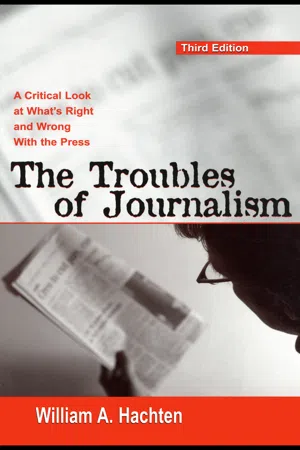
eBook - ePub
The Troubles of Journalism
A Critical Look at What's Right and Wrong With the Press
- 200 pages
- English
- ePUB (mobile friendly)
- Available on iOS & Android
eBook - ePub
The Troubles of Journalism
A Critical Look at What's Right and Wrong With the Press
About this book
Information
CHAPTER 1
Best News Media in the World?
There is much to criticize about the press, but not before recognizing a ringing truth: the best of the American press is an extraordinary daily example of industry, honesty, conscience, and courage, driven by a desire to inform and interest readers.
—Ben Bradlee
A major news event can occur unexpectedly somewhere in the world at any moment—the explosion of a jet airliner in midair, a terrorist bombing of an American military facility, the assassination of a world leader, an outbreak of war in the Middle East, a major oil spill in a ecologically sensitive region.
On hearing about an important news story, millions of Americans then turn to their television sets or radio to learn more—to CNN perhaps, or to an all-news radio station for the first details from the Associated Press (AP) or Reuters or from broadcast reporters. The evening network news shows will give a fuller picture and one of the networks—ABC on Ted Koppel’s Nightline, or maybe NBC or CBS may put together a special report later that evening. The news will also be available on cable networks and the Internet.
The next morning more complete stories with additional details will appear in more than 1,500 daily newspapers and hundreds of radio and television stations will recap the story with more developments. If the story is big enough, if it “has legs”—of continuing interest—The New York Times may devote three or four inside pages to more details, related stories, and news photos. Other major dailies may do the same. Within a week, the news magazines—Time, Newsweek, and U.S News and World Report—will publish their own versions, complete with cover stories, more background, and commentary.
If an event is important enough, aware Americans will know the basic essentials—“Terrorists bomb U.S. military housing in Saudi Arabia,”—within 24 hours, and the “news junkies” and interested specialists among us will know a great deal more.
The quintessential “big story” of recent memory, of course, was the terrorist attacks of September 11, 2001. After the collapse of The World Trade Center’s twin towers, the scarring of the Pentagon in Washington, DC, the crash of four airliners, and about 3000 lives lost, Americans (and others in the West) no longer felt safe from the threats of a dangerous world beyond our borders. Damage from the 9/11 events was estimated to be about $350 billion. The United States promptly embarked on a war against terrorism.
News coverage of 9/11 was comprehensive and magnificent. In New York and Washington, journalists covered a local story of grave national and international import. Global color television, nonstop and constantly updated, carried unfolding details to every corner of the world. Supplemented by radio, print, the Internet, and cell phone, much of the world saw the same video and news reports as Americans. Nielsen Media Research reported an American audience of 79.5 million watching television news in prime time on 9/11. The Internet audience (which is international) was huge as well. The number of page views that CNN.com normally receives on an average day is 14 million. On 9/11, the number of page views on CNN.com jumped to 162.4 million. Moreover, the vast audience approved of the way both the U.S. government and the media had responded. According to a Pew Research Poll, 89% of the public felt the media had done a good or excellent job in covering the attacks; professional journalists agreed.
Another Pew poll taken in October 2001 found that the terrorist attacks and war in Afghanistan had created a new internationalist sentiment among the U.S. public. And support for assertive U.S. leadership had grown. These dramatic opinion shifts as well as greatly expanded media coverage of international news did not, however, persist.
Even on slow news days, such extensive communication of so much news and information, driven by high-speed computer systems, communication satellite networks, and various databases, is commonplace today. Many Americans will pay little attention and will not be much impressed, but to some of us, such an impressive journalistic performance can be dazzling. For when it is good, modern journalism is very good indeed—as any careful examination of the annual Pulitzer prizes, DuPont-Columbia awards, National Magazine awards, and Peabody awards should remind us. Probably no newspaper covers the day’s news as well and as thoroughly as does The New York Times, which received six of its 89 Pulitzer prizes for its 9/11 coverage. Rivals that may outperform the Times at times (and they often do) would be other major U.S. dailies such as The Washington Post, The Los Angeles Times, and The Wall Street Journal.
There are many good newspapers, of course, in other open, democratic societies, many of which serve their readers well. Newspapers are edited for the interests and concerns of their own readers in their own cultures, so comparisons of papers across national boundaries are often interesting but probably pointless.
NATIONAL MEDIA SET AGENDA
These four daily papers just mentioned plus Time, Newsweek, U.S. News, and the television networks—ABC, NBC, CBS, and CNN—plus National Public Radio (NPR)—are often referred to as the national media, and to a large extent they set the news agenda for other media across America. The national media decide what is major or important news in New York City and Washington, DC, and that will be considered, or at least noted, in Pocatello and Peoria, because electronic news, as well as AP news, reaches almost every community.
This nationalizing of the American press took place over several decades. News magazines and nationwide radio news were well established before World War II. A national television news system took on real importance after the 30-minute format took over in 1963. The highly successful 60 Minutes appeared in 1968 and Nightline in 1979, becoming important supplements to the evening news and imitated later by lesser broadcast news magazines. In 1970, educational and noncommerical radio licensees formed NPR and out of it came two superior daily news programs, All Things Considered and Morning Edition. C-SPAN also started in 1979 and CNN in 1980. In the 1990s, other cable channels from NBC and Fox became players, while more and more of the public turned to the Internet for late-breaking news as well as sports results.
Due to facsimile and satellite publication, several major newspapers, The Wall Street Journal, The New York Times, and U.S.A. Today are now available to many millions through home delivery, by same-day mail, or on newsstands almost everywhere in the nation. Today, an American interested in significant news has almost the same access to these national media as anyone in New York City or Washington, DC.
In this sense, national has two meanings. These media are available across the country and they provide news and information of national, not of local or parochial, interest. This agenda-setting function of the national media flies in the face of the reality that most news is local, as the perusal of page one of any small daily newspaper or local television news show will attest. People are most interested in what happens close to home, whatever seems to most directly affect their own lives. A small airplane crash at a nearby airport is a bigger story than a jet going down with 250 aboard in Europe.
But for important news from distant places, the national media decide what is significant or at least highly interesting, and regional and local media generally take heed. The national media also gather and edit foreign news.
The dissemination of that news is assisted greatly by the AP, the cooperative news service owned by U.S. press and broadcast outlets, which is instantly available to almost every daily paper and most broadcasters. Reuters and the news syndicates of The New York Times, The Washington Post, and The Los Angeles Times Companies supplement the AP’s round-the-clock coverage. News video reports on television and cable networks are often syndicated or cooperatively shared with local broadcasters in much the same way. United Press International (UPI) is no longer able to compete with AP and Reuters.
Televised news has evolved as an elaborate process of gathering and disseminating news and video from domestic and foreign organizations. For many millions, a television set and perhaps a car radio may be their only source of news. A major reason for the steady decline of afternoon newspapers in big cities was that the papers’ midday deadlines enabled the evening television news shows to offer major stories breaking too late to be reported by those papers.
Although declining in audiences and profits, the three networks news shows, identified for many years with ABC’s Peter Jennings, NBC’s Tom Brokaw, and CBS’s Dan Rather, usually maintain professional standards. Until 1996, Jennings’ report was considered the best; ABC’s news resources, especially in foreign news, were superior, and Jennings was seemingly less tempted than CBS or NBC to present more entertainmentoriented and trivial features at the expense of hard news. More recently, NBC has topped the ratings and CBS has made something of a comeback. But essentially the highly competitive networks stay fairly close together in the size of their audiences as well as their popular appeal and choice of news content.
Broadcast media and print media each have different strengths in reporting major news stories. For epochal events from the opening attacks of the Iraq War to the election returns of a presidential contest, network television can command the nation’s attention for hours on end.
Television news, both network and cable, easily switches locales to bring information and comments from a variety of sources; at times, widely scattered reporters or experts can be brought together electronically to report or engage in group discussions—all of which we take for granted. Through video and spoken reports, television viewers get the headlines and the first available facts. (However, the number of news bureaus maintained abroad by television networks has markedly declined. More on this later).
Newspapers and news magazines, however, have the space and the time to provide more stories in greater detail and background and offer greater analysis than broadcasting. Moreover, print media are much better on follow-up stories to inform the public about what really happened during, say, the air war over Kosovo and Serbia and its complex aftermath.
NEW CATEGORIES OF NEWS
This book is critical of some current journalistic practices, so it is important to realize that in many ways the news media today are better than they have ever been. Forty years ago, most newspapers considered the news was covered adequately if they reported some news of government affairs and politics, a smattering of foreign news, local crime and disaster stories, some business news, and sports. In addition, light and human-interest features to divert and entertain were often included.
In recent years, this same subject mix is still being covered but in much more detail and depth. For journalism is very much a part of the information explosion and news media now have far larger amounts of news available. More importantly, the definitions of what is news have been greatly expanded to include news and developments about science, medical research, reviews of movies, the arts and popular culture, the entertainment business, a wide range of social problems, education, legal affairs, information technology and the computer revolution, personal health, nutrition, and many more stories of the business and financial world here and abroad. Much of this expanded reporting is done by specialists with professional training in their fields. (These expanded news categories are distinct from the gossip, trivia, and celebrity-oriented sensationalistic stories that have also proliferated.)
A recent study of media during the last 20 years found that the current news media are producing fewer stories about what happened today than 20 years ago, and are devoting less coverage to government and foreign affairs. More prevalent now are features on lifestyle, human interest, personal health, crime, entertainment, scandal, and celebrities. Why the shift? The Cold War was over, and technology, medical science, and the environment took on new importance. This broader newspaper and broadcast coverage is supplemented by a plethora of specialized magazines, journals, and books that deal with such topics in a more leisurely and detailed manner.
But during the first 2 years of the war on terrorism, the media were full of news of the wars in Aghanistan and Iraq as well as domestic stories about homeland security and various efforts of government and business—particularly the airlines and airports—to protect the nation against terrorist attacks.
Any person living anywhere in America who is determined to be well-informed and be on top of the news can do so by owning a television set with cable, subscribing to a national newspaper such as The New York Times or The Wall Street Journal, listening to NPR, selectively watching CNN and C-SPAN, and subscribing to several magazines such as Newsweek, Harper’s The New Republic, The New Yorker, The Atlantic, Foreign Affairs, or The Economist, plus getting a good state or regional daily newspaper.
Further, our hypothetical news junkies can gain access to a lot more news and information (as well as rumor and conjecture), if they also own a computer with a modem to scan the news and information available from online services such as America Online, Google, Yahoo, CNN, MSNBC, Slate, or the interactive editions of hundreds of newspapers on the World Wide Web, as well as hundreds of “bloggers” offering opinions, criticism, and tirades about the news (see chap. 12, this volume).
At this time of media bashing, it is well to remember that a lot of good reporting still gets done by newspapers. Phillips (1996) commented:
Anyone with an hour for a Nexis computer search can come up with 50 courageous exposes of special interests buying congressional favors, lobbies run amok, the plight of the Middle Class and such in The New York Times, The Washington Post, The Wall Street Journal, The Chicago Tribune, The Philadelphia Inquirer, The Los Angeles Times, and The Boston Globe. The ghost of Lincoln Steffens is not gone from the nation’s newsrooms, (p. 8)
The leading newspapers employ an impressive number of investigative reporters. Press critic, Ben Bagdikian, commented that newspapers are much better today than they were 40 years ago and report a great deal more news than before. But, he added...
Table of contents
- COVER PAGE
- TITLE PAGE
- COPYRIGHT PAGE
- PREFACE TO THIRD EDITION
- PREFACE
- INTRODUCTION
- CHAPTER 1: BEST NEWS MEDIA IN THE WORLD?
- CHAPTER 2: GLOBAL IMPACT OF AMERICAN MEDIA
- CHAPTER 3: FREEDOM OF THE PRESS: THEORY AND VALUES
- CHAPTER 4: RECENT HISTORY OF THE PRESS
- CHAPTER 5: BIGGER, FEWER, AND MORE LIKE-MINDED
- CHAPTER 6: NEWS ON THE AIR: A SENSE OF DECLINE
- CHAPTER 7: THE FADING AMERICAN NEWSPAPER?
- CHAPTER 8: WHY THE PUBLIC MISTRUSTS THE MEDIA
- CHAPTER 9: THE CLINTON SCANDAL AND “MIXED MEDIA”
- CHAPTER 10: FOREIGN NEWS REVIVED?
- CHAPTER 11: COVERING WARS IN AN ERA OF TERRORISM
- CHAPTER 12: NEWS AND COMMENT ON THE INTERNET
- CHAPTER 13: EDUCATING JOURNALISTS
- CHAPTER 14: CONCLUSION: JOURNALISM AT A TIME OF CHANGE
- REFERENCES
Trusted by 375,005 students
Access to over 1.5 million titles for a fair monthly price.
Study more efficiently using our study tools.
Frequently asked questions
Yes, you can cancel anytime from the Subscription tab in your account settings on the Perlego website. Your subscription will stay active until the end of your current billing period. Learn how to cancel your subscription
No, books cannot be downloaded as external files, such as PDFs, for use outside of Perlego. However, you can download books within the Perlego app for offline reading on mobile or tablet. Learn how to download books offline
Perlego offers two plans: Essential and Complete
- Essential is ideal for learners and professionals who enjoy exploring a wide range of subjects. Access the Essential Library with 800,000+ trusted titles and best-sellers across business, personal growth, and the humanities. Includes unlimited reading time and Standard Read Aloud voice.
- Complete: Perfect for advanced learners and researchers needing full, unrestricted access. Unlock 1.5M+ books across hundreds of subjects, including academic and specialized titles. The Complete Plan also includes advanced features like Premium Read Aloud and Research Assistant.
We are an online textbook subscription service, where you can get access to an entire online library for less than the price of a single book per month. With over 1.5 million books across 990+ topics, we’ve got you covered! Learn about our mission
Look out for the read-aloud symbol on your next book to see if you can listen to it. The read-aloud tool reads text aloud for you, highlighting the text as it is being read. You can pause it, speed it up and slow it down. Learn more about Read Aloud
Yes! You can use the Perlego app on both iOS and Android devices to read anytime, anywhere — even offline. Perfect for commutes or when you’re on the go.
Please note we cannot support devices running on iOS 13 and Android 7 or earlier. Learn more about using the app
Please note we cannot support devices running on iOS 13 and Android 7 or earlier. Learn more about using the app
Yes, you can access The Troubles of Journalism by William A. Hachten in PDF and/or ePUB format, as well as other popular books in Languages & Linguistics & Communication Studies. We have over 1.5 million books available in our catalogue for you to explore.