- 120 pages
- English
- ePUB (mobile friendly)
- Available on iOS & Android
eBook - ePub
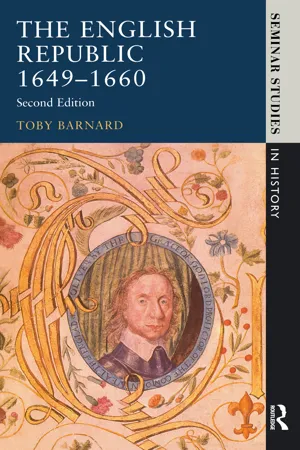
The English Republic 1649-1660
About this book
The book begins by introducing the complicated events leading to the execution of Charles I in 1649 and then offers a detailed analysis of the political experimentation which followed. Toby Barnard argues that although the survival of the revolutionary order was bound up with Cromwell, and collapsed after his death, the regime defeated both its domestic and foreign enemies and was more stable than has often been thought. The book also investigates changes on the structures of power, on the ruling elites and in the localities.
1 ENGLAND IN 1649
By 1649 an uneasy peace had settled over England after seven years of intermittent civil wars. Only a minority of zealots had wanted war when it broke out in August 1642; when it ended in 1646 even fewer approved it. The political instability of the 1650s arose largely from varied reactions to the war years. By way of introduction we must describe how the more serious differences originated.
When the Long Parliament assembled in November 1640 its members were virtually united in condemning the royal policies of the preceding decade. Parliament legislated to prevent those policies being repeated. It guaranteed regular meetings for itself and punished the authors of recent acts. Parliament divided when veteran critics of the king, led by Lord Bedford and John Pym, revealed their programme. They asked the king for the great offices of state, so that they might simultaneously profit and protect the nation from the king’s efforts to erect an absolutism on the continental model. Charles I angrily refused to forfeit his traditional prerogative to choose his own ministers. By requesting office Pym antagonised many who had happily supported him so long as he attacked only the innovations of the 1630s. When, in 1641, the backwoodsmen in parliament discovered that decentralised and cheap government, exercised mainly by the justices of the peace,* was not Pym’s prime aim and that instead he wished parliament to pay more towards the expenses of government in return for an end to the king’s right to select his ministers and army commanders, many detached themselves from Pym and turned neutral or royalist. The movement in Charles I’s favour was accelerated by the religious radicalism, apparently connived at by Pym, which first drove the bishops from the House of Lords and then threatened them with abolition.
The divisions within parliament, between a minority with national priorities and anxious to capture government and a traditionalist majority whose horizons were bounded either by their estates, by their parishes or by their shires, deepened once civil war broke out. Local efforts to avert conflict had failed. Experience of warfare soon confirmed the gloomy prognostications and swelled the numbers of those who urged an immediate cessation to the fighting. Unruly soldiers rampaged through the countryside, wasting property and intimidating civilians; taxes multiplied until an unheard of proportion of national wealth drained away to Westminster; the operations of the law courts were temporarily suspended; familiar institutions of county and town government, notably the commission of the peace,* were superseded by new county committees intended to be more subservient to the central government; and even the customary local hierarchies were endangered as men from outside the usual circle of country rulers took command of the forces and the shire administrations. Parliament by 1645 ruled more tightly, arbitrarily and expensively than Charles I had ever done [84, 86, 87].
Parliament’s innovations won it the war, but the victory cost parliament the scant popularity it had enjoyed in 1642. With the war finished it was expected that parliament would settle with the king. Any treaty would surely see parliament shed its recently assumed powers, dismantle the novel institutions in the localities, and disband its expensive armies. When no treaty was signed and the costly novelties continued, parliament was blamed. Its members and their friends in the provinces were suspected of prolonging the emergency for their own profit.
Nationwide impatience turned to anger as a succession of bad harvests increased food prices and unemployment worsened. A majority of MPs wanted to conclude a treaty, but could not. Peace-making was complicated by the attitude of a part of the army, linked with a minority of MPs and well-organised radicals in London and other towns. Some soldiers, seeing themselves as the architects of parliament’s success, expected to shape the coming settlement. They proposed to reduce the king’s power to choose ministers and army officers, and insisted on a measure of religious freedom. They also asked that the ordinary soldiers should be compensated for their considerable sacrifices. By 1647 a section of parliament’s forces was prepared to stop any settlement which did not satisfy it [79, 129].
Parliament was also hampered by the king, who saw neither the necessity nor the propriety of acceding to its terms. Charles calculated, realistically enough, that his enemies – parliament, its allies in Scotland and its armies – would soon fall out among themselves. Then he would be able to detach at least one element in the parliamentary coalition. Furthermore he expected help, either from his English subjects, wearied by parliament’s oppressions, or from Scotland, Ireland or the Continent. By 1648 dislike of parliamentarian rule was expressed in armed risings [50, 79]. Royalists too easily mistook this disillusionment with parliament for enthusiasm for Charles I. Those who attempted to turn the insurrections to the king’s advantage saw the revolts quickly collapse. However, Charles had succeeded in engaging the aid of some Scots, who in June 1648 invaded England. The events of 1648 – the Second Civil War – reminded parliament of its feeble hold over the country. Most MPs responded by redoubling their efforts to agree with Charles I, as the only method to recover popularity. The new war affected the soldiery and their friends very differently. The seemingly invincible army regarded itself as an instrument chosen by God to refashion England. The king, clearly the author of the recent war, having invited in the Scots, was now described in the army as ‘that man of blood’ who had to be called to account [144 p. 54].
By the autumn of 1648 parliament and its forces were seriously at odds. The former was prepared to waive many of its earlier demands in order to reach an agreement with the king, and proposed that he return to London, where a popular reaction in his favour was likely. The army commanders, abetted by MPs like Henry Marten and Edmund Ludlow, acted to prevent parliament taking steps which might well culminate in Charles I’s unconditional restoration. On 3 December 1648 Colonel Pride forcibly prevented about 100 MPs reputed to favour concessions to the king from sitting in the Commons. The Long Parliament, first elected in 1640, now had fewer than 200 active members. Nevertheless it still claimed to represent the entire nation of five million [115].
Pride’s Purge was merely the first act in a programme which dangerously isolated the purged or ‘Rump’ Parliament and the army from the population. The king’s duplicity and obstinacy made him too untrustworthy to be restored to his old position. In January 1649 the Rump authorised an entirely novel High Court of Justice to try him for high treason. The king showed his contempt for the newly minted doctrines of treason by refusing to acknowledge the authority of the court. The latter hurriedly declared him guilty. On 30 January 1649, outside the new Banqueting House in Whitehall, Charles I was beheaded [124].
Some had toyed with the idea of substituting another Stuart for the stubborn Charles I, but none could be found to do parliament’s bidding. Monarchy had to be replaced, but the Rump were ill-prepared. After some fumbling, in March the Rump abolished monarchy in England, and then, after more delay, declared England ‘a Commonwealth and Free State’ on 19 May 1649. Reluctantly the Rump had made a revolution. The changes were half-hearted improvisations. Ideological republicans were rare in England. Some among the educated had visited or read of the continental republics of Holland and Venice; the godly knew that Scripture commended republics [51, 107, 193]. Only the unexpected intransigence of the defeated Charles I had forced his opponents into revolution and republicanism as the way out of the political impasse. But killing the king, the most unpopular of a series of unpopular acts, created fresh problems. The revolutionaries could settle and control the country only if they found a popular alternative to monarchy. For the moment the army deterred malcontents from working actively against the Rump and for the Stuarts’ restoration. The Rump’s dependence on the army was dangerous, and needed to be replaced with a wider following. As we shall see, the Rump strove in vain to enlarge its support, and ended by antagonising the soldiery.
2 THE ARMY AND OLIVER CROMWELL
The army, called into being by parliament, in turn created the Rump and then partnered it in revolution. Before tracing the collapse of the uncomfortable alliance, let us consider the army and its commanders before 1649.
No army in the 1640s, whether the king’s or parliament’s, was liked by civilians. In the early stages of the First Civil War parliament’s forces were as unruly as, and more incompetent than, the royalist regiments. Most were recruited and fought in a small area, and were commanded by local landowners. Conditions of service were poor, with irregular pay and rampant disease, so that many soldiers deserted. As supplies slowly improved and as officers were promoted on their merits, discipline tightened. In 1645, after a violent political battle, timid aristocratic commanders were retired and the regional armies were refashioned, part of them as the New Model Army. The latter, commanded by Thomas Fairfax and its cavalry led by Oliver Cromwell, was favoured with regular supplies and pay by parliament. The New Model’s reputation was made by its victory over the King at Naseby. Once heroic exploits gave way in 1646 to tedious garrison duties, the soldiers incurred the hatred of townspeople. Some soldiers, encouraged by their officers and radical preachers, reflected on their own plight, on the straits of the civilians from whose ranks they had recently been plucked and into which they would soon return, and on the kingdom’s future. Naturally the soldiers worried about their pay, much of which was owed by parliament; who would command and where they would be sent next; how the widows and orphans of their slain comrades could be helped, and what they themselves would do when demobilised. By 1647 these soldiers feared parliament, for it intended to regain popularity by sending some of them to reconquer Ireland and by disbanding the remainder. MPs hoped by these means simultaneously to reduce taxes and to free themselves from the soldiers’ meddling [75, 85, 87, 129].
These plans enraged many soldiers, some of whom had followed attentively recent political and religious controversies. The soldiery vowed to remain united until parliament satisfied their material worries. In published apologias the soldiers explained why they had disobeyed parliament’s orders. Furthermore, they impugned the present parliament, which had treated them so badly, as unrepresentative of the nation and as dominated by corrupt and self-interested men. The soldiers argued that as free-born Englishmen they had the right to air their complaints and to promote the interests of the entire population in the new settlement. The officers had been assisted in their deliberations by elected agents from the rank-and-file, the Agitators. As the army criticised parliament and stated its desires, it was far from united. Fairfax and Cromwell, although sympathetic to their men’s professional grievances, believed that politics should be left to parliament. By August 1647, it was clear that parliament was controlled by members careless of the army’s problems and of the nation’s safety, and Fairfax and Cromwell reluctantly supported the army marching on London and expelling from parliament those who were too friendly to Charles [129].
Once parliament had been remodelled, Cromwell hoped that it could be left to treat with the king. But a small knot of radicals, some soldiers and some civilians from London, had acquired a taste for politics. They now expected to shape the coming settlement, and produced a clumsy compendium of political, social and religious reforms which were to be included. The Levellers’ proposals went beyond the familiar wish to restrict the king’s powers, to replace the present parliament and to alter the structure of the state Church, and suggested that future parliaments, if they were to avoid the weaknesses of the Long Parliament, should be elected on a different franchise and for redistributed constituencies, and that the maximum as well as minimum life should be stipulated. These schemers also considered how to pay the clergy more equitably, how to make the law courts cheaper and easier to use, how to provide work and share profitable trade, how to relieve the poor and sick more efficiently, and how to help those who in increasing numbers had fallen into debt during the war [28, 29, 38, 47, 57, 79].
Cromwell allowed the divisive debate until he needed to use the army. Then he summarily silenced the few Levellers and returned wholeheartedly to his tactic of working through parliament to achieve a satisfactory settlement. Cromwell’s policy changed on the outbreak of the Second Civil War. He and Fairfax were fully stretched in suppressing a dangerous insurrection clearly engineered by the king. Parliament at the same time had resumed its talks with Charles, and dropped some of the conditions on which it had earlier insisted. Faced with the prospect of a treaty which would restore, on too generous terms, a monarch now deeply distrusted, Cromwell and Fairfax were prepared to let the army block the unacceptable settlement. Cromwell himself could not completely overcome his repugnance at the soldiers usurping the MPs’ role, and left the practical arrangements to others. However, once parliament had been purged, Cromwell worked hard to enlist support for the sickly Rump. At the same time he explored ways by which Charles I might be retained as king [115]. None could be found, and Cromwell accepted the inevitability of Charles’s trial and execution. Cromwell, like many Rumpers, became a reluctant revolutionary. He had been converted, largely through the king’s own deviousness, to the view that Charles I was too dangerous to be spared. Yet Cromwell was still attached to traditional institutions. He had wanted to retain the monarchy and had pleaded for the retention of the House of Lords. When those institutions were swept away, Cromwell bowed to the changes as the working out of divine providence. Henceforward he would try other forms of government so long as they satisfied two needs. One was to stabilise the exhausted and divided country by devising a government which would be solidly supported in the provinces; the other was to please the victors by forwarding godly reformation. Soon enough Cromwell discovered that few shared both objectives and that his twin aims of a stable and godly nation were incompatible.
3 THE RULE OF THE RUMP PARLIAMENT 1649-1653
THE RUMP ESTABLISHED
The revolution which had killed the king, abolished the monarchy and substituted a Commonwealth, had been made by a small group of MPs and some army officers. The survival of the unloved new régime was from the start uncertain. The army had to shield the Commonwealth against its enemies: plotters in England and possible invaders on behalf of Charles Stuart, Charles I’s eldest son, from Scotland, Ireland or the continent. Between 1649 and 1653 the size of the army increased from 47,000 to 60,000 men, and the tax burden grew proportionately. Notwithstanding the Rumpers’ preferences, the régime inevitably depended on the soldiers for its life. But even the large army could not guarantee success for the revolution. It might defeat challengers but it could not engender support in London or the provinces.
The Commonwealth was weak because few had actively wanted it and because even those who had created it, the Rumpers and the officers, expected different results from it. The soldiers thought they had acquired a parliament which would speedily draft a new constitution and then transfer power to a fresh parliament. The Rump, while finalising the details of this novel system, was expected to start the long-delayed reform of society and the Church, and to allay the soldiers’ professional grievances. But those who looked for reform, the soldiers, the Levellers and the members of the autonomous religious congregations, disagreed about the nature and even the necessity of the proposed changes.
The Levellers tended to concentrate on secular matters, such as reducing taxes, curbing the arbitrary powers assumed by parliament and bestowed promiscuously on its local agents, breaking the hurtful monopoly over lucrative trade enjoyed by the great London companies, and protecting agricultural tenants against their landlords. The Levellers shared with the army a wish to curtail the might of parliament. Years lived under the Long Parliament had taught even its former supporters that it was not the expected protector of men’s liberties. The Levellers argued that the people were sovereign, and though the people might delegate power to a parliament, the latter must be made more accountable and more sensitive to the people’s wishes. To this end it was proposed to redistribute parliamentary seats, giving more to the counties where the bulk of the population lived and where voters were freer to express their preferences, and fewer to the towns, which could more easily be controlled by the wealthy and powerful. It was also recommended that the electorate be increased, though reformers differed on whether to use rate or tax paying or mere residence as the qualification [31, 47, 78].
In contrast, most sectaries* thought chiefly of building the New Jerusalem. To achieve that, the gospel must first be purified and then spread more thoroughly, especially in the neglected and remote north and Wales. Restraints which had stopped godly men from preaching and which inhibited the free growth of congregations must be removed. Even secular institutions, like parliament and the law courts, had to be brought into conformity with the word of God [65, 80, 81, 113].
Radicals and sectaries deluged the Rump with contradictory proposals. Mistakenly the Rump ignored their requests. Although soldiers and radicals disagreed about the exact form of changes, most insisted that changes must come. Buoyed up by a remarkable series of victories, and emboldened by the unthinkable that had been accomplished, the toppling of a monarch, they wished to complete their revolution. Only when pressed by the army did the Rump attend to reform – in the summer of 1649, the winter of 1649–50, and the autumns of 1650 and 1651. Until 1652 these occasional flurries of activity, inspired usually by Cromwell, satisfied the busy soldiers. Then the officers scrutinised the Rump’s record and saw how poor it was. A few MPs, like the libertine and committed republican Henry Marten, shared the soldiers’ and radicals’ priorities [Williams in 96, 130]. Most Rumpers, however, regarded their chief work as governing the country, a full-time task. The Rumpers saw no urgency about transferring their power to a successor. The MPs, some of whom had sat continuously at Westminster since 1640, had become too accustomed to power to relinquish it willingly. This wish to cling to their positions was not, as the army contended, entirely self-interested. MPs argued convincingly that the country was still too unsettled to hold new elections, which would only return royalists.
The Rumpers’ reluctance to retire into the provincial obscurity from which they had come, led many historians to label them as corrupt profiteers. That hostile assessment of the Rump, fostered by those who removed it in 1653, has been challenged [130]. The Rump can be defended on the grounds that many of the expectations of what it might do were unrealistic, and that its members adequately performed those humdrum but essential tasks which they set themselves. As an assembly, the Rump was neither better nor worse than other seventeenth-century parliaments. Certainly the older view that depicted the Rumpers as fervent revolutionaries intent on overturning the familiar landmarks in Church and state has been convincingly refuted. Those in the Rump who had schemed to be rid of the king were a minority – no more than seventy. Those already committed to republicanism in 1649 were a small handful. The majority of Rumpers sat on in parliament because thereby they might curb revolutionary excesses, bring government back into more traditional channels and, at the same time, forward their own and their constituents’ interests.
Yet the Rumpers differed in some vital ways from the members of other seventeenth-century parliaments. Their powers, their history and their present tasks all made them unique. Never before had parliament acted as executive as well as legislature and governed the realm. Many of the MPs had successfully run a war against the king, and in doing so had mastered complex administrative and financial procedures. For almost nine years they had dwelt in London. More recently they had authorised the trial and execution of their sovereign, and, albeit reluctantly, invented the Commonwealth. In 1649 the MPs confronted unique problem...
Table of contents
- Cover
- Half Title
- Title Page
- Copyright Page
- Table of Contents
- An introduction to the series
- Note on referencing system
- PART ONE; THE BACKGROUND
- PART TWO: DESCRIPTIVE ANALYSIS
- PART THREE: ASSESSMENT
- PART FOUR: DOCUMENTS
- Glossary
- Bibliography
- Index
- Related Titles
Frequently asked questions
Yes, you can cancel anytime from the Subscription tab in your account settings on the Perlego website. Your subscription will stay active until the end of your current billing period. Learn how to cancel your subscription
No, books cannot be downloaded as external files, such as PDFs, for use outside of Perlego. However, you can download books within the Perlego app for offline reading on mobile or tablet. Learn how to download books offline
Perlego offers two plans: Essential and Complete
- Essential is ideal for learners and professionals who enjoy exploring a wide range of subjects. Access the Essential Library with 800,000+ trusted titles and best-sellers across business, personal growth, and the humanities. Includes unlimited reading time and Standard Read Aloud voice.
- Complete: Perfect for advanced learners and researchers needing full, unrestricted access. Unlock 1.5M+ books across hundreds of subjects, including academic and specialized titles. The Complete Plan also includes advanced features like Premium Read Aloud and Research Assistant.
We are an online textbook subscription service, where you can get access to an entire online library for less than the price of a single book per month. With over 1.5 million books across 990+ topics, we’ve got you covered! Learn about our mission
Look out for the read-aloud symbol on your next book to see if you can listen to it. The read-aloud tool reads text aloud for you, highlighting the text as it is being read. You can pause it, speed it up and slow it down. Learn more about Read Aloud
Yes! You can use the Perlego app on both iOS and Android devices to read anytime, anywhere — even offline. Perfect for commutes or when you’re on the go.
Please note we cannot support devices running on iOS 13 and Android 7 or earlier. Learn more about using the app
Please note we cannot support devices running on iOS 13 and Android 7 or earlier. Learn more about using the app
Yes, you can access The English Republic 1649-1660 by T.C. Barnard in PDF and/or ePUB format, as well as other popular books in History & British History. We have over 1.5 million books available in our catalogue for you to explore.