- 280 pages
- English
- ePUB (mobile friendly)
- Available on iOS & Android
eBook - ePub
About this book
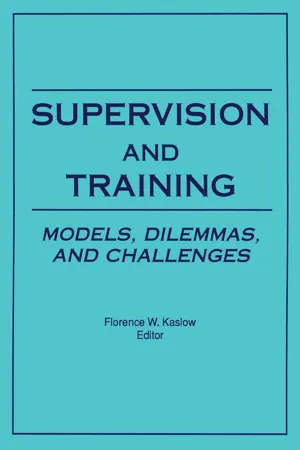
Challenging methods of training, consultation, and supervision--predicated on different ideas about how people learn most effectively--are highlighted in this exceptional volume. Distinguished educator Florence W. Kaslow has compiled new concepts and state-of-the-art approaches that greatly enhance our understanding of the process whereby good professionals become better professionals. Both direct and indirect training methodologies are discussed, and a variety of dynamic, behavioral, and eclectic approaches to the supervision of individual, group, and family therapies are described.
Information
PART I:
THE ECOLOGICAL CONTEXT
1
Supervision, Consultation
and Staff Training—
Creative Teaching/Learning Processes
in the Mental Health Profession
ABSTRACT. This chapter explores the structure and nature of the three processes of supervision, consultation and staff training. It considers the initial orientation to each and how the supervisor/supervisee, consultant/consultée, trainer/trainee form special pairings and interact. Learning each process as a recipient also enables one to incorporate some aspects which they may later offer as a provider. And the cycle begins anew.
THE THREE MAJOR TEACHING PROCESSES
Supervision
When students enter graduate or professional school and begin their first practicum, field placement, internship or residency, they are immediately assigned a supervisor. This is standard operating procedure in all of the mental health disciplines—throughout the formal graduate school educational experience. Similarly it occurs if and when one enters a post graduate training institute program and again in the clinical practice of therapy within an agency setting. What is the raison d'etre?
In assigning cases to students, the educational institution and the host clinical setting share responsibility for the quality of care. The trainee therapist is there primarily as part of his/her educational process and is not considered fully qualified; therefore someone else carries responsibility for insuring that treatment is ethical and efficacious—this someone is the supervisor. The same accountability concerns apply with the beginning staff member; the question to be answered is for how long is intensive supervision essential and advisable and what are the indicators for a decreased amount or change in focus over time?
Nature of the Process
In any role that inherently entails responsibility, there must be concomitant authority. Thus, the supervisor is usually endowed with the authority to truly oversee the work—and to carry back-up and fill-in responsibility if the trainee is absent or veers off what the supervisor deems to be a sound treatment plan utilizing appropriate methodology. To carry out this function, the supervisor should get to know the supervisee's work well—his/her strengths and weaknesses, areas of and gaps in knowledge, interpersonal relationship skills, personality style, areas of flexibility and rigidity, level of maturity, range of skills, etc. Yet, it is critical to remember that the reason for knowing this is to enhance the trainee's learning experience and the effectiveness of the treatment. As Abroms (1977) indicated so succinctly, supervision is a therapy of the therapy and not of the therapist. If the trainee is having problems which interfere with his/her learning and ability to help patients, such blockages or counter-transference phenomena are surely grist for the supervisory mill. To evade dealing with them is to do a disservice to trainees and patient(s) alike. But, to become the trainee's therapist and attempt to delve beyond difficulties specifically germane to the trainee's caseload is to exceed one's function and to be intrusive into the trainee's personal life. If the person's conflicts are such that they can not be handled and resolved appropriately through a learning and insight riented supervision as a growth process experience, then the trainee should be referred for therapy—preferably to someone not central to the training program as confidentiality is of critical import in such instances (Kaslow, 1984).
Supervision and therapy are parallel processes (Abroms, 1977). The supervisor's behavior constitutes a much more compelling model of how a session should be conducted than does his/her verbalization about the structure of a therapy hour. Like the therapy setting, the supervisory milieu should be designed as a safe sanctuary—private, uninterrupted by phone calls or visitors, and with an atmosphere conducive to exploration of one's concerns—in this instance about their therapeutic work—and to creativity as part of one's professional growth.
Just as therapy is a shared endeavor in which everyone involved in the session determines content and the flow of the process, so too in supervision. However, quite early in therapy, preferably the first session, the therapist must set out the ground rules and the structure; if these are challenged or contested, the therapist must win the battle for structure (Napier & Whitaker, 1978) or it is unlikely that the therapy will evolve effectively.
In supervision, it is posited here that the supervisor should outline the basic structure he/she adheres to yet try to evolve the relationship as a partnership or joint endeavor geared to improving the quality of the supervisee's practice. The more neophyte the trainee, and the more obligatory the supervisory sessions are, the greater the supervisor's role and responsibility for determining the framework, frequency and emphasis of the supervision. The more advanced the clinician, and the more voluntarily supervision is sought—as in private practice when one personally seeks out and pays for supervision—(see Chapter 9) the more the contractual aspects may be negotiated. Short term and long term learning objectives need to be articulated, discussed and agreed upon. I concur with Cleghorn and Levin (1973) that learning objectives can be subdivided into several categories. They delineate perceptual skills, conceptual skills and executive abilities. I would add to these categories another—intervention skills. For junior trainees progressive mastery in each area should be evaluated at periodic, pre-established intervals—coinciding with graduate school or institutional calendars when need be—or jointly determined by supervisor and supervisee if no external schedule exists. For senior clinicians who have purchased supervisory time based on a desire for assistance in certain specific areas only, the evaluation should assess only these aspects of practice. Nonetheless, it might be within the supervisor's purview to tactfully highlight other areas of weakness, as he or she perceives them.
Certainly issues around authority, power and control will surface. The trainee's feelings about senior people who represent “authority” figures and who do, in reality, have some “control” over their professional future may well be a factor to be dealt with in supervision. Similarly, the supervisor's degree of comfort with his/her necessary authority and whether it is perceived and utilized rationally or irrationally, minimally or maximally, will be elements in the tone that evolves in the relationship. Issues of punctuality of sessions, in submission of records and tapes, of making and returning calls, of doing assigned readings, and in working collaboratively with other staff and collateral professionals may need to be addressed. Confronting these issues should be done diplomatically, sensitively and honestly—but only when they exist.
Some supervisees respect and relate to authority well, are self directing and can still respond to what another has to teach and do not have a problem with promptness. The content and focus of supervisory sessions should be tailored to the needs, personality, style and clientele of the trainee therapist and to realization of the learning objectives or goals of the particular supervision. The process does not exist in a vacuum nor can each supervision of different trainees by the same supervisor be a carbon copy of all his/her other supervisions.
One or Multiple Supervisors?
One question that frequently arises amongst the faculty in graduate and professional school programs as well as in post graduate training institutes is: should the trainee be assigned to only one supervisor to whom they will be accountable on all cases or can the trainee have multiple supervisors to be consulted on different cases and even participate in the selection of the supervisors? Traditionally, schools of social work have followed the first procedure (Kutzik, 1977) using the rationale that the student's growth and learning would be maximized if it were coordinated through one person; that assignment to two or more supervisors would dilute the intensity of the relationship and the pressure to work through perplexing clinical dilemmas, interpersonal conflicts, and personal blocks or counter-transference problems. By working with the student on many cases over time, the supervisor can become familiar with the repetitive patterns and have more data to work with regarding his or her knowledge base and characteristic mode of functioning. This preference also centers around the fact that this model prevents: splitting of supervisory staff, showing favoritism, and difficulties in making certain all cases have supervisory backup. When social work students are assigned to more than one supervisor—the division usually is that one handles clinical matters and the other deals with administrative concerns (Hanlan, 1972).
Arguments against the trainee having only one supervisor for an academic or clinical year, and against their having no voice in the selection of that person include: (1) that if there is a personality clash—the trainee is locked in to the relationship with little recourse and no one to take his/her part—if he/she goes over the supervisor's head to the next higher ranking person in the administrative hierarchy he/she is accused of being rebellious, aggressive, “difficult”, and unable to “fit”; (2) that few supervisors are “expert” in all kinds of cases and that training is enriched by the opportunity to work with several people—each in their area of greatest competency; (3) that this narrows the students chance to be exposed to different styles and theoretical perspectives during their formative, flexible years in training.
Many psychology and psychiatry training programs and post graduate institutes, including those in group and family therapy, provide greater latitude. An intern, extern or resident may be assigned (or can request) a primary supervisor who carries major responsibility for his/her clinical practice. In addition, the trainee is free to, and encouraged to, seek supervision from others in cases which fall outside of the scope of the main supervisor's expertise. In one program in which I taught, some of the psychology and psychiatry trainees had as many as five supervisors. One might be for psychological testing, another for a child play therapy case, a third for a family therapy case, a fourth for behavioral therapy in a case of phobic anxiety and a fifth for group therapy. Interestingly, during the seven years I taught at this medical school and graduate school in the northeast I saw little splitting, dilution of relationships, unnecessary duplication, or jealousy. At faculty meetings, those supervising a particular student pooled their observations and concerns and the director of the program channeled these back to the student when the need to do so arose. In this program the vast majority of trainees felt privileged to be able to seek supervision from many talented clinicians, across professional disciplines and theoretical persuasions, and rarely were there battles for control or problems of supervisee/ supervisor match. Every effort was made to keep these deliberations as confidential as possible.
In all likelihood the flexibility or rigidity of the supervisory selection or assignment and the supervisory processes that the student is exposed to early in his/her training will color his/her idea of what constitutes good and bad supervision. Hopefully, trainees will become familiar with different viable patterns and processes, such as those described in the chapters contained in this volume. Subsequently, when they graduate and are supervising, out of this broad assortment of possibilities they should be stimulated to choose those that are most applicable to their trainees' and agencies' needs and to add to these creatively—continuing to refine, experiment and expand that which exists.
The Ideal Supervisor—Becoming and Being
The portrait of an ideal supervisor that has evolved from my trainees struggling to define such an entity and from my readings and observations is a multifaceted and complex one. He/she should be ethical, well informed, knowledgeable in his/her theoretical orientation, clinically skilled, articulate, empathie, a good listener, gentle, confrontative, accepting, challenging, stimulating, provocative, reassuring, encouraging, possess a good sense of humor, a good sense of timing, be innovative, solid, exciting, laid back—but not all at the same time—the supervisory mode and mood should be appropriate to the trainee's stage of professional development and level of personal maturity (see Friedman & N. Kaslow, Chapter 3).
Unfortunately, too often it is assumed that once a person finishes his/her formal training and receives the requisite graduate or medical degree for practice, he/she is ready to supervise graduate students and residents. It is posited here that no matter how talented and intuitive one might be, they need to acquire a knowledge base and sound clinical training to become a skilled and professional therapist. Similarly, appropriate and stimulating training is essential before one undertakes to serve in a supervisory capacity. Having had experiences with several supervisors during one's training does not, ipso facto, make them qualified. It is important also to acquire: some knowledge of the history of and literature on supervision in the various mental health professions, some conceptual framework for viewing the supervisory process and relationship, some in-depth exposure to the gamut of extant supervisory techniques, and a practicum experience in supervising under supervision. One can either take a course in supervision during their graduate/professional training (the final year is recommended), or at the post graduate level in a training institute. Sometimes graduate schools wisely offer such courses for would be and beginning supervisors. A group milieu in which questions can be raised and ideas and experiences shared is a fine beginning point. “Perks for supervisors in the form of adjunct faculty rank, library privileges, and/or free parking on busy campuses express the department's appreciation for their contribution and underscore the importance of their task. Attendance at a “mandatory” course might be increased through such “perks”.
In-agency supervision of supervision is another method for providing a supervised experience. Again, audio and vid...
Table of contents
- Cover Page
- Half Title page
- Title Page
- Copyright Page
- Contents
- Editors
- Foreword
- Preface
- Part I The Ecological Context
- Part II Supervision of Therapy: Models and Paradigms
- Part III Training to Improve the Quality of Practice
- Index
Trusted by 375,005 students
Access to over 1.5 million titles for a fair monthly price.
Study more efficiently using our study tools.
Frequently asked questions
Yes, you can cancel anytime from the Subscription tab in your account settings on the Perlego website. Your subscription will stay active until the end of your current billing period. Learn how to cancel your subscription
No, books cannot be downloaded as external files, such as PDFs, for use outside of Perlego. However, you can download books within the Perlego app for offline reading on mobile or tablet. Learn how to download books offline
Perlego offers two plans: Essential and Complete
- Essential is ideal for learners and professionals who enjoy exploring a wide range of subjects. Access the Essential Library with 800,000+ trusted titles and best-sellers across business, personal growth, and the humanities. Includes unlimited reading time and Standard Read Aloud voice.
- Complete: Perfect for advanced learners and researchers needing full, unrestricted access. Unlock 1.5M+ books across hundreds of subjects, including academic and specialized titles. The Complete Plan also includes advanced features like Premium Read Aloud and Research Assistant.
We are an online textbook subscription service, where you can get access to an entire online library for less than the price of a single book per month. With over 1.5 million books across 990+ topics, we’ve got you covered! Learn about our mission
Look out for the read-aloud symbol on your next book to see if you can listen to it. The read-aloud tool reads text aloud for you, highlighting the text as it is being read. You can pause it, speed it up and slow it down. Learn more about Read Aloud
Yes! You can use the Perlego app on both iOS and Android devices to read anytime, anywhere — even offline. Perfect for commutes or when you’re on the go.
Please note we cannot support devices running on iOS 13 and Android 7 or earlier. Learn more about using the app
Please note we cannot support devices running on iOS 13 and Android 7 or earlier. Learn more about using the app
Yes, you can access Supervision and Training by Florence Kaslow in PDF and/or ePUB format, as well as other popular books in Psychology & Education in Psychology. We have over 1.5 million books available in our catalogue for you to explore.