As the Baby Boomer cohort moves from middle to later adulthood, it is likely this generation will redefine what it means to age. Growing older will no longer be synonymous with loss and decline. In fact, it is true that the majority of older adults today live fulfilling lives. This special issue discusses ways in which older adults can age successfully—that is—how individuals can maintain their physical and cognitive health, as well as maintain a healthy engagement with life. Also addressed are the universal challenges faced by older adults in their pursuit to age successfully. The objective of this collection is to serve as a stimulus to future research on aging and change in the later years of life. It presents an outstanding array of articles that cover a range of central issues in this area of study. Each author provides a unique insight into the mystery and challenge that awaits us all: the ability to age successfully.
eBook - ePub
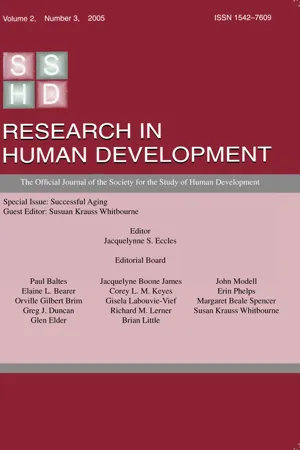
Successful Aging
A Special Issue of research in Human Development
- 62 pages
- English
- ePUB (mobile friendly)
- Available on iOS & Android
eBook - ePub
About this book
Information
Publisher
Psychology PressYear
2014Print ISBN
9780805894233
9781138167124
Edition
1eBook ISBN
9781317759225
Table of contents
- Cover
- Title Page
- Successful Aging: Introductory Perspectives
- What’s So Good About Aging?
- An Attentional Perspective on Successful Socioemotional Aging: Theory and Preliminary Evidence
- What Can We Learn From Longitudinal Studies of Adult Development?
Trusted by 375,005 students
Access to over 1.5 million titles for a fair monthly price.
Study more efficiently using our study tools.
Frequently asked questions
Yes, you can cancel anytime from the Subscription tab in your account settings on the Perlego website. Your subscription will stay active until the end of your current billing period. Learn how to cancel your subscription
No, books cannot be downloaded as external files, such as PDFs, for use outside of Perlego. However, you can download books within the Perlego app for offline reading on mobile or tablet. Learn how to download books offline
Perlego offers two plans: Essential and Complete
- Essential is ideal for learners and professionals who enjoy exploring a wide range of subjects. Access the Essential Library with 800,000+ trusted titles and best-sellers across business, personal growth, and the humanities. Includes unlimited reading time and Standard Read Aloud voice.
- Complete: Perfect for advanced learners and researchers needing full, unrestricted access. Unlock 1.5M+ books across hundreds of subjects, including academic and specialized titles. The Complete Plan also includes advanced features like Premium Read Aloud and Research Assistant.
We are an online textbook subscription service, where you can get access to an entire online library for less than the price of a single book per month. With over 1.5 million books across 990+ topics, we’ve got you covered! Learn about our mission
Look out for the read-aloud symbol on your next book to see if you can listen to it. The read-aloud tool reads text aloud for you, highlighting the text as it is being read. You can pause it, speed it up and slow it down. Learn more about Read Aloud
Yes! You can use the Perlego app on both iOS and Android devices to read anytime, anywhere — even offline. Perfect for commutes or when you’re on the go.
Please note we cannot support devices running on iOS 13 and Android 7 or earlier. Learn more about using the app
Please note we cannot support devices running on iOS 13 and Android 7 or earlier. Learn more about using the app
Yes, you can access Successful Aging by Susan Krauss Whitbourne in PDF and/or ePUB format, as well as other popular books in Psychology & Developmental Psychology. We have over 1.5 million books available in our catalogue for you to explore.