eBook - ePub
Managing Natural Wealth
Environment and Development in Malaysia
- 468 pages
- English
- ePUB (mobile friendly)
- Available on iOS & Android
eBook - ePub
Managing Natural Wealth
Environment and Development in Malaysia
About this book
The remarkably rich natural environment of Malaysia attracts the interest of both industry and the environmental community. Managing Natural Wealth analyzes major natural resource and environmental policy issues in the country during the 1970s and 1980s-a period of profound socioeconomic change, rapid depletion of natural resources, and the emergence of serious problems with pollution. Managing Natural Wealth is an important up-date to Environment and Development in a Resource-Rich Economy: Malaysia under the New Economic Policy. First published in hardcover in 1997, this pathbreaking book emphasized economics as a source for analyzing the issues involved in environmental and natural resource management in developing countries. The access that Jeffrey Vincent and Rozali Mohamed Ali and the contributing authors had to unpublished data and key decisionmakers made their account an essential reference for policymakers and researchers in Malaysia and throughout the globe. Managing Natural Wealth includes a review of key developments since the 1990s by S. Robert Aiken and Colin H. Leigh, two geographers with a long-standing interest in environmental change in Malaysia and an understanding of the institutional context of its environmental policy that is unmatched in the scholarly community.
Information
1
Natural Resources and the
Environment in the Malaysian
Context
Environment in the Malaysian
Context
Malaysia provides an ideal case for examining the relationships among natural resources, environmental quality, and development from an economic perspective. To begin, it is one of the most resource-rich countries in the world. In this regard it stands in contrast to the East Asian “tigers” (South Korea, Taiwan, Hong Kong, and Singapore) that are often cited as models of successful economic development, and it is more similar to the rest of the developing world. Land and mineral resources were the basis of the country’s economy when the Federation of Malaysia was formed in 1963. The relative importance of resource-based sectors has declined since, but they remain important in absolute terms. Indeed, GDP in primary sectors—mining and quarrying, agriculture, forestry, and fishing—was larger by a factor of more than two in real terms in 1990 than in 1970 (Figure 1.1). So were exports of primary commodities (Figure 1.2).1
During most of the 1970s and 1980s, Malaysia was the world’s largest producer and exporter of tin, tropical timber, natural rubber, and palm oil. The rapid total GDP growth shown in Figure 1.1 stands in marked contrast to the experience of most other resource-rich countries, which have tended to grow less rapidly than countries with fewer natural resources (Sachs and Warner 1995). Gaining a better understanding of the role of natural resources in Malaysia’s exceptional economic performance is therefore important not only from a research standpoint but also for practical policy making, both within the country and elsewhere.
As elsewhere, economic growth in Malaysia has been accompanied by serious pollution problems in industrialized and urbanized areas. Unlike most developing countries, however, Malaysia began monitoring these problems in the early stages of industrialization. It established a national system of monitoring stations for air and water quality in the late 1970s. The combination of its rapid economic growth and the existence of abundant, high-quality data on trends in environmental quality creates an unusually good opportunity for studying the relationship between economic development and pollution. The results of such analysis could be useful not only for predicting future environmental trends in the country, but also for determining, in a more general sense, whether a trade-off between growth and environmental quality is inevitable. Malaysia might offer a valuable reference case for other countries where industrialization is less advanced.
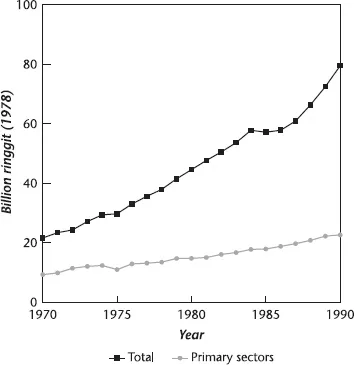
Figure 1.1 GDP: total and primary sectors
Malaysia therefore merits a closer look by environmental economists outside as well as inside the country. This chapter begins the examination of the Malaysian experience at a general level. Its purpose is twofold: to provide essential background information for readers who are not very familiar with the country, and to identify the broad research questions that will be the subject of more detailed analysis in the remainder of the book.
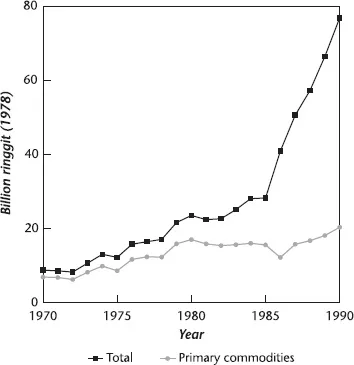
Figure 1.2 Exports: total and primary commodities
MALAYSIA: KEY FEATURES
Malaysia is located in the humid tropics in Southeast Asia. Geographically, its two parts are separated by more than 500 kilometers of the South China Sea (Figure 1.3). One part, Peninsular Malaysia, borders Thailand and extends south from the land mass of Asia. The other, composed of the states of Sabah and Sarawak, extends along the northern coast of the island of Borneo. The Borneo states cover somewhat more area, 198,160 km2 (124,449 km2 for Sarawak and 73,711 km2 for Sabah2) compared to 131,598 km2 for Peninsular Malaysia.
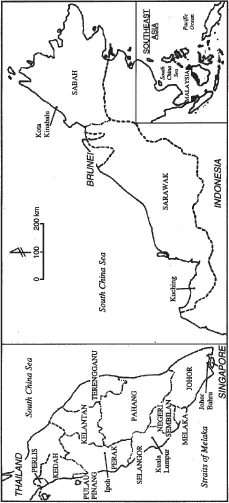
Figure 1.3 States and major cities of Malaysia.
The country’s peninsular/insular composition gives it a long coastline. Consequently, marine resources—in particular, offshore oil and gas, and marine fisheries—are economically important. Plains many kilometers wide extend along most coasts. The soils in these lowland areas are generally nutrient poor, but they have good physical properties. Hence, agricultural development, primarily for perennial tree crops, has been extensive. Table 1.1 shows estimates of land use in the three major regions of the country over time.
Forests were the largest single land use in all three at all points in time, but the area in agriculture expanded substantially. Because rainfall is abundant year-round in most of the country,3 agriculture is primarily rain fed, except in the northern peninsular states that form the country’s rice bowl. The interior of the country is rugged—the highest peak in Southeast Asia, Gunung Kinabalu at 4101 meters, is in Sabah—and heavily forested, due to the difficulty of developing agriculture (although vegetables are grown in some highland areas).
Table 1.1 Land use by region (in thousands of hectares)
Region and use | 1966a | 1974b | 1981 | 1990c |
Peninsular Malaysia | ||||
Agriculture | 2,736 | 3,565 | 4,085 | 4,244 |
Forestd | 10,034 | 8,843 | 8,460 | 6,270 |
Urban | 134 | 199 | 251 | — |
Other | 311 | 430 | 448 | — |
Sabah | ||||
Agriculture | 313 | 693 | ||
Forest | 6,949 | 4,437 | ||
Urban | 9 | — | ||
Other | 118 | — | ||
Sarawak | ||||
Agriculture | 2,814 | 3,206 | 4,045 | |
Forest | 9,433 | 9,032 | 8,301 | |
Urban | 12 | 15 | 37 | |
Other | 136 | 72 | 62 |
Sources: For Peninsular Malaysia, Wong (1971) for 1966, Economic Planning Unit (1980) for 1974, Kementerian Pertanian (1992) for 1981, and Kementerian Pertanian (1992) and Kementerian Perusahaan Utama (1992) for 1990. For Sabah, Kementerian Pertanian (1992) for 1970 and Seksyen Banci and Perangkaan, Bahagian Ekonomi Pertanian (1990) for 1990. For Sarawak, Kementerian Pertanian (1992) for 1976, and Jabatan Pertanian (various issues) for 1966 and 1991.
a 1970 for Sabah.
b 1976 for Sarawak.
c 1991 for Sarawak.
d Broadly defined, to make estimates comparable across years. Includes dryland forests, swamps and swamp forests, scrub forests, and grassland. The 1990 estimate for Peninsular Malaysia is more narrowly defined.
Malaysia is one of the least densely populated countries in Asia, and Sabah and Sarawak are particularly sparsely populated (Table 1.2). The population is multi-ethnic in all parts of the country. Malays, who are Muslim and traditionally dwe...
Table of contents
- Front Cover
- Title Page
- Copyright
- About Resources for the Future and RFF Press
- About ISEAS
- Resources for the Future
- Dedication
- Contents
- Preface
- Preface to Environment and Development in a Resource-Rich Economy
- Acknowledgments
- About the Contributors
- 1. Natural Resources and the Environment in the Malaysian Context
- 2. Natural Resources and Economic Sustainability
- 3. Petroleum
- 4. Forests
- 5. Agricultural Land
- 6. Marine Fisheries
- 7. Freshwater
- 8. Pollution and Economic Development
- 9. Air Pollution and Health
- 10. Water Pollution Control
- 11. Conclusions
- Natural Wealth: Depletion or Conservation?
- Bibliography
- Index
Trusted by 375,005 students
Access to over 1.5 million titles for a fair monthly price.
Study more efficiently using our study tools.
Frequently asked questions
Yes, you can cancel anytime from the Subscription tab in your account settings on the Perlego website. Your subscription will stay active until the end of your current billing period. Learn how to cancel your subscription
No, books cannot be downloaded as external files, such as PDFs, for use outside of Perlego. However, you can download books within the Perlego app for offline reading on mobile or tablet. Learn how to download books offline
Perlego offers two plans: Essential and Complete
- Essential is ideal for learners and professionals who enjoy exploring a wide range of subjects. Access the Essential Library with 800,000+ trusted titles and best-sellers across business, personal growth, and the humanities. Includes unlimited reading time and Standard Read Aloud voice.
- Complete: Perfect for advanced learners and researchers needing full, unrestricted access. Unlock 1.5M+ books across hundreds of subjects, including academic and specialized titles. The Complete Plan also includes advanced features like Premium Read Aloud and Research Assistant.
We are an online textbook subscription service, where you can get access to an entire online library for less than the price of a single book per month. With over 1.5 million books across 990+ topics, we’ve got you covered! Learn about our mission
Look out for the read-aloud symbol on your next book to see if you can listen to it. The read-aloud tool reads text aloud for you, highlighting the text as it is being read. You can pause it, speed it up and slow it down. Learn more about Read Aloud
Yes! You can use the Perlego app on both iOS and Android devices to read anytime, anywhere — even offline. Perfect for commutes or when you’re on the go.
Please note we cannot support devices running on iOS 13 and Android 7 or earlier. Learn more about using the app
Please note we cannot support devices running on iOS 13 and Android 7 or earlier. Learn more about using the app
Yes, you can access Managing Natural Wealth by Jeffrey R. Vincent,Rozali Mohamed Ali,Jeffrey R. Professor Vincent,Rozali Professor Mohamed Ali in PDF and/or ePUB format, as well as other popular books in Politics & International Relations & Environmental Economics. We have over 1.5 million books available in our catalogue for you to explore.