![]()
PART I
THE OUTFLOW OF CORPORATE KNOWLEDGE
![]()
1
THE LARGEST GENERATION LEAVES A GAP
Your organization grew and prospered under the direction of several large generations of educated and driven individuals. First, the World War II generation, also called The Greatest Generation, has almost completely left the workforce taking with it a unique set of attitudes and behaviors that allowed corporations to thrive in a linear way. Next, their children, Baby Boomers, who became if not the greatest, then certainly The Largest Generation, carried many of their parents’ ideals to work with them.
The Boomers, however, have a few unique characteristics that evolved corporate values and structures to be more responsive to individuals. Boomers’ values begat an agile and mission-driven workforce as opposed to the formal organizational structure of the World War II generation.
While this book is not a social or labor history of the post-World War II corporate workforce, suffice it to say that a very large, educated, and dedicated labor cohort is exiting the workforce taking with them values, knowledge, and experience that, in many cases, may be the secret to your organization’s success. It is within their historical context that we can understand what they are taking with them.
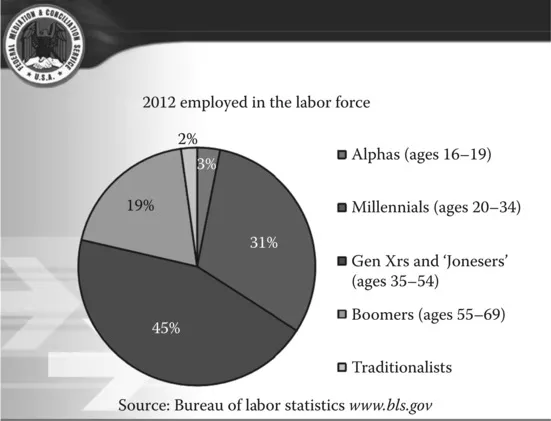
In fact, the workforce has entered a unique period between 2015 and 2020 when fully five generations will be in the labor pool at the same time. As recent Bureau of Labor Statistics data shows, people over 65 are staying in the workforce longer for many reasons, but mostly for economic ones. While they are sticking around and imparting wisdom, the younger wait to truly seize the reins. Some signs indicate they are no longer waiting and are upending old traditions and structures. In this tension, the value of decades of valuable information may be caught in the undercurrents of resentment, ambition, and impatience to get on with the future.
Out with the Old
Organizational development experts have given much attention to the interpersonal challenges of this circumstance. You can hire any number of experts who will train you how to work to successfully integrate the styles of multiple generations in the workforce. Let me suggest the tensions extend beyond the social implications of this phenomenon. This particular demographic distribution, as seen in Figure 1.1, demonstrates a convergence of talents, skills, and attributes that need to be conveyed not from one generation to the next but perhaps from one generation to another that is three degrees removed from it. That transfer presents several challenges including both what and how that learning is relayed. It is also happening in a time of technological advances that alter assumptions about what is important.
Generational filters require that knowledge, skills, and attitudes (KSAs in training parlance) not only be captured, but also preserved and translated in such a way that the knowledge itself remains relevant and usable to a workforce with different frames of reference.
Figure 1.1 Five generations in the workplace*
It is in this context that we will explore the challenge of finding your experts and preserving their knowledge in ways that make it accessible to their grandchildren and great-grandchildren.
A Working with SMEs Methodology
A Working with SMEs methodology creates a system for identifying and transferring the critical knowledge and talent of your subject matter experts that is leaving the workforce in unprecedented numbers given this unique confluence of circumstances. In order to understand the situation, it helps to reflect on the context of the kind of labor that is leaving your organization. In that spirit, each business must examine the kinds of knowledge, skills, and attitudes (KSAs) that undergird your successful organization so that you can accurately identify what to capture and how to capture it.
When people leave, the worst thing that can happen is that they take critical skill sets with them that you cannot replace. The second worst thing that can happen is that, when you discover they possessed irreplaceable pieces of your corporate puzzle, you hire them back as consultants at exorbitant rates on their own time schedules. The best outcome is that you use their last, best years with your company capturing what they know. If you are shooting for the best outcome, the Working with SMEs methodology is a process for memorializing their successes.
Meanwhile, you can feel an almost perceptible anxiety around the imminent retirement of the Baby Boomer generation. In casual and formal discussions on workforce training, leaders in business and industry worry openly about what will happen in the next 5–10 years when a huge bulk of talent walks out the doors of the local businesses that count on them. The Working with SMEs methodology is designed to give you a system for catching that important information before it leaves and provides your business with a knowledge management plan to preserve and transfer it to new generations of employees.
In these next chapters, we will delve into the questions to help you determine the how, what, why, and where to capture critical knowledge.
One question, though, is easy to answer. You need read no further to find out when to capture your critical organizational knowledge. The answer is Now.
Shallow Learning: Learning, Learning Everywhere…
With some reluctance, I use the words “shallow learning.” But, in truth, the rapid pace of change and technological advances have made much learning a quick-hit endeavor. We live in a world of constant growth and innovation on a global level, and that has begotten a generation of shallow learners. Shallow learning is not necessarily a bad thing, and it is quite necessary to keep pace with new information.
But collecting information, developing training, and storing and transferring knowledge for shallow learners is much different than it is for deep learners. Shallow learning actually is most appropriate for many jobs. Shallow learning assumes you only need to know what you need to do to accomplish the task at hand. That task may be on an assembly line doing a repetitive task, or it may be in a service job repeating specific functions and interactions according to a predetermined script or set of actions. Repetition in most jobs is a good thing because it means a job is being achieved within certain guidelines or best practices guaranteeing defined quality and outcomes.
While shallow learning works for many jobs and most tasks – or snippets of jobs – many other jobs require deep learning. When a job requires deep learning, usually the worker is hired with a strong skill set and knowledge base. It is your company’s job to customize your internal deep knowledge assets for these workers so they can acquire your organization’s specific knowledge and goals. You hire the right knowledge and skill set to accomplish the tasks and then manage your human assets in a way that you can take advantage of their experience and education to achieve your corporate purpose. When you have a full grasp of the abilities of your knowledge workers, you can assemble and disseminate the correct corporate knowledge to them to accomplish your goals.
Knowledge acquisition is a two-way street as well. Your deep knowledge workers will contribute to your corporate body of knowledge to make it relevant to changes in the marketplace and industry. Deep knowledge workers by definition have a 360o view of their subject that most of your workforce does not share.
Because your deep knowledge workers come to you with a skill set and experience behind them, they also enter your organization with a lot of preconceived ideas about how things should work. After all, certain ways of doing things have worked for them before. The danger of bringing in high value knowledge workers is that they may shape your organization in ways that you did not intend and that do not serve your long-term vision for your business. For this reason, your deep knowledge workers need to be involved in the strategic initiatives and direction of your goals for the organization so the horsepower that you engaged when you hired them is pulling in the same direction as leadership intends.
We will talk more about strategic planning in the second part of the book, but for now tuck away in the back of your mind that everything we discuss between here and there assumes alignment with a vision that is well-conceived and faithfully executed. How you achieve that strategic plan – and how you engage your experts and leaders in designing it – is discussed later.
The World’s Oldest Profession
The world’s oldest profession is not what you think! Training is actually the world’s oldest profession. When the first human babies popped out of the first human mamas, the mamas immediately ramped up knowledge, skills, and attitudes transfer. I was not there and have not actually seen this documented, but it is a fairly safe bet. If mama did not transfer her acquired wisdom to her child, the species would not have survived. And therein lies the foundation for my assumption.
You can eat this; it is safe.
Stay away from that animal; it is dangerous.
Put one foot in front of the other like this.
Do not forget to put your napkin in your lap and start with the silverware on the outside of your place setting.
Mamas have been keeping babies safe and viable in their environments by imparting acquired wisdom from the beginning of time. So I rest my case. Training is the world’s oldest profession.
Extending this example, critical, just-in-time information is the heart of learning and doing.
Early childhood learning is all about see one and do one – Tie your shoes by bringing this loop around.
Early childhood learning is about immediate feedback – I told you not to touch the stove!
Early childhood learning is about mentoring – Next time she teases you, tell her how that makes you feel.
Early childhood learning relies on these strategies in the moment because they work. Those same methods have served industrial and business knowledge, skills, and attitudes transfer since we hammered out the second wheel. Again, I wasn’t there, but it is a safe assumption that the human who smoothed out the rough edges on the first wheel figured out a plan for replicating the process and told the next person. And that approach became the way it was done.
Early childhood education from mother to child is about the value of short, demonstrative, and immediate learning opportunities.
In the fashion of the watchful caregiver, the uptake of just-in-time educational videos and smartphone reminders allows employees to have tutors and mentors at their fingertips all day long. The training industry is learning how to take advantage of this development in on-demand learning. Short video and electronic smartphone snippets of on-the-job training and reminders are sophisticated extensions of the old-fashioned paper job aid posted in a workstation.
These electronic job aids provide heretofore impossible access to experts. No matter what your experts do for you, whether she is the best assembler on the floor or he is the best accountant in your department, make sure they are documenting their actions using short, transferable snippets because all the pieces of their aggregated wisdom becomes the bedrock of knowledge transfer.
You can build larger and more intensive learnings from these pieces, but it is important to collect these learning components in situ.
We will discuss how you collect information, how you choose what to collect, and how to bottle it for consumption later. For now, the immediate important fact is that humans learn best in the moment, when they need it. So capturing and preserving information from experts to be accessed on an as-needed basis is the foundation of knowledge transfer for your organization.
With all this valuable expertise floating around, leaders need to identify it and employees need guidance to find it after it has been captured.
Content Curation for Shallow Learning
Content curation for shallow learning jobs is a matter of gathering or making available short snippets of information so they are easy to understand and storing them in a way that they can be easily retrieved when needed.
For example, let us say your new line workers need to recall the exact order for attaching the colored wires to the doodad. They may hav...