- 192 pages
- English
- ePUB (mobile friendly)
- Available on iOS & Android
eBook - ePub
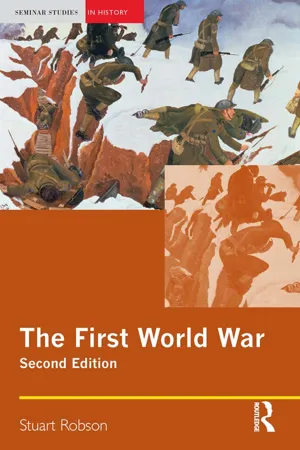
The First World War
About this book
This is a compelling account of the First World War. It offers clear analysis of the war on land, sea, and air, and considers the impact of the war on Europe's civilian population. Issues addressed include the relationship between war and industrialisation, trench warfare, the long term effects of the war on changing social structures, and economic and demographic consequences. The main text is supplemented by a rich selection of primary source material (from songs, soldiers' slang, to diary accounts).
| PART ONE | BACKGROUND |
| CHAPTER ONE |
WAR KNOWN AND WAR IMAGINED
THE CIVILIAN VIEW OF WAR
The First World War began on 3 August 1914 when Germany declared war on France and invaded Belgium. Germany and Austria-Hungary* (the Central Powers) fought against Russia, France and the British Empire (the Triple Entente*). After the Pact of London of September 1914 which bound the latter three not to make a separate peace, they became known as the Allies. They were joined by Italy in 1915 and then by America in 1917, as an associated but not allied power. The war grew out of the diplomatic crisis that began when Gavrilo Princips, a Bosnian Serb, assassinated Archduke Francis Ferdinand and his wife. The archduke was the heir to the throne of Austria-Hungary. Austria-Hungary sought to punish Serbia for sponsoring such terrorism. Russia defended Serbia, a fellow Slavic state. Germany insisted that the rest of Europe keep out of the business that her ally Austria-Hungary had with Serbia. France was bound by treaty to assist Russia. Britain did not have formal treaty commitments to France or Russia, but informal military and naval arrangements seemed to the government to amount to a moral commitment to help France. People in the towns and cities of the belligerent nations welcomed the outbreak of war almost universally and assumed the conflict would be over by Christmas. It did not end until 11 November 1918. Historians estimate that the war led to approximately 9.5 million military deaths.
After the First World War, survivors across all of Europe looked back to the world before 1914 with profound nostalgia. They contrasted the bleakness of the war and its aftermath to the radiant light of a golden age the war seemed to have destroyed, an age of peace, prosperity and tranquility [Doc. 10]. This homesickness for a time rather than a place showed up more in personal memoirs or fiction than in academic history, which was instead obsessed with finding the diplomatic causes of the war.
Of all the myths about the age before 1914, that of the Long Peace is the most enduring, echoed as it has been in both high and popular culture. It is also the least realistic. After all, British people in their sixties in 1914 would have lived through at least twenty-four wars. Myths, however, usually rest on facts and for that reason should not be taken lightly. What matters in history is not only what happens but also what people think happens – or has happened. People living in 1914 thought peace was normal because the wars since 1850 had been brief and peripheral to their lives. War for most people had become war imagined. At the same time, without reality as a check, war had become idealized as a test not just of state power but also of the moral strength of individuals and nations. Social changes encouraged this perception.
Modernization arrived in force after 1870, in an era that Norman Stone has called ‘the great transformation’ (Norman, 1983). People were on the move – literally, with 30 million Europeans migrating outside Europe and 60 million more moving into the cities of Europe. They were also trying to move socially, climbing the new ladder of urban society. Movement brought contact with strangers, which in turn raised new questions such as ‘who am I?’ and ‘who are we?’ – questions that had not seemed important in the isolated, unchanging life of rural society. Together with self-consciousness about one’s identity came a yearning for certainty in a world in which, as Karl Marx observed, everything solid melts into air. Historians are now paying close attention to the changing experience of women in this era. But change had an impact on masculinity too. When the role of women was starting to change and activities that had traditionally defined masculinity were mutating, what did it mean to be a man? Kipling wrote a sentimental poem outlining a modern version of Aristotelian gentility that avoided extremes of behaviour, although its title, ‘If’, suggests the limits of a stiff upper lip as a code of conduct. Being a gentleman meant juggling a lot of ‘thou shalls’ and ‘thou shall nots’. Yet the ideal of chivalry that he evoked had an important revival in the Victorian era. Middle-class men found emotional satisfaction in imagining themselves to be knights in shining armour. It was not just a matter of a taste for literature set in the Middle Ages but a way of expressing the ideal of the gentleman. A gentleman devoted his life to fair play and to helping others. In this deliberately old-fashioned view of life, war served as the ultimate test of character. The gentleman-warrior, schooled on the playing fields of the public schools, put his life on the line for the sake of honour. Cowards and bullies thought only of themselves and their narrow, selfish interests. They broke the rules, violated the spirit of the game and so of course they lost, whatever the final score. Yet it was not just against cads that the gentleman-knight defined himself. What he did could not be done by women. Men made war and war made men. It was the surest way to define masculinity and test character. The cult of the gentleman rationalized the violence and terror of war by treating death as the ultimate challenge. The gentleman should aspire to die a good death, facing it as Peter Pan did, as a ‘great adventure’.
War was imagined to be a purgative as well as a test. It was assumed to be the opposite of peace and therefore free of the sins peace had acquired: individualism, materialism, cynicism, uncertainty, aimlessness or boredom. Eric Leed argues that people welcomed the war as an escape from the dispiriting realities of the new industrial world (Leed, 1979). They did not realize that war itself would be industrialized. It would not provide an escape from mechanized routine but only an intensification of it.
THE PROFESSIONAL VIEW OF WAR
Were the professional soldiers wiser than civilians about what would be the realities of war? Yes and no. By 1914 many of them factored new technologies and social realities into their guesses about the next war. Civilians might imagine that war was a gallant and uplifting adventure, and soldiers often shared the assumption that character mattered most in life, but soldiers also knew that the staggering increase in firepower brought about by a century of industrialization ensured a corresponding rise in violence and casualties. They expected the next war to be terrible. Like the public, however, they thought that it would be brief and mobile. In particular, they assumed that improvements in manpower, firepower and command would strengthen the attack. They did not realize that in the first instance the defence would benefit more, simply because it could be dug in while the attack had to move above ground [Doc. 8].
The experts and the public were in various stages of denial about the nature of warfare because the profound changes that had occurred over the previous century were not so much hidden from sight as they were unpalatable to those who believed that war ought to embody a purpose other than brute killing. Both the natural and the customary limits to violence had weakened. Total, unlimited warfare had at least become possible. The French Revolution led to the ‘nation in arms’, with an economy devoted solely to the demands of war production supporting the armed forces. The Industrial Revolution increased firepower exponentially, above all with artillery. Formerly cast in bronze or iron and loaded from the muzzle,* the new guns were bored out of high quality steel and loaded from the breech.* Mechanisms to absorb the recoil meant that guns stayed in place and retained their aim after they were fired. The simple division between light field artillery* and heavier garrison or siege artillery became more elaborate as specialized guns and projectiles appeared: howitzers with a plunging or steep arc of fire; quick-firing field guns using shrapnel against human targets; immense longrange guns on fixed mountings or railway carriages to destroy heavy defensive positions; early versions of trench mortars that gave the infantry portable artillery of their own; heavy machine guns that filled a niche between small arms and artillery.
Armies in the past had been limited in size by the inherent difficulties of co-ordinating a large group, by problems of supply and by the shortage of men willing to become trained, reliable soldiers. Hierarchic organization and training overcame the problem of control, although linking the sharp end of combat with the centres of command remained a problem throughout the First World War. Problems of supply and logistics* were less severe. The ancient custom of overestimating one’s needs and producing more than enough to win was finally practical when mass production arrived. Getting the mountain of stuff to where it was needed was also easier because of the modern railway system and the existence of all-weather paved roads in Western Europe.
As for the traditional limitation on the size of armies, all the major powers except Britain and her Dominions solved the problem by adopting conscription, thereby making all men of military age liable, at least in theory, to serve. In Germany men were liable to serve at age 20 for two years in the infantry and three in the cavalry or field artillery. After that they might serve in the reserve for four to five years, which meant a fortnight of training each year. There could also be terms in the Landsturm, an emergency national guard, between age 17 and 20, and the Landwehr or militia for 11 years after that, taking a man to age 45. The Landsturm and Landwehr, however, were only mobilized in wartime emergencies.
With the Germans providing the model, the other continental powers followed with varying degrees of thoroughness. By 1914 the major powers had million-man armies made up of young first-line soldiers and huge reserves of older trained men.
Why was the impact of this seismic change not understood more clearly, especially by military professionals? The answer, perhaps, is that if war had indeed tilted to the defensive side, it had lost much of its apparent purpose. To be sure, states could be more confident about defending themselves against attack, even surprise attack, which is how most wars had started. But that seemed to point to mass armies digging in and going nowhere. What, then, was the point? Good question, and rather than answering it in a clear-headed way, people built optimistic assumptions into their plans and projections.
WAR PLANS
What did the military leaders plan to do when war came? Only the leaders of Germany planned to initiate a general European war, and then it would seem that they did so because they were convinced war was coming, probably by 1916, whether or not they wanted one. Better that it come when they could still expect to win or even survive against the perceived ‘encirclement’ posed by France and Russia. The great general Helmuth von Moltke, Bismarck’s military partner in creating the German Empire between 1864 and 1871, had planned for a limited war that involved defending in the west against France and seeking limited gains in the east. His eventual successor, Count Alfred von Schlieffen (Chief of the Great General Staff 1891–1906), took a strong and united Germany for granted. He saw no reason to play it safe the way Moltke had; the safety that such caution would provide seemed temporary, given the danger Germany would still face on two fronts. If a two-front war were coming, he looked for a way to win it decisively. Whether or not he came up with a formal plan (the Schlieffen Plan*) is now a matter of historical debate, but it seems safe to say that he devised a formula or set of working assumptions which committed most of the German army to a sweep through the Lowlands into Northern France, then hooking south to the west of Paris. Assuming that the French advanced east into Alsace and Lorraine, the provinces they had lost to Germany in 1871, the Germans could hook around them going the other way. Germany would beat France within six weeks and then use her railway system to shift east to defeat France’s ally, Russia. Schlieffen’s approach was a bold gamble which had the considerable virtue of addressing the gravest problem the German leaders thought they faced: what to do in the event of a two-front war. By doing so, however, Schlieffen reduced the incentive to ask just how likely such a war was. Was there any evidence available to the Germans that the French and Russians were indeed going to attack? Were there no nonviolent ways, such as negotiation, to deal with the neighbours? Was Germany in fact subconsciously inventing reasons to precipitate a war? Schlieffen might not have bequeathed his state with a plan but, after he left office, his state acted as if he had and, moreover, as if it were the only plan they could now follow. Every international situation Germany faced after 1906 increasingly led back to the assumed solution, the magic bullet, war against France – even if France were only marginally involved. When all you have is a hammer, everything looks like a nail.
Moltke’s nephew, also named Helmuth von Moltke, succeeded Schlieffen in 1906. When Russia not only rebuilt much of her military power after her defeat by the Japanese in 1905 but also started to build railways in what had been the underdeveloped glacis of Russian Poland, Moltke began to worry about the prospects of attacking in the west and defending in the east. Russia might show up on Germany’s eastern frontier in strength before France was defeated. What then? Increasing the size of the army* seemed one logical step to take. The problem here was that the German Navy was also eating up the scarce tax resources available to the central government (the Reich), and money bills to pay for arms increases had to obtain the approval of the Reichstag, the national parliament. Moreover, conservative elements in the Prussian Ministry of War were reluctant to dilute the traditional composition of the army, which constituted an aristocratic officer corps and a peasant rank and file. Expansion of the army would mean drawing upon the middle and working classes of the cities. In the end, the stark necessities of security overrode conservatism and political complications, and the Reichstag passed army bills in 1912 and 1913 that increased the size of the army by around 20 per cent.
Moltke was closer to having the manpower that would be required for his ambitious plans, but he was no closer to solving the problems of moving and supplying such a human mass and dealing with its exhaustion in combat than Schlieffen had been. Having willed the conclusion – that a pre-emptive attack in the west would save Germany from defeat in a two-front war – the leaders of Germany now willed the premise, the two-front war. The attack would work because it would have to work. When there are nails everywhere, what you are carrying had better be a hammer.
What of the military plans of the other powers? By 1914, most Austrian leaders of Germany’s ally Austria–Hungary also wanted a war, but it was to be a limited war against Serbia, intended to curb Balkan nationalism. A wider war against Russia frightened them. The landed elite ruling Hungary, the Magyars, could not see how a war against either Serbia or Russia would serve their interests and resisted it until the last minute.
Following defeat in 1871, the French put their faith in fixed fortifications along the common border with Germany, hoping to guard against another invasion. Schlieffen was impressed enough by these defences to avoid them and so his plan called for an advance to the north. The fixed defences were meant to serve as a shock absorber that would buy the French enough time to determine where the main weight of the German attack was falling. Plan XV, adopted in 1905, assumed that the Germans would be attacking out of Alsace and Lorraine. When evidence from German railway construction and hints about Schlieffen’s thinking pointed to an attack coming through Belgium, the French military at first thought they were being deceived. Such an attack would require a heavy commitment of reserves in the first line, and that seemed unlikely. By 1909, however, the omens had grown too persuasive to dismiss, and the new Plan XVI assumed that the Germans would come through Belgium and then turn south towards Verdun. The French response would be to keep their main force concentrated on their eastern frontier and then meet the Germans at Verdun (Strachan, 2001).
A change in organization in 1911 that brought operational and strategic planning under one roof in the General Staff also brought a new Chief of Staff, Joseph Joffre. His background was in military engineering, and in railways in particular. Historians have tended to cite his lack of interest in strategic thinking and innovation as evidence of his intellectual mediocrity, but more recent writers have been kinder, pointing to a practicality and imperturbability that served France well. He focused on the tasks at hand. The main challenge he faced by 1912 was the expansion of the German Army. In response, in 1913 he secured the increase in the term of service in the French Army from two to three years, improved training and by 1914 provided an overall increase in the regular forces of 200,000 men. Strachan (2001) argues that, despite the qualms Joffre and others had about relying too heavily on the reserves, of the 3.6 million men France mobilized in 1914, 2.9 million were reservists or territorials.
Joffre’s pragmatism showed up in his new plan, Plan XVII.* Instead of waiting to see where the Germans attacked and letting them come, Joffre wanted to counter-attack as soon as possible, preferabl...
Table of contents
- Cover Page
- Half Title page
- Title Page
- Copyright Page
- Contents
- Introduction to the Series
- List of Maps and Plates
- Acknowledgements
- Chronology
- Dedication
- Part One Background
- Part Two Limited War, 1914–15
- Part Three Total War
- Part Four ‘Going on or Going Under'
- Part Five Assessment
- Part Six Documents
- Glossary
- Who's Who
- Primary Sources, Websites And Further Reading
- Seminar Studies in History
Trusted by 375,005 students
Access to over 1.5 million titles for a fair monthly price.
Study more efficiently using our study tools.
Frequently asked questions
Yes, you can cancel anytime from the Subscription tab in your account settings on the Perlego website. Your subscription will stay active until the end of your current billing period. Learn how to cancel your subscription
No, books cannot be downloaded as external files, such as PDFs, for use outside of Perlego. However, you can download books within the Perlego app for offline reading on mobile or tablet. Learn how to download books offline
Perlego offers two plans: Essential and Complete
- Essential is ideal for learners and professionals who enjoy exploring a wide range of subjects. Access the Essential Library with 800,000+ trusted titles and best-sellers across business, personal growth, and the humanities. Includes unlimited reading time and Standard Read Aloud voice.
- Complete: Perfect for advanced learners and researchers needing full, unrestricted access. Unlock 1.5M+ books across hundreds of subjects, including academic and specialized titles. The Complete Plan also includes advanced features like Premium Read Aloud and Research Assistant.
We are an online textbook subscription service, where you can get access to an entire online library for less than the price of a single book per month. With over 1.5 million books across 990+ topics, we’ve got you covered! Learn about our mission
Look out for the read-aloud symbol on your next book to see if you can listen to it. The read-aloud tool reads text aloud for you, highlighting the text as it is being read. You can pause it, speed it up and slow it down. Learn more about Read Aloud
Yes! You can use the Perlego app on both iOS and Android devices to read anytime, anywhere — even offline. Perfect for commutes or when you’re on the go.
Please note we cannot support devices running on iOS 13 and Android 7 or earlier. Learn more about using the app
Please note we cannot support devices running on iOS 13 and Android 7 or earlier. Learn more about using the app
Yes, you can access The First World War by Stuart Robson in PDF and/or ePUB format, as well as other popular books in History & Social History. We have over 1.5 million books available in our catalogue for you to explore.