This book addresses the linguistic challenges faced by diverse populations of students at the secondary and post-secondary levels as they engage in academic tasks requiring advanced levels of reading and writing. Learning to use language in ways that meet academic expectations is a challenge for students who have had little exposure and opportunity to use such language outside of school. Although much is known about emergent literacy in the early years of schooling, much less has been written about the development of advanced literacy as students move into secondary education and beyond. Developing Advanced Literacy in First and Second Languages: Meaning With Power:
*brings together work on first and second language acquisition and emphasizes the importance of developing advanced literacy in the first language, such as Spanish for bilingual students, as well as English;
*spans a range of theoretical orientations and analytic approaches, drawing on work in systemic functional linguistics, genre theory, and sociocultural perspectives;
*addresses the content areas of science, history, and language arts;
*provides specific information about genres and grammatical features in these content areas; and
*presents suggestions for teacher education.
What unites the contributors to this volume is their shared commitment to a view of literacy that emphasizes both the social contexts and the linguistic challenges. The chapters collected in this volume contribute in important ways to research and pedagogy on advanced literacy development for the multilingual and multicultural students in today's classrooms. This book is particularly useful for researchers and students in language and education, applied linguistics, and others concerned with issues and challenges of advanced literacy development in first and second languages.
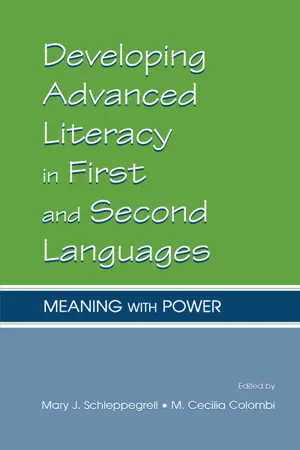
eBook - ePub
Developing Advanced Literacy in First and Second Languages
Meaning With Power
- 288 pages
- English
- ePUB (mobile friendly)
- Available on iOS & Android
eBook - ePub
Developing Advanced Literacy in First and Second Languages
Meaning With Power
About this book
Information
1
Theory and Practice in the Development of Advanced Literacy
University of California, Davis
“Advanced literacy,” as we present it in this volume, refers to the kind of meaning-making that is typical of secondary and postsecondary schooling, and that is also required for participation in many of the professional, technical, bureaucratic, and social institutions of our world. We focus particularly on educational contexts, where students need to work in content areas that have particular ways of making meaning. Students’ learning of disciplinary knowledge requires participation in social contexts where texts are actively constructed. Students need to be able to participate in literacy in ways that enable them to contribute to the evolution of knowledge by shaping what is learned and shared, or by challenging current practices and developing new ways of using language in advanced literacy contexts. With full participation by all students, from all backgrounds and experiences, the disciplines and institutions of our society can evolve in new ways that take account of the diversity of experiences and needs that these students represent. Without full participation by all, the inequities that characterize our society will continue to be reproduced.
Literacy is often talked about as if it were an attribute of a person (she is literate); or, on the other hand, as something that someone has or doesn’t have (he has functional literacy). But in today’s complex world, literacy means far more than learning to read and write in order to accomplish particular discrete tasks. Continual changes in technology and society mean that literacy tasks are themselves always changing, calling for skills in handling technical, bureaucratic, and abstract language; often simultaneously requiring that people get meaning from print, visual, electronic, and other kinds of media. In this context of change, literacy cannot be thought of as something that is achieved once and for all. We need to understand literacy as a process of meaning-making that continuously evolves both in society and in the individual. This book contributes to such an understanding by focusing on advanced literacy contexts where meaning-making depends on control of a range of semiotic resources as well as on an understanding of social and linguistic expectations for participation in those contexts.
Literacy is a social semiotic (Halliday, 1978; Lemke, 1989); a form of social action where language and context coparticipate in the meaning-making enterprise. Meaning is not inherent in texts; it comes from “how they are used and interpreted in communities” (Lemke, chap. 2, this volume). Lemke stresses the connection between the local context and the larger society, saying that “the meanings we make on any occasion are both uniquely emergent and culturally typical; they depend both on local contexts and on other meanings made in other times and places.” The kinds of meanings that are made in the institutions of learning and working and living today are complex meanings that call for complex uses of language and other semiotic resources. The development of advanced literacy is also a social process of enculturation into the values and practices of specialist communities. Lemke emphasizes how language is integrated with other semiotic resources in advanced literacy tasks, describing, as an example of this, the “multiple semiotic modalities” employed in “doing science” in school, in professional contexts, and in scientists’ communication with the public.
At the level of society, new kinds of literacy are constantly evolving. We have seen in recent history the development of new material means of making meanings (electronic, video, and others) along with new contexts of meaning-making in all domains of inquiry. Every discipline is continually evolving new ways of seeing, investigating, discussing, and evaluating knowledge, creating new contexts and new ways of doing literacy. These new ways of doing literacy that evolve at the level of society also continually put new demands on individuals. An individual’s growth and development and ability to participate in the powerful institutions of our society require ever expanding knowledge and control over meaning-making in new contexts and through new semiotic resources. This means that control over the basic resources of print (learning to read and write) is only the first step in developing the complex set of understandings, skills, and social forms that enable participation in the many institutions of our world that are partially constructed and maintained through the process of literacy.
This has major implications for our schools. Students need move beyond the basics to do science, history, and other subjects; to construct arguments and critique theories; and to integrate print, visual, interactional, and electronic means of developing and sharing knowledge—in other words, to develop advanced literacy skills. The challenge to educators is to make advanced literacy possible for all students.
The wide range of backgrounds and experiences that students bring to our classrooms makes the pedagogy of advanced literacy a complex endeavor. Our schools serve students who speak different languages and dialects, who have been socialized in different ways, and who face vastly different challenges in their daily lives. We can not rely on methods of literacy development that assume a homogeneous group of students who share similar cultural backgrounds and language experiences. In order to enable all students to participate in the institutions in our society, we need a new understanding of the literacy demands of those institutions and approaches that provide students with the experiences they need to enter into dialogue with others.
Multicultural classrooms are the norm in our schools today. The 2000 U.S. Census reported a population of over 280 million people in the United States, and of those more than 30% consider themselves ethnic minority. Together with these demographic changes come new educational challenges. Although much research has described the diversity of student populations and different ways of interacting in their communities, the focus in literacy research has concentrated primarily on the early stages of literacy development. But students need to move beyond initial literacy if they are to become full participants in the dialogue and texts that provide access, power, and opportunity in today’s world. Learning to use language in ways that meet the school’s expectations for advanced literacy tasks is a challenge for all students, but it is especially difficult for those who have little opportunity for exposure to and use of such language outside of school. Students have different experiences of language use in their homes and communities, and teachers are often not prepared to recognize and build on the experiences of students whose backgrounds are different from their own. Students whose cultural practices are similar to those of the school are able to transfer those practices to the school setting, but students from other backgrounds need to engage in meaningful experiences of authentic social practices involving speech, writing, tools, and technologies, and to focus on the ways that different semiotic systems, especially language, contribute to meaning making in those social contexts, in order to develop advanced literacy.
A great part of the diversity in our school-age populations is linguistic, and this linguistic diversity is clearly related to the challenges and problems of developing advanced literacy skills. Linguistic diversity manifests itself in different ways. Some students are bilingual, some are learning English, and some speak varieties or dialects of English that are not recognized and valued in school. This book brings together research on advanced literacy from a variety of contexts, including Spanish in a bilingual context, English as a second language (ESL), and standard English as a second dialect.
Latinos are the fastest growing population in the United States, with a total of 35.3 million, roughly equal to that of African Americans. Latinos are people of any race who (themselves or their ancestors) come from Spanish-speaking countries; in the United States, about two thirds of them are of Mexican descent with the largest concentration in the Southwest (California, Colorado, New Mexico, Arizona, Texas, and Nevada). The Latino population of the east coast presents a different profile. New York City, for example (García, chap. 13, this volume) has a Latino population of 30%, and of those, 40% were born in the United States. New York Latinos born in Spanish-speaking countries come mostly from Puerto Rico, the Dominican Republic, Colombia, Ecuador, and México. This makes Spanish the most frequently spoken language in the United States, after English. In some parts of the country, such as California, Spanish speakers make up more than one third of the total population. Spanish language students are more than 70% of all English learners in our schools, but many other languages are also spoken at home by our students, as one in seven school-aged children is not from an English speaking background (McKay & Wong, 2000).
In our current educational system, many students fail to continue development of their first languages as they become proficient in English. Even when students are provided with instruction in their mother tongues, such as in bilingual programs, the focus has typically been on developing their English skills so that they can make a transition into English-only classrooms. This means that bilingual students rarely develop advanced biliteracy. When literacy skills are taught in a language other than English, development frequently ends with initial literacy. This is a loss for the individual students and for society, as we know that bilingualism and biliteracy provide cognitive and social advantages to students (Bialystock & Hakuta, 1994; Cummins, 1983; 1989; Hakuta 1986), and that L1 academic language skills can serve as a basis for development of L2 literacy skills (Cummins & Danesi, 1990; Verhoeven 1991; see also chapters in Faltis & Wolfe, 1999, and Pérez, 1998). Maintaining and developing the first language facilitates the development of the second language, particularly at the levels of advanced literacy, and promotes bilingualism, a benefit for us as a society.
The chapters by Colombi and García (chaps. 4 and 13 respectively, this volume) discuss issues of advanced literacy development in Spanish-speaking students, focusing on helping these students develop full biliteracy. García, for example, shows how bilingual student-teachers working toward certification face major roadblocks in developing advanced literacy in Spanish (their first language) and English. She attributes their difficulties to the lack of venues in which the rich cultural and rhetorical traditions of Spanish advanced literacy can be meaningfully experienced in the U.S. context, where monolingualism is valued over bilingualism; and to the simplified version of the English rhetorical tradition that these students have been taught in school. Colombi offers a more positive outlook on this issue by showing how university students who have never had the opportunity to develop advanced literacy skills in Spanish, their first language, can develop their writing from more oral styles toward more written styles as they learn to make grammatical choices that structure their texts in more academic ways.
Another population addressed by this volume is second language learners of English. Students whose first language is not English are themselves diverse. They may be bilingual students who are developing linguistic skills in more than one language, or they may be losing their first languages as they move toward monolingualism in English. They may have been educated to levels of advanced literacy in their first languages, or they may have no first language literacy skills. Almost 3.4 million students in the United States are in programs for students who are limited in their English proficiency (Macías, 2000). Students who are learning English as a second language are at great risk for school failure, as research suggests that with current practice it takes students many years to develop the advanced literacy skills that enable them to do grade-level work in English (Collier, 1987). Many ESL students spend years in classrooms where they are expected to pick up English through immersion; losing valuable time in which they could be developing language skills through structured opportunities to learn the genres and registers that are important for school success.
Scarcella (chap. 11, this volume) identifies a series of factors that affect the development of advanced literacy in ESL students, including first language literacy skills, good oral English skills on entry to school, and opportunities to interact with speakers of standard English. She suggests that the most important factor in ensuring success for all language learners is the opportunity to engage in instructional activities that help students learn how to do advanced literacy tasks.
Many of the contributors to this volume consider the explicit teaching of language an important aspect of effective instruction in advanced literacy. It is important to understand the demands of language learning beyond basic conversational competence to enable second language learners of English to participate in ever more abstract and demanding contexts of learning. Celce-Murcia (chap. 7, this volume) provides examples of three grammatical structures that are typically taught only at the sentence level and shows how we need to help learners understand how such structures function in extended discourse. Schleppegrell (chap. 6, this volume) shows how university ESL students in chemical engineering courses are unable to draw on the linguistic strategies that their native-speaker peers use to structure lab reports and discuss experimental results. She shows how a sentence-level focus on correcting their grammatical errors does not address the deeper challenges these students face in constructing authoritative and well-organized texts. Merino and Hammond (chap. 12, this volume) provide suggestions for how skills in this lab report genre might begin to be developed by bilingual students or second-language learners even in the upper-elementary grades. They argue that the development of advanced literacy must be scaffolded from the early years by engaging students in academic language tasks, and not just the personal and narrative tasks that are typically assigned to students in the early grades.
The third population that this book addresses are native speakers of English who speak nonstandard dialects, or whose socialization has prepared them to use language in ways that are not valued at school. These students also face great challenges; similar to the challenges faced by bilingual students and second language learners. African American students are the largest population of nonstandard dialect speakers, but students from many backgrounds speak varieties of English that are not recognized and supported through school literacy tasks. As Baugh (chap. 9, this volume) reports, sociolinguistic studies have demonstrated that a nonstandard dialect such as African American English (AAE) is a fully formed linguistic system that has emerged under particular historical and social circumstances. Baugh provides background on the situation of African American students and outlines the challenges that African American speakers of nonstandard English face in developing advanced literacy in mainstream schools. Sociolinguists have shown the variability and richness of linguistic resources and purposes for literacy that characterize populations of nonstandard dialect speakers, and have urged that other dialects also be maintained and developed (e.g., Wolfram, Adger, & Christian, 1999).
Although these studies have made major contributions to the ways we see and understand other varieties of English, the work that has followed from the sociolinguistic studies has not focused on how students who speak nonstandard dialects might be guided in the development of advanced literacy skills. In addition, the challenges faced by students who speak nonstandard dialects can also face students whose dialects are close to standard English but whose life experiences have not prepared them for the kinds of literacy tasks they are expected to participate in at school. As with the other populations we have discussed, research with speakers of nonstandard dialects has typically focused primarily on the context of initial literacy; on the early stages of reading and writing and on remedial programs for older students. For advanced literacy, accepting that students come to school speaking different dialects that need to be respected is not enough. As Delpit (1995, 1998) has pointed out, in addition to recognizing and valuing what students bring to the classroom from their ways of using language in their home communities, we also need to help students develop new ways of meaning that enable them to participate successfully in advanced literacy contexts. Students also have to gain access to ways of making meaning that are currently socially distributed in ways that leave out many segments of society.
This book addresses issues of advanced literacy development common to all of the student populations we have described. What all of these students share is a need for experience in the sociocultural contexts...
Table of contents
- Cover
- Half Title
- Title Page
- Copyright Page
- Table of Contents
- Preface
- 1 Theory and Practice in the Development of Advanced Literacy
- 2 Multimedia Semiotics: Genres for Science Education and Scientific Literacy
- 3 The Development of Abstraction in Adolescence in Subject English
- 4 Academic Language Development in Latino Students’ Writing in Spanish
- 5 Writing History: Construing Time and Value in Discourses of the Past
- 6 Challenges of the Science Register for ESL Students: Errors and Meaning-Making
- 7 On the Use of Selected Grammatical Features in Academic Writing
- 8 Literacies, Identities, and Discourses
- 9 African American Language and Literacy
- 10 Enhancing the Critical Edge of (L2) Teacher-Education: Some Issues in Advanced Literacy
- 11 Some Key Factors Affecting English Learners’ Development of Advanced Literacy
- 12 Writing to Learn: Science in the Upper-Elementary Bilingual Classroom
- 13 Writing Backwards Across Languages: The Inexpert English/Spanish Biliteracy of Uncertified Bilingual Teachers
- Author Index
- Subject Index
Trusted by 375,005 students
Access to over 1.5 million titles for a fair monthly price.
Study more efficiently using our study tools.
Frequently asked questions
Yes, you can cancel anytime from the Subscription tab in your account settings on the Perlego website. Your subscription will stay active until the end of your current billing period. Learn how to cancel your subscription
No, books cannot be downloaded as external files, such as PDFs, for use outside of Perlego. However, you can download books within the Perlego app for offline reading on mobile or tablet. Learn how to download books offline
Perlego offers two plans: Essential and Complete
- Essential is ideal for learners and professionals who enjoy exploring a wide range of subjects. Access the Essential Library with 800,000+ trusted titles and best-sellers across business, personal growth, and the humanities. Includes unlimited reading time and Standard Read Aloud voice.
- Complete: Perfect for advanced learners and researchers needing full, unrestricted access. Unlock 1.5M+ books across hundreds of subjects, including academic and specialized titles. The Complete Plan also includes advanced features like Premium Read Aloud and Research Assistant.
We are an online textbook subscription service, where you can get access to an entire online library for less than the price of a single book per month. With over 1.5 million books across 990+ topics, we’ve got you covered! Learn about our mission
Look out for the read-aloud symbol on your next book to see if you can listen to it. The read-aloud tool reads text aloud for you, highlighting the text as it is being read. You can pause it, speed it up and slow it down. Learn more about Read Aloud
Yes! You can use the Perlego app on both iOS and Android devices to read anytime, anywhere — even offline. Perfect for commutes or when you’re on the go.
Please note we cannot support devices running on iOS 13 and Android 7 or earlier. Learn more about using the app
Please note we cannot support devices running on iOS 13 and Android 7 or earlier. Learn more about using the app
Yes, you can access Developing Advanced Literacy in First and Second Languages by Mary J. Schleppegrell, M. Cecilia Colombi, Mary J. Schleppegrell,M. Cecilia Colombi in PDF and/or ePUB format, as well as other popular books in Education & Education General. We have over 1.5 million books available in our catalogue for you to explore.