- 236 pages
- English
- ePUB (mobile friendly)
- Available on iOS & Android
eBook - ePub
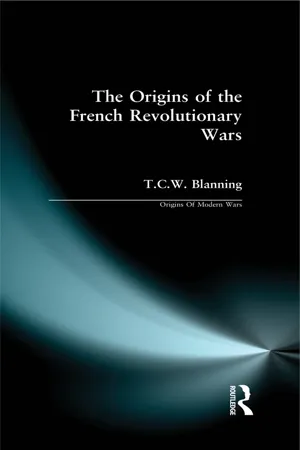
The Origins of the French Revolutionary Wars
About this book
A major synthesis of current research on the three wars fought by France during the Revolution - against Austria and Prussia; Britain, Spain and the United Provinces; and against the Second Coalition.
contains analysis of the theories of war including Clausewitz, and the role of ideology
Chapter 1
The Origins of Great Wars
They spent the rest of the hour discussing violence in the modern world. On the whole, the bricklayers seemed to think it was a good thing.
'I mean what's the point of going out on a Saturday night and getting pissed if you can't have a bit of a barney at the same time? Got to get rid of your aggression somehow', said an unusually articulate bricklayer, 'I mean it's natural isn't it?'
'So you think man is a naturally aggressive animal', said Wilt.
'Course he is. That's history for you, all them wars and things. It's only bloody poofters don't like violence.'
(Tom Sharpe, Wilt)1
Psychological Explanations of War
The problem with which the day-release bricklayers were wrestling at the Fenland College of Arts and Technology has exercised many minds from many disciplines in every age, and never more intensively than at present. A recent bibliography, disconcertingly but perhaps appropriately sponsored by the Mental Health Research Institute of the University of Michigan, lists about 2,500 authors.2 The destructive potential of the nuclear bomb, although used in anger only twice during the forty-odd years since its invention, has made war per se a subject on which only one opinion is possible. While there is much furious debate on how best to avoid it, deterrence theorists vie with unilateralists in the vehemence of their condemnation. Long gone are the days when such robust theorists as Heinrich von Treitschke extolled 'the greatness of war', 'the sublimity of war', 'the moral majesty of war' and derided the notion of perpetual peace as 'not only impossible but immoral as well'.3 Treitschke, of course, lived at a time when wars were short, when casualties were light and - most important of all -when the God of Victories smiled on the 'right' side. Tens of millions of deaths in twentieth-century conflicts - and the prospect of untold millions more to come - have lent a new urgency to the investigation of the origins and nature of war, so that it can be better avoided in future.
To the fore in this exercise have been psychologists. As they have plumbed the depths of the human psyche, they have been able to trawl up what seem to be the really fundamental causes of war. Far, far removed from the diplomatic historian's surface-world of tainted mushrooms or railway timetables, down past the structures of the social scientist and the economist's forces of production, the psychologists' bathyscope keeps going until it touches rock-bottom. Needless to say, the fantastic creatures they find there vary considerably in shape and dimension. What the observers have in common, however, is an angle of vision which is both individualistic (because the starting-point is always the individual human psyche) and abstract (because human nature is always regarded as timeless and universal).
In 1932, under the auspices of the League of Nations, Sigmund Freud exchanged letters with Albert Einstein on the causes of war, without alas being able to rise above the level of tentative superficiality.4 More representative of the genre is E. F. M. Durbin and John Bowlby's Personal Aggressiveness and War, first published on the eve of the Second World War but still influential and still cited with respect.5 At the core of their analysis lie man's aggressive impulses. Punished and prevented in childhood by parents and in adulthood by the state, his ensuing frustration is resolved by three unconscious mechanisms. The first is 'transformation', by which the hostility is transferred from the immediate repressing agent to some more distant collective target: Jews, Communists, Fascists, Germans, Argentinians, or whoever have the best credentials at the time. But just as a child's relationship with his parents is an ambivalent mixture of love and hatred, so is transformation accompanied by a second, more positive mechanism: 'displacement'. By this means, familial loves and hatreds are transferred to some greater entity such as a church, a political party or, above all, a state: 'These various kinds of groups can attract absolute loyalty and canalise torrents of hatred and murder through the mechanism of displacement.'6 A third crucial mechanism is 'projection', by which the individual projects on to others his own unrecognised and unaccepted dark impulses. To avoid being divided against his own self, all his potential self-hatred is lavished on third parties: 'Projection is an admirable mechanism for turning the other man into the aggressor, for making hatred appear as a passion for righteousness, for purifying the hate-tormented soul. By this means all war is made into religious war - a crusade for truth and virtue.'7
Transformed aggression, displacement and projection have always existed, as mechanisms to resolve what would otherwise be intolerable psychological strain. In the modern period, however, it is the nation-state which has emerged as the main agent of release. That was inevitable, given the state's superior ability to punish private aggression, while its collective nature and size allow it to act with an amorality and lack of conscience which would be intolerable in an individual. So the scene is set for endemic international warfare: 'War is due to nationalism, not because the nation-state is either a peace-making or a war-mongering form of organisation in itself - there are pacific nations and aggressive nations - but because the triumph of aggressive impulses will always manifest itself in a group form and the great group organisation of the age is the nation-state.'8 But whatever the scale of the agent of our release, it must never be forgotten that the essential unit is the individual human psyche, with all its impulses and frustrations: 'War is due to the expression in and through group life of the transformed aggressiveness of individuals.'9
Although Durbin and Bowlby disclaim any great originality, disarmingly describing their work as 'enlightened common sense', their analysis has an appealing cogency. That is due partly, of course, to the depths at which they are operating: in the Stygian darkness of the psyche, a 40-watt bulb seems bright. It is when one applies their concepts — and those of other psychologists — to concrete situations that doubts begin to arise. In particular, there looms the obstinate problem of peace. If only all men at all times in all societies were engaged in war, then the psychological sequence of aggression — frustration —projection would be a sufficient cause. Awkwardly, war is neither permanent nor ubiquitous. In certain societies at certain times it is only intermittent, even exceptional.
The psychologists are well aware of this problem, of course. Durbin and Bowlby concede without further ado that 'Fighting and peaceful cooperation are equally "natural" forms of behaviour, equally fundamental tendencies in human relations. Peaceful cooperation predominates — there is much more peace than war.' All they claim — with a modesty that is now becoming more irritating than disarming — is that 'the willingness to fight is so widely distributed in space and time that it must be regarded as a basic pattern of human behaviour'.10 But that is to reduce the explanation to the simple, if not banal, formula that: there is war between humans because there are humans. What is needed is an explanation of why peaceful cooperation breaks down and is replaced by war. It is at this point that the limitations of the psychologists' abstract individualism becomes apparent, as their analysis dissolves in a welter of possibilities: 'The nations may fight because of simple acquisitiveness, or simple frustration, or a simple fear of strangers. They may fight because of displaced hatred, or projected hates or fears. There is no single all-embracing cause — no single villain of the piece, no institution nor idea that is wholly to blame.'11 Psychologists willing to be more precise are more entertaining but no more enlightening, as the following list of 'motives making for war' from another influential work shows: the auto-erotic motive of narcissism (identification with the grandeur of the nation), exhibitionism, the allo-erotic motive of homosexuality (physical contact with a large number of one's own sex in the services), heterosexuality (defence of womenfolk), sadism and the Oedipus complex.12
In short, psychologists can explain war (to their own satisfaction, at least) but, by the very nature of their methodology, they cannot explain wars. They are aware of this, of course. Durbin and Bowlby announce at the outset that they do not intend to explain the causes of any specific war, only the causes of war per se. They conclude later that 'nations can fight only because they are able to release the explosive stores of transformed aggression, but they do fight for any of a large number of reasons'.13 Pryns Hopkins is equally blunt: 'Whatever are the causes of war — and they may be legion — it is clear that the fact of war depends completely upon man's willingness to fight.'14 But that, surely, is veering perilously close to a tautology. Moreover, if psychology cannot explain any specific war, then one must wonder whether it can explain war per se — for war per se is only the aggregate of all wars, past and present. Just because psychology postulates the universality of human nature, it cannot explain a phenomenon which is intermittent. As Kenneth Waltz has pointed out, human nature may have been the cause of war in 1914, but it was also the cause of peace in 1910 — and whatever else changed in those four years, it was not human nature.15 It is violence which is universal, not war, which is just one very specialised form of violence. So the formula expressed at the beginning of this paragraph needs to be refined still further: psychologists can explain violence, but they cannot explain wars, or indeed war.16
One way round the war-peace dichotomy is to argue that war is a permanent and ubiquitous condition of mankind. That is the solution adopted by Franz Alexander, who has argued that war is the natural and normal way of settling conflicts between groups. Consequently, pacifism is a morbid phenomenon and pacifists (if they are not mentally deficient) are neurotics. What looks like a period of peace is in reality nothing more than a preparation for war: 'A student of European and ancient history can differentiate rightly only between periods of actual and latent war, the latter being misleadingly called periods of peace.'17 This possesses an attractive simplicity, not to say brutality, but fails on two counts. In the first place, no evidence is presented to show that the periods of war are more 'normal' than the periods of peace (or 'latent war'). It therefore makes just as much —or just as little — sense to say that it is war which has never really existed and that what looks like a period of war is in reality nothing more than a preparation for peace. Secondly, it obscures rather than solves the war-peace dichotomy, leaving still unanswered the fundamental question: what determines the incidence of out-and-out war, as opposed to latent war?
If verbal dexterity cannot solve that particular problem, neither can it overcome another defect deriving from psychology's abstract individualism: its populism. Just because psychology can only deal at the level of the individual psyche, it can only explain causation at a mass level. It does not deal with human beings but with the human being. So a psychological account of the origin of war is essentially populist, in that it assumes the impulse to come from the people as a whole. For example:
Those hatreds which in peace-time smoulder in every human soul, varying only in intensity, become licensed then [in war] to vent themselves upon the national enemy. One is allowed- nay ordered-to march against this symbol of the evil father with gun and bayonet, bomb and flame-thrower. The more one tortures, maims, and kills...
Table of contents
- Cover
- Half Title
- Series Title
- Title
- Copyright
- Contents
- Editor's Foreword
- Preface
- 1. The origins of great wars
- 2. Conflict in Europe before the Revolution
- 3. The origins of the war of 1792 (I): from the fall of the Bastille to the Declaration of Pillnitz (27 August 1791)
- 4. The origins of the war of 1792 (II): from the Declaration of Pillnitz to the declaration of war (20 April 1792)
- 5. The origins of the war of 1793
- 6. The origins of the War of the Second Coalition
- Conclusion
- Further Reading
- Index
Trusted by 375,005 students
Access to over 1.5 million titles for a fair monthly price.
Study more efficiently using our study tools.
Frequently asked questions
Yes, you can cancel anytime from the Subscription tab in your account settings on the Perlego website. Your subscription will stay active until the end of your current billing period. Learn how to cancel your subscription
No, books cannot be downloaded as external files, such as PDFs, for use outside of Perlego. However, you can download books within the Perlego app for offline reading on mobile or tablet. Learn how to download books offline
Perlego offers two plans: Essential and Complete
- Essential is ideal for learners and professionals who enjoy exploring a wide range of subjects. Access the Essential Library with 800,000+ trusted titles and best-sellers across business, personal growth, and the humanities. Includes unlimited reading time and Standard Read Aloud voice.
- Complete: Perfect for advanced learners and researchers needing full, unrestricted access. Unlock 1.5M+ books across hundreds of subjects, including academic and specialized titles. The Complete Plan also includes advanced features like Premium Read Aloud and Research Assistant.
We are an online textbook subscription service, where you can get access to an entire online library for less than the price of a single book per month. With over 1.5 million books across 990+ topics, we’ve got you covered! Learn about our mission
Look out for the read-aloud symbol on your next book to see if you can listen to it. The read-aloud tool reads text aloud for you, highlighting the text as it is being read. You can pause it, speed it up and slow it down. Learn more about Read Aloud
Yes! You can use the Perlego app on both iOS and Android devices to read anytime, anywhere — even offline. Perfect for commutes or when you’re on the go.
Please note we cannot support devices running on iOS 13 and Android 7 or earlier. Learn more about using the app
Please note we cannot support devices running on iOS 13 and Android 7 or earlier. Learn more about using the app
Yes, you can access The Origins of the French Revolutionary Wars by T.C.W. Blanning in PDF and/or ePUB format, as well as other popular books in History & European History. We have over 1.5 million books available in our catalogue for you to explore.