The global increase in the number of slums calls for policies which improve the conditions of the urban poor, sustainably. This volume provides an extensive overview of current housing policies in Asia, Africa and Latin America and presents the facts and trends of recent housing policies. The chapters provide ideas and tools for pro-poor interventions with respect to the provision of land for housing, building materials, labour, participation and finance. The book looks at the role of the various stakeholders involved in such interventions, including national and local governments, private sector organisations, NGOs and Community-based Organisations.
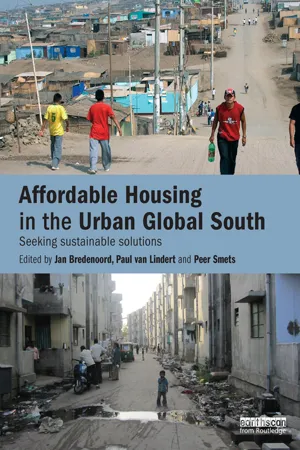
eBook - ePub
Affordable Housing in the Urban Global South
Seeking Sustainable Solutions
- 438 pages
- English
- ePUB (mobile friendly)
- Available on iOS & Android
eBook - ePub
Affordable Housing in the Urban Global South
Seeking Sustainable Solutions
About this book
Information
1
INTRODUCTION
Governance, sustainability and affordability of low-income housing
Today the urban Global South is the part of the world that faces the most rapid urbanization processes. Here, cities grow in size and number, which makes it rather difficult for the poorer sections of society to find adequate shelter and security of tenure. This has led to an increasing number of dwellers living in poor housing conditions: an estimated 2 billion by 2030. One of the big challenges is aiming at ‘inclusive cities for all’, including the urban poor, which could be achieved via better housing policies designed for the total urban low-income population (UN-Habitat 2003). Therefore, given the characteristics outlined above, affordable and sustainable housing solutions for the poor are needed in the Global South. As a consequence of limited incomes and weak national and local housing policies in a number of countries, affordable housing is out of reach for millions of low-income families. While the upgrading of poor housing conditions is indispensable, a range of affordable housing alternatives ought to be promoted in order to bring sufficient ‘decent’ housing solutions to the low-income brackets in particular. Other contemporary challenges are concerned with a turning away from settlement deterioration, new informal settlement formation and a severe lack of sufficient housing production mechanisms.
Seen against the background of significant political, economic, social and environmental changes throughout the world, difficulties, challenges and opportunities are different from the past. New shelter strategies for the millions of people without decent homes are urgently needed in this twenty-first century.
A large part of the world’s affordable housing delivery is self-managed housing, or (assisted) self-help housing and the ‘build as you go’ approach. As these housing delivery practices have received less attention (at least in a number of countries), this book gives much consideration to self-managed housing with grassroots incentives. Incorporating this in public and formal social housing delivery systems is invaluable; ignoring or combating it is unwise. Self-managed housing limitations in particular deserve attention, especially in irregular land developments. As not all houses are being built durably and through sustainable construction, this includes the low quality of housing.
This book has three objectives. First, this volume intends to contribute to the debate about the international habitat and housing agenda. Second, and based on the experiences gained from a variety of locations, its aim is to seek innovative and sustainable solutions that can bring affordable low-income housing production to scale. In this respect, the diversity of urban and regional contexts, but also the range of relevant stakeholders involved, is taken into account. In addition, attention is paid to both the potential and limitations of aided and non-aided selfhelp housing. Third, this book aims at placing the search for sustainable solutions for affordable low-income housing under the umbrella of governance. Therefore stakeholders have to work together without knowing the exact results, which requires some sense of resilience. Towards this end, the next section briefly focuses on the history of low-income housing and its policies in the city. This is followed by a discussion of the relevant concepts of governance, sustainability and affordability.
A brief history of low-income housing
The development of effective housing policy and planning should be seen not only in relation to the nature of housing, but also in relation to the tensions between housing as a consumption good and housing as an economic good with a market value. As a consumption good, housing serves as the basis for households and individuals to avoid impoverishment and increase their wealth and well-being. For some, housing is just a roof, while others regard it as their most valuable possession (Beall and Fox 2009: 125–127).
The provision of housing by governments is a relatively recent phenomenon. Newly independent states in Asia and Africa set up many large-scale housing projects, which partly mirrored post-war European welfare states and the injustices of the colonial period. Moreover, while such developments nourished the pride of the newly formed countries, these housing projects were not affordable for the urban poor (Beall and Fox 2009: 127). UNCHS (1996) estimated that less than 10 per cent of the housing stock in low- and middle-income countries was public housing. Consequently, the urban poor have had to employ self-help in constructing shelter in an incremental manner (e.g. Mangin 1967; Turner 1976). This was followed by sites-and-services schemes and settlement upgrading plans. These approaches, which have become part of the urban fabric, tend to be ‘uniform solutions’ implemented as pilot projects in many cities in the urban Global South. However, recent sites-and-services projects are often less popular; many are typically located far from income-generating activities and lack suffi- cient access to public transport and the city (see e.g. Bredenoord and Verkoren 2010: 360–361; Fernández-Maldonado and Bredenoord 2010; Klaver 2011).
The government’s role as a housing provider changed into a role as an enabler of housing markets. In this respect, the government takes care of the legislative, institutional and financial framework (Pugh 1997). As a result, a stakeholder approach gained ground under the umbrella of urban governance. Although the western-based approach of neoliberalism focuses on the formal sector and neglects the informal sector (Brenner and Theodore 2002; Peck et al. 2013; Rolnik 2013), studies surrounding the urban Global South include the formal as well as the informal sector; each plays a vital role in the production of housing (e.g. Smets 2004; Simone 2010).
Whether it concerns owner-occupied or rental housing, dwellings should be built and basic facilities provided. Therefore, land, construction materials, building skills and knowledge, and finance are required. Each is outlined in the following paragraphs.
Although housing occasionally may be constructed above water, land is generally a necessary component of housing construction. The discussion on land and land titling – as a means to ensure security of tenure – has received a boost since the publication of De Soto (2001). The assumption is that land titling will help households and individuals realize asset value that encourages self-help construction and improvement. Although these assumptions have been criticized (Gilbert 2002; Smets 2003), titling processes nonetheless are widespread. Payne (Chapter 2) elaborates on such land issues.
Moreover, construction materials have received attention since cheaper materials could lead to lower production costs. The literature generally calls this low-cost housing rather than low-income housing (Smets 2004). More recently attention has also been given to the sustainability of building materials (see Kessler, Chapter 5).
As building skills and knowledge are necessary for shelter construction, building skills development and the transfer of this knowledge to self-builders is required. Some initiatives involved in building skills and knowledge aim at sustainable house construction, for example those provided by the Technical Training Resource Centre in Karachi. Other examples encompass private sector organizations such as the CEMEX cement company in Mexico (see Box 15.2) and many housing non-governmental organizations (NGOs) (see also Bredenoord and Van Lindert, Chapter 4).
Finally, unless compensated by self-help, finance is needed for all parts of the construction process. Although finance can be derived from the formal financial sector, it is not easily accessible for the poorer segments of society (Ferguson and Smets 2010; Smets 1997). Therefore, dwellers also use informal forms of finance such as small loans from family members, colleagues, neighbours, friends, moneylenders, and pawnbrokers, as well as funds from financial self-help groups (Smets 2004).
Governance and the stakeholders
Over the past few decades, the ‘enabling approach’ has gained a permanent place in the international habitat discourse (UNCHS 1990). It became generally accepted that the principal role of governments should not be the provision of housing to all citizens but rather the enabling of ‘housing markets to work’ (Mayo and Angel 1993). It was not coincidental that this shift took place in an international ideological environment of neoliberal supremacy. In the context of renewed market thinking and a gradual retraction of the state, the role of central governments and multilateral development institutions is also restrained within the public sector in habitat sector policies. Priority was given to the development of more efficient finance systems for housing construction by the formal sector, for example the national housing banks. Thus, there was an increasing awareness that the state could not – and should not – act as the provider of housing. The initiatives from civil society and the private sector are influenced by the ‘new’ role of the state concerning the responsibility to establish the appropriate financial, legal and regulatory frameworks.
In the 1990s, much work was done on the development of the roles, values and responsibilities of governments with respect to the urban habitat. A leading motive was that self-help initiatives by households and communities, which account for the lion’s share of total urban housing supply and neighbourhood upgrading, should be stimulated as much as possible by means of a proactive attitude on the part of the government. As such, the role of the government was to shift towards other activities such as the guaranteeing of housing security, the supply of land for housing, the facilitation of credit facilities, the development of an appropriate public transport system, adequate solid waste management and basic service provision in general. In addition, local government should be better equipped to complement the many neighbourhood level initiatives and interventions in a strategy of citywide inclusive development. The worldwide trend towards public sector reforms and the decentralization of political power and public responsibilities to municipalities also supports this new role of local government with respect to housing and the provision of collective services (van Lindert and Verkoren 2010).
In the 1990s and 2000s the acknowledgement of the important role that local governance has to play became firmly rooted in general thinking about sustainable urban development. Testimonies to this paradigm shift were the Local Agenda 21, launched at the important Earth Summit in Rio de Janeiro in 1992, and the Habitat Agenda, proclaimed at the City Summit in Istanbul in 1996. Both agendas aim at an enhanced involvement of civil society and the private sector, in order to arrive at truly participatory planning processes at the municipal level (Metropolis 1994). Starting from the principles of partnership, capacity strengthening, and the exchange of knowledge, the Habitat Agenda expressly claims that cooperation between all actors, from public to private, including community-based organizations, non-governmental organizations and individuals, is necessary in order to arrive at sustainable urban development. The Habitat Agenda attaches major significance to the strengthening of civil society at all levels and to the participation of all actors in the decision-making process (UNCHS 1996).
Today, after over two decades of systematizing available knowledge on urban development interventions, it has become generally accepted that the design of sustainable urban and housing development strategies should be based on the following three basic principles.
First, it is recognized that sustainable urban development will only be possible if policies and strategies are embedded in a multi-disciplinary, holistic, and pluralist approach, and that long-term programme support is needed for institutional capacity building. As such, good local governance and urban management, appropriate regulatory frameworks, sustainable environmental management, and the development of local – often neighbourhood-based – economic activities, are essential preconditions to reduce urban poverty and to redistribute resources in such a way as to include the urban poor in the formal city (Gilbert et al. 1996; Shah and Shah 2006).
A second key principle – partnership – focuses on cooperation between the public, civic, and private sectors. Local multi-sector partnerships may create the synergies that are absolutely necessary for a successful approach to urban development (Batley 1996; Payne 1999; Corrêa de Oliveira 2004). External partnerships are just as important, as strategic alliances with donor organizations may provi...
Table of contents
- Cover
- Half Title
- Title Page
- Copyright Page
- Dedication
- Table of Contents
- List of figures
- List of tables
- List of boxes
- Notes on contributors
- Foreword: Housing in an urban planet. Seeking the nexus housing–sustainable urbanization by Claudio Acioly Jr.
- Acknowledgements
- 1 Introduction: governance, sustainability and affordability of low-income housing
- Part I Thematic perspectives
- Part II Asia
- Part III Latin America
- Part IV Africa
- Conclusion
- Index
Trusted by 375,005 students
Access to over 1.5 million titles for a fair monthly price.
Study more efficiently using our study tools.
Frequently asked questions
Yes, you can cancel anytime from the Subscription tab in your account settings on the Perlego website. Your subscription will stay active until the end of your current billing period. Learn how to cancel your subscription
No, books cannot be downloaded as external files, such as PDFs, for use outside of Perlego. However, you can download books within the Perlego app for offline reading on mobile or tablet. Learn how to download books offline
Perlego offers two plans: Essential and Complete
- Essential is ideal for learners and professionals who enjoy exploring a wide range of subjects. Access the Essential Library with 800,000+ trusted titles and best-sellers across business, personal growth, and the humanities. Includes unlimited reading time and Standard Read Aloud voice.
- Complete: Perfect for advanced learners and researchers needing full, unrestricted access. Unlock 1.5M+ books across hundreds of subjects, including academic and specialized titles. The Complete Plan also includes advanced features like Premium Read Aloud and Research Assistant.
We are an online textbook subscription service, where you can get access to an entire online library for less than the price of a single book per month. With over 1.5 million books across 990+ topics, we’ve got you covered! Learn about our mission
Look out for the read-aloud symbol on your next book to see if you can listen to it. The read-aloud tool reads text aloud for you, highlighting the text as it is being read. You can pause it, speed it up and slow it down. Learn more about Read Aloud
Yes! You can use the Perlego app on both iOS and Android devices to read anytime, anywhere — even offline. Perfect for commutes or when you’re on the go.
Please note we cannot support devices running on iOS 13 and Android 7 or earlier. Learn more about using the app
Please note we cannot support devices running on iOS 13 and Android 7 or earlier. Learn more about using the app
Yes, you can access Affordable Housing in the Urban Global South by Jan Bredenoord,Paul Van Lindert,Peer Smets in PDF and/or ePUB format, as well as other popular books in Architecture & Urban Planning & Landscaping. We have over 1.5 million books available in our catalogue for you to explore.