eBook - ePub
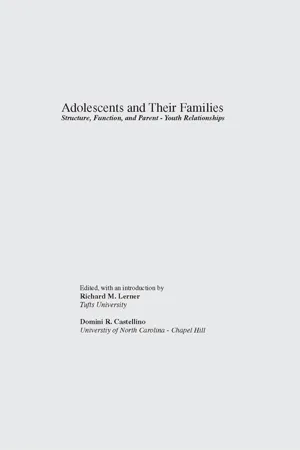
Adolescents and Their Families
Structure, Function, and Parent-Youth Relations
- 392 pages
- English
- ePUB (mobile friendly)
- Available on iOS & Android
eBook - ePub
Adolescents and Their Families
Structure, Function, and Parent-Youth Relations
About this book
First published in 1999. The adolescent period is marked by changes in the biological, psychological, cognitive, and social dimensions of the individual, as well as by changes in the adolescents' multilevel context (i.e., the peers, family, school, and other institutions in his or her ecology). Adolescence is a dynamic period, one which exemplifies the importance of understanding the relations between the developing individual and his or her changing context. The articles included in this volume represent the current range of scholarship pertaining to adolescents and their families, and exemplify the use of such an approach. The articles underscore the continual importance of the family across adolescence.
Information
Ecology of the Family as a Context for Human Development: Research Perspectives
Cornell University
This review is based on a longer background paper prepared at the request of the Human Learning and Behavior Branch of the National Institute of Child Health and Human Development in connection with the development of their Five Year Plan for Research.
I am indebted to the following colleagues for their constructive criticism of the original document: Josephine Arastah, Mavis Hetherington, Richard Lemer, Jeylan T. Mortimer, Joseph H. Pleck, Lea Pulkinnen, Michael Rutter, Klaus Schneewind, and Diana Slaughter. Appreciation is also expressed to Gerri Jones for typing innumerable revisions of the manuscript.
Correspondence concerning this article should be sent to Urie Bronfenbrenner, Department of Human Development and Family Studies, Cornell University, Ithaca, New York 14853.
This review collates and examines critically a theoretically convergent but widely dispersed of research on the influence of external environments on the functioning of families as contexts of human development. Investigations falling within this expanding domain include studies of the interaction of genetics and environment in family processes; transitions and linkages between the family and other major settings influencing development, such as hospitals, day care, peer groups, school, social networks, the world of work (both for parents and children), and neighborhoods and communities; and public policies affecting families and children. A second major focus is on the patterning of environmental events and transitions over the life course as these affect and are affected by intra-familial processes. Special emphasis is given to critical research gaps in knowledge and priorities for future investigation.
The purpose of this article is to document and delineate promising lines of research on external influences that affect the capacity of families to foster the healthy development of their children. The focus differs from that of most studies of the family as a context of human development, because the majority have concentrated on intrafamilial processes of parent-child interaction, a fact that is reflected in Maccoby and Martin’s (1983) recent authoritative review of research on family influences on development. By contrast, the focus of the present analysis can be described as “once removed.” The research question becomes: How are intrafamilial processes affected by extrafamilial conditions?
Paradigm Parameters
In tracing the evolution of research models in developmental science, Bronfenbrenner and Crouter (1983) distinguished a series of progressively more sophisticated scientific paradigms for investigating the impact of environment on development. These paradigms provide a useful framework for ordering and analyzing studies bearing on the topic of this review. At the most general level, the research models vary simultaneously along two dimensions. As applied to the subject at hand, the first pertains to the structure of the external systems that affect the family and the manner in which they exert their influence. The second dimension relates to the degree of explicitness and differentiation accorded to intrafamilial processes that are influenced by the external environment.
External Systems Affecting the Family
Research paradigms can be distinguished in terms of three different environmental systems that can serve as sources of external influence on the family.
Mesosystem models. Although the family is the principal context in which human development takes place, it is but one of several settings in which developmental process can and do occur. Moreover, the processes operating in different settings are not independent of each other. To cite a common example, events at home can affect the child’s progress in school, and vice versa. Despite the obviousness of this fact, it was not until relatively recently that students of development began to employ research designs that could identify the influences operating, in both directions, between the principal settings in which human development occurs. The term mesosystem has been use to characterize analytic models of this kind (Bronfenbrenner, 1979). The results of studies employing this type of paradigm in relation to the family are summarized below, in the section “Mesosystem Models.”
Exosystem models. The psychological development of children in the family is affected not only by what happens in the other environments in which children spend their time but also by what occurs in the other settings in which their parents live their lives, especially in a place that children seldom enter—the parents’ world of work. Another domain to which children tend to have limited access is the parents’ circle of friends and acquaintances—their social network. Such environments “external” to the developing person are referred to as “exosystems.” The findings of investigations employing exosystem designs are reviewed below, in the section “Exosystem Models.”
Chronosystem models. Traditionally in developmental science, the passage of time has been treated as synonymous with chronological age; that is, as a frame of reference for studying psychological changes within individuals as they grow older. Especially during the past decade, however, research on human development has projected the factor of time along a new axis. Beginning in the mid 1970s, an increasing number of investigators have employed research designs that take into account changes over time not only within the person but also in the • environment and—what is even more critical—that permit analyzing the dynamic relation between these two processes. To distinguish such investigations from more traditional longitudinal studies focusing exclusively on the individual, I have proposed the term chronosystem for designating a research model that makes possible examining the influence on the person’s development of changes (and continuities) over time in the environments in which the person is living (Bronfenbrenner, 1986a).
The simplest form of chronosystem focuses around a life transition. Two types of transition are usefully distinguished: normative (school entry, puberty, entering the labor force, marriage, retirement) and nonnormative (a death or severe illness in the family, divorce, moving, winning the sweepstakes). Such transitions occur throughout the life span and often serve as a direct impetus for developmental change. Their relevance for the present review, however, lies in the fact that they can also influence development indirectly by affecting family processes.
A more advanced form of chronosystem examines the cumulative effects of an entire sequence of developmental transition over an extended period of the person’s life—what Elder (1974, 1985) has referred to as the life course. During the past decade, studies of the impact of personal and historical life events on family processes and on their developmental outcomes have received increasing attention. Several of these investigations have yielded findings of considerable substantive and theoretical significance. These are described, along with other relevant researches employing a chronosystem design, below (“Chronosystem Models”).
Family Processes in Context
With respect to explicitness and complexity, research paradigms can again be differentiated at three successive levels.
Social address model. At the first level, the family processes are not made explicit at all, because the paradigm is limited to the comparison of developmental outcomes for children or adults living in contrasting environments as defined by geography (e.g., rural vs. urban, Japan vs. the United States), or by social background (socioeconomic status, ethnicity, religion, etc.). Hence the name “social address” (Bronfenbrenner, 1979).
Given their restricted scope, social address models have a number of important limitations summarized in the following passage:
No explicit consideration is given … to intervening structures or processes through which the environment might affect the course of development. One looks only at the social address—that is, the environmental label—with no attention to what the environment is like, what people are living there, what they are doing, or how the activities taking place could affect the child. (Bronfenbrenner & Crouter, 1983, pp. 361–362)
Despite these shortcomings, social address models remain one of the most widely used paradigms in the study of environmental influences on development. Two reasons may account for their scientific popularity. The first is their comparative simplicity, both at a conceptual and an operational level. Indeed, they can be, and sometimes have been, employed without doing very much thinking in advance, a procedure, alas, that is reflected in the product. But social address models, when appropriately applied, can also serve as a helpful scientific tool. Precisely because of their simplicity, they can be implemented easily and quickly. Hence, they may often be the strategies of choice for exploring uncharted domains. Like the surveyor’s grid, they provide a useful frame for describing at least the surface of the new terrain. A case in point is their application in identifying developmental outcomes associated with what Bronfenbrenner and Crouter (1983) have called the “new demography”—single parents, day care, mothers in the labor force, remarriage, or (perhaps soon) fathers in the role of principal caregiver.
Process-context model. Paradigms at this second level explicitly provide for assessing the impact of the external environment on particular family processes. As documented in Bronfenbrenner and Crouter’s analysis (1983), such paradigms represent a fairly recent scientific development, appearing in a reasonably full form only in the late 1960s and early 1970s. Because the corresponding research designs tend to be more complex than those employed in social address models, a concrete illustration may be helpful. For this purpose, I have selected one of the earliest examples of its kind, but one that still deserves to be emulated as a model for future research. In a series of researches growing out of his doctoral dissertation, Tulkin and his colleagues (Tulkin, 1973a, 1973b, 1977; Tulkin & Cohler, 1973, Tulkin & Covitz, 1975; Tulkin & Kagan, 1972) sought to go beyond the label of social class in order to discover its manifestations in family functioning. The first study focused on families with an infant under one year of age. To control for the child’s sex and ordinal position, the sample was limited to firstborn girls, first studied when they were 10 months old. The initial publication (Tulkin & Kagan, 1972), based on home observations, reported that middle-class mothers engaged in more reciprocal interactions with their infants, especially in verbal behavior, and provided them with a greater variety of stimulation. The second study (Tulkin & Cohler, 1973) documented parallel differences in maternal attitudes; middle-class mothers were more likely to subscribe to statements stressing the importance of perceiving and meeting the infant’s needs, the value of mother-child interaction, and the moderate control of aggressive impulses. Furthermore, the correlations between maternal behavior and attitudes were substantially greater in middle-class than in lower-class families. Next, in two experiments, Tulkin (1973a, 1973b) found that middle-class infants cried more when separated from their mothers, but were better able to discriminate the mother’s voice from that of an unfamiliar female from the same social class. Finally, several years later, Tulkin and Covitz (1975) reassessed the same youngsters after they had entered school. The children’s performance on tests of mental ability and language skill showed significant relationships to the prior measures of reciprocal mother-infant interaction, strength of maternal attachment, and voice recognition when the children had been 10 months old. Once again, the observed correlations were higher for middle-class families. Even more important from a developmental perspective, the relationships of maternal behavior at 10 months to the child’s behavior at age 6 were considerably greater than the contemporaneous relationships between both types of variables in the first year of life. The investigators, however, were quick to reject the hypothesis of a delayed “sleeper effect.” Rather, they argued that mothers who engage in adaptive reciprocal activity with their infants at early ages are likely to continue to do so as the child gets older, thus producing a cumulative trend.
Although a number of other investigators of socialization and social class have observed mother-child interaction, Tulkin’s work remains unique in combining three critical features: (a) an emphasis on social class differences in process rather than merely in outcome; (b) demonstration of the key role played by child rearing values and the higher correspondence between parental values and behavior among middle-class than working-class families; ...
Table of contents
- Cover
- Title Page
- Copyright Page
- Table of Contents
- Introduction Adolescents and Their Families: A View of the Issues
- THE FAMILY AS A CONTEXT AND FAMILY PROCESS
- VARIATIONS IN FAMILY STRUCTURE AND FUNCTION
- FAMILY AND ECONOMIC STRESS
- TEENAGE PARENTING
- Acknowledgments
Trusted by 375,005 students
Access to over 1.5 million titles for a fair monthly price.
Study more efficiently using our study tools.
Frequently asked questions
Yes, you can cancel anytime from the Subscription tab in your account settings on the Perlego website. Your subscription will stay active until the end of your current billing period. Learn how to cancel your subscription
No, books cannot be downloaded as external files, such as PDFs, for use outside of Perlego. However, you can download books within the Perlego app for offline reading on mobile or tablet. Learn how to download books offline
Perlego offers two plans: Essential and Complete
- Essential is ideal for learners and professionals who enjoy exploring a wide range of subjects. Access the Essential Library with 800,000+ trusted titles and best-sellers across business, personal growth, and the humanities. Includes unlimited reading time and Standard Read Aloud voice.
- Complete: Perfect for advanced learners and researchers needing full, unrestricted access. Unlock 1.5M+ books across hundreds of subjects, including academic and specialized titles. The Complete Plan also includes advanced features like Premium Read Aloud and Research Assistant.
We are an online textbook subscription service, where you can get access to an entire online library for less than the price of a single book per month. With over 1.5 million books across 990+ topics, we’ve got you covered! Learn about our mission
Look out for the read-aloud symbol on your next book to see if you can listen to it. The read-aloud tool reads text aloud for you, highlighting the text as it is being read. You can pause it, speed it up and slow it down. Learn more about Read Aloud
Yes! You can use the Perlego app on both iOS and Android devices to read anytime, anywhere — even offline. Perfect for commutes or when you’re on the go.
Please note we cannot support devices running on iOS 13 and Android 7 or earlier. Learn more about using the app
Please note we cannot support devices running on iOS 13 and Android 7 or earlier. Learn more about using the app
Yes, you can access Adolescents and Their Families by Richard M. Lerner,Domini R. Castellino, Richard M. Lerner in PDF and/or ePUB format, as well as other popular books in Psychology & Developmental Psychology. We have over 1.5 million books available in our catalogue for you to explore.