eBook - ePub
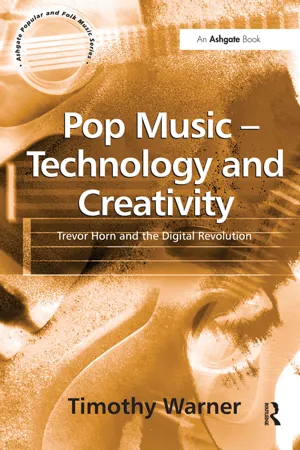
Pop Music - Technology and Creativity
Trevor Horn and the Digital Revolution
- 188 pages
- English
- ePUB (mobile friendly)
- Available on iOS & Android
eBook - ePub
About this book
This highly original and accessible book draws on the author's personal experience as a musician, producer and teacher of popular music to discuss the ways in which audio technology and musical creativity in pop music are inextricably bound together. This relationship, the book argues, is exemplified by the work of Trevor Horn, who is widely acknowledged as the most important, innovative and successful British pop record producer of the early 1980s. In the first part of the book, Timothy Warner presents a definition of pop as distinct from rock music, and goes on to consider the ways technological developments, such as the transition from analogue to digital, transform working practices and, as a result, impact on the creative process of producing pop. Part two analyses seven influential recordings produced by Trevor Horn between 1979 and 1985: 'Video Killed the Radio Star' (The Buggles), 'Buffalo Gals' (Malcolm McClaren),'Owner of a Lonely Heart' (Yes), 'Relax' (Frankie Goes to Hollywood), 'Slave to the Rhythm' (Grace Jones), and albums by The Art of Noise and Propaganda. These records reveal how the creative use of technology in the modern pop recording studio has informed Horn's work, a theme that is then explored in an extensive interview with Horn himself.
Information
Subtopic
MusicaPart One
Pop Music
Chapter 1
Characteristics of Pop Music
Pop music is a slippery concept. (Frith, Straw and Street, 2001, p. 94)
In the past 40 years the phrase ‘pop music’ has come to refer to a particular branch of popular music. Although pop music might be regarded as a relatively recent phenomenon, few elements have remained constant during its short history. As a result, providing a simple, straightforward definition of pop is problematic. The New Grove Dictionary of Music and Musicians defines pop as ‘a term that from the late 1950s has been applied to the central and most widely circulated kinds of popular music (analogously with “pop art”), in particular rock and roll, reggae etc.’. For Hardy and Laing, on the other hand, it is ‘a broad term normally used for the softer, even more teenage-oriented, sounds that emerged as Rock ’n’ Roll waned in the early 1960s. It is often contrasted with the tougher or more serious-minded Rock’ (Hardy and Laing, 1990, p. x).
Yet comparing pop with rock raises new problems. While British writers1 seem able to make clear distinctions between pop and rock, their American counterparts – as several important studies suggest2 – do not perceive such marked contrasts between the two. This tends to suggest that any definition of pop music is not only historically but also geographically determined. The present study which, as we shall see, clearly differentiates between pop and rock, must therefore be viewed as the reflection of a culture that is, at least in part, fundamentally British (or even English).3
Pop and rock
The comparison between pop and rock has often been used to suggest that pop music is less worthy of serious consideration. For example:
The Monkees reached their peak in 1967 … the year pop music seemed to split into two distinct camps, leaving on the one hand the music of the underground, incorporating acid-rock and head music, and on the other, mundane bubblegum, pop at its most blatantly commercial and at its most hideously banal. Bubblegum was tots’ music, literally, distinguished by its crude, pip-squeak rhythm and nursery-rhyme lyrics, conveyor-belt music at its lowest level ever. (Stephen Barnard, in Gillett and Frith, 1996, p. 126)
It must therefore be stressed that for the purposes of this study pop music will simply be compared to rock in order to highlight, rather than make value judgements upon, the significant features that emerge.
In the past 15 years the elements that characterize rock have grown increasingly diverse and fragmented: the days of rock as a vibrant and cohesive artistic form seem to have passed. As Martin Cloonan has noted: ‘If 1967 saw the beginning of rock as art, 1992 saw rock as nostalgia’ (Cloonan, 1996, p. 7). Hence, the rock under discussion here is largely confined to that style of popular music which flourished during the period 1967–87.
Adopting such a qualified and circumspect approach enables several clear distinctions to be made between pop and rock. These might be summarized as follows:
| Pop | Rock |
| Singles | Albums |
| Emphasis on recording | Emphasis on performance |
| Emphasis on technology | Emphasis on musicianship |
| Artificial | Real ('authentic') |
| Trivial | Serious |
| Ephemeral | Lasting |
| Successive | Progressive |
These distinctions include factors as diverse as record format, performance, featured sounds, musical technique, social make-up, and historical development. The preferred audio format for pop is the single – the 7-inch, 45 rpm vinyl disc, the compact disc (CD) or cassette single – while rock tends to rely to a greater extent on the album format; the Top 20 which charts the commercial success of individual singles is dominated by pop music. In comparison to other kinds of popular music, pop places very little emphasis on ‘live’ performance; indeed, much of the pop music produced in recording studios cannot be reproduced live convincingly. On the other hand, live performance is regarded as a fundamental aspect of rock and one of the characteristics that confers ‘authenticity’.4 Pop music features the voice and most pop stars are singers, rather than instrumentalists, while rock often places greater emphasis on the electric guitar. Unlike rock, pop often makes greater use of modern electronic technology: pop music is usually not only realized but created in the recording studio. Traditional musical skills, especially flamboyant manual dexterity on a conventional musical instrument, are rarely stressed on pop recordings. Finally, like fashion, pop music goes through cyclical patterns of change instead of following a linear development, while rock has some sense of its own historical development.5
As Simon Frith points out: ‘Rock was something more than pop, more than rock ’n’ roll. Rock musicians combined an emphasis on skill and technique with the romantic concept of art as individual expression, original and sincere’ (Frith, in Martin, 1983, p. 36). As early as 1970 Andrew Chester was writing of a rock aesthetic6 and in academic circles rock has established a musical credibility which pop has been denied. Allan Moore writes of ‘progressive’ (that is, rock) musicians developing ‘an ideology of artistic freedom and self-expression … within what was considered a freedom from the constraint of an immediate, dancing audience’ (Moore, 1993, p. 57) and, later, ‘a concern with aesthetic and individual rather than immediate and communal qualities’ (ibid.). Rock involves the creative, artistic pursuits of the individual, while pop is an immediate, communal form.
Keith Negus builds on this distinction and suggests two kinds of ‘ideology of creativity’: the organic and the synthetic. ‘The organic ideology of creativity is a naturalistic approach to artists … The synthetic ideology of creativity is a combinatorial approach to both acts and material … These … distinctions … found expression in a rigid distinction between rock and pop’ (Negus, 1992, p. 54).
Although a number of artists have produced work that simultaneously draws on elements of both pop and rock, the general distinctions outlined above remain valid.
Pop as a format: the single
In the past 50 years, consumer formats for recorded music have become smaller. Simultaneously the amount and quality of recorded sound on each successive format have increased. Yet throughout this period, and in spite of several important technological developments, the ‘single’ has persisted. When CBS introduced the 33⅓ rpm, 12-inch, long-playing (LP), microgroove disc in 1948, RCA countered with the 45 rpm, 7-inch, extended play disc a year later; and this quickly ‘established itself as the format for popular hits’ (Gronow and Saunio, 1999, p. 98).
With the development of the compact cassette and the CD, record companies started releasing versions of these formats as singles for pop music, and this principle continues to the present day. Like many other kinds of modern popular music, pop is technologically mediated but, unlike these, it consistently tends to adopt recorded formats that do not fully exploit the technological resources available. Moreover, accepting the single as the main vehicle of delivery for pop music also suggests that, unlike many other kinds of music, pop music is largely purchased and consumed on a piece-by-piece basis, and those pieces are highly distinctive musically: diatonic, strophic songs of three to five minutes duration.
The idea of a ‘hit parade’ – a weekly list of the best-selling records – was established in the early days of radio when only one consumer format for recorded sound was available: the 78 rpm disc. The consistency of musical duration in pop music, as well as the emphasis on a single piece of music rather than a collection, enable and encourage the continuation of this tradition across several formats.
The arrival of online music distribution, while having the potential to bring about enormous changes in the record industry as we know it, nevertheless continues to favour the single piece as the basic unit of recorded sound. Hence MP3.com, the Internet-based company that typifies this latest form of recorded music dissemination, offers downloads of MP3 files on a piece-by-piece basis. Moreover, MP3.com has ‘Top 10’ charts in a variety of genres, indicating which are the week’s most often downloaded recordings.
The continued importance of the single in pop music is also evident in the newer contracts that some pop stars are signing. Hence George Michael ‘wants to see how well the new record [a single] is marketed before giving the company enough material for a full LP’ (Morrison, 2002).
The single, then, is the preferred format for pop music but, in spite of the continued support that it receives from record companies, is rarely financially viable. In recent years the costs of production, distribution and retailing of most singles are only covered through the sale of albums. Record companies use the single as a showcase for the artist in the hope that consumers will then purchase the album. For pop music, record companies often employ record producers to provide an album’s worth of recorded material. Hence, the pop record producer will usually simultaneously concentrate on producing one or more pieces which will be suitable for release as singles, while also achieving a similar level of musical and technological manipulation for the rest of the material on the album.
Short and sweet
Most pop songs last less than five minutes. Before the introduction of the long-playing record, it made sense for one pop song to fit on one side of a 78 rpm record: there was a technological reason why pop songs were short. Nowadays there are no such technological constraints but pop albums continue to be collections of five-minute songs. This suggests that single songs of short duration are a fundamental musical characteristic of pop.
Inevitably, listening to a four-minute pop single is quite different from listening to a recording of a whole opera by Wagner, for instance. The pop listener has to be drawn into the music quickly, and no ambiguity is really possible (unless, of course, the fundamental character of the piece is ambiguity). It is perhaps for this reason that pop music has generated so many qualifying classifications: a pop recording tends to state its classification within the first 20 seconds or so, enabling the listener to decide whether to carry on listening or not. Simon Frith wrote that as a critic he received ‘20 to 30 LPs to listen to each week and the only way through the ever growing pile is instant classification’ (Frith, 1983, p. 18). Similarly, for the artistes and repertoire (A & R) departments of large record companies the sheer number of demonstration recordings that are received each week demand that only the first few seconds can be listened to: if the recording does not attract attention almost immediately then it is rejected. This seemingly rather ruthless approach, also adopted by disc jockeys (DJs) and many pop music listeners, highlights another characteristic of pop music: the first few seconds of a pop record must be both immediate and compelling. At times, the start of a recording is so impressive that the rest of the song disappoints: as an example one might cite the beginning of Jerry Rafferty’s ‘Baker Street’,7 a memorable saxophone solo followed by a somewhat less memorable song. The brevity of most pop songs demands a structure which will, first, capture the listener’s attention, second, sustain and nurture that attention through some sense of progression and change, and, finally, tease the listener by ending at the point of maximum attention and interest. Songs that do not follow this plan are rare and will require some other element(s) to enable them to sustain the listener’s interest.
The art of the familiar
Pop songs are designed … to sound familiar. (Frith, Straw and Street, 2001, p. 97)
In order to capture a listener’s interest immediately, a pop record must simultaneously present something that is both familiar and yet distinctive enough to differentiate it from its competitors. Hence, every pop record will have several musical characteristics that have appeared, in similar guises, on earlier records. As a result, inexperienced listeners will often find it difficult to differentiate one record from another, giving rise to the criticism that ‘they all sound the same’.
Similarly, a number of already known musical elements, originally developed and associated with other kinds of popular music (Gospel or rap, for example), may appear on pop records, and this aspect of pop music has become increasingly prevalent in recent years as a result of sampling. These elements can take many forms: a vocal inflection (for example, breaking to falsetto at the end of a phrase); a vocal interjection (for example, ‘come on’ or ‘yeah’); a particular chord pattern (for example I–flatVII–IV); a guitar gesture (for example, chugging power chords); a rhythmic motive (for example, a distinctive shuffle beat); or a particular synthesizer figure (for example, the ‘pad’ keyboard).
As a result, individual pop recordings often contain a number of elements that at least partially make reference to other records and, consequently, hardly seem original. This derivative quality in much pop music is an important characteristic, offering potential for musical analysis (see Tagg, 1991, for example). It also makes pop music markedly different from ‘serious’ music. Instead of trying to produce innovative, different or unusual works, pop musicians clearly favour relatively minor modifications to existing musical parameters. Indeed, part of the delight of popular music lies in the recognition of elements that echo previous pieces and, here again, sampling is important (see Chapter 7 on The Art of Noise). The role of these elements may be related to the notion of ‘Signifyin(g)’, first posited by Gates Jr. (1988) and described by Potter as follows:
Simply put, Signifyin(g) is repetition with a difference; the same and yet not the same. When, in a jazz riff, a horn player substitutes one arpeggio for another in moving from key to key, or shifts a melody to what would be a harmony note, or ‘cuts up’ a well-known solo by altering its tempo, phrasing or accents, s/he is Signifyin(g) on all previous versions. (Potter, 1995, p. 27)
This common stock of musical ideas means that each new pop recording will have a number of elements which are already familiar to the audience. This sense of the familiar is a recurrent aspect of pop music generally and is evident in several areas, including musical ideas, lyrical themes and iconography. It also inevitably has a historical dimension: pop music plays with collective cultural memory. This has become a feature of many television documentaries in which images of the past are accompanied by pop music recordings of the same period. This facet of pop music to evoke a sense of the past is also evident in a number of popular films (such as American Graffiti, Goodfellas or Platoon) and in television advertising (Levi’s jeans advertisements, for example). However, there is something of an idealized quality in many of these evocations: it is not ‘how it was’ but rather ‘how it should have been’, an odd kind of fantasized nostalgia. In recent years, some of the pop recordings used in popular films and advertising have been re-released and been successful in the Top 20. While this may be, and often is, interpreted as pop music’s inability to renew itself as a form, it may also be viewed in a somewhat different light: the people who buy these records often have no memory of the original release and instead are fascinated by evocations of a past which has been reinterpreted in the light of the present. This aesthetic of the past is evident in new recordings, too. For example, the use of musical clichés associated with early rock ’n’ roll from the early 1970s onwards (Mud and Shakin’ Stevens, for example) ensures that rock ’n’ roll will never (quite) die; similarly, in the 1960s groups like The Temperance Seven aped 1930s British dance bands, and in the 1990s The Beatles found powerful imitators in Oasis. The timbre of the lead...
Table of contents
- Cover
- Half Title
- Title
- Copyright
- Contents
- List of Tables
- General Editor's Preface
- Acknowledgements
- Introduction
- Part One: Pop Music
- Part Two: Technology and Creativity
- Conclusion
- Appendix 1: Interview with Trevor Horn
- Appendix 2: Trevor Horn Discography
- Discography
- Bibliography
- Index
Trusted by 375,005 students
Access to over 1.5 million titles for a fair monthly price.
Study more efficiently using our study tools.
Frequently asked questions
Yes, you can cancel anytime from the Subscription tab in your account settings on the Perlego website. Your subscription will stay active until the end of your current billing period. Learn how to cancel your subscription
No, books cannot be downloaded as external files, such as PDFs, for use outside of Perlego. However, you can download books within the Perlego app for offline reading on mobile or tablet. Learn how to download books offline
Perlego offers two plans: Essential and Complete
- Essential is ideal for learners and professionals who enjoy exploring a wide range of subjects. Access the Essential Library with 800,000+ trusted titles and best-sellers across business, personal growth, and the humanities. Includes unlimited reading time and Standard Read Aloud voice.
- Complete: Perfect for advanced learners and researchers needing full, unrestricted access. Unlock 1.5M+ books across hundreds of subjects, including academic and specialized titles. The Complete Plan also includes advanced features like Premium Read Aloud and Research Assistant.
We are an online textbook subscription service, where you can get access to an entire online library for less than the price of a single book per month. With over 1.5 million books across 990+ topics, we’ve got you covered! Learn about our mission
Look out for the read-aloud symbol on your next book to see if you can listen to it. The read-aloud tool reads text aloud for you, highlighting the text as it is being read. You can pause it, speed it up and slow it down. Learn more about Read Aloud
Yes! You can use the Perlego app on both iOS and Android devices to read anytime, anywhere — even offline. Perfect for commutes or when you’re on the go.
Please note we cannot support devices running on iOS 13 and Android 7 or earlier. Learn more about using the app
Please note we cannot support devices running on iOS 13 and Android 7 or earlier. Learn more about using the app
Yes, you can access Pop Music - Technology and Creativity by Timothy Warner in PDF and/or ePUB format, as well as other popular books in Mezzi di comunicazione e arti performative & Musica. We have over 1.5 million books available in our catalogue for you to explore.