Emergent Science
eBook - ePub

Emergent Science

Teaching science from birth to 8

  1. 272 pages
  2. English
  3. ePUB (mobile friendly)
  4. Available on iOS & Android
eBook - ePub

Emergent Science

Teaching science from birth to 8

About this book

Emergent Science is essential reading for anyone involved in supporting scientific learning and development with young children aged between birth and 8. Drawing on theory, the book helps to develop the essential skills needed to understand and support science in this age range.

The book is organised into three parts: development, contexts and pedagogy, exploring the underpinning theory alongside practical ideas to help trainees, teachers and childcare practitioners to create high-quality science experiences for the children they teach.

The text includes guidance on developing professional, study and research skills to graduate and postgraduate level, as well as all the information needed to develop scientific skills, attitudes, understanding and language through concrete, social experiences for young children.

Features include:

  • Reflective tasks-at three levels of professional development;- early career/student, developing career/teacher and later career/leader.
  • Case studies that exemplify good practice and practical ideas.
  • Tools for learning - explain how science professionals can develop their professional, study skills and research skills to Masters level

Frequently asked questions

Yes, you can cancel anytime from the Subscription tab in your account settings on the Perlego website. Your subscription will stay active until the end of your current billing period. Learn how to cancel your subscription.
No, books cannot be downloaded as external files, such as PDFs, for use outside of Perlego. However, you can download books within the Perlego app for offline reading on mobile or tablet. Learn more here.
Perlego offers two plans: Essential and Complete
  • Essential is ideal for learners and professionals who enjoy exploring a wide range of subjects. Access the Essential Library with 800,000+ trusted titles and best-sellers across business, personal growth, and the humanities. Includes unlimited reading time and Standard Read Aloud voice.
  • Complete: Perfect for advanced learners and researchers needing full, unrestricted access. Unlock 1.4M+ books across hundreds of subjects, including academic and specialized titles. The Complete Plan also includes advanced features like Premium Read Aloud and Research Assistant.
Both plans are available with monthly, semester, or annual billing cycles.
We are an online textbook subscription service, where you can get access to an entire online library for less than the price of a single book per month. With over 1 million books across 1000+ topics, we’ve got you covered! Learn more here.
Look out for the read-aloud symbol on your next book to see if you can listen to it. The read-aloud tool reads text aloud for you, highlighting the text as it is being read. You can pause it, speed it up and slow it down. Learn more here.
Yes! You can use the Perlego app on both iOS or Android devices to read anytime, anywhere — even offline. Perfect for commutes or when you’re on the go.
Please note we cannot support devices running on iOS 13 and Android 7 or earlier. Learn more about using the app.
Yes, you can access Emergent Science by Jane Johnston in PDF and/or ePUB format, as well as other popular books in Education & Education General. We have over one million books available in our catalogue for you to explore.

Information

Publisher
Routledge
Year
2013
eBook ISBN
9781317807797
Section 1
Development
1 The development of emergent skills
2 The development of emergent thinking
3 The development of emergent attitudes
Chapter 1
The development of emergent skills
Overview
In this chapter we look at:
The scientific process and the skills that are part of that process
What these emergent skills look like in children in the early years and how we can support their development
Research into the skill of observation by Jane Johnston
How to select and use literature, as part of the study skills theme
Practical and reflective tasks that look at the link between social and scientific skills
Activity boxes on how collections of objects can lead to the development of scientific skills
Knowledge boxes focusing on gravity and air resistance.
Introduction
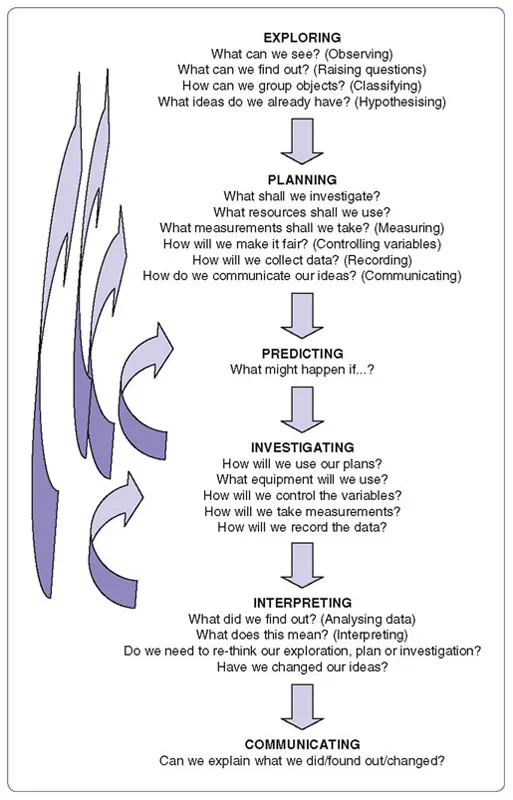
Science is a practical and social endeavour, involving the development and use of a range of skills. Some of the skills are generic ones that are of use in other aspects of the children’s lives (e.g. observation, interpretation), whilst others are quite specific to enquiry in science and other related subjects (e.g. classification, handling variables). The skills involved in science form part of the scientific process (see Figure 1.1). The scientific process is not fully linear, although it does follow certain stages, beginning with observation and ending with interpretation and communication. However, at every stage, it may be appropriate to revisit an earlier stage in a more cyclical way. So, for example, children may have observed that puddles dry up in the sun and may begin to explore this further by predicting that bigger puddles will dry faster. They may draw a line around the puddles and see how much they have dried up after one hour. At that stage they may wish to revisit their prediction and compare the speed at which small puddles dry up with that at which big puddles dry up. They may also decide to measure the gap between the drawn lines or extend the time gap between observation and measurement. They may then try to make sense of their explorations and discuss where the water goes to, at which stage they may decide to go back to observing the puddles to focus on this.
Figure 1.1 The scientific process
Source: Johnston (2005: 32)
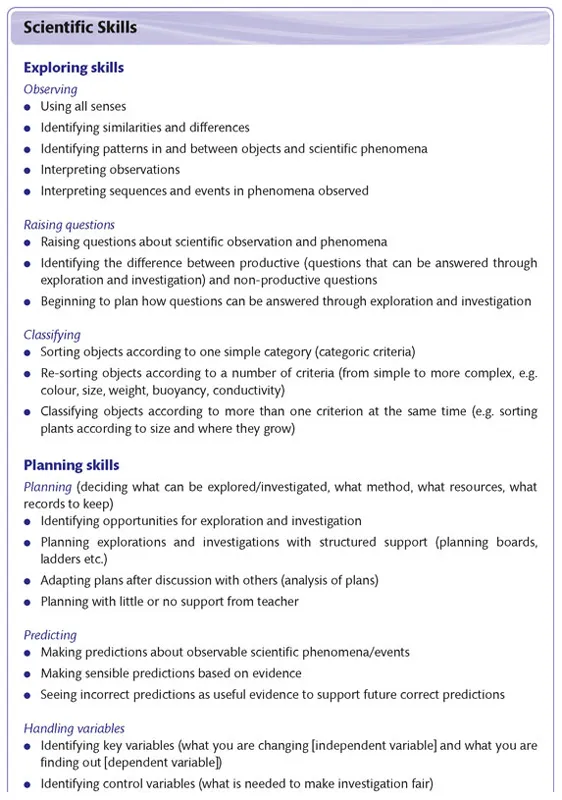
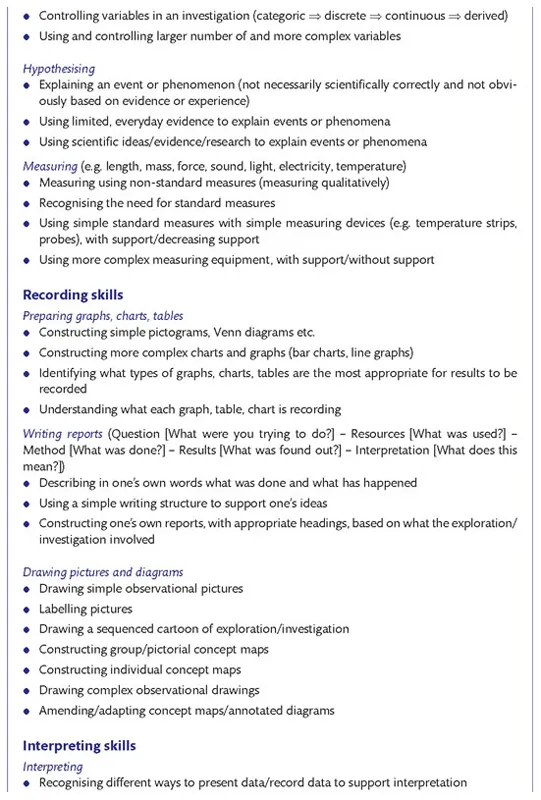
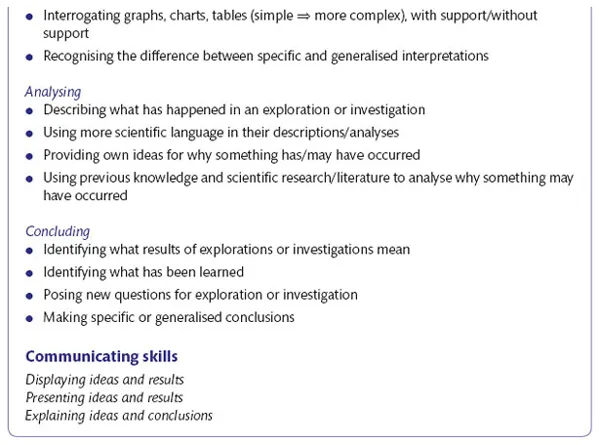
Like all practical processes, the scientific process is one that is developed in a holistic way, but that does not mean that individual skills cannot and should not be focused on for specific development. If we leave children to develop skills without focus (by exposure or a kind of osmosis), the probability is that the skill will be underdeveloped. We also need to understand what the skills are and how they develop – in Figure 1.2 the different skills that make up the scientific process are analysed in more detail.
Figure 1.2 A breakdown of scientific skills
Study Skills
Selecting and using the literature
In this chapter, the study skills we are focusing on to develop your learning involve the selection and use of the literature. When we select reading, we should try to get a comprehensive understanding of the areas and choose a balance among policy documents, professional texts, research articles and online information. The balance is important, as over-reliance on one type of text will weaken any argument you are trying to make. For example, over-reliance on policy documents merely reiterates government policy and does not show an understanding of the tensions that exist among policy, practice and research. Likewise, over-reliance on web-based texts does not take into consideration the validity of the text and you may be reiterating the subjective view of the author. Overreliance on research will not help you to consider the implications of the findings on practice and provision and future policymaking.
Effective reading involves understanding the issue you are researching and looking at the objectivity of the author, the argument he or she is making and how that fits in with your thinking and experience. This is critical reading – the first step toward the critical use of ideas from reading. Critical reading involves reading for understanding and reflection on what that reading means in terms of your own practice, your ideas and the current policies in early years education and care. In order to fully understand what you are reading, it needs to be read and re-read, making notes as you go and recording the full bibliographical reference.
In this book we use the Harvard system of referencing, which involves putting the name(s) of the author(s) and the date of publication in the main text, along with page numbers in cases where you use a direct quotation. Full references should be provided at the end of the piece of writing, as follows (note that the punctuation varies slightly from publisher to publisher):
Book: Name, Initial (Year). Title of Book. Place of publication: publisher.
Journal article: Name, Initial (Year). Title of article. Title of Journal, volume (number), page range.
Chapter in a book: Name, Initial (Year). Title of chapter. In: Name of Editor, Initial., eds. Title of Book. Place of publication: Publisher, page range.
At the end of each chapter, you will find references that illustrate how this works in practice.
When reading and referencing reading, you should always use original sources and they should always be read and referenced, rather than citing references that have been used in the book you are reading. This is necessary, not only for scholarly purposes and because it aids understanding, but also because you need to check that the original author and reference are correct.
The notes you make on your reading can be used to support arguments you are making. Effective use of reading involves making persuasive arguments and using reading to support it, rather than merely citing reading, as this shows an understanding of the issues through analysis of the ideas expressed in the text rather than description. This is discussed further in the following chapters. As one’s skill of using reading develops, so will the ability to develop critical arguments using the literature.
Study skills tasks
Consult early years policy documents, professional documents and research papers and find references to early years skills in general and scientific skills in part...
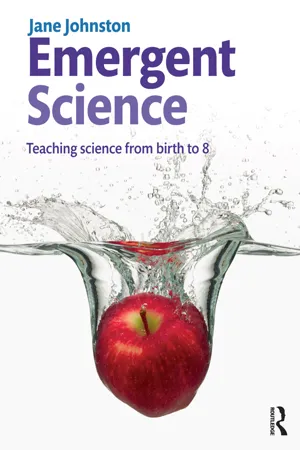

Table of contents

  1. Cover
  2. Half Title
  3. Title Page
  4. Copyright Page
  5. Dedication
  6. Table of Contents
  7. List of illustrations
  8. Contributors
  9. Acknowledgements
  10. Introduction
  11. Section 1: Development
  12. Section 2: Contexts
  13. Section 3: Pedagogy
  14. Glossary of terms and acronyms
  15. Index