Basic Concepts in Family Therapy
eBook - ePub

Basic Concepts in Family Therapy

An Introductory Text, Second Edition

  1. 640 pages
  2. English
  3. ePUB (mobile friendly)
  4. Available on iOS & Android
eBook - ePub

Basic Concepts in Family Therapy

An Introductory Text, Second Edition

About this book

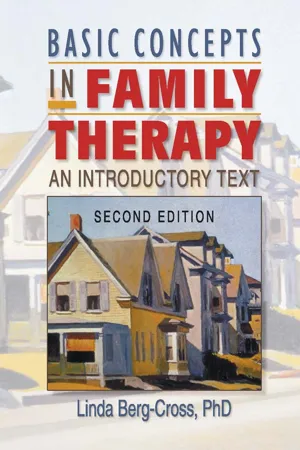
Gain confidence and creativity in your family therapy interventions with new, up-to-date research!Basic Concepts in Family Therapy: An Introductory Text, Second Edition, presents twenty-two basic psychological concepts that therapists may use to understand clients and provide successful services to them. Each chapter focuses on a single concept using material from family therapy literature, basic psychological and clinical research studies, and cross-cultural research studies. Basic Concepts in Family Therapy is particularly useful to therapists working in a family context with child- or adolescent-referred problems, and for students and clinicians treating the problems they see every day in their community. The book builds on the strengths of the first edition, incorporating ideas and articles that have become worthy of investigating since 1990 into the original text. This new edition also introduces five new chapters on resiliency and poverty, adoption, chronic illness, spirituality and religion, and parenting strategies. The new chapters make the book far more relevant for students and clinicians try ing to use family theory and technique in response to the problems they see in their communities. Basic Concepts in Family Therapy will assist you in offering clients better services by providing a deeper understanding of the contemporary family in its various forms, the psychological bonds that shape all families, and the developmental stages of the family life cycle. This exploration of how family demography, stages and life cycles affect family functions is a solid foundation from which all of the therapeutic concepts in this book can be explored. Some of the facets of family therapy you will explore in Basic Concepts in Family Therapy are:

  • the importance of spirituality and religion in family therapy
  • generational boundaries, closeness, and role behaviors
  • managing a family's emotions
  • defining problems and generating and evaluating possible solutions
  • teaching children specific attitudes, values, social skills, and norms
  • transracial adoptions and normative processes and developmental issues of adoptive parents
  • strategies for reducing conflict
  • . . . and much more!Basic Concepts in Family Therapy will help to broaden your understanding of the ways families function in general. You can use the effective concepts explored in this text to make a thorough assessment of the impact of a disorder on a child and on the rest of his or her family, as well as how family dynamics might have shaped or exacerbated the problems. The concepts described in this text can be customized to clients'cultural values to avoid unnecessary resistance. As a new therapist, you will gain confidence in your assessments, and if you are already a seasoned professional, you will gain creativity in your interventions.

Frequently asked questions

Yes, you can cancel anytime from the Subscription tab in your account settings on the Perlego website. Your subscription will stay active until the end of your current billing period. Learn how to cancel your subscription.
No, books cannot be downloaded as external files, such as PDFs, for use outside of Perlego. However, you can download books within the Perlego app for offline reading on mobile or tablet. Learn more here.
Perlego offers two plans: Essential and Complete
  • Essential is ideal for learners and professionals who enjoy exploring a wide range of subjects. Access the Essential Library with 800,000+ trusted titles and best-sellers across business, personal growth, and the humanities. Includes unlimited reading time and Standard Read Aloud voice.
  • Complete: Perfect for advanced learners and researchers needing full, unrestricted access. Unlock 1.4M+ books across hundreds of subjects, including academic and specialized titles. The Complete Plan also includes advanced features like Premium Read Aloud and Research Assistant.
Both plans are available with monthly, semester, or annual billing cycles.
We are an online textbook subscription service, where you can get access to an entire online library for less than the price of a single book per month. With over 1 million books across 1000+ topics, we’ve got you covered! Learn more here.
Look out for the read-aloud symbol on your next book to see if you can listen to it. The read-aloud tool reads text aloud for you, highlighting the text as it is being read. You can pause it, speed it up and slow it down. Learn more here.
Yes! You can use the Perlego app on both iOS or Android devices to read anytime, anywhere — even offline. Perfect for commutes or when you’re on the go.
Please note we cannot support devices running on iOS 13 and Android 7 or earlier. Learn more about using the app.
Yes, you can access Basic Concepts in Family Therapy by Linda Berg Cross in PDF and/or ePUB format, as well as other popular books in Social Sciences & Developmental Psychology. We have over one million books available in our catalogue for you to explore.

Table of contents

  1. Cover Page
  2. Basic Concepts in Family Therapy
  3. Notes for Professional Librarians and Library Users
  4. Half Title page
  5. THE HAWORTH PRESS
  6. Title Page
  7. Copyright Page
  8. Dedication
  9. Contents
  10. About The Author
  11. Contributors
  12. Preface
  13. Acknowledgments
  14. Introduction
  15. Unit I: Getting Acquainted with the Family
  16. Chapter 1 Exploring the Family Structure
  17. Unit II: Family Concepts — A Systems Perspective
  18. Chapter 2 Individuation
  19. Chapter 3 Separation
  20. Chapter 4 Cutoffs
  21. Chapter 5 Triangles
  22. Chapter 6 Rituals
  23. Chapter 7 Secrets
  24. Chapter 8 Multigenerational Effects
  25. Chapter 9 Networks and Ecosystems
  26. Unit III: Family Concepts—Ecological Stressors
  27. Chapter 10 Family Resiliency and Poverty
  28. Chapter 11 Chronic Illness in Children: Stressors and Family Coping Strategies
  29. Chapter 12 Adoption and Infertility
  30. Unit IV: Family Concepts—a Cognitive Perspective
  31. Chapter 13 Communication Styles
  32. Chapter 14 Problem Solving
  33. Chapter 15 Family Productivity
  34. Unit V: Family Concepts— A Sibling Perspective
  35. Chapter 16 Birth Order
  36. Chapter 17 Sibling Relationships
  37. Unit VI: Family Concepts—A Social Psychological Perspective
  38. Chapter 18 Attribution
  39. Chapter 19 Equity Theory
  40. Chapter 20 Reactance
  41. Chapter 21 Cultural Influences on the Family
  42. Chapter 22 Spirituality
  43. Resources
  44. Author Index
  45. Subject Index