- 142 pages
- English
- ePUB (mobile friendly)
- Available on iOS & Android
eBook - ePub
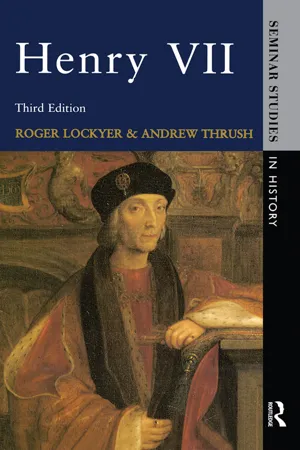
Henry VII
About this book
This study reassesses the policies of the founder of the Tudor dynasty and shows how Henry worked within existing traditions rather than breaking with the past. Every facet of the reign is considered including the nature of government - both at central and local level, financial policy, relations with the Church, foreign policy, economic affairs and concludes by assessing Henry as a 'new monarch'.
PART ONE: THE BACKGROUND
1 THE YORKIST INHERITANCE
In 1399 Henry Bolingbroke, Duke of Lancaster, deposed Richard II and seized the throne for himself. Although he thereby established the House of Lancaster as the ruling dynasty he had set an example that other ambitious magnates would one day follow, with fateful consequences for his descendants. The second Lancastrian monarch, Henry V, who succeeded his father in 1413, won prestige for himself and his dynasty by reasserting the old claim to France, taking an army across the Channel, and winning a resounding victory at Agincourt in 1415. But Henry V died in 1422, leaving as heir a baby son. A minority was always a dangerous time for a dynasty, particularly one so recently established, but the magnates who surrounded the infant Henry VI behaved with remarkable restraint and protected his inheritance.
It was only when Henry came of age that things started to go badly wrong. One reason for this was that the early triumphs in France had given way to defeats, and the financial strain of maintaining the English armies there was causing unrest at home. Another, and more important, reason was Henry’s singular lack of the qualities needed to make a successful ruler. He was too easily swayed by those around him, and open-handed to the point of irresponsibility. By giving away royal lands and patronage to those he favoured, he blew into flames the smouldering jealousies among the magnates and thereby precipitated violent quarrels between them that he proved unable to resolve [31; 33]. Henry’s incapacity and occasional relapses into insanity intensified rivalry among the leading nobles and led directly to the conflicts between them that became known as the Wars of the Roses. The only possible outcome to these, other than stalemate, was the triumph of one of the magnate factions, and this came about in March 1461 when Edward, Duke of York, destroyed the Lancastrian army at Towton in Yorkshire. Just over a year later he was crowned king as Edward IV.
THE GOVERNMENT OF THE REALM
Edward IV was not yet twenty when he became king, and the energy which he derived from his strong physique was reinforced by his determination to be a strong ruler. He had many of the qualities needed for success. He won men to him by his charm and easy manners, while women found his good looks irresistible, but he was no mere playboy. He had a keen business sense, he could be ruthless in the pursuit of his objectives, and he was resolved to restore the royal authority [34].
The change of ruler had an immediate effect upon the Council, which was the principal instrument of royal government. Under Henry VI it had been a virtually autonomous body, dominated by the magnates, and Sir John Fortescue, who had served as Chief Justice under Henry VI, accurately summarised its weaknesses: ‘The King’s Council was wont to be chosen of great princes, and of the greatest lords of the land, both spiritual and temporal, and also of other men that were in great authority and offices. Which lords and officers had at hand also many matters of their own to be treated in the Council, as had the King. Wherethrough, when they came together, they were so occupied with their own matters and with the matters of their kin, servants and tenants, that they attended but little, and otherwhile nothing, to the King’s matters’ [11 p. 145]. Edward rapidly changed this state of affairs. He did not exclude magnates from the Council if he thought he could depend on their loyalty, but he did not allow them to dominate it, and he insisted that they should attend to his business rather than their own.
In the second half of Edward’s reign, post-1471, there were some twenty noble Councillors, but many of these were Yorkist creations, and as a group they were smaller than the clerics, who numbered about thirty-five [27]. Clerics had always played a major part in medieval government because they were literate, they could be rewarded for service to the crown by promotion in the Church, and they left no legitimate heirs to claim a hereditary right to advise the King. Under Edward, as under his predecessors, churchmen occupied major offices of state such as the Lord Chancellorship, but the episcopate was no longer the preserve of the aristocracy. Edward tended to choose as bishops men who came from lesser gentry or merchant families and were therefore dependent on royal favour for their advancement [34].
Much the same was true of the third group of Councillors, consisting mainly of officials of the royal household, which numbered eleven in the first half of the reign but increased to twenty-three post-1471 – a sign of its increasing importance. The members of this group were drawn from the gentry and had often received a professional training as lawyers or estate administrators. They were already prominent in local government, but under Edward they moved into positions of authority at the centre, and as the crown’s power expanded so did theirs.
The names of more than 120 Councillors survive for Edward’s reign, but they never all met at any one time. In practice the Council consisted of anything from nine to twelve members, and the maximum recorded attendance was twenty. The King summoned whom he liked when he liked, and although the Council would, if Edward so wished, discuss major issues and make recommendations, he accepted or rejected these as he saw fit [27; 28; 34].
While Edward’s accession resulted in a sharp decline in the influence of the magnates on government, the new King was not anti-noble by temperament. As a magnate himself Edward felt at ease in the company of his fellow nobles and during the course of his reign he created over thirty peerages. A number of these new peers held important offices at Court – William Hastings for instance, who was made a baron in 1461, was Lord Chamberlain of the household for the whole of Edward’s reign – but their principal function, like that of the old nobles, was to maintain order in the localities, and Edward deliberately built up aristocratic influence where he believed it was in his interest to do so. He presented Hastings with large grants of confiscated property in the Midlands; he gave William Herbert lands and offices to establish his predominance in Wales; and in the second part of his reign he made his brother, Richard, Duke of Gloucester, the greatest magnate in the north [28].
The maintenance of order continued to be a problem throughout Edward’s reign, for the effects of the civil wars did not disappear overnight. Also, Edward made little attempt to curb retaining, which was a major source of disorder since it allowed his greater subjects to maintain what were, in effect, private armies. However, when disorder became a major threat to the security of his throne, Edward would act swiftly and decisively. During the first part of his reign in particular he made extensive use of the Constable’s Court, or Court of Chivalry, which, under the ruthless leadership of John Tiptoft, Earl of Worcester and Constable of England, dealt in a summary fashion with those it deemed guilty of insurrection. Edward also issued frequent commissions of oyer and terminer, empowering the members to put down riots and other breaches of the peace. These commissions would usually include Councillors, household officials, nobles and judges, and their combined authority was calculated to overawe all but the most arrogant offenders [34]. However, Edward was not content to act solely by deputies. He was always on the move himself, travelling in state from one disturbed area to another and using the majesty of his kingly office, as well as his own abundant energy and self-confidence, to impose order. In some instances – particularly when his own adherents were themselves the cause of unrest – Edward preferred to turn a blind eye to what was going on, but in general he took a firm stand and demonstrated beyond any shadow of doubt his determination to be obeyed.
2 YORKIST FINANCIAL ADMINISTRATION
The weakness of royal government in the mid-fifteenth century had sprung, in large part, from shortage of money. The first Lancastrian had enjoyed a revenue of some £90,000 annually, but by the closing years of Henry VI’s reign this had diminished to £24,000 [34]. Edward realised that in order to make the crown strong again he would have to restore it to solvency, but this turned out to be a slow process. He could have called on Parliament for assistance, but Parliament had become a focus for opposition to the monarch during the Lancastrian period and he may well have thought that a break with the past implied a reduction in its role. He summoned only six Parliaments during a reign of twenty-three years, and he assured members in 1467 that ‘I purpose to live upon mine own, and not to charge my subjects but in great and urgent causes concerning the weal of themselves and also the defence of them and of this my realm, rather than my own pleasure’. Edward was as good as his word, for although he received nearly £190,000 in parliamentary taxation during the course of his reign, he used this to meet the ‘extraordinary’ costs of suppressing rebellions at home and waging war abroad.
As far as the ‘ordinary’ revenue was concerned, Edward was dependent upon his own resources. When he seized the crown he took over the royal estates, including those of the Duchy of Lancaster, and he also held extensive properties in his own right as Duke of York. Furthermore, he persuaded Parliament to pass four Acts of resumption which restored to the crown a good deal of the land given away by Henry VI. The mere possession of property, however, was no guarantee of wealth: the crown lands needed to be administered in such a way that they would yield a substantial and increasing profit. The medieval monarchy had developed, in the Exchequer, a sophisticated and elaborate mechanism for collecting and auditing the King’s revenues, but its procedure was slow and during the civil wars it had fallen badly behind. Edward wanted to exercise the same close, personal control over his revenues as he did over policy-making, and for this reason he increasingly by-passed the Exchequer and made the royal Chamber – which had hitherto dealt only with the finances of the Court and household – into a national treasury.
From early in his reign Edward began the practice of removing lands from Exchequer control and placing them instead under specially appointed receivers and surveyors who accounted to the Chamber. Sir Thomas Vaughan, the Treasurer of the Chamber, thereby became a key figure in the administration of the royal finances, but Edward himself took an active role, inspecting the Chamber accounts and giving Vaughan instructions by word of mouth. ‘By 1483’, in the words of Edward’s biographer, ‘there had emerged a system of highly personal financial control, centred on the Chamber, which anticipated in all essentials the structure once thought to have been created by the early Tudors’ [34 p. 375].
Edward had other sources of revenue apart from the crown lands. In 1465 Parliament voted him Customs duties (tonnage and poundage) for life, and as foreign trade expanded with the return of more settled conditions the Customs became increasingly valuable. By the end of the reign they were bringing in some £34,000 a year, which was considerably more than the net yield of the royal estates. Edward also made substantial profits through engaging in trading ventures on his own account. The crown’s feudal rights, especially wardship, were a further source of income, but Edward had to tread carefully here since he risked provoking a hostile reaction from the landowners. Following the conclusion of peace with France by the Treaty of Picquigny in 1475 (see below, p. 81), Edward added a pension of £10,000 to his annual revenues. The result of all these developments was that by 1475 Edward was solvent – the first English sovereign to be in this happy state for more than a century and by the time he died he had pushed the crown’s income up to some £70,000 a year. This was not as high as under Henry IV, but nearly three times what it had been at the time of Edward’s accession [34].
PART TWO: ANALYSIS
3 THE NEW KING
Yorkist rule came to an abrupt end in August 1485 when Henry Tudor defeated and killed Edward IV’s brother and successor, Richard III. The new King, Henry VII, was the posthumous son of Edmund Tudor, who had been created Earl of Richmond by his half-brother, Henry VI. Edmund’s mother was Catherine of France, who had first been married to Henry V and, after his death, took as her second husband one of her household officers, Owen Tudor, who belonged to an old Welsh family. However, Henry’s real claim to the throne came from his mother, Margaret Beaufort, who was descended from Edward III through the marriage of his fourth (but third surviving) son, John of Gaunt, Duke of Lancaster, to Catherine Swynford (see Genealogy, p. 115). But Catherine’s children had been born before she married Gaunt, and although an Act of Richard II’s reign removed the stain of illegitimacy from the Beauforts, Henry IV subsequently inserted a clause excluding them from any right of succession to the crown.
Henry was born in January 1457 at Pembroke Castle and was brought up by his uncle Jasper Tudor, Earl of Pembroke. However, after the defeat and subsequent murder of Henry VI in 1471 it seemed safer for Henry Tudor, who was now head of the house of Lancaster, to move out of the Yorkists’ range. He and Jasper therefore fled to Brittany. Henry spent fourteen years in exile, waiting for an opportunity to return and claim what he regarded as his inheritance. In the autumn of 1483 the moment seemed to have arrived, for Henry planned a landing in England to coincide with the Duke of Buckingham’s rebellion against Richard III. But the rebellion broke out prematurely, Buckingham was captured and executed, and although Henry set sail, his ships were dispersed in a storm. When he arrived off the English coast he decided not to land, perhaps because a call to arms issued by the Bishop of Exeter a day after Buckingham’s execution attracted only limited support [37].
The triumphant Richard now put pressure on the Duke of Brittany to hand over the troublesome exile, and Henry had to take refuge in France, where, in November 1484, he began to style himself King – the first time a pretender to the English throne had ever dared to assume the royal title before he had actually laid hands on the crown [40]. Henry may have hoped thereby to win support from those Yorkists who had never forgiven Richard for murdering Edward IV’s young sons, Edward V and Richard, Duke of York – ‘the Princes in the Tower’ – in order to seize the throne for himself. If so, it may be significant that Sir John Risley, a former servant of Edward IV, chose this moment to defect to Henry, along with his sons and a handful of retainers [64].
There was little chance that Henry’s small forces, even with the addition of Yorkist malcontents, would succeed in toppling Richard. But Charles VIII of France offered money, a fleet, and an army of 4,000 mercenaries, gambling that Henry, if ever he became King, would pursue pro-French policies. With this invaluable support, Henry set out for England once again, and on 7 August 1485 landed in Milford Haven, thereby outflanking Richard’s southern defences, and marched swiftly through Wales and the West Midlands, leaving Richard too little time to gather his entire strength [36; 42; 93]. Though a trickle of volunteers came in to join the pretender, there was no general rising in his favour. But if Henry’s cause aroused little enthusiasm, neither did Richard’s. Only nine nobles, less than a quarter of the English baronage, joined the King at Bosworth, in Leicestershire, where the two armies met on 22 August, and not all of these were firmly committed to him [27]. Henry had good reason to hope that when the moment of decision came, some of them would hold back or even switch their allegiance. A key figure in his calculations was Thomas, Lord Stanley, who had become the third husband of Lady Margaret Beaufort and was therefore Henry’s stepfather. Stanley deliberately avoided committing his forces to the battle. So at first did his brother, Sir William Stanley. But at the crucial moment, when Henry was losing ground, Sir William sent his 3,000 men to attack Richard in the rear. Richard knew the game was up. With a cry of ‘Treachery!’ he plunged into the heart of the battle and was struck down. The circlet of gold which adorned his brow fell off and was picked up by Lord Stanley, who placed it on Henry’s head. Richard’s naked body was slung over a horse and carried ignominiously away to Leicester, where it was buried [10].
Henry VII, who was now, at the age of twenty-eight, King of England, was a virtual stranger to his kingdom, having spent the first part of his life in Wales and the rest in exile. He was slim, taller than average, and his face, with its straight, Roman nose, its pronounced cheekbones, and its large hooded eyes, was one of considerable nobility [Doc. 1]. We are accustomed to think of Henry as a silent, grave man, whose countenance, as Bacon said, ‘was reverend, and a little like a churchman’, but this is only part of the picture. It is true that he cultivated discretion to such a point that men could never be certain what he was thinking, but despite Bacon’s comment that where Henry’s pleasures were concerned ‘there is no news of them’, the new King had his lighter side. Apart from hunting and hawking, to which he was devoted, he enjoyed gambling and playing tennis. When the old royal palace of Sheen, in Surrey, was destroyed by fire, he replaced it with...
Table of contents
- Cover Page
- Half Title page
- Title Page
- Copyright Page
- Contents
- Editorial foreword
- Note on referencing system
- Preface to the Second Edition
- Preface to the Third Edition
- Acknowledgements
- Part One: The Background
- Part Two: Analysis
- Part Three: Assessment
- Part Four: Documents
- Chronological summary
- Genealogy
- Bibliography
- Index
Trusted by 375,005 students
Access to over 1.5 million titles for a fair monthly price.
Study more efficiently using our study tools.
Frequently asked questions
Yes, you can cancel anytime from the Subscription tab in your account settings on the Perlego website. Your subscription will stay active until the end of your current billing period. Learn how to cancel your subscription
No, books cannot be downloaded as external files, such as PDFs, for use outside of Perlego. However, you can download books within the Perlego app for offline reading on mobile or tablet. Learn how to download books offline
Perlego offers two plans: Essential and Complete
- Essential is ideal for learners and professionals who enjoy exploring a wide range of subjects. Access the Essential Library with 800,000+ trusted titles and best-sellers across business, personal growth, and the humanities. Includes unlimited reading time and Standard Read Aloud voice.
- Complete: Perfect for advanced learners and researchers needing full, unrestricted access. Unlock 1.5M+ books across hundreds of subjects, including academic and specialized titles. The Complete Plan also includes advanced features like Premium Read Aloud and Research Assistant.
We are an online textbook subscription service, where you can get access to an entire online library for less than the price of a single book per month. With over 1.5 million books across 990+ topics, we’ve got you covered! Learn about our mission
Look out for the read-aloud symbol on your next book to see if you can listen to it. The read-aloud tool reads text aloud for you, highlighting the text as it is being read. You can pause it, speed it up and slow it down. Learn more about Read Aloud
Yes! You can use the Perlego app on both iOS and Android devices to read anytime, anywhere — even offline. Perfect for commutes or when you’re on the go.
Please note we cannot support devices running on iOS 13 and Android 7 or earlier. Learn more about using the app
Please note we cannot support devices running on iOS 13 and Android 7 or earlier. Learn more about using the app
Yes, you can access Henry VII by Roger Lockyer,Andrew Thrush,Andrew Thrush in PDF and/or ePUB format, as well as other popular books in History & British History. We have over 1.5 million books available in our catalogue for you to explore.