eBook - ePub
Differentiating By Student Learning Preferences
Strategies and Lesson Plans
- 169 pages
- English
- ePUB (mobile friendly)
- Available on iOS & Android
eBook - ePub
About this book
This book shows teachers how to differentiate instruction based on their students' learning preferences. Included are strategies and lesson plans for visual, auditory and kinesthetic learners; analytical, practical and creative learners; and multiple intelligences, etc. Also included are over 50 blackline masters which you can copy or download to use in your classroom.
Information
1
Differentiating by Learning Preferences
The biggest mistake of past centuries in teaching has been to treat all children as if they were variants of the same individual.
—Howard Gardner
I give credit for much of my learning success to my seventh-grade language arts teacher, Mr. Buccini. Early in the year, he had a discussion about studying for an upcoming quiz and talked about different ways to study. As he was talking, I was thinking about how I liked to learn. I thought that rather than just reading my notes over and over, I would tape-record them and listen to them instead. This studying technique worked so well that I have used it ever since.
From my own personal experiences as a learner and from watching students in the classroom, I became interested in examining and using learning preferences to improve learning. When I first heard the term differentiated instruction used and described, I thought to myself, “Hey, I do that!” I know that as you read this book, you will have many of those moments, too. This book will offer a variety of ways to think about differentiating instruction by learning preferences.
A Step Back: What Is Differentiated Instruction?
Through our experiences with people of all ages, we can say with confidence that people differ in the ways in which they learn. This is very apparent in a classroom, where a teacher is responsible for ensuring that subject-matter outcomes are met while dealing with an extremely diverse group of students. Differentiated instruction provides a way of thinking about teaching and learning that helps teachers not only recognize differences but also offers a framework in which to respond.
One model that is often used in planning for differentiated instruction is one that was conceptualized by Carol Ann Tomlinson of the University of Virginia (Figure 1.1). It is certainly not the only model or the only way to think about differentiated instruction; however, it is used and well accepted by many educators. The graphic makes it quite easy to see the different components and how they are interrelated.
Figure 1.1. Differentiated Instruction Model (Tomlinson 2001)
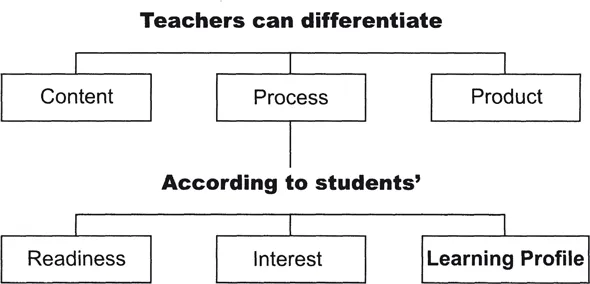
Tomlinson (2001) says that teachers can differentiate three things: the content, which is the what of teaching; the process, or the how of teaching; and the product, which is how students demonstrate understanding of their learning. In order to determine what to differentiate, teachers must first determine how ready students are for a particular concept, what their interests are, and what their learning profile is.
This Book Series
This series of books has been designed to help teachers focus on one particular aspect of differentiation at a time. The components of differentiated instruction cannot be completely separated from each another, but by exploring in depth, teachers may be able to get a picture of what differentiation might look like in the classroom without being overwhelmed. The three books, one focusing on student interest, one on readiness, and this one on learning profiles, are all interrelated, and they can give teachers practical strategies and lesson plans in each area so that they can study and adapt for their particular group of learners, and together they can help teachers develop a comprehensive view of differentiation.
What Are Learning Preferences?
Tomlinson defines a learning profile as a composite of the “ways in which we learn best as individuals” (2001, p. 60). It can include things such as learning styles, personality styles, culture, gender, intelligences, and learning environment preferences. These terms have been used and interpreted differently in literature. In this book, the term learning preference will be used in a broad sense to include student learning styles, intelligences and preferences, and other factors that influence how students respond to learning experiences. Moving beyond the definitions and theories, the purpose of this book is to present practical ways to recognize and celebrate differences and to provide a variety of experiences that can positively influence students. It is a hopeful way of thinking—it recognizes that students are different, but that we can use their strengths for personal development and to accomplish meaningful learning.
Research Connections
Learning can be described as a highly personal process in which each person absorbs and retains information and skills (Dunn, 1984; Teele, 1999; Williamson & Watson, 2006). Sparks and Castro (2006) write of a necessary paradigm shift from learning new information to understanding the process of learning itself. Helping students discover how they learn best and using this information to their advantage can help them to “learn how to learn” for a lifetime.
Thomas Armstrong, in his book Multiple Intelligences in the Classroom (2000, p. 17), describes some of the factors that can affect the ways in which we learn. They include biology (including heredity, genetic factors, and brain injuries), personal experiences (including interactions with parents, teachers, friends, and other people of significance and access to resources) and culture or history (including time and place of birth and cultural influences).
Learning Preferences Are Not Stagnant
A frequent misconception about learning preferences is that they are set early in life and never change. In fact, they develop over time with our previous and continuous experiences (Armstrong, 2004; Silver, Strong & Perini, 1997; Sparks & Castro, 2006; Sternberg & Grigorenko, 2004; Sternberg & Zhang, 2005). Some key ideas include the following:

It is important to share these key ideas with students so that they are encouraged to experiment with different kinds of tasks, which will help them develop different ways of learning. They must also understand that learning preference does not equal ability.
Students Have the Capacity to Develop Balance in Learning Preferences
People do not have just one type of learning preference. Often they have several types that work well for them. In fact, some learners have a degree of balance between learning preferences, and many everyday tasks require different kinds of thinking at the same time. Most people are not equally adept in all areas, but greater balance can be developed over time (Sternberg, 2000; Williamson & Wat...
Table of contents
- Cover
- Title Page
- Copyright Page
- Dedication
- Acknowledgments
- Meet the Author
- Table of Contents
- 1. Differentiating by Learning Preferences
- 2. Assessing Learning Preferences and Building Classroom Climate
- 3. Activity Structures That Support Differentiation by Learning Preference
- 4. Lessons Differentiated by Learning Preference
- 5. Creating and Adapting Lessons
- 6. Managing a Differentiated Classroom
- 7. How to Begin
- Blackline Masters
- References
Trusted by 375,005 students
Access to over 1.5 million titles for a fair monthly price.
Study more efficiently using our study tools.
Frequently asked questions
Yes, you can cancel anytime from the Subscription tab in your account settings on the Perlego website. Your subscription will stay active until the end of your current billing period. Learn how to cancel your subscription
No, books cannot be downloaded as external files, such as PDFs, for use outside of Perlego. However, you can download books within the Perlego app for offline reading on mobile or tablet. Learn how to download books offline
Perlego offers two plans: Essential and Complete
- Essential is ideal for learners and professionals who enjoy exploring a wide range of subjects. Access the Essential Library with 800,000+ trusted titles and best-sellers across business, personal growth, and the humanities. Includes unlimited reading time and Standard Read Aloud voice.
- Complete: Perfect for advanced learners and researchers needing full, unrestricted access. Unlock 1.5M+ books across hundreds of subjects, including academic and specialized titles. The Complete Plan also includes advanced features like Premium Read Aloud and Research Assistant.
We are an online textbook subscription service, where you can get access to an entire online library for less than the price of a single book per month. With over 1.5 million books across 990+ topics, we’ve got you covered! Learn about our mission
Look out for the read-aloud symbol on your next book to see if you can listen to it. The read-aloud tool reads text aloud for you, highlighting the text as it is being read. You can pause it, speed it up and slow it down. Learn more about Read Aloud
Yes! You can use the Perlego app on both iOS and Android devices to read anytime, anywhere — even offline. Perfect for commutes or when you’re on the go.
Please note we cannot support devices running on iOS 13 and Android 7 or earlier. Learn more about using the app
Please note we cannot support devices running on iOS 13 and Android 7 or earlier. Learn more about using the app
Yes, you can access Differentiating By Student Learning Preferences by Joni Turville in PDF and/or ePUB format, as well as other popular books in Education & Classroom Management. We have over 1.5 million books available in our catalogue for you to explore.