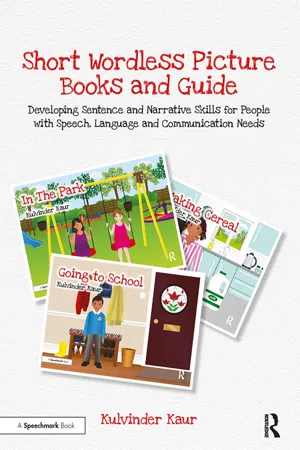
Short Wordless Picture Books and Guide
eBook - ePub

Short Wordless Picture Books and Guide

Developing Sentence and Narrative Skills for People with Speech, Language and Communication Needs

  1. 104 pages
  2. English
  3. ePUB (mobile friendly)
  4. Available on iOS & Android
eBook - ePub

Short Wordless Picture Books and Guide

Developing Sentence and Narrative Skills for People with Speech, Language and Communication Needs

About this book

This collection of short wordless picture books helps to support children with speech, language and communication needs as they develop their expressive sentence and narrative skills through storytelling. Each book is comprised of six colourful images that follow a simple everyday routine such as 'Brushing Teeth', 'Having a Haircut' and 'Walking the Dog'. Unlike traditional picture books, they follow a film scroll effect, showing the progression of time and allowing the child to follow the story to its resolution. Because of their simplicity, the books can support children as they move from simple to intermediate sentence levels, as well as encouraging them to consider additional elements of language such as cause and effect, sequencing and inference.

This resource includes:

  • Ten beautifully illustrated picture books, each following a simple pattern of routine, disruption and resolution
  • An accompanying guidebook including story scripts, cue questions and prompts for using the resource to support additional skills

Although developed specifically to help children with speech, language and communication needs, this set is suitable for any child who requires support and practice in developing their speech. It is an invaluable resource for speech and language therapists, teaching staff and caregivers.

Frequently asked questions

Yes, you can cancel anytime from the Subscription tab in your account settings on the Perlego website. Your subscription will stay active until the end of your current billing period. Learn how to cancel your subscription.
No, books cannot be downloaded as external files, such as PDFs, for use outside of Perlego. However, you can download books within the Perlego app for offline reading on mobile or tablet. Learn more here.
Perlego offers two plans: Essential and Complete
  • Essential is ideal for learners and professionals who enjoy exploring a wide range of subjects. Access the Essential Library with 800,000+ trusted titles and best-sellers across business, personal growth, and the humanities. Includes unlimited reading time and Standard Read Aloud voice.
  • Complete: Perfect for advanced learners and researchers needing full, unrestricted access. Unlock 1.4M+ books across hundreds of subjects, including academic and specialized titles. The Complete Plan also includes advanced features like Premium Read Aloud and Research Assistant.
Both plans are available with monthly, semester, or annual billing cycles.
We are an online textbook subscription service, where you can get access to an entire online library for less than the price of a single book per month. With over 1 million books across 1000+ topics, we’ve got you covered! Learn more here.
Look out for the read-aloud symbol on your next book to see if you can listen to it. The read-aloud tool reads text aloud for you, highlighting the text as it is being read. You can pause it, speed it up and slow it down. Learn more here.
Yes! You can use the Perlego app on both iOS or Android devices to read anytime, anywhere — even offline. Perfect for commutes or when you’re on the go.
Please note we cannot support devices running on iOS 13 and Android 7 or earlier. Learn more about using the app.
Yes, you can access Short Wordless Picture Books and Guide by Kulvinder Kaur in PDF and/or ePUB format, as well as other popular books in Education & Education General. We have over one million books available in our catalogue for you to explore.

Information

Publisher
Routledge
Year
2019
eBook ISBN
9781351104340
Edition
1

User Guide contents

Chapter 1 Introduction
Chapter 2 How to use this resource
Chapter 3 Story scripts: Simple to intermediate
Chapter 4 Additional skills
WH questions
Recognising emotions and situation-based emotions
Cause and effect
Sequencing
Time concepts
Connectives
Pronouns
Inference
Topical conversation
Further reading

Chapter 1 Introduction

This series of wordless picture books aims to help children with speech, language and communication needs (SLCN) develop their expressive sentence and narrative skills through learning to tell stories. The resource is appropriate for children aged three onwards and is aimed at any child from this age who requires practice in developing their speech and who may be receiving speech and language therapy input. The stories are an aid for speech and language therapists, learning support and teaching assistants, teachers, caregivers and parents.
The resource comprises ten simple stories and the sentence levels can be advanced from simple to intermediate. They can be told by children who are starting to form simple sentences and children who require help with forming grammatically correct, longer and more descriptive sentences.
The stories have been intentionally developed around themes that are likely to be familiar to children, and they follow a film scroll effect; this formula has been used to facilitate understanding for children with limited receptive language. General story and picture books do not follow this formula and therefore are not always appropriate to use because of the unfamiliarity of events, ideas and language, and because the illustrations are often there to accompany the text and may ‘jump’ from one scene to another.
The formula of each story is a disruption or an interesting event in a familiar routine followed by a resolution. This guide offers strategies on how to teach and progress the child through each level and provides simple and intermediate scripts for each story. It has an additional skills section at the end to help develop key skills and comprehension (Chapter 4). It is advisable to read Chapter 2, on teaching strategies, before progressing to Chapters 3 and 4.
Although this resource is primarily for SLCN, it can be used for literacy development by teachers in Early Years, Key Stage 1, and English Speakers of Other Languages.

Chapter 2 How to use this resource

Who it’s for

This resource is appropriate for children who have the following skills:
  • have a repertoire of common receptive and expressive nouns, verbs, adjectives and prepositions
  • able to recognise the above in pictures
  • able to imitate three-word sentences, e.g., if you say to the child, ‘Say “I want chips”’, the child must be able to repeat.

Which stage to start from

The stories are divided in two sections based on the two sentence levels: simple and intermediate. Below is a table outlining what each sentence level consists of to help you decide which is the most appropriate for the child to start at:
Description Average words for each sentence / page Average words for each story
Simple This level mainly includes one clause: subject-verb-noun. 5 words 30 words
Intermediate This level includes longer sentences which mainly consist of two joining clauses, and sometimes two one-clause sentences fora page. The sentences describe the story in more detail, and conjunctions are used to join the events on the page together and are sometimes used to join the events across pages together. 9 words 55 words
Start at the child’s current word utterance level. If you’re unsure of this, assess their level by asking them to say a four-word sentence and see if they can repeat it easily. If they can’t, then start with simple sentences. If they can do simple sentences easily and can copy an eight-word sentence, start with the intermediate level.

How much to do at one time

This depends on a number of factors and will depend on each child and their individual progress.
In particular,...

Table of contents

  1. Cover
  2. Half Title
  3. Title
  4. Copyright
  5. Pack contents
  6. Guidebook
  7. Making Cereal
  8. Going to School
  9. Brushing Teeth
  10. Having a Haircut
  11. Walking the Dog
  12. In the Bakery
  13. In the Park
  14. Playing Hide and Seek
  15. At School
  16. Swimming