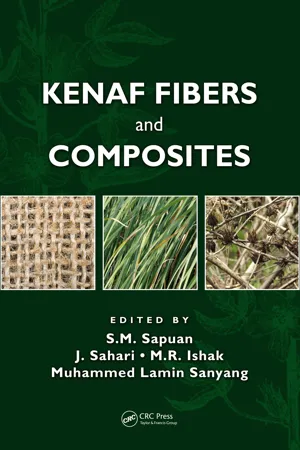
Kenaf fiber is gaining attention as an alternative reinforcement for composite products due to low cost, reduced environmental impact, and attractive mechanical properties. Kenaf Fibers and Composites covers the breadth of these exciting materials, from raw material preparation to application in a variety of products. It discusses fiber characterization and properties, how to prepare kenaf-based composites, and design, manufacturing, and applications. It also covers hybrid fiber composites, kenaf fiber thermosetting composites, kenaf fiber thermoplastic composites, kenaf fibers in various lengths, and forms and arrangements such as particulates, continuous roving, and woven fabrics. Cellulose-based kenaf composites and kenaf fiber-filled biopolymer composites are presented.
eBook - ePub
Kenaf Fibers and Composites
- 231 pages
- English
- ePUB (mobile friendly)
- Available on iOS & Android
eBook - ePub
1Natural Fiber CompositesChallenges and Opportunities
Faris M. Al-Oqla and S.M. Sapuan
1.1Introduction
1.2Natural Fibers
1.3Life Cycle Assessments of NFCs
1.4Major Issues in the Development of NFCs
1.4.1Water Absorption Characteristics of NFCs
1.4.2Compatibility of Fibers and Polymers in NFCs
1.4.3Thermal Stability of Natural Fibers
1.4.4Factors Influence the Composite Performance
1.5Applications of NFCs
1.6Future Developments
1.7Summary
1.8Conclusions
References
1.1Introduction
Infrastructural physical components are usually constructed utilizing materials from finite resources such as steel, aluminum, and reinforced concrete. It is statistically proven that buildings alone consume about half of the total resources used globally. This has led to environmental damage and depletion of available natural resources. In addition, most of the conventional building-oriented materials and constructional processes are energy-intensive to produce, and are primarily responsible for a significant amount of landfill volume, thus producing about 40% of greenhouse gas emissions (Sallih, Lescher, and Bhattacharyya 2014). Furthermore, due to population growth, an increase in the demand for conventional materials leaves a large ecological footprint.
The growing interest in long-term sustainability, as well as awareness of environmental issues, has emphasized the proper utilization of natural resources by new environmental regulations. This has resulted in changing public and governmental attitudes and has stimulated considerable advancements in natural composite materials. Natural fiber composites (NFCs) have been recently highlighted in various industrial applications and have been slowly replacing conventional materials based upon several factors. (Abral et al. 2014; Agoudjil et al. 2011; Ahuja, Mir, and Kumar 2007; AL-Oqla and Sapuan 2014b; Almagableh, AL-Oqla, and Omari 2017).
Proper material selection has become pivotal in engineering to attain successful and sustainable design, as well as customer satisfaction attributes (AL-Oqla and Sapuan 2014b; Alves et al. 2010a). Moreover, the implementation of new materials in the industrial sector is usually limited by several constrains and limitations, such as the inherent relationship between the materials and their availability, cost, compatibility with the product design, machinability, recyclability, and performance in the final product form. This makes compromising these constraints, advantages, and disadvantages in selecting materials an intricate matter, where proper decisions have to be made concerning modern techniques like optimization methods, informative decisions, and expert systems utilizing the pairwise comparisons. (Dweiri and Al-Oqla 2006; AL-Oqla and Hayajneh 2007; Al-Oqla and Omar 2012; Al-Oqla and Omar 2014; Al-Widyan and Al-Oqla 2011, 2014; Dalalah, Al-Oqla, and Hayajneh 2010; Dieter 1997; Jahan 2010). In comparison to conventional composites, NFCs have greater specific strength and stiffness, better resistance to corrosion, greater fatigue strength and impact absorption capacities, recyclability, adaptability to hazardous environments, lower life-cycle costs, and non-toxicity (Dittenber and GangaRao 2011; Faruk et al. 2012a; AL-Oqla, Sapuan, Ishak, and Aziz 2014). Such advantages of NFCs resulted from the advantages of their constituents (fillers and polymers) particularly the natural fibers that have major advantages over traditional glass fibers. Such advantages include low cost, energy recovery, good thermal and acoustical insulation characteristics, availability, degradability, CO2 sequestration enhancements, reduced dermal and respiratory irritation, and reduced tool wear in machining operations (Kalia 2011b; Faruk et al. 2012b; Alves et al. 2010b; Mir et al. 2010; Pickering et al. 2007; Sarikanat 2010). The features, as well as the performance of products, made from NFCs strongly depend upon the properties of their in...
Table of contents
- Cover
- Half Title Page
- Title Page
- Copyright Page
- Contents
- Editors
- Author
- Chapter 1 Natural Fiber CompositesChallenges and Opportunities
- Chapter 2 Kenaf FiberStructure and Properties
- Chapter 3 Adhesion Characteristics of Kenaf Fibers
- Chapter 4 Kenaf Fiber-Reinforced Thermoplastic Composites
- Chapter 5 Effect of Silica Aerogel on Polypropylene Reinforced with Kenaf Core Fiber for Interior Automotive Components
- Chapter 6 Impact of Silane Treatment on the Properties of Kenaf Fiber Unsaturated Polyester Composites
- Chapter 7 Effects of Material Types on the Failure Modes Crashworthiness Parameters of Kenaf Composite Hexagonal Tubes
- Chapter 8 Eco-Friendly Kenaf Hybrid Materials
- Chapter 9 Ballistic Properties of Hybrid Kenaf Composites
- Chapter 10 Cellulose-Based Composites from Kenaf Fibers
- Chapter 11 Development and Characterization of Kenaf Nanocomposites
- Chapter 12 Concurrent Design of Kenaf Composite Products
- Index
Trusted by 375,005 students
Access to over 1.5 million titles for a fair monthly price.
Study more efficiently using our study tools.
Frequently asked questions
Yes, you can cancel anytime from the Subscription tab in your account settings on the Perlego website. Your subscription will stay active until the end of your current billing period. Learn how to cancel your subscription
No, books cannot be downloaded as external files, such as PDFs, for use outside of Perlego. However, you can download books within the Perlego app for offline reading on mobile or tablet. Learn how to download books offline
Perlego offers two plans: Essential and Complete
- Essential is ideal for learners and professionals who enjoy exploring a wide range of subjects. Access the Essential Library with 800,000+ trusted titles and best-sellers across business, personal growth, and the humanities. Includes unlimited reading time and Standard Read Aloud voice.
- Complete: Perfect for advanced learners and researchers needing full, unrestricted access. Unlock 1.5M+ books across hundreds of subjects, including academic and specialized titles. The Complete Plan also includes advanced features like Premium Read Aloud and Research Assistant.
We are an online textbook subscription service, where you can get access to an entire online library for less than the price of a single book per month. With over 1.5 million books across 990+ topics, we’ve got you covered! Learn about our mission
Look out for the read-aloud symbol on your next book to see if you can listen to it. The read-aloud tool reads text aloud for you, highlighting the text as it is being read. You can pause it, speed it up and slow it down. Learn more about Read Aloud
Yes! You can use the Perlego app on both iOS and Android devices to read anytime, anywhere — even offline. Perfect for commutes or when you’re on the go.
Please note we cannot support devices running on iOS 13 and Android 7 or earlier. Learn more about using the app
Please note we cannot support devices running on iOS 13 and Android 7 or earlier. Learn more about using the app
Yes, you can access Kenaf Fibers and Composites by S. M. Sapuan, M.R. Ishak, J. Sahari, Muhammed Sanyang, S. M. Sapuan,M.R. Ishak,J. Sahari,Muhammed Lamin Sanyang,Muhammed Sanyang, S. M. Sapuan, M.R. Ishak, J. Sahari, Muhammed Lamin Sanyang in PDF and/or ePUB format, as well as other popular books in Technology & Engineering & Chemistry. We have over 1.5 million books available in our catalogue for you to explore.