- 160 pages
- English
- ePUB (mobile friendly)
- Available on iOS & Android
eBook - ePub
About this book
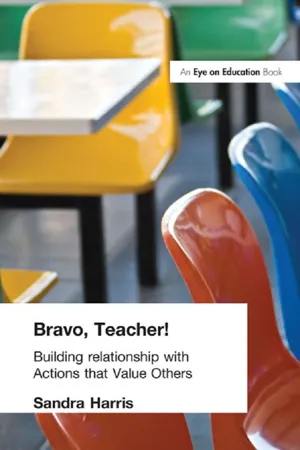
As they wrestle with today's rules, regulations and high-stakes testing, our best teachers never forget that strong, positive relationships are at the core of student success. This book shows us how to build relationships with students, parents, and co-workers to create the kind of learning environments where all students achieve success.
Information
1
Actions that Uphold High Standards—Point to the Stars
It is not a disgrace not to reach the stars, but it is a disgrace to have no stars to reach for.
Benjamin Mays
Grace Ann was my very first student. She was the first child to walk through the door of my fifth-grade classroom the very first year that I taught school, and she was smiling. She was tall, skinny, black, and poor. She lived in the nearby project, the oldest of nine children. Grace Ann was 12 years old. She was a good reader, although I don’t remember ever seeing her select a book to read during free reading time. She said that she did not like math, but she was actually quite good with numbers when she chose to be. She loved kickball and was very good at it. Some days she would do her class work, and some days she would not. Some days she would bring in her homework, and some days she would not. Still, I liked having Grace Ann in my class. Even at 12, there was resilience about her—after all, she made it through each day still smiling.
One day I was visiting with the girls in our class at recess, and I asked them to tell me what they wanted to do when they grew up. Grace Ann responded first: “I want to sleep with lots of men, like my Mama does.”
My first reaction was surprise—was she trying to shock me? Then, I looked clearly into her eyes. I did not see guile or sophisticated cleverness, instead I saw a child whose only goals quite simply were framed by the person she cared for the most—her mother.
The challenging question that all teachers face was set before me at that very moment: What could I do to point Grace Ann to the stars?
Grace Ann was my student in the days long before mandated standards and high-stakes testing, but the same challenge faces teachers today. How do we point our students to the stars? How do we uphold a high standard for every child? Here again, there are no easy answers. But the truth is, we have no choice. When we decided to become teachers, we committed to do all that we can to “[sustain] success for all students so that failure is not an option” (Blankstein, 2004, p. 5). This is not an easy task. But we know that most tasks worth doing are never easy. What could be more important than committing to make the world a better place by helping its future leaders?
State and national accountability standards and the No Child Left Behind Act of 2001 (NCLB) were created to help all children achieve, but there is no doubt that they are surrounded by controversy. Many educators support these standards because they feel that when applied properly they serve as specific criteria that guide schools with clear, consistent curriculum standards for all teachers to use for all children (Scheurich & Skrla, 2003). Yet, I hear teachers every day who are concerned that it may be harder today to uphold a high standard for every child because of the limits of these mandated accountability standards. Despite this complexity, teachers recognize that in the quest to uphold a high standard for every child, mandated high-stakes testing is a place to begin, not the place to end. BRAVO (Building Relationships with Actions that Value Others) teachers search their soul to understand themselves more fully and examine their own beliefs about children, they accept the responsibility to uphold a high standard for every child, and they create a classroom culture of achievement. When they do this, they build valuing relationships with all students that point them to the stars.
Search Your Soul
Before we can accept the responsibility to uphold high standards for every child, we must understand what we believe about ourselves as teachers and what we believe about children. When we glibly say that “every child can learn,” do we really mean it, or have we just jumped on the bandwagon because it is politically correct to do so? These are deeply personal questions, but what we believe about ourselves as teachers, and what we believe about children, is a message that comes through loud and clear to our students, their parents, and other faculty. After examining our beliefs, we must evaluate our actions, then we must commit to taking the first step and doing what we believe, just as Rosa Parks did when she refused to go to the back of the bus. She said, “I knew someone had to take the first step, so I made up my mind, not to move” (Eisen, 1995).
Know Your Own Identity
Before you can understand the way that teachers influence the children in your classrooms, you must understand your own identity. Ask yourself the following questions (this is not a comprehensive list of identity questions, but it is a beginning):
♦ How do I describe myself?
♦ What is my family history?
♦ What is my purpose in life?
♦ What do I value?
♦ What kinds of careers are important to my family?
♦ What do I believe about gender roles?
♦ How do I relate to others?
♦ What do I believe about other people?
♦ Do I have friends who are from backgrounds different than mine?
♦ What do I do to enlarge my experiences with people of different cultures?
Now, ask yourself the following questions that specifically relate to teaching:
♦ What is the purpose of teaching?
♦ What do I believe about teaching children?
♦ What kind of behavior do I expect from students?
♦ What do I expect of my students’ parents?
♦ Do I believe that every child can achieve?
When you reflect on these questions honestly and answer them privately, you will become aware of influences that perhaps you had no idea existed in your life and in your classroom. You will also understand why you relate better to some people than to others in some instances. Now, let’s continue this journey to examine our beliefs and our actions.
Examine Your Beliefs
What you believe about yourself as a teacher and what you believe about all children are closely related. I don’t want to sound trite, but consider this: What if you had been Helen Keller’s teacher? Would you have believed in yourself and your abilities as a teacher enough to teach her? I know, I know, you are thinking you could not have been successful with someone with her deficits because you did not have the training. Well, you can’t get off the hook that easily. Let’s assume you have whatever training is necessary to work with any child. Would you have believed in yourself enough as a teacher to be able to teach Helen? You say, “Yes, I believe that I am an effective teacher, and effective teachers have the power to change children’s lives.”
Let’s consider the next set of questions about what you believe about teaching: Do you believe that all children want to learn, regardless of their circumstances? Did Helen want to learn in spite of the dark, silent world in which she lived? You say, “Yes, she wanted to learn. Yes, I believe all children want to learn, regardless of their circumstances.”
Now, take another step. Do you believe that all children can be successful or just some children? You say, “Yes, I believe that all children have the potential to be successful.”
You have searched your soul and examined your beliefs, and here is what you believe: You believe in yourself as an effective teacher and you believe that effective teachers help children. You believe that all children want to learn regardless of their circumstances. You believe that all children have the potential to be successful.
Examine Your Actions
What do your actions say about what you believe? Do your actions show that you are always learning more about your craft so that you can be the most effective teacher possible? Or do you only attend professional development seminars when forced and then sit in the back row and grade your papers? I know some can be pretty boring—but that’s not the point. The point is this: Do your actions show that you are so interested in learning more about teaching and about children that you take every opportunity to improve?
Because you believe that all children want to learn regardless of their circumstances, what do your actions show? Do you provide enrichment activities? Do you provide tutoring for children who are behind? Do you get to know all of your students so that you can understand what their needs are? Do you look for new, creative ways to motivate all of your children?
Because you believe that all children in your classroom have the potential to be successful, do you celebrate their successes? Do you celebrate individual improvement? Do you collaborate with parents to help them help you help their child? Do you team with other faculty to enhance learning opportunities for all children? You say, “Yes, yes, yes, yes, and yes, to all of these. My actions show that I believe in myself and in children.”
Make a Personal Commitment
There is a story about a 5-year-old boy who had been cured of a life-threatening disease. Soon after, it was discovered that his sister had the same illness. Her only chance of recovery was a blood transfusion from him, because he had just the right antibodies. The doctor explained the situation to the little brother and asked if he would be willing to give his blood to his sister. He hesitated for only a moment before he said yes. As the transfusion progressed, he lay in bed next to his sister and smiled when he saw the color return to her cheeks. Then his face grew pale and his smile faded. He looked up at the doctor and asked, “Will I start to die right away?” Being young, the little boy had misunderstood the doctor and thought he had to give his sister all of his blood in order to save her. But he was willing to make a personal commitment to what he believed.
Now that you have explored your own beliefs and actions by looking deeply into your own soul, you need to make a personal commitment to uphold yourself to high standards and to hold every child that you teach to a high standard of achievement. In other words, you commit to doing what you say you believe. You commit to making the most of every moment you have with your students to point each of them to the stars.
Accept Responsibility to Uphold High Standards for Every Child
Now that we know that we believe in and are committed to holding ourselves and all of our students to a high standard of success, we are ready to accept this responsibility. To do this, it is important to look more closely at today’s accountability system and high-stakes testing. Teachers must understand the dilemma created by high-stakes testing to commit to making standards work for all children.
Understand the Dilemma
I talk with teachers every day, and I have never met one who is not in favor of educator accountability. Just recently I was riding from the airport to my hotel with a woman who carried a bag with a big red apple on it. I asked if she was a teacher (silly question, I know). Of course, and she was on her way to a Texas Assessment of Knowledge and Skills (TAKS) conference. When I asked how she felt about all of the testing, she grimaced and said, “I am actually glad that we are being more accountable, ...but it seems that all we are allowed to do is teach to the test when there is so much more to teaching than testing!” Many teachers are frustrated and unhappy with the mandated accountability that is in place. Not because they are unwilling to be accountable, but because of the way it has been implemented. For example, consider the NCLB that requires that only 1% of children can be exempt from testing (now waived to 3%). Yet, in Texas, for example, the average number of identified special education students is 10% in a district. What about the other 7%? What do we do for them?
Unfortunately, many parents, and the media, do not understand the testing dilemma of standardized accountability. Certainly, accountability is appropriate and a good idea. But as James Popham (2005) points out, it is possible for schools labeled as “low performing” by NCLB tests to actually be doing a good job of instruction, especially considering that often these schools serve lower socioeconomic status (SES) students. At the same time, schools labeled as “high performing” might actually be doing a bad job of instruction since many of these schools serve students of higher socioeconomic status. In other words, sometimes, students in low SES schools have backgrounds that create barriers when success is only determined by one test, whereas high SES students tend to have the test-taking advantage and score well even though instruction has not been the best. The point of this comparison is not to question the quality of teachers in these schools, but to emphasize that the tests which are being used to determine teaching quality as they are written do not measure teaching quality. Success should be measured by considering a variety of factors including individual student improvement. These should be measured in a variety of ways that include portfolios and teacher observation.
Recently, I had a conversation with an excellent third-grade teacher whose class has made wonderful academic progress. However, at the beginning of the year, most of the students were below grade level, and the state test and NCLB designation of low or high performing will not be based on the individual gains of each child. Despite her good teaching and the children’s achievement gains, it is likely their performance on the test will label the school as low performing. The problem is not holding children who are so different in so many ways to the same standard, but how we determine if that standard has been met. Testing all children in the same way, usually a multiple-choice test, is a one-size fits all mentality that does not consider the complexity, diversity, uniqueness, and individuality of children.
As high-stakes tests are implemented ...
Table of contents
- Cover Page
- Title Page
- Copyright Page
- Table of Contents
- Introduction
- 1 Actions that Uphold High Standards—Point to the Stars
- 2 Actions That Are Empowering—Less Is More
- 3 Actions That Demonstrate Respect for All—Every Individual Is Important
- 4 Actions That Support All Students—Rekindle the Inner Spirit
- 5 Actions That Challenge the Imagination—Participate in Discovery
- 6 Actions That Demonstrate Culturally Responsive Teaching—The Mosaic of Moral Purpose
- 7 Actions That Are Courageous—Fragile Blossoms in the Snow
- 8 Relationships: The True Thread
- 9 References
Trusted by 375,005 students
Access to over 1.5 million titles for a fair monthly price.
Study more efficiently using our study tools.
Frequently asked questions
Yes, you can cancel anytime from the Subscription tab in your account settings on the Perlego website. Your subscription will stay active until the end of your current billing period. Learn how to cancel your subscription
No, books cannot be downloaded as external files, such as PDFs, for use outside of Perlego. However, you can download books within the Perlego app for offline reading on mobile or tablet. Learn how to download books offline
Perlego offers two plans: Essential and Complete
- Essential is ideal for learners and professionals who enjoy exploring a wide range of subjects. Access the Essential Library with 800,000+ trusted titles and best-sellers across business, personal growth, and the humanities. Includes unlimited reading time and Standard Read Aloud voice.
- Complete: Perfect for advanced learners and researchers needing full, unrestricted access. Unlock 1.5M+ books across hundreds of subjects, including academic and specialized titles. The Complete Plan also includes advanced features like Premium Read Aloud and Research Assistant.
We are an online textbook subscription service, where you can get access to an entire online library for less than the price of a single book per month. With over 1.5 million books across 990+ topics, we’ve got you covered! Learn about our mission
Look out for the read-aloud symbol on your next book to see if you can listen to it. The read-aloud tool reads text aloud for you, highlighting the text as it is being read. You can pause it, speed it up and slow it down. Learn more about Read Aloud
Yes! You can use the Perlego app on both iOS and Android devices to read anytime, anywhere — even offline. Perfect for commutes or when you’re on the go.
Please note we cannot support devices running on iOS 13 and Android 7 or earlier. Learn more about using the app
Please note we cannot support devices running on iOS 13 and Android 7 or earlier. Learn more about using the app
Yes, you can access Bravo Teacher by Sandra Harris in PDF and/or ePUB format, as well as other popular books in Pedagogía & Gestión del aula. We have over 1.5 million books available in our catalogue for you to explore.