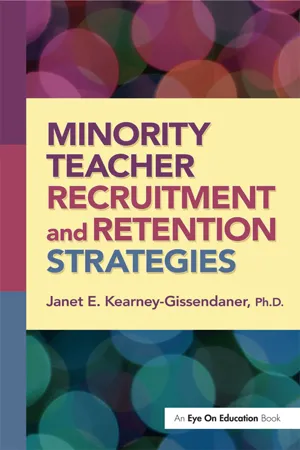
The tools and resources in this book help school leaders seamlessly incorporate minority teacher recruitment and retention programs into current human-resources activities. With details about exemplary minority teacher recruitment and retention programs, this book also showcases strategies for how to replicate such programs in your own school or district.
Contents include: A Critical Examination of Teacher Shortages: Thoughts on Needed Change; Identification of Recruitment Models Focused on Minority Teachers: A Theoretical; Concept and Survey; Pipeline Programs for Minority Teacher Recruitment; and Prepare for Action.
- 144 pages
- English
- ePUB (mobile friendly)
- Available on iOS & Android
eBook - ePub
Minority Teacher Recruitment and Retention Strategies
About this book
Information
1

A Critical Examination of Teacher Shortages: Thoughts on Needed Change
A Compelling Unsolved Challenge
Public school districts across the nation are alarmed by the continued severe shortages of teachers, African-American, and other races. Minority teacher shortages have continued to worsen for over four decades, and school district officials need programs that work to sustain recruitment, selection, and retention of quality minority teachers. This compelling problem is of national significance because classrooms are multicultural in nature (Recruiting New Teachers, 1994). There is an urgent need for teachers who represent many cultures to teach our students. This need did not come about recently, but dates back to school systems in the throes of implementing desegregation after the Brown v. Education decision. At that time, 80% of the school population was white and 20% was minority. By 1996, the number of minority students had risen to approximately 35% of the student population; and today it stands at nearly 40% and growing (Torres, Santos, Peck, & Cortes, 2004). It is no wonder that minority teacher shortages have been a hot topic spanning four decades. While percentages of minority students are high and growing, a daunting task is before us to increase the number of minority teachers available for this growing population of minority students as well as to provide role models for nonminority students.
Student diversity remains in stark contrast to teacher diversity. According to Torres et al., the American Association of Colleges for Teacher Education (AACTE; 2004), in 1997 reported that the vast majority of teachers in our schools and in teacher preparation programs were white (87%) and female (74%). In 1977, minority teachers constituted approximately 12.2% of the total number of teachers. More recent estimates indicate that the percentage of white teachers in public schools is as high as 90%, meaning that the percentage of minority teachers may have decreased to 9% (Torres et al., 2004, p. 3). The recent advent of the baby boomer retirement has made an enormous impact on America’s elementary and secondary school classrooms leaving a void in the number of available teachers who had years of accumulated knowledge and experience—a void which will only worsen in the coming decade. This is compounded by what is happening at the other end of the pipeline. As young teachers are dropping out, the number of minority students, especially Hispanics, is steeply rising; but the teaching pool remains almost exclusively white (Duarte, 2000, pp. 19–23).
According to a report of the Northwest Regional Laboratory (NWREL), 1997, when teachers of color are missing, minority students land in more special education classes, have higher absentee rates, and tend to be less involved in activities (p. 1).
According to the NWREL report, the Education Trust, a Washington, DC–based nonprofit organization that works to reduce the achievement gap, notes that “data from schools show that lower income children and children of color can excel if they are taught at high levels” (p. 1). Research shows many other factors influence this achievement gap. Some important ones are family involvement, cultural differences, expectations, grouping arrangements, and English language acquisition (p. 1).
The Office of Educational Research and Improvement (OERI), U.S. Department of Education, sponsored, in part, the following information regarding elements that enhance the achievement, attitudes, and behavior of minority group students. These have been summarized in part by NWREL (2001, p. 13).
- Strong leadership on the part of school administrators
- Teachers who believe they are responsible for students’ learning and capable of teaching them effectively
- High expectations for student learning and behavior on the part of administrators and teachers
- Safe and orderly, well-disciplined, but not rigid school environment
- Teachers who are adept at modifying instructional materials and strategies in response to students’ differing learning styles and needs
- Recruitment and hiring of minority teachers
Causes of Teacher Shortages
Knowing some of the causes of teacher shortages, particularly those pointed out by Haberman (2005), turns us in a direction of recruitment and retention that must be built and sustained over time. Nourishing the pipeline of prospective teachers will be a critical factor in providing a solid baseline of qualified teachers in all licensure areas for the future.
Haberman describes the length of an average teaching career being eleven years. Teachers who decide to pursue lifelong careers in the classrooms are now clearly the exception (p. 3). He further states that the majority of those who graduate from traditional education programs never take jobs as teachers.
In 2001, sixty-one percent of the newly certified graduates did not take teaching jobs. This lower figure does not mean more teachers entered classrooms, however, since the total number produced in 2001 had declined by almost 20 percent. These nonteaching certified graduates frequently referred to by many as ‘fully qualified’ don’t take teaching positions because the jobs are primarily in urban schools serving diverse children in poverty. (Haberman, p. 31)
Haberman (2005) also mentions this reason as yet another cause for the teacher shortage. He further emphasized that the young white adults who compose over 90% of the traditionally trained teachers simply “don’t want or cannot relate to diverse children and youth in urban poverty” (p. 4).
A third reason for the teacher shortage Haberman notes is the number of beginners who take jobs in urban schools but fail or leave. Based on data from the National Center for Educational Statistics School and Staffing Survey, school staffing problems were seen to be primarily due to excess demand resulting from a revolving door where large numbers of teachers depart for reasons other than retirement (p. 4). Haberman (2005) reported that, in his own city, half of the new teachers were gone in three years or less and that many quit in the first year.
A fourth reason Haberman (2005) posed for the teacher shortage in urban schools is the shortage of special education teachers. Haberman states, “This shortage is exacerbated by the practice of many suburbs, small towns, parochial and private schools contracting out the education of their children with special needs to nearby urban school districts.” He contends that it not only increases the shortage in urban districts, but raises costs (p. 4). And, typically, these shortages projected by Haberman in special education and math are experienced by many districts across the nation. Additionally, districts across our nation randomly report that shortages occur in some foreign languages, dual certification and licensed teachers, and some areas of science.
Other reasons for teacher shortages that Haberman (2005) projects are:
| ♦ | the greater entrance level career opportunities now available to women outside of teaching |
| ♦ | college graduates of color who now have greater access to larger numbers of careers than in former times |
| ♦ | math and science teachers leaving at a higher rate than others, many of whom are men seeking better opportunities |
Need for Change
The American Association for School Personnel Administrators (AASPA) recognized the need for a publication to provide their membership with information on successful minority teacher recruitment models nationwide to address the challenges of minority teacher shortages. AASPA provided data on minority teacher percentages from member districts and provided a forum for the author to work with data provided by member school districts on numbers and percentages of minority teachers in districts represented during a two-year period. The author chaired an ad hoc minority recruitment committee of AASPA for the purpose of finding successful minority recruitment models nationwide and then directed action plans to showcase respective district model plans that work to produce and retain quality minority teachers. These model plans, representing urban, suburban, rural, and combinations of plans, provide excellent ideas for districts or organizations to develop a minority recruitment model suited for their school district or organization.
Policy development within each district or organization solidifies commitment to this process; Grow Your Own programs will plant the seed which needs constant nurturing. Minority teacher recruitment on historically black college campuses will provide visualization for students, enabling these prospective teachers on campuses across the nation to realize the compelling need to commit to the teaching profession!
The benefits of having minority teachers in the classroom include positive role models for minority and majority students alike, increased cultural sensitivity, bridging the achievement gap and exits for many minority students, and frequent bilingual abilities. Citing these benefits, scholars are alarmed by the fact that minority teacher representation today in our public schools is only around 3% of the total pool of teachers. It is no wonder that minority teacher shortages have emerged over the past five decades as among the most burning educational issues.
Demands on Minority Teacher Hiring
Knowing that American’s school age population has become more multicultural and multiethnic, and its teaching workforce reflects a trend in the opposite direction, it is logical that teachers of color are in high demand in all subjects, grade levels, and geographic areas as reported by Recruiting New Teachers, 2004. In Recruiting New Teachers’ 2000 study of the largest urban school districts, almost 73% of the responding districts reported an immediate need for teachers of color. The 2003 National Commission on Teaching and America’s Future reported that individuals of African-American, Hispanic and Latino, Asian, and Native American descent make up 14% of K–12 teachers, while 36% of students are from such backgrounds (Recruiting New Teachers, 2004).
Minority Teacher Deficit: Lessons Learned
Torres et al., 2004, summarize and argue the review of literature in the field of minority teacher recruitment, development, and retention. Recent research is discussed regarding the contributions of teachers of color to the education of both white and minority students. There are primary lessons to be learned from this information to ready ourselves in taking on this monumental challenge we face in combating the current minority teacher shortage today!
The first lesson is the history of the present minority teacher shortage. Historically, the teaching profession was extremely important to the African-American people. Prior to the Civil Rights Act of 1964, it was reported that most college-educated African Americans were in the teaching profession. And, in 1954, approximately 82,000 African-American teachers were responsible for the education of 2 million African-American public school students. But by 1964, at least 38,000 of the 82,000 African-American educators nationwide had lost their teaching positions (Torres et al., 2004).
The underrepresentation of the minority teachers seems to have been an unintended side effect of the partial implementation of desegregation following the Supreme Court decision in Brown v. Board of Education (1954). While minority students were transferred in some numbers into majority-white schools, African-American teachers were transferred with far less frequency. There were no provisions made at that time to integrate school faculties, administrations, and staff. Instead, African-American teachers and administrators were either dismissed or demoted, and the schools hired white teachers and administrators to deal with the increase in student population, according to Torres et al., 2004.
This set the stage for the following struggle surrounding the condition of the minority teacher in the United States as the the lack of commitment to having a diverse teaching staff ultimately affected the pipeline for minority teachers to enter the profession.
Many issues worked greatly to limit the number of African- American teachers in the profession following the Brown v. Board of Education decision: for example, teacher testing, certification, and salary differentials. The testing requirements began in the South and did not become law in other states until the mid-1980s. Personnel and human resource officials in states without testing recruited southern minority teachers whose coursework met certification requirements in their states. They offered higher salaries without having to require testing as in the South. This incentive was used to lure prospective teachers from the South to the North and continued well in to the early 1990s until state boards of education changed the requirements for certification and instituted the National Teacher Exam (NTE) in additional states. Time frames were set for teachers to meet requirements, and those teachers who were unable to comply were terminated. These were short-lived strategies since testing and the recent advent of the No Child Left Behind Act posed additional challenges for minority prospective teachers as well as teachers already in the profession working to meet additional certification and licensure requirements.
Today: The Impetus for Change
We need now, more than ever, to implement programs that influence minority students to enter teaching and help them through the pipeline, provide opportunities for employment, and retain them for leading our children across the nation. We also need to retain the “bright shining stars” (teachers) whom we already have in the teaching force.
Therefore, to avoid losing ground on providing a minority teaching force of excellence, we must do the following: a) constantly review the existing research on the impact of teachers of color; b) expand our research base on culturally responsive teaching and the role that ethnicity plays in fostering student achievement; c) study the pipeline to teaching to identify a variety of institutional conditions and practices that limit access, prompt failure, and create hostile learning environments for prospective teachers of color; d) redesign teacher preparation and curricula to effectively address issues of diversity and culturally responsive teaching; e) develop high quality alternative teacher preparation models; f) address teacher assessment issues, in particular the impact of teacher competency testing on the pool of prospecti...
Table of contents
- Cover
- Title Page
- Copyright Page
- Table of Contents
- Preface
- Acknowledgements
- 1 A Critical Examination of Teacher Shortages: Thoughts on Needed Change
- 2 Identification of Recruitment Models Focused on Minority Teachers: A Theoretical Concept and Survey
- 3 Introduction and Information on Five Exemplary Minority Teacher Recruitment Models
- 4 Pipeline Programs for Minority Teacher Recruitment
- 5 Prepare for Action
- References
- Recommended Resources
Trusted by 375,005 students
Access to over 1.5 million titles for a fair monthly price.
Study more efficiently using our study tools.
Frequently asked questions
Yes, you can cancel anytime from the Subscription tab in your account settings on the Perlego website. Your subscription will stay active until the end of your current billing period. Learn how to cancel your subscription
No, books cannot be downloaded as external files, such as PDFs, for use outside of Perlego. However, you can download books within the Perlego app for offline reading on mobile or tablet. Learn how to download books offline
Perlego offers two plans: Essential and Complete
- Essential is ideal for learners and professionals who enjoy exploring a wide range of subjects. Access the Essential Library with 800,000+ trusted titles and best-sellers across business, personal growth, and the humanities. Includes unlimited reading time and Standard Read Aloud voice.
- Complete: Perfect for advanced learners and researchers needing full, unrestricted access. Unlock 1.5M+ books across hundreds of subjects, including academic and specialized titles. The Complete Plan also includes advanced features like Premium Read Aloud and Research Assistant.
We are an online textbook subscription service, where you can get access to an entire online library for less than the price of a single book per month. With over 1.5 million books across 990+ topics, we’ve got you covered! Learn about our mission
Look out for the read-aloud symbol on your next book to see if you can listen to it. The read-aloud tool reads text aloud for you, highlighting the text as it is being read. You can pause it, speed it up and slow it down. Learn more about Read Aloud
Yes! You can use the Perlego app on both iOS and Android devices to read anytime, anywhere — even offline. Perfect for commutes or when you’re on the go.
Please note we cannot support devices running on iOS 13 and Android 7 or earlier. Learn more about using the app
Please note we cannot support devices running on iOS 13 and Android 7 or earlier. Learn more about using the app
Yes, you can access Minority Teacher Recruitment and Retention Strategies by Janet Kearney-Gissendaner in PDF and/or ePUB format, as well as other popular books in Didattica & Didattica generale. We have over 1.5 million books available in our catalogue for you to explore.