- 284 pages
- English
- ePUB (mobile friendly)
- Available on iOS & Android
eBook - ePub
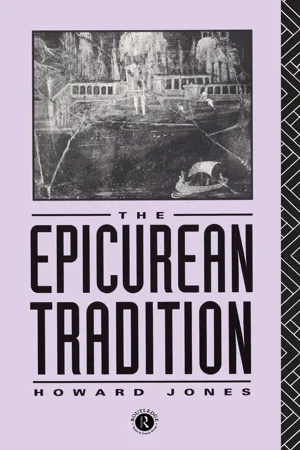
Epicurean Tradition
About this book
First published in 1992. Epicureanism has had a long and complex history. This book is the first to chronicle this history, from its beginnings in Greece in the fourth century BC to its role in the development of philosophy and science in the sixteenth and seventeenth centuries. Divided equally between the classical and post-classical worlds, The Epicurean Tradition is a notable contribution to classical scholarship and to the history of ideas.
1

MAN FOR A SEASON
In the case of Epicurus, who believed firmly that death is the end, it is not without irony that his own death marked but the beginning of a journey which would take him far in time and distance from his native Samos. We shall not make the journey with him step by step. Rather, we shall contrive to meet up with him at various stopping places along the way. The further we travel, however, the more we must be prepared for him to be wearing a different face. While the outline may be familiar, the features will sometimes be blurred, the lines indistinct. It is important, therefore, that we pause at the start to equip ourselves with a faithful portrait.
Epicurus is as much as any philosopher a product of his age, and the essentials of his thought, as well as the appeal of the life style which he advocated, can be understood only with reference to the political, social, and intellectual forces which distinguish the Hellenistic from the Classical era. If the Battle of Plataea in 479 BC and the Battle of Aegospotami in 404 can be singled out as events which mark important turning-points in the history of fifth-century Greece, the Battle of Chaeronea in 338 can be assigned a corresponding role for the fourth century. Here the combined forces of Athens, Boeotia, Achaea, Corinth, Megara, Euboea, Acarnania, and Leucas succumbed to the superior strength of Philip II of Macedon, and a chapter in Greek history came to an end. Through this victory, together with the terms of the League of Corinth, which were ratified in the following year, Philip realized his aim of bringing the Greek states under his control, putting an end to their interstate warring, and securing a united partner for his campaign against Persia. If the Greek states could now enjoy stability, the price they paid was freedom. Yet it would be a mistake to regard the happenings of 338–337 as more than the culmination of events which were long in the making. Since the end of the Peloponnesian War the Greek states had been preparing their own downfall. The early decades of the fourth century witnessed a degree of internecine struggle which wasted material resources and sapped emotional energy to the point where the belated resistance against Macedon was but the last futile throes of a people which had rendered itself incapable of more than token effort.
But to point out that the Greek states were to a large extent the victims of their own failure to live in harmony is to tell only a part of the story. This political disunion itself was only the most visible symptom of a deep-rooted illness, a psychological malaise whose origins may be traced back to the period of the Peloponnesian War itself. It is noteworthy that in his account of the plague which ravaged the city of Athens during the first years of the war the historian Thucydides dwells with equal focus upon the physical symptoms of the disease and upon its psychological effects. While there were those who were prepared to risk their own lives in ministering to relatives and friends who were afflicted, there were more who abandoned all religious and moral conventions: ‘neither fear of the gods nor respect for human sanctions had any restraining effect; in the one case men decided that it made no difference whether one worshipped or not, since death came to all regardless; in the other, no one expected to live long enough to be brought to trial and be made to pay the penalty for his wrongdoings’.1 But in so far as the plague served to reveal the baser elements in human nature it is only a microcosm of the war itself. For in a number of places in his History Thucydides allows events themselves and the deliberations which attended them to disclose a new morality governing the actions of politicians and people alike, a morality born of the pressures of war and complemented by a novelty of speech and argument which is both child and parent of the changing ethical climate. The revolutions which broke out at Corcyra and other cities serve him as illustrations of a ‘general deterioration of character throughout the Greek world’ as ‘human nature, given to crime even when law prevails, rejoiced to show its true self – dominated by passion, a violator of justice, and an enemy to anything better than itself.2 Similarly, the Athenian debate of 425 over the fate of the Mytilenaeans, in which ‘self-interest’ and ‘advantage’ are set against decency and a regard for justice as the only proper bases for action, makes it clear that we are in a world of situation ethics, where decisions are to be taken not with reference to absolute moral norms but in accordance with the convenience of the moment.3
There is much here, of course, of Thucydides the rationalist. As a product of the fifth-century enlightenment he stresses the human factor in the determination of events, and finds it easy to see a correlation between the worsening condition of contemporary society and a degeneration of human character which is both its cause and its effect.4 To this extent, therefore, we must allow for a distorted picture. However, we have only to consider certain of Thucydides’ contemporaries to see that it is not altogether out of focus. For example, we do not need to turn the comic dramatist into an ardent reformer to admit that Aristophanes perceived no less than Thucydides, and perhaps with greater concern, the emergence of an ethical nihilism which threatened to undermine the very foundations of Greek society. It is a confrontation between old and new values, which is presented nowhere more directly than in the agon scene in the Clouds where Right Argument and Wrong Argument battle for the allegiance of the prospective client Pheidippides. Here, at the middle point of the play, a marvellous display of verbal juggling earns Wrong Argument a temporary victory. It is only after the ruinous consequences of this new teaching have been revealed that the verdict is reversed, and in the kommos which brings the play to a close the Thinking Shop is burned down and its proprietors, Socrates and Chaerephon, are driven off.
Aristophanes’ concerns are clear. In exposing Socrates and Chaerephon as charlatans, comical to be sure, but dangerous in their manipulation of truth and in their general disregard for traditional values, he was taking aim at the growing influence in Athenian life of the Sophistic movement. He was realist enough to recognize the powerful appeal which Sophistic ideas and techniques exercised upon a generation of young Athenians who were at once disillusioned through war and rebellious enough in spirit to embrace anything which possessed the double attraction of heterodoxy and novelty. But the subversion of old standards which the new education threatened was something which he was bound to resist.
What of Socrates? That Aristophanes cast him in the role of arch-Sophist is understandable from a dramatic point of view. There was nobody at Athens more unorthodox, and as material for parody and caricature he could not be passed over. Yet the fact is that Aristophanes’ portrayal is an ironic distortion. For, unless it can be shown that Plato’s portrait of Socrates is from first to last an artful fabrication, it must be recognized that Socrates was no less an opponent of the Sophists than was Aristophanes himself, and for the same reasons. Of this the Gorgias alone offers sufficient illustration. Even if we allow that Plato’s representation of Gorgias, Polus, Callicles, and Socrates is a dramatization, none the less we may take the basic disagreement between Socrates and the rest to be an accurate enough reflection of the gulf which separated the historical Socrates from the Sophists of his generation. And what is at issue is the refusal on the part of the professional teachers of rhetoric to accept what Socrates regarded as a primary responsibility, namely, that of instructing their pupils in the proper use of the techniques of persuasion. In Socrates’ view the Sophists were dealers in a spurious art on a level with cookery. As the one caters to the pleasure of the palate while neglecting the well-being of the body as a whole, so the other flatters the ears and minds of the hearers but offers nothing of substance for moral direction or improvement.5
We have taken into account only three representatives of late fifth-century society, but the impression they leave is one which a fuller review of the sources would little alter. The closing decades of the fifth century witnessed a genuine crisis in public and private morality, a crisis born of two seemingly disparate parents: on the one side, a bold confidence in the sufficiency of human resource that could allow Protagoras to proclaim man ‘the measure of all things’; on the other, a despair, intensified by the reality of war, at the gulf between man’s promise and the visible fruits of human effort. It is against this background that we must view the events of the first half of the fourth century. The Peloponnesian War had been in a real sense the tragedy of Athens. Sophocles in the Antigone had sounded the warning note – ‘Wonders are many, and none more wonderful than man . . . all-skilful man, all-inventive, all-resourceful . . . possessing skill beyond hope which brings him sometimes to evil, sometimes to good.’6 Like the tragic hero the city had fallen victim to its own greatness, and those who survived the collapse could not but feel that they had seen the best of their times. For the spirit which characterizes the decades following the war is one of despondency, manifesting itself in an absence of true purpose. It is true that we witness a quite bewildering succession of alliances between various states, each pushing for place, and this suggests that there was energy still. However, the motivating factor was no longer the kind of civic pride which supported political and military action during the previous century, but more often than not the manoeuvring of party factions seeking means of gaining or consolidating internal power. When finally Macedon presented the Greek states with a challenge to their survival, the will to resist lay deeply buried. For a reading of Demosthenes’ Olynthiacs and Philippics confirms that the Athenian orator’s greatest obstacle was not his political opponents, or Philip himself, but the apathy of his fellow citizens.
Up to this point we have spoken in general terms of the demoralizing, not to say paralysing, effects of the Peloponnesian War as they are manifested in the attitude and behaviour of whole states during the first half of the fourth century. Far from recovering the vitality and sense of purpose which they had possessed in abundance, the Greek states fell into a lethargy, awakened periodically by changing rivalries which were consequential only to the extent that they worked towards the eventual loss of Greek freedom. We need pursue the matter on this level no further. After Chaeronea and the League of Corinth the Greek states, while they retained a nominal autonomy, were without the opportunity for independent action. They settled into their role as partners in Alexander’s campaigns, and a different chapter in Greek history begins to be written.
It is important, however, now that we have taken a broad look at the major political changes which occurred during the fourth century and considered the effects of these changes upon whole states, to examine their impact upon the lives of individuals during the period. For there is no doubting that it was profound. If we limit our attention to the citizens of Athens and go back to the close of the Peloponnesian War, we must recognize that those who survived that long struggle, and for most it had occupied the majority of their years, undoubtedly experienced those symptoms which are common to defeated peoples, but more intensely than most. For the Athenians had suffered a reversal of fortune as extreme as any in history. During the fifth century the Athenian citizen could look to his city with no ordinary pride. When, at the beginnning of the war, the Athenian leader Pericles, in an admittedly chauvinistic display, pronounced Athens ‘the school of Hellas’, he was making a claim whose truth all Greeks, Athenians and non-Athenians alike, recognized. The building programme on the Acropolis had transformed the city into the architectural show-piece of the Greek world; the sculptural work of Phidias and his school represented the finest of its kind; the annual dramatic festivals presented the highest achievement of the tragic and comic art; the political and judicial system offered every citizen the opportunity to indulge his interest and exercise his talents in the everyday business of government and law; the city’s position at the head of a powerful confederacy guaranteed its citizens security and prestige; the city’s thriving commercial interests added the material benefits of trade with all parts of the Mediterranean world. In short, in terms of providing the citizens with security of person, material prosperity, intellectual and aesthetic stimulation, and the opportunity for personal fulfilment, fifth-century Athens had reached a stage of development that could be matched by no other state in the Greek world. It is against this that we must measure the fall of Athens at the close of the century. In a not wholly symbolic way the Athenians had been prepared. In his description of the plague Thucydides remarks that the citizens were presented daily with the sight of prosperous persons suddenly losing all they possessed. What had happened to some had now happened to all. The reversal was not so sudden, but it was no less final.
This does not mean that the military collapse of Athens brought life to a standstill or that the outward pattern of Athenian society was not recognizably the same. In fact, although she was never to regain fully her former prosperity, Athens recovered remarkably quickly from the material consequences of the war. Following a brief period during which the city was administered by the Thirty Tyrants, political institutions were restored, and in the wider sphere the city began to regain some of her former influence. It is none the less true that in fundamental ways the life of the Athenian citizen was considerably altered. During the first part of the fourth century he found himself living in a new city, new in the sense that the role it played in Greek affairs was so little decisive that commitment to civic and political activity could no longer compete with the more immediate claims of private life. After the conquests of Alexander he found himself living in a new world, a cosmopolitan universe of which Greece formed only a part. To the sense of disillusionment which alienated him from the affairs of his own city had been added a more general feeling of insignificance which served to intensify the impulse to turn away from the outer world and seek security and self-identity within the narrower sphere of private relationships.
It is a change which is reflected in the literature and the art of the period.7 Already with the late plays of Euripides classical tragedy had been transformed into melodrama, the interest centring no longer around general moral and religious issues of concern to the audience at large, but around personal relationships between characters.8 We know too little of the development of tragedy during the fourth century to be categorical, but it is generally agreed that the Euripidean trend was sustained; that the fourth-century tragedians, while they followed their classical counterparts in taking their plots for the most part from the stock of traditional myths, in selection and treatment displayed a pronounced interest in theatricality and effect rather than enduring substance. In short, the playwright was intent less upon confronting the audience with serious spiritual issues than upon creating an exciting world of intrigue and romance into which it could escape.
In comedy the change is even more marked. The distinction between Old, Middle, and New Comedy is itself a Hellenistic one, and, while we are not yet in a position to determine the place of Middle Comedy in the development of the genre, the contrast between Old and New Comedy is strikingly illustrative of our theme.9 Old Comedy, as it is represented by Aristophanes, is essentially civic. As the festival which provides the occasion is a public event, so the issues which the poet addresses are for the most part societal issues which engage the attention of the theatre-goers not as individuals but as fellow members of the polis. The elements of parody, satire, personal invective, and topical allusion presuppose a shared experience of the varied pattern of contemporary Athenian society. This is not to say that the poet of Old Comedy is totally tied to the world of civic life. There is no dramatist more ready than Aristophanes to indulge in flights of fancy and to transport the audience into a realm of comic fantasy. Yet even here, as in the Birds, we are not totally removed from reality. Cloud-cuckoo-land cannot exist without the backdrop of Athens. And we can say as much of Old Comedy itself. With New Comedy the case is different. If Old Comedy is civic, New Comedy is domestic.10 The setting may be urban, but it can be any Greek community. For the materials from which the writer of New Comedy constructs his plays are ...
Table of contents
- Cover
- Title page
- Copyright page
- Contents
- Preface
- 1 MAN FOR A SEASON
- 2 SCHOOL IN THE GARDEN
- 3 THE INVASION OF ITALY
- 4 THE CHRISTIAN REACTION
- 5 MEDIEVAL INTERLUDE
- 6 THE HUMANIST DEBATE
- 7 FRENCH REVIVAL
- 8 EPICURUS BRITANNICUS
- Notes
- Bibliography
- Index
Trusted by 375,005 students
Access to over 1.5 million titles for a fair monthly price.
Study more efficiently using our study tools.
Frequently asked questions
Yes, you can cancel anytime from the Subscription tab in your account settings on the Perlego website. Your subscription will stay active until the end of your current billing period. Learn how to cancel your subscription
No, books cannot be downloaded as external files, such as PDFs, for use outside of Perlego. However, you can download books within the Perlego app for offline reading on mobile or tablet. Learn how to download books offline
Perlego offers two plans: Essential and Complete
- Essential is ideal for learners and professionals who enjoy exploring a wide range of subjects. Access the Essential Library with 800,000+ trusted titles and best-sellers across business, personal growth, and the humanities. Includes unlimited reading time and Standard Read Aloud voice.
- Complete: Perfect for advanced learners and researchers needing full, unrestricted access. Unlock 1.5M+ books across hundreds of subjects, including academic and specialized titles. The Complete Plan also includes advanced features like Premium Read Aloud and Research Assistant.
We are an online textbook subscription service, where you can get access to an entire online library for less than the price of a single book per month. With over 1.5 million books across 990+ topics, we’ve got you covered! Learn about our mission
Look out for the read-aloud symbol on your next book to see if you can listen to it. The read-aloud tool reads text aloud for you, highlighting the text as it is being read. You can pause it, speed it up and slow it down. Learn more about Read Aloud
Yes! You can use the Perlego app on both iOS and Android devices to read anytime, anywhere — even offline. Perfect for commutes or when you’re on the go.
Please note we cannot support devices running on iOS 13 and Android 7 or earlier. Learn more about using the app
Please note we cannot support devices running on iOS 13 and Android 7 or earlier. Learn more about using the app
Yes, you can access Epicurean Tradition by Howard Jones in PDF and/or ePUB format, as well as other popular books in History & Ancient History. We have over 1.5 million books available in our catalogue for you to explore.