- 286 pages
- English
- ePUB (mobile friendly)
- Available on iOS & Android
eBook - ePub
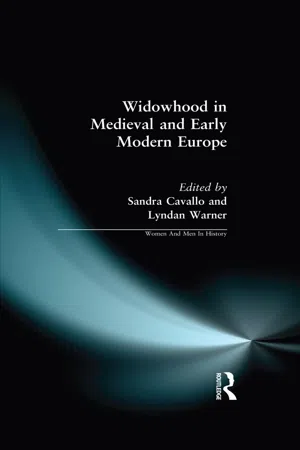
Widowhood in Medieval and Early Modern Europe
About this book
This new collection of essays brings together brand new research on widowhood in medieval and early modern Europe. The volume opens with an introductory chapter by the Editors which looks generally at the conditions and constructions of widowhood in this period. This is followed by a range of essays which illuminate different dimensions of widowhood across Europe - in England, Italy, France, Germany and Spain. A particular attraction of the volume is the attention given to widowers, and the comparisons made between the male and female experience of widowhood. It is an exciting reinterpretation of the subject which will do much to undo the traditional stereotype of the widow.
Contributing to the volume are: Jodi Bilinkoff, Giulia Calvi, Sandra Cavallo, Isabelle Chabot, Julia Crick, Amy Erikson, Dagmar Freist, Elizabeth Foyster, Margaret Pelling, Pamela Sharpe,Tim Stretton, Barbara Todd, and Lyndan Warner.
Part One
Defining Widowhood
Chapter One
Introduction
Widowhood, ‘widowerhooď: problems of visibility and definition
In recent decades historical research has seen a shift from a focus on women’s experience to an emphasis on studies of gender which compare and contrast the lives of men and women. In studies of the pre-industrial period, however, widowhood has often been presen ted solely as a female experience, making the topic of widowhood a virtual province of women’s history. In reality, the death of a wife, especially in her childbearing years, meant that men, too, frequently experienced widowhood, although widowers tended to remarry more often, and after shorter intervals, than widows. Ironically, despite the usual invisibility of women in the historical record, in the case of widowhood, it is more often the widower who is ‘invisible’. One of the aims of the collection is to seek out the ‘invisible widower’ and set up a series of comparisons with widows.
In some ways the death of a spouse affected women more than men. Upon widowhood a wife’s legal and patrimonial condition changed. She was no longer a ‘feme covert’: a woman whose legal entity was ‘covered’ by her husband. And the widow often becomes visible to the historian because she left traces of her new ‘uncovered’ legal status. Scholars have sought to examine the widow’s actions and options at a time when she could be said to be operating at her most independent, although subject to family and financial constraints. Many of the chapters in this volume examine how widows negotiated these constraints, how widows were both vulnerable and resourceful, and in some cases exploited their vulnerability to advantage. By contrast, the widower’s legal status did not change at the death of his wife.
Several of the chapters consider the experience of widowhood from ‘the male perspective’ and embark on a new research enterprise, which has been tentatively termed ‘widowerhooď by some of the contributors. ‘Widowerhooď is not a particularly defined state. In Chapter 2, for example, Julia Crick reminds us that in the medieval period, charters and legal records define men by rank not marital status. Margaret Pelling encounters the same difficulties tracing widowers in early modern England in Chapter 3. When officials in Norwich took a census of the poor in the 1570s, the word ‘widower’ was rarely used and the closest designation was ‘single men’.1
1. See also Barbara Todd, ‘Demographic determinism and female agency: the remarrying widow reconsidered … again’, Continuity and Change 9 (1994), p. 437 n. 66.
The terminology of widowhood is fascinating because it is one of the rare cases where the male term, widower, derives from the female term. The terms widow in English, widewe in Old English, weduwe in Middle Dutch and Dutch, Witwe in German, vidua in Latin, viuda in Spanish, vedova in Italian, veuve in French, all derive from an Indo-European base word meaning ‘to separate’ or ‘to divide’. The Latin vidua meant ‘to be deprived of’ as well as ‘widow’ and the masculine and neutral forms viduus and viduum derived from the feminine.2 Hence the terms for widower become weduwnaar in Dutch, Witwer in German, viudo in Spanish, vedovo in Italian, veuf in French. So it is perhaps not surprising that historians have explored the conditions of widows more thoroughly than widowers, given the long association of the state of widowhood with women.
2. Ernst Klein, A Comprehensive Etymological Dictionary of the English Language (Amsterdam, 1967); Dictionnaire Etymologique de la Langue Latine: Histoire des Mots, 4th edn (Paris, 1985).
However, the problems of tracing widows and widowers go beyond this gender question of whether the terms of widowhood applied to both men and women. Widowhood seems a fairly straightforward term. A stage of life which begins with the death of a spouse, it is defined as the ‘state or condition of a widow or widower, or (contextually) the time during which one is a widow or widower’.3 As many of our contributors demonstrate, however, the ‘condition of a widow or widower’ was never as straightforward as the definition might suggest. In medieval Europe, for example, monogamous Christian marriage was far from the norm. The practice of concubinage was common.4 In Anglo-Saxon England, as Crick argues, the widespread existence of sexual partners, or concubines, meant that in the event of a death a whole range of terms might be used to describe the surviving partner. The survivor might be known as a bedfellow, a wife (rather than widow), or a laf (meaning the one left behind). Therefore, the death of a husband or sexual partner and the change of status wrought by widowhood is not certain; it must be inferred. ‘Widows have to be prised out of the documentary record; the process is as labour-intensive as identifying widowers in other periods’ (p. 32).
3. The Shorter Oxford English Dictionary.
4. James Brundage, Law, Sex and Christian Society in Medieval Europe (Chicago, 1987), pp. 98–103 and 297–300.
Furthermore, it would be misleading to suggest that sexual liaisons outside Christian marriage are symptomatic of the medieval period alone. Among the Dutch gentry in the sixteenth and seventeenth centuries, widowers took mistresses and fathered illegitimate children. When these widowers died they left provisions for their widowed companions and orphaned children and, in doing so, exhibited attitudes ‘similar in many respects to a legitimate marital relationship’.5 Little is known about the status of the widowed concubine. It is sometimes assumed that this condition was frowned upon or reserved to women of low station - however, in Chapter 11 Jodi Bilinkoff provides an excellent example of a widowed clerical concubine in fifteenth-century Spain. Although not formally a wife, Elvira Gonzalez de Medina was the companion of a prominent noble member of the clergy and after his death she founded a religious community of women. Doña Elvira’s religious foundation eventually became a Carmelite convent - one of the most important convents in Spain - headed by her illegitimate children and their heirs.
5. Sherrin Marshall, The Dutch Gentry, 1500–1650: Family, Faith and Fortune (New York, 1987), pp. 66–7.
Taking a companion was not a socially acceptable possibility for a bereaved and lonely wife. Withdrawal from the world - whether as a vowess, vowed to chastity, a lay Deo devota in mourning clothes, or through retreat behind the convent wall - was a more suitable option for the medieval widow or the early modern Catholic widow.6 Entry into a religious order was a path which could itself produce the condition of widowhood. As Patricia Skinner notes in Chapter 4, a husband might enter a monastery while his wife was alive, but this left her effectively a widow.
6. Bernhard Jussen, On church organization and the definition of an estate: the idea of widowhood in late antique and early medieval Christianity’, Tel Aviver Jahrbuch für deutsche Geschichte22 (1993), pp. 31, 33–5; St Francis de Sales, ‘Advice to widows’, in Introduction to the Devout Life (London and New York, 1961), p. 195.
Similarly, husbands also left their wives without giving any indication of their whereabouts. The numbers of abandoned wives should not be underestimated and some legal systems made provisions for marital desertion. Under Lombard laws in medieval southern Italy, as Skinner comments, for example, the absence of a husband for more than three years allowed his wife to assume his death. For early modern England, Pelling draws attention to the high numbers of deserted wives in the Norwich Census of the Poor. David Vassberg’s research on migration in sixteenth- and seventeenth-century Spain supports the claims of Skinner and Pelling on desertion. Vassberg has identified a category of ‘virtual widows’ in the censuses of Castilian villages - abandoned wives whose husbands deserted them, usually to avoid debt imprisonment.7
7. David E. Vassberg, ‘Widows and their children in early modern rural Castile’, paper presented at Symposium ‘Widowhood: Conditions and Constructions’, University of Exeter, 16–17 May 1996, p. 2; Vassberg, The Village and the Outside World in Golden Age Castile: Mobility and Migration in Everyday Life (Cambridge, 1996), pp. 114–15.
From the early church to the early modern parish and the emerging state, attempts to reform or eliminate irregular practices shaped the widow’s and widower’s experience. These institutional changes reveal what medieval and early modern societies expected of a widow or widower; in particular how the survivor should behave at the death of a spouse. The stereotypes associated with female widowhood - the ideal models encouraged by legal codes and biblical stories as well as the worrisome examples of vice and profligacy feared by legislators and magistrates - have been well-studied. The typical or model widower is much less obvious largely because, as Pelling, Skinner, Sharpe, Foyster and Warner point out, there was no clear ideal model to which the widower was meant to aspire. This volume, therefore, seeks to sketch the figure of the widower and compare him with his female counterpart as well as to highlight the extent to which women and others manipulated positive and negative stereotypes for the widow. And, as we shall see, widows regularly gave the appearance of conforming to idealized models whenever they found themselves face-to-face with authority in negotiations for poor relief, in the law courts, or in the defence of their interests.
Models and stereotypes
Perhaps the most well-known stereotypes are the good or ideal widow, the merry widow, and the poor widow. For the Spanish humanist Juan Luis Vives, the ideal widow maintained the memory of her late husband and lived as a ‘perpetual wife’. Vives’ Instruction of a Christian Woman, discussed in Chapters 5 and 12, was translated in the first half of the sixteenth century from Latin into English, French, German, Spanish and Italian. His emphasis on chastity and continued obedience, however, inhibited any public transactions which might expose the widow to dishonour and in some ways encouraged inaction or passivity at a time when a widow faced financial and legal responsibilities for herself and her children. In Chapter 5 Barbara Todd contrasts Vives’ ideal widow with advice which sought to teach the widow self-control. The Protestant author of the seventeenth-century English manuscript ‘The Widdowe Indeed’ stressed the requisite chastity, solitariness, charity to others, and the obvious desolation of widowhood, but he also recognized how of all women the widow came closest to experiencing the ‘preeminence and prerogative of a man’. This ideal Protestant widow may have had the opportunities to exercise her independence; nevertheless, her bereavement meant that she channelled her energies into spiritual matters, salvation and the attainment of Christian virtues.
The merry widow was usually portrayed as rich, worldly, ready to enjoy her independence and satisfy her sensual appetite; a stereotype which contrasts sharply with the glimpses into the lives of bereaved widows provided by Todd’s chapter. The caricatures of the worldly widow and the faithful, chaste widow can be found in drama, ballads, prescriptive literature and memoirs and, as we see in the chapters by Foyster, Stretton and Warner, these characterizations played a noticeable role in the way widows, or at least their lawyers and witnesses, represented their lives to authorities.
While the stereotypical merry widow did not have a direct male counterpart, the ‘lusty old man’ stereotype examined in Chapters 3 and 6 mocked men in a similar fashion. European satires often targeted the foolish old man lusting after a ...
Table of contents
- Cover
- Half Title
- Series Page
- Title
- Copyright
- Contents
- Acknowledgements
- Notes on Contributors
- Foreword
- List of illustrations and tables
- PART ONE: Defining Widowhood
- PART TWO: Models and Paradoxes
- PART THREE: Marital and Family Constraints
- PART FOUR: Narratives and Constructions of Widowhood
- Suggestions for reading on widowhood
- Index
Trusted by 375,005 students
Access to over 1.5 million titles for a fair monthly price.
Study more efficiently using our study tools.
Frequently asked questions
Yes, you can cancel anytime from the Subscription tab in your account settings on the Perlego website. Your subscription will stay active until the end of your current billing period. Learn how to cancel your subscription
No, books cannot be downloaded as external files, such as PDFs, for use outside of Perlego. However, you can download books within the Perlego app for offline reading on mobile or tablet. Learn how to download books offline
Perlego offers two plans: Essential and Complete
- Essential is ideal for learners and professionals who enjoy exploring a wide range of subjects. Access the Essential Library with 800,000+ trusted titles and best-sellers across business, personal growth, and the humanities. Includes unlimited reading time and Standard Read Aloud voice.
- Complete: Perfect for advanced learners and researchers needing full, unrestricted access. Unlock 1.5M+ books across hundreds of subjects, including academic and specialized titles. The Complete Plan also includes advanced features like Premium Read Aloud and Research Assistant.
We are an online textbook subscription service, where you can get access to an entire online library for less than the price of a single book per month. With over 1.5 million books across 990+ topics, we’ve got you covered! Learn about our mission
Look out for the read-aloud symbol on your next book to see if you can listen to it. The read-aloud tool reads text aloud for you, highlighting the text as it is being read. You can pause it, speed it up and slow it down. Learn more about Read Aloud
Yes! You can use the Perlego app on both iOS and Android devices to read anytime, anywhere — even offline. Perfect for commutes or when you’re on the go.
Please note we cannot support devices running on iOS 13 and Android 7 or earlier. Learn more about using the app
Please note we cannot support devices running on iOS 13 and Android 7 or earlier. Learn more about using the app
Yes, you can access Widowhood in Medieval and Early Modern Europe by Sandra Cavallo,Lyndan Warner in PDF and/or ePUB format, as well as other popular books in History & European History. We have over 1.5 million books available in our catalogue for you to explore.