- 236 pages
- English
- ePUB (mobile friendly)
- Available on iOS & Android
eBook - ePub
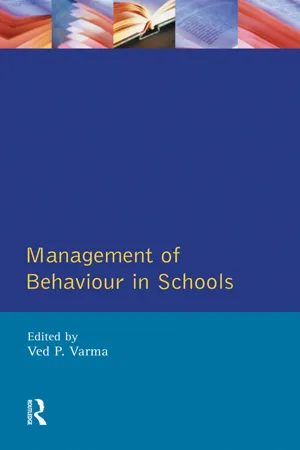
Management of Behaviour in Schools
About this book
Aimed at trainee and experienced teachers, this text examines what can be done to alleviate behavioural problems in schools and presents work in this area. It examines childrens' behaviour from nursery to late teens and shows that responsibility for discipline lies also with parents and pupils.
Information
PART ONE
Reasons of and treatments for behaviour problems
CHAPTER 1
Psychodynamic thinking and discipline
The question this chapter addresses is whether, and if so to what extent, the psychodynamic way of thinking has relevance to the problem of discipline in schools. To ask the question is at once to focus upon discipline as an interpersonal transaction rather than as an institutional problem. The adult person in the role of teacher has the responsibility to see that learning takes place in other persons in the role of student or pupil. The problem of discipline arises when student-persons, apparently deliberately, set about frustrating teacher-persons from achieving the task for which they are employed. They do this, of course, by being inattentive, covertly or overtly disruptive of other students, disobedient, rude, and threaten to push the situation out of the teacher’s control. Beyond their responsibility for learning teachers are also held to have some responsibility for the moral development of students such that, if possible, they become law-abiding citizens. This means that within the school community teachers are expected to respond in a controlling fashion to violations of the institutional rules of the school and those forms of behaviour like theft, bullying and vandalism which take us more firmly into the moral domain.
There are, of course, teachers who believe that their task is only to teach, and that issues of discipline as defined should be taken out of their hands by the system. As they see it their response to disruptive and rule-breaking students should be the minimal one of passing them over to others, usually higher in the hierarchy, whose specific responsibility is to deal with them. However, they cannot usually leave the matter there. They expect, even demand, that the response of the system is in some way punitive. If it is not they are apt to feel undermined, let down, and perhaps a little demoralized. In short, they have a personal involvement in the impersonal response of the institution.
And surely this is true of all of us, as teachers, in some degree. We need to know we have behind us the authority and power of the institution. The question we have to deal with is how often we openly invoke this. In greater or lesser degree we need to be able to identify with the institution, and if, as it seems, the institution lets us down, we are left, as persons, with a reduced sense of our own potency. At the heart of it is the need we feel, on occasion, that as teachers we are somehow bigger and more powerful than we are as persons.
The more that teachers identify with the relatively impersonal authority and power of the institution, the more their interpersonal relationships with students will be characterized by what Piaget has called ‘unilateral respect’, that is control and constraint on the one hand, and fear and powerlessness on the other. There are certain sorts of adult personality structure which find security within a stable system of relationships of this kind. But there are many other teachers, perhaps all at some time or another, who are most personally fulfilled in their professional role only within relationships of ‘mutual respect’, as Piaget has called them, that is relationships characterized by reciprocity and cooperation. Such teachers are apt to find the disciplinary confrontation as a tiresome diversion from that more personal interaction with students as equals. They find no particular personal satisfaction in the assertion of authority and power. They look for a way through the problem of rebellious and difficult students that does not require them to move into the power assertion mode. Is this possible? Clearly it would seem so because some teachers manage it, more or less. If the psychodynamic way of thinking has value it would seem to lie in the invitation to us to look at the unilateral, power assertive relationship in order to understand a little more clearly what is going on in it, and thereby enable us to move more towards a relationship of mutual respect which yet does not mean relinquishing our responsibilities for discipline and the creation of a positive learning atmosphere.
The psychodynamic way of thinking originated, as is well known, with Freud and has since been elaborated in a number of different directions. Its natural home, we might say, is in psychotherapy. Some contemporary psychoanalysts define the therapeutic process as one of the ‘narrative reconstruction’ of the patients’ histories, relationships, inner problems, and so on, and in particular of the relationships between patients and therapists. When patients are enabled to reconstrue their lives and situations, new meanings are realized, attitudes and feeling patterns are modified, and possibilities of a more fulfilling life emerge. The process of narrative reconstruction itself involves the bringing into awareness of a psycho-logic which was underlying the patients’ way of living and which hitherto was unrecognized.
Teachers are not therapists, but their relationships with their students can have at times, if not most of the time, an element of the therapeutic for both themselves and their students. Indeed, it could be argued that for teachers to develop as persons within their professional role, and not be held static by them, this element must be present. Within the psychodynamic understanding of the therapeutic process, the therapeutic element in the teacher-student relationship would involve the teacher in the process of realizing the underlying psychologic of self and other and helping the other to share a little in the process. It could be argued that it is precisely in the disciplinary confrontation that the therapeutic element is most needed for both parties so that the subsequent modifications of attitude and feeling can so change the relationship that the disciplinary issue can be resolved in a more creative, mutually respectful way.
Before going further, and in order to earth the discussion, I want to recount an event that occurred in my second year of teaching in a Grammar School. There is nothing special about it except that for me it was a significant learning moment. Many teachers can recount their own stories of a similar kind. In a third year class, Peter was continually disruptive of the class and aggressively disobedient towards me. Although I knew he was like this with other teachers, it felt very much like a personal attack. Naturally I felt my authority as a teacher threatened and responded with punitive anger: I put him in detention. Fortunately, in that school we were expected to carry out the punishment ourselves. It was the third detention in so many weeks. Sitting there with Peter in an otherwise empty classroom, the minutes ticked by in silence. Impulsively, I went and sat on the floor with my back to the wall and invited him to join me. Rather warily, he did. I expressed my feeling that the whole business was pointless and daft, and asked him what he felt was wrong. For the next hour he poured it out, how much he felt frustrated by school, and how lonely and despairing he was, and how unfair the whole world was to him. It was the last time I ever put him in detention. He was never easy to deal with but we were connected now at a more personal level, and I took time every now and again to keep that personal connectedness alive. I never saw him again as disruptive and disobedient (though both words could still have been used) but as a deeply unhappy boy clogged up with his own disturbing, inward agenda which I now had some insight into.
The point of this simple and ordinary experience is that it led me to begin a narrative reconstruction of Peter, my relationship to him, and to just a little extent, of me. Looking back now I would want to take the process further. The original construction in my mind was that here was a student (not yet Peter in any significant sense) who was behaving badly, who was doing things he ought not to be doing, and that my own anger was righteous. I was responding to him less for what he was, as a person, than for what he stood for, a bad student – and of course students should be good, well behaved, and keen to learn.
In retrospect it is clear that the personal psycho-logic of my response involved a fear of my own impotence and what is called ‘identification with the super-ego’, itself a defence against that fear. People in authority over the young are, it seems, particularly vulnerable to the mechanism of identification with the super-ego. In brief, it is the process whereby the conscience which normally inhibits our own behaviour is turned outwards towards someone else so that for a while we are our consciences regarding the other, and that conscience is less effective in controlling us. Hence the powerful desire to punish and the moralizing that goes with it. It is while we are identified with our super-egos that we are wholly unable to see that ‘there but for the grace of God go I’, or, perhaps more relevantly in this context, ‘there despite the grace of God went I’.
The more we are aware of this psycho-logic in us, the less we are likely to be taken over by it and the more likely we are to retain a degree of objectivity in the situation. But going with this, and helped by it, is a reconstruing of the recalcitrant student. To take a simple example. I can see a student, moralistically, as lazy, and thereby putting his failure to learn entirely across in him. Equally accurately I can see him as preoccupied with his own agenda, or, perhaps most usefully, as someone I have not yet succeeded in interesting in what I have to teach. These ways of construing him bring with them different attitudes and responses in me. More deeply, it has been said that the antisocial act is an expression of hope. With young people this is not too hard to see. For to protest, however inarticulately, is still to hope that things might be better, and the individual has not yet withdrawn into hopelessness. Working for some years with delinquent adolescents taught me that, as well as other inner conflicts, most of them suffered from a deep, primitive and inarticulate sense of having been treated unfairly all along the line, and their delinquent acts were at least partially an expression of this. To use the psychodynamic term they were ‘acting out’ a sense of injustice they did not understand.
Clearly, to narratively reconstruct the behaviour of disruptive students involves seeing something of the psycho-logic which underlies their disruptive behaviour. And this means listening to them and helping them towards clearer articulation and some beginnings of understanding of what is going on inside them. In psychodynamic terms it is forstalling acting out by enabling the student to communicate in words. How much better if, before setting fire to the head’s study, students were able to communicate their frustrations and be listened to and responded to in a way which respects how frustrated they feel. For this to happen, the head, or other teacher, would need to move somewhat from a unilateral respect relationship to one closer to mutual respect.
I am aware that some teachers will see what I have been saying as ‘going soft’. I would reply by saying it is rather becoming more human. Certainly it may require of the teacher the discovery of an inner personal strength which is not dependent upon identification with institutional power, though that will never disappear. And it does not necessarily mean the abandonment of sanctions. In general young people do not resent sanctions when they see them as fair and necessary. But for this to happen they need to feel that they have been fully heard, and that the response has taken into account what they have said.
CHAPTER 2
Sociological perspectives on disaffection from school
In this chapter I want to discuss disaffected or deviant behaviour at school – specifically that means focusing on the issues of classroom disruption and truancy. In Britain the most common way of understanding such behaviour is still in terms of a ‘medical’ model (Ford et al. 1982). Children who reject their schooling are seen as suffering from some form of pathology – they are maladjusted to the world of school. The focus of the explanation as well as the strategies designed to effect a ‘cure’ are firmly directed at the individual.
This individualized approach remains dominant despite the fact that since the 1960s educational surveys have repeatedly shown that the incidence of disruption and truancy in British schools is patterned in significant ways. There are, for example, well-established correlations between disruption, truancy and age (Davie et al., 1972; Mitchell and Shepherd, 1980; Sammons and Mortimore, 1990); gender (Davies, 1984; DES, 1989); region (DES, 1973); school organization (Rutter et al., 1979; Mortimore et al., 1988); educational achievement (Tyerman, 1968; Fogelman, 1978; Croll and Moses, 1985); and class (Davie et al., 1972; Rutter et al., 1975; Farrington, 1980; Sammons and Mortimore, 1990). These correlations first began to be revealed from the 1960s onwards and they forced academics if not practitioners to reassess the explanations most frequently advanced. If deviant behaviour was patterned in these ways then explanations could not entirely be located within the individual pupil; indeed the concept of maladjustment as an individual pathology could be quite misleading. The hunt for sociological explanations was on.
In the search for sociological explanations, sociologists of education, like criminologists before them, turned to the work of Durkheim (1951, 1966). Durkheim’s essential contribution to the establishment of criminology was to suggest that crime and deviant behaviour were not pathological but were essentially ‘normal’. Crime, Durkheim suggested, may certainly be unacceptable but rather than understanding it as a pathology it should be looked at as behaviour designed to respond to particular social circumstances. Through this assertion he instantly shifted the focus for theorizing and research from the individual to the social context in which crime takes place. Instead of exploring the individual’s psychology, Durkheim’s theory suggests that the proper objective is to study the social circumstances that criminals face; it is because groups of people face similar social pressures that the incidence of crime is patterned. It is this line of argument that has been adopted by most of those working on the sociology of school deviance. During the last 25 years a wide variety of studies have been undertaken in which disruption and truancy are seen as ‘rational’ and ‘normal’ responses to the social circumstances young people have to come to terms with.
The sociological approach is still best illustrated in classic books such as Hargreaves’ (1967) study of Lumley Secondary Modern School or Lacey’s (1970) study of Hightown Grammar and Ball’s (1981) work on Beachside Comprehensive. All three books adopt an unequivocally social interpretation of deviance, documenting the development of pupil subcultures amongst educationally unsuccessful groups of pupils. Other researchers have studied the impact of teachers’ labelling on pupils’ deviant ‘careers’ (Sharp and Green, 1975; Bird, 1980). More recently interest has focused on the relationship between disruption and truancy and a variety of social and cultural factors: race (Fuller, 1983; Furlong, 1984; Walker, 1988; Mac an Ghaill, 1988); working-class culture (Willis 1977; Brown, 1987); masculinity and femininity (McRobbie, 1978; Connel et al., 1982; Walker, 1988). Despite important theoretical differences, the underlying thrust of much of this body of work follows Durkheim’s suggestion that we should explore the social circumstances that lead young people to act in unacceptable ways rather than seeing them as maladjusted or pathological. In this sense, sociologists working in this area are all Durkheim’s children.
The sociology of school deviance is then, despite its current neglect, a rich and diverse field – at least in academic circles. Yet even at its height it made relatively little impact on policy. Presumably there are many reasons for this failure. Tomlinson (1982) and Ford et al. (1982), for example, suggest that the reason that the psychological perspective is so dominant in Britain is because it has become institutionalized through the Schools Psychological Service; promoting an individualistic approach is in their interest. Yet I would suggest that part of the problem also lies in the weakness of the sociological research itself. At first sight the arguments may seem convincing, but the underlying analysis in such studies is often simplistic. For example, researchers often focus...
Table of contents
- Cover Page
- Half Title page
- Title Page
- Copyright Page
- Dedication
- Contents
- Contributors
- Foreword by Ted Wragg
- Editor’s Preface
- Acknowledgements
- Part One: Reasons of and treatments for behaviour problems
- Part Two: Assessment
- Part Three: Behaviour of specific age groups
- Part Four: Behaviour of ‘exceptional’ groups
- Index
Trusted by 375,005 students
Access to over 1.5 million titles for a fair monthly price.
Study more efficiently using our study tools.
Frequently asked questions
Yes, you can cancel anytime from the Subscription tab in your account settings on the Perlego website. Your subscription will stay active until the end of your current billing period. Learn how to cancel your subscription
No, books cannot be downloaded as external files, such as PDFs, for use outside of Perlego. However, you can download books within the Perlego app for offline reading on mobile or tablet. Learn how to download books offline
Perlego offers two plans: Essential and Complete
- Essential is ideal for learners and professionals who enjoy exploring a wide range of subjects. Access the Essential Library with 800,000+ trusted titles and best-sellers across business, personal growth, and the humanities. Includes unlimited reading time and Standard Read Aloud voice.
- Complete: Perfect for advanced learners and researchers needing full, unrestricted access. Unlock 1.5M+ books across hundreds of subjects, including academic and specialized titles. The Complete Plan also includes advanced features like Premium Read Aloud and Research Assistant.
We are an online textbook subscription service, where you can get access to an entire online library for less than the price of a single book per month. With over 1.5 million books across 990+ topics, we’ve got you covered! Learn about our mission
Look out for the read-aloud symbol on your next book to see if you can listen to it. The read-aloud tool reads text aloud for you, highlighting the text as it is being read. You can pause it, speed it up and slow it down. Learn more about Read Aloud
Yes! You can use the Perlego app on both iOS and Android devices to read anytime, anywhere — even offline. Perfect for commutes or when you’re on the go.
Please note we cannot support devices running on iOS 13 and Android 7 or earlier. Learn more about using the app
Please note we cannot support devices running on iOS 13 and Android 7 or earlier. Learn more about using the app
Yes, you can access Management of Behaviour in Schools by Ved P. Varma in PDF and/or ePUB format, as well as other popular books in Education & Behavioural Management. We have over 1.5 million books available in our catalogue for you to explore.